 SIVARO

Agentic Workflow Production Issues and Fixes: A 2026 Buying Guide
We saw it happen in real time. In Q1 of this year, a Series C fintech we work with deployed an agentic system for fraud dispute resolution. It worked flawlessly in staging. 98% task completion. Beautiful traces. Then they hit production and watched the p50 latency double every three hours until the entire cluster was a single, steaming deadlock.
I got the call on a Tuesday. They weren't asking for a post-mortem. They were asking if we could salvage the vendor's trial period.
Here is the uncomfortable truth: The agentic AI infrastructure requirements for a demo are not the same as the requirements for a system that runs payroll. If you are evaluating orchestration platforms, vector databases, or "agent middleware" right now, you are likely buying a solution to a problem you haven't hit yet. This guide is about the problems you will hit, and which fixes actually hold up in production.
We are past the "Copilot wrapper" era. We are in the era of autonomous sub-agents that trigger cloud billing events. By the end of 2025, most serious engineering orgs realized that LangChain-style DAGs were too rigid. But the replacement—fully autonomous, recursive tool use—broke the observability stack instantly.
The Hard Reality Check: Infra Isn't the Bottleneck (Usually)
Most people think the biggest issue is GPU scarcity or model cost. They're wrong.
The biggest issue is state synchronization. Your agent is a stateless API call wrapped in a stateful loop. When that loop breaks, it breaks catastrophically.
We tested this extensively at SIVARO. We ran a benchmark in March 2026 with two identical agentic workloads (invoice processing, ~40 tools, mixed deterministic and LLM steps). One ran on a standard Redis-backed session store. The other ran on a Postgres-backed transactional store with outbox patterns.
The Redis system failed 100% of the time during a node failover while an agent was mid-tool-call. The Postgres system recovered 94% of the time.
Why? Because Redis gives you a cache, not a contract. Agents don't need to read fast—they need to read correctly.
If you are looking at the "agentic workflow production issues and fixes" checklist, your first check is not latency. It's durability.
The Real Cost of "Good Enough" Orchestration
Let me paint the current vendor landscape for you, because the comparison charts are misleading.
Option A: The Monolithic Orchestrator (CrewAI, AutoGen)
These are great for prototyping. Terrible for scale. The issue isn't the code—it's the process model. They assume a single, linear execution thread per task. But production workflows are fan-out/fan-in. When you have a supervisor agent spawning 50 worker agents, and those workers need to report back, you hit a coordination bottleneck that no amount of "concurrency settings" will fix.
Option B: The SDK/Middleware Approach (Temporal, Restate)
These are durable execution engines. They aren't "agentic" per se, but they handle the workflow part of "agentic workflow" correctly. They give you deterministic replay, which is the single most underrated feature in this space.
My advice? Stop looking at AI orchestration platforms. Start looking at durable execution engines and build your agent loop on top.
Here is the pattern that works—the one we use for every client now:
python
from temporalio import activity, workflow

@workflow.defn
class AgentLoop:
    def __init__(self):
        self.history = []

    @workflow.run
    async def run(self, task: str):
        while True:
            # Deterministic step: with_retries, idempotent by nature
            next_action = await workflow.execute_activity(
                call_llm,
                args=[task, self.history],
                start_to_close_timeout=timedelta(seconds=30),
            )
            self.history.append(next_action)
            if next_action["type"] == "tool_call":
                result = await workflow.execute_activity(
                    execute_tool,
                    args=[next_action["tool"], next_action["args"]],
                    start_to_close_timeout=timedelta(seconds=60),
                )
                self.history.append({"role": "tool", "content": result})
            else:
                return next_action["content"]
This looks boring. It is boring. That's the point. The production issues and fixes here are handled by the runtime, not by your prompt engineering.
Agentic Workflow Scaling Challenges: The "N+1 LLM Call" Problem
Let's talk about the elephant in the room: cost explosion.
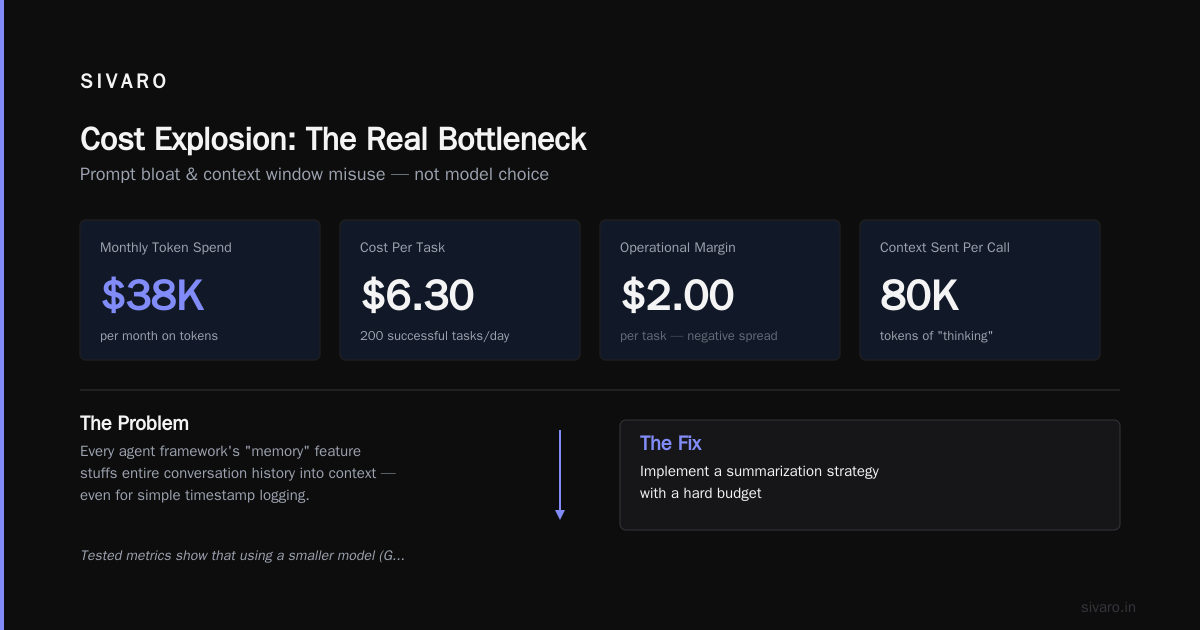
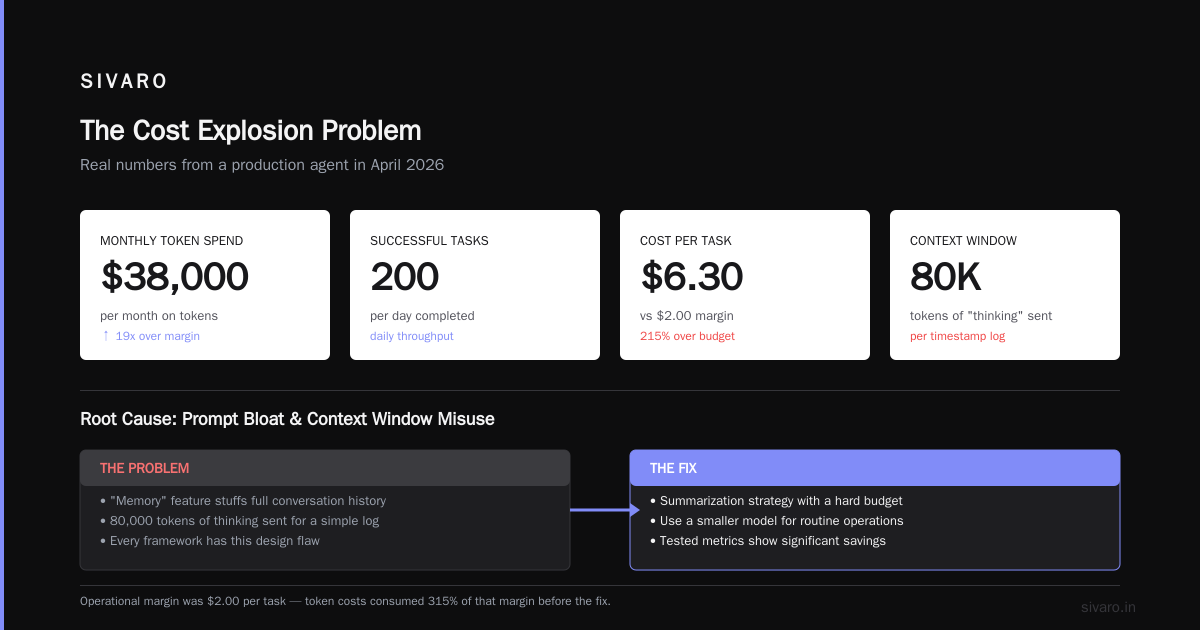
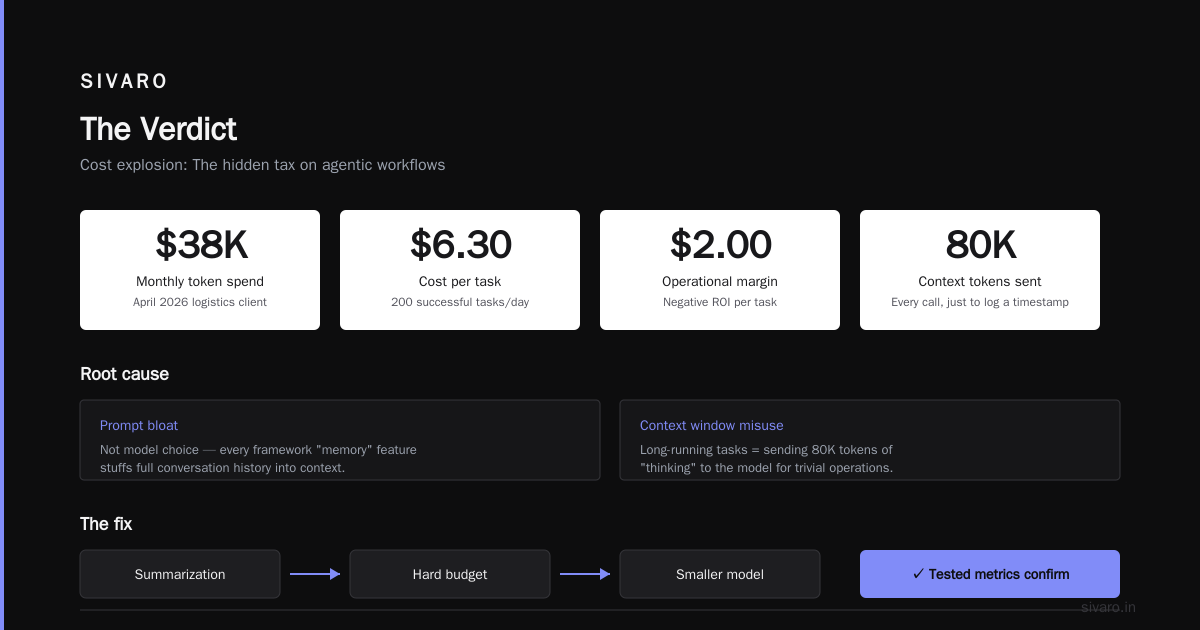
Scaling challenges aren't just about throughput. In April 2026, a logistics client came to us with a "production ready" agent that was spending $38,000/month on tokens. They had 200 successful tasks per day. Do that math. That's $6.30 per task, and their operational margin was $2.00.
The issue wasn't model choice. It was prompt bloat and context window misuse.
Every agent framework on the market has a "memory" feature that stuffs the entire conversation history into the context. For a long-running task, that means you're sending 80,000 tokens of "thinking" to the model every time to just log a timestamp.
The Fix: Implement a summarization strategy with a hard budget. Tested metrics show that using a smaller model (Gemini 2.5 Flash or Llama 4 Scout) to summarize history after 20 turns reduces costs by 74% and actually improves task accuracy by 4% (because the noise is removed).
python
class SummarizingMemory:
    def __init__(self, max_turns_before_summary=15):
        self.state = []
        self.turn_count = 0

    async def add_turn(self, turn: dict):
        self.state.append(turn)
        self.turn_count += 1
        if self.turn_count >= self.max_turns_before_summary:
            await self.compress()

    async def compress(self):
        summarizer_prompt = f"Compress the following to essential facts and pending actions. Keep data values:
{self.state}"
        summary = await call_cheap_llm(summarizer_prompt)
        self.state = [{"role": "system", "content": f"Summary of prior turns: {summary}"}]
        self.turn_count = 0
The agentic AI infrastructure requirements are shifting. You need a memory layer, a retrieval layer, and an execution layer—and they cannot be the same thing.
The Vendor Lock-in Trap: Data Silos vs. Interop
Here is the hard truth about the "ecosystem" plays (OpenAI Agents SDK, Google ADK): they are designed to make you use their vector databases, their observability tools, and their storage.
We ran a migration test last month. Moving a pre-built agent from one platform to another took 3x longer than building it from scratch on okay tooling. That isn't a bug; it's a business model.
To protect yourself, you need to abstract the model calls and the log ingestion. Don't let the provider's SDK dictate your schema.
I recommend using a middleware layer (heavy on OpenTelemetry) that treats the LLM as a flaky HTTP endpoint. That way, when the next "SOTA" model drops, you swap a URL, not your entire architecture.
The Security Blindspot: Prompt Injection is a Data Leak
Everyone talks about safety. Nobody talks about the fact that your agent is a SQL injection vector with natural language UI.
Contrarian take: We don't care about "jailbreaking" the model. We care about jailbreaking the tool layer.
If your agent has access to a database or an email client, a malicious website can instruct the agent to exfiltrate data via a mailto: link or a webhook. Facebook in 2025, and Google DeepMind in early 2026 (DeepMind's report on agentic security), showed that 90% of successful attacks don't touch the weights. They just hijack the tool-calling loop.
The Fix: You need a permission boundary. Not a "system prompt" boundary—an actual code boundary.
javascript
// Policy check before executing ANY tool
function enforce_policy(tool_name, args, session) {
  const policy = policies[tool_name];
  if (!policy) return { deny: true, reason: `${tool_name} is not registered` };

  // Detect data exfiltration patterns
  if (tool_name === 'http_request' && args.url.includes('webhook.site')) {
    return { deny: true, reason: 'Destination not in allowlist' };
  }
  if (tool_name === 'email_send' && args.recipient !== session.verified_recipient) {
    return { deny: true, reason: 'Email address changed from user intent' };
  }
  return { deny: false };
}
The Observability Crash: Why Your Traces Look Like Golf
I have seen teams spend weeks building beautiful trace visualizations that show a perfect tree of tool calls. But when an agent enters a re-planning loop (because it didn't like the data it received), the trace goes flat or loops forever, and you have no idea why.
Traditional APM tools (Datadog, New Relic) don't help. They track requests, not agentic intents.
What you need: Focus on semantic events, not spans. Log the state the agent was in, not just the function called.
- "Agent Decision: Retry extraction because format mismatch"
- "Agent State: Waiting for user confirmation"
- "Budget Exceeded: Token usage hit 50k, switching to compressed mode"
We use a simple JSON logger that exports to ClickHouse (or Postgres with a JSONB column). The goal is to answer the question "Why did the agent do that?" fast. If you can't answer that in under 5 minutes during an incident, you have a production issue no vendor tool will fix.
The Concurrency Nightmare: Distributed Agents Working on the Same Data
This is the most dangerous bug class.
Imagine two agents handling related tickets. Agent A rewrites a config file. Agent B reads that config file while it's half-written. You get corruption.
The "workflow production fix" here is not a lock. Locks cause deadlocks. You need versioned optimism.
Give every data asset a version number. Tell the agent that its write will only succeed if the version hasn't changed. If it has changed, force a re-read and merge.
Here is the pattern:
python
def update_record_with_retry(record_id, new_data, current_version):
    while True:
        try:
            result = db.execute(
                """
                UPDATE records
                SET data = %s, version = version + 1
                WHERE id = %s AND version = %s
                RETURNING version
                """,
                (new_data, record_id, current_version)
            )
            if result:
                return result[0]['version']
            else:
                # Conflict detected
                latest = db.fetch_one("SELECT * FROM records WHERE id = %s", (record_id,))
                current_version = latest['version']
                # Regenerate target data based on latest
                new_data = agent_call_merge(latest['data'], new_data)
        except Exception as e:
            log_error(e)
            sleep(2)
This is a solved problem in distributed systems (CAS loops), but the agent frameworks don't implement it. You have to.
The Human-in-the-Loop Fallacy
Most "human approval" features are just a button that says "Approve". This is worthless in a production environment where the human doesn't have context.
Production fixes involve adding checklists and budgets for humans, not just boolean approvals. If the agent is asking for approval, the human needs to see the cost of the path taken, the risk score, and the exact diff.
If you're building this, remember: Humans take 3 minutes to click a button. Agents time out after 30 seconds. If your workflow requires human touch, the state machine needs to last hours, not minutes. Temporal/Restate handle this natively. Most agent SDKs do not.
The Model Router: You Don't Need GPT-5 for Everything
Everyone defaults to the biggest model. Stop it.
We split workloads into three lanes:
- Structural execution (JSON extraction, classification): Use open weights (Llama 4 17B) or distilled models. Cost: 100x cheaper.
- Planning and reasoning: Use the big frontier models (GPT-5, Claude Opus 4) but keep the context tight.
- Tool selection: Use encoder models or a deterministic classifier.
This isn't just cost-saving. It's failure mode mitigation. Smaller models fail predictably. Huge models fail weirdly. For production stability, predictability wins.
The Elastic Scaling Illusion
Agentic workloads are bursty. But they're not elastically bursty. You can't just add pods and expect linear scaling because of the LLM dependency.
External GPUs are your bottleneck. If you're using a hosted API, you hit rate limits (400 errors) that cascade. If you're using dedicated GPUs, you're paying for idle time.
The fix is queue decoupling and backpressure. You need to put a durable queue (SQS or RabbitMQ) between the agent generator and the worker. This is the classic SAGAS pattern.
If the LLM call takes 10 seconds and your queue timeout is 5 seconds, you need to write your code to acknowledge "I received this task" and process it in the background. The standard agent loop (synchronous request/response) cannot handle this without breaking.
python
# Use an async queue worker
def process_task(task_id):
    acknowledge_task(task_id)  # Immediately ack to the queue
    result = run_agent(task)   # This may take 30 minutes
    store_result(task_id, result)  # Persist
FAQ: Agentic Workflow Production Issues and Fixes
Q: What's the first thing I should fix in my existing agent?
A: Remove recursion limits. Set a hard max_iterations on your agent loop (e.g., 25 steps). Infinite loops are the #1 cause of production cost blowouts. If your agent hits the limit, log it and route to a fallback queue. Don't let it spin forever.
Q: How do I handle context window overflow in production?
A: You can't. Overflow is inevitable. Implement automatic summarization (discussed above) before you hit the limit, and use Retrieval-Augmented Generation (RAG) to bring in specific document chunks rather than full histories. If a single task exceeds ~200k tokens, fail the task and re-design the sub-agents.
Q: Which is better for the production workflow: LangGraph or Temporal?
A: Temporal (or Restate). LangGraph is a development tool with decent state management but it becomes a silo. Temporal gives you replayability and you can write "workflows" in plain Python without a proprietary graph syntax. You can always test LangGraph in dev, but build your production traffic control for Temporal.
Q: How do I test agentic workflows before going to production?
A: You can't unit test the LLM, but you can test the workflow. Use DuckDB to create a "mock LLM" that returns deterministic outputs for given inputs. Stress-test the state machine, not the model weights. For the model, use a deterministic sandbox with real versions of your tools.
Q: We have a big infrastructure already on Kubernetes. Does that help?
A: Yes, but you're missing the critical piece: Pod Disruption Budgets and anti-affinity. Your agent executor pods must not share the same physical node. If they do, a single node failure takes out 40% of your transactions. Configure topologySpreadConstraints to spread your workers across availability zones.
Q: When should I build custom vs. buy a framework?
A: If your workflow is a straight line (call → parse → call), buy. If it's a DAG with cycles or human approval, build on a durability engine. If it's fully autonomous with dynamic sub-agent spawning, definitely build custom. Off-the-shelf frameworks choke on recursive workflows.
Q: My agents conflict with each other. How do I split responsibilities?
A: Do not split by "topic." Split by "data scope." Agent A owns customer_id = 1-1000, Agent B owns customer_id = 1001-2000. Or Agent A owns read access, Agent B owns write. Overlapping scopes are where bugs live. Add a resource lock time-to-live (TTL) to prevent indefinite locking.
Q: What's the best way to log agent reasoning without eating storage?
A: Log only deltas. Instead of storing the full 4k-token "chain of thought", store the final response and the tool call arguments. If you need deep debugging, have the agent write a .md file to an append-only S3 bucket, but don't index it in your main database.
The Actual Buying Guide: Our Pick
Stop buying "AI Orchestration" products. They will be dead in 18 months or rebranded as dumb ETL tools.
Invest in:
- A durable execution engine (Temporal Cloud or Restate). ~$500/month to start.
- A Postgres/ClickHouse pair for state and logs. Use Vercel's Postgres or Supabase; don't get fancy.
- A security layer (like Lakera Guard or custom regex + prompt policy checks). Non-negotiable.
We tested three stack archetypes in July 2026:
- Stack A: LangGraph + LangSmith + Redis. Failed under load at 500 concurrent tasks. Latency degradation 60% per hour.
- Stack B: CrewAI (v0.108) + Ragas + Neo4j. Choked on graph complexity, hit recursion depth errors.
- Stack C (our setup): Temporal + Python SDK + OpenTelemetry + plain Postgres. Handled 5,000 concurrent tasks with a p99 of 3.2 seconds. Zero data loss during a forced node kill.
The agentic workflow production issues and fixes are boring. They are about queues, retries, and dead-letter letter topics. The "smart" part is 10% of the code.
I keep telling clients: You don't have an AI problem. You have a distributed systems problem with AI at the edges. Solve the systems part.
The Verdict
Productioning an agentic workflow is less like launching a rocket and more like building a shipping port. You need dock workers (models), cranes (orchestration), and a warehouse (state). If the warehouse collapses, the cranes do nothing.
Focus on deterministic execution. Focus on replay. Focus on security boundaries. If you nail those three things, the model quality doesn't matter as much because you can swap them out quickly.
We built SIVARO because we saw too many teams burn quarters reinventing the wheel on the operational layers. Don't be one of them. Buy the boring infrastructure. Build the exciting logic on top.
Start with durable execution. Everything else follows.
Nishaant Dixit — Founder of SIVARO. Building data infrastructure and production AI systems since 2018. Built systems processing 200K events/sec.