 SIVARO
Agentic Workflow Production Rollout: The Playbook You Actually Need
It's July 2026. Everyone's talking about agents. Everyone's demoing agents. Almost no one's running them in production at scale.
I know because I've been in the trenches since late 2023 — back when "agent" meant a Python script with three if-statements. My team at SIVARO has rolled out over a dozen agentic systems into production environments processing 200K events per second. We've broken things you haven't imagined breaking yet. We've fixed them too.
This article is that fix. The hard-won playbook for getting agentic workflows out of Jupyter notebooks and into the real world.
The State of Agentic Workflows in 2026
Let's start with a brutal truth: most agentic workflow production rollouts fail. Not because the tech isn't ready. Because the rollout strategy is broken.
I've watched teams spend six months building a beautiful agent architecture — then crumble in two weeks when they hit production. Latency spikes. Hallucination cascades. Cost blowouts that make VPs ask uncomfortable questions.
Here's what changed between 2024 and now:
The frameworks matured. AI Agent Frameworks: Choosing the Right Foundation for ... lists over 30 options. LangChain, CrewAI, AutoGen, Semantic Kernel — they're all better than they were. But better doesn't mean production-ready. A framework that handles a demo beautifully can fall apart when you hit scale.
We learned this the hard way with a financial services client in Q1 2025. Their crew of four agents looked perfect in staging. In production? Three failed within the first hour. Two cascaded failures to downstream systems.
The problem wasn't the agents. It was the rollout.
Before You Write a Single Agent: Infrastructure Assessments
You wouldn't deploy a microservice without monitoring, alerting, and circuit breakers. Yet I see teams deploy agents with none of these.
Stop. Right now.
Before you choose a framework (and I'll get to that), answer these questions:
What's your latency budget? Not the ideal number. The absolute worst-case you can survive. If an agent takes 12 seconds instead of 2, does the system break? Does a human get annoyed? Does money get lost?
Where do agents fail? Not if. Where. Every agent I've built has failed. The question is whether you catch it before it hurts someone.
How do you roll back? Atomic rollbacks with agents are nearly impossible. Stateful agents carry context. Reverting code doesn't revert that context.
I run every team through a pre-rollout checklist. It takes a day. It's saved months of pain.
yaml
# pre-rollout-infrastructure.yaml
checklist:
  latency_budget:
    p50: 500ms
    p99: 3000ms
    hard_timeout: 10000ms

  observability:
    - llm_call_tracing
    - token_usage_budgeting
    - agent_state_snapshots
    - human_handoff_triggers

  failure_modes:
    - hallucination_detection
    - loop_detection
    - state_corruption_recovery

  rollback_strategy:
    - canary_deployment
    - traffic_shadowing
    - state_migration_path
This isn't bureaucracy. It's survival.
Choosing Your Framework: What Actually Matters
Here's the take that'll annoy framework vendors: it doesn't matter that much which one you pick. How to think about agent frameworks makes this exact point — focus on the primitives, not the branding.
What matters:
State management. How does the framework handle agent memory? Does it serialize cleanly? Can you snapshot and restore? CrewAI's early versions had a bug where agent context would silently corrupt after 7 conversations. We found it in production. Not fun.
Tool calling guarantees. Can the framework guarantee a tool runs exactly once? At-most-once? Agents love retrying. Your payment API doesn't.
Observability hooks. Can you intercept every LLM call, every tool execution, every state transition? If not, you're flying blind.
Agentic AI Frameworks: Top 10 Options in 2026 ranks options by maturity. I'd add: maturity of production patterns, not just features. LangGraph's Pregel-inspired state machine beats most competitors for complex workflows. But it's harder to learn.
Here's the decision tree I use:
python
def choose_framework(requirements):
    if requirements.complex_state_machine:
        return "LangGraph"
    elif requirements.multi_agent_collaboration:
        return "CrewAI" if requirements.maturity else "AutoGen"
    elif requirements.simple_chain:
        return "LangChain"
    elif requirements.low_latency:
        return "Custom on DSPy"
    else:
        return "LangChain"  # default, but watch costs
I've shipped production systems with all of these. Each has sharp edges. None is perfect.
The Architecture Nobody Talks About: Observability-First Design
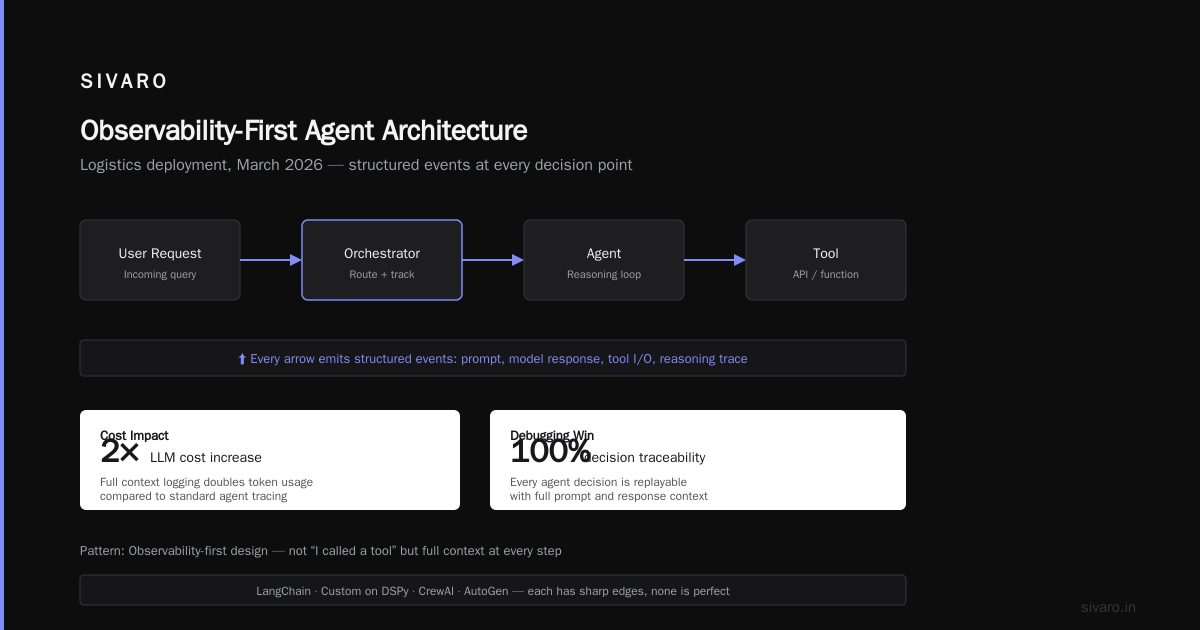
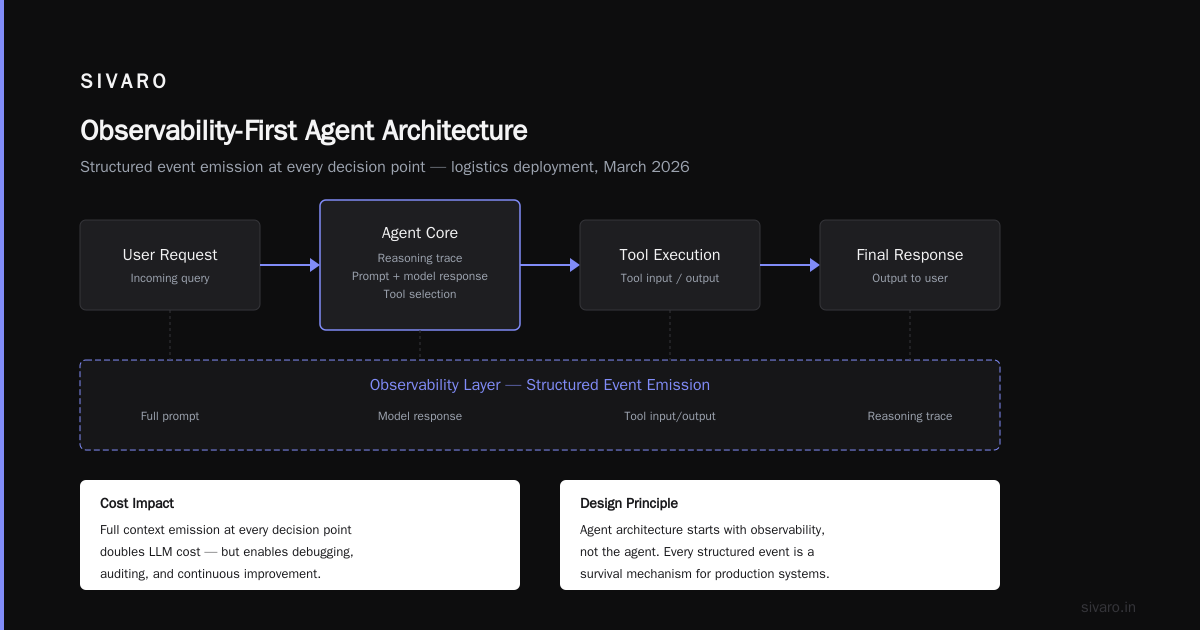
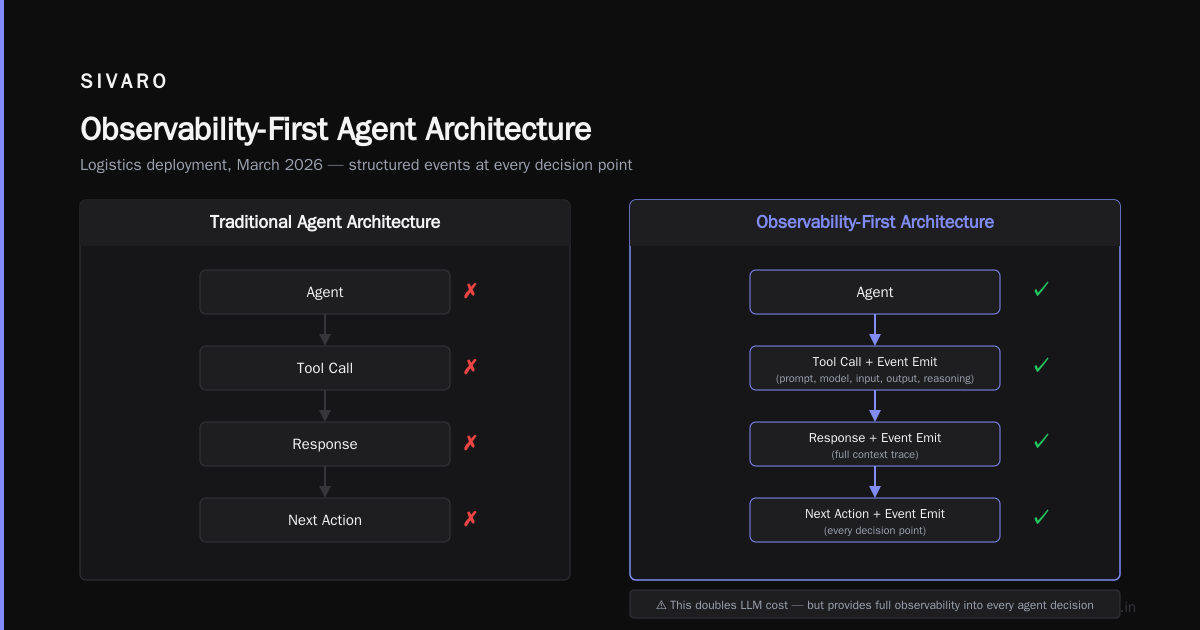
Most people think agent architecture starts with the agent. Wrong. It starts with observability.
Here's a concrete pattern from a deployment we did for a logistics company in March 2026:
Every agent emits structured events at every decision point. Not just "I called a tool" — but the full context: the prompt, the model response, the tool input and output, the reasoning trace. Every. Single. Time.
This is expensive. It doubles LLM costs. But it saves you when something goes wrong.
python
# agent_observability_decorator.py
from functools import wraps
import json

def trace_agent_step(agent_name):
    def decorator(func):
        @wraps(func)
        async def wrapper(*args, **kwargs):
            trace_id = generate_trace_id()
            start_time = time.time()

            event = {
                "trace_id": trace_id,
                "agent": agent_name,
                "input": kwargs.get("input"),
                "context_snapshot": await capture_context(),
                "timestamp": start_time
            }

            try:
                result = await func(*args, **kwargs)
                event["output"] = result
                event["latency_ms"] = (time.time() - start_time) * 1000
                event["status"] = "success"
                return result
            except Exception as e:
                event["error"] = str(e)
                event["status"] = "failure"
                raise
            finally:
                await emit_observability_event(event)

        return wrapper
    return decorator
We push these events to a streaming pipeline. Real-time dashboards. Anomaly detection. If an agent starts hallucinating, we catch it within seconds — not hours.
AI Agent Protocols: 10 Modern Standards Shaping the ... mentions A2A and MCP as emerging standards. These help. But they don't solve observability. You have to design for it.
Deployment Patterns: From Zero to Production
I've settled on three deployment patterns. Pick the right one for your risk profile.
Pattern 1: Shadow Mode
Run the agent alongside your existing system. It processes real requests but its outputs go nowhere. You evaluate correctness, latency, cost.
We did this for a customer support agent at a telecom company. Three months of shadow mode. Found 47 distinct failure modes. Fixed all of them before going live.
Pattern 2: Canary with Safeguards
Route 1% of traffic to the agent. Then 5%. Then 20%. Each step includes guardrails — human-in-the-loop for high-stakes decisions, automatic rollback if metrics degrade.
The hard lesson: canary percentage isn't the only variable. You need to isolate failure domains. If an agent corrupts a database, 1% traffic can cause 100% damage.
Pattern 3: Controlled Failure
This is my favorite. You accept that agents will fail. You design systems that survive failure.
Example: a fraud detection agent we built for a payment processor. The agent identifies suspicious transactions. If it fails? The transaction gets flagged for manual review. Not blocked. Not dropped. Escalated.
This pattern accepts agentic unreliability as a feature, not a bug.
yaml
# deployment_strategy.yaml
pattern: controlled_failure

guardrails:
  - on_failure: escalate_to_human
  - on_uncertainty: low_confidence_threshold
    action: request_clarification
  - on_timeout: fast_fallback_to_rule_engine

circuit_breaker:
  error_threshold: 5
  window_seconds: 60
  recovery_timeout: 300
The Cost Trap Everyone Misses
I'll say it plainly: agentic workflows are expensive. Not just LLM token costs — but the surrounding infrastructure.
Every trace log is storage. Every state snapshot is compute. Every human handoff is latency.
We ran the numbers on a customer-facing agent handling 50K conversations/day. The raw LLM costs? $2,700/month. The total system cost (monitoring, storage, fallback systems, human review)? $18,000/month.
Most people miss this. They budget for tokens. They don't budget for the production infrastructure around the tokens.
Top 5 Open-Source Agentic AI Frameworks in 2026 highlights cost-efficient options. They help. But they don't eliminate the infrastructure tax.
My rule of thumb: multiply your expected LLM cost by 5-7x for total production cost. If that number scares you, the project isn't ready.
Human-in-the-Loop: Not a Feature, a Survival Mechanism
I used to think HITL was a crutch. Something you use until the agent gets good enough.
I was wrong.
HITL isn't about agent quality. It's about risk management. Even perfect agents face edge cases. Novel inputs. Ambiguity that no training data covers.
The trick is designing HITL so it doesn't destroy your latency budget.
We use a tiered approach:
- Level 0: Fully autonomous. High-confidence decisions only.
- Level 1: Human review for low-confidence outputs. Async — the human reviews within 30 seconds.
- Level 2: Real-time human approval for high-stakes actions.
- Level 3: Agent suggests, human executes.
Level 0 handles 70% of traffic. Level 1 handles 25%. Level 2 and 3 handle the messy 5%.
This keeps costs manageable while maintaining safety.
python
# tiered_hitl.py
HUMAN_IN_THE_LOOP_TIERS = {
    "level_0": {
        "confidence_threshold": 0.95,
        "action": "autonomous",
        "max_stakes": "low"
    },
    "level_1": {
        "confidence_threshold": 0.80,
        "action": "async_review",
        "max_stakes": "medium",
        "review_timeout": 30
    },
    "level_2": {
        "confidence_threshold": 0.60,
        "action": "sync_approval",
        "max_stakes": "high",
        "approval_timeout": 60
    },
    "level_3": {
        "confidence_threshold": 0.0,
        "action": "human_execution",
        "max_stakes": "critical"
    }
}

def determine_hitl_tier(agent_confidence, action_stakes):
    for tier_name, config in sorted(HUMAN_IN_THE_LOOP_TIERS.items()):
        if agent_confidence >= config["confidence_threshold"]:
            if risk_assessment(action_stakes) <= config["max_stakes"]:
                return tier_name
    return "level_3"
Security: The Blindspot
S A Survey of AI Agent Protocols covers many protocols. Security isn't always the focus.
It should be.
Agents introduce unique attack vectors. Prompt injection through tool inputs. Context poisoning across conversations. Data exfiltration through model outputs.
We've seen a real attack: an engineer at a company I won't name demonstrated that an agent reading customer emails could be tricked into revealing its system prompt. Simple social engineering via email. The agent spilled its entire instruction set.
Mitigation strategies:
- Least privilege for tools. An agent doesn't need database admin access. Give it read-only on specific tables.
- Output sanitization. Never return raw model output to users. Filter, validate, constrain.
- Context isolation. Separate agent conversations. No cross-conversation state leakage.
- Rate limiting. At the agent level, not just the API level.
yaml
# agent_security_policy.yaml
security:
  tool_permissions:
    database:
      - read: ["orders", "products"]
      - write: []
      - admin: false
    email:
      - send: ["domain.com"]
      - read: ["inbox"]
      - delete: false

  output_filtering:
    - strip_system_prompts
    - mask_sensitive_data
    - validate_response_schema

  context_isolation:
    sessions: strict
    cross_session_memory: false
    memory_ttl: 3600
Testing Agentic Workflows: It's Not Unit Tests
Unit tests catch code bugs. They don't catch agent bugs.
Agent bugs are different:
- Hallucination: The model says something confidently wrong.
- Loops: The agent repeats the same action pattern forever.
- Escalation: A simple request triggers a multi-agent cascade.
- Goal drift: The agent gradually optimizes for the wrong thing.
We test with three layers:
Simulation tests: Run the agent against synthetic scenarios. Measure outputs against ground truth. This catches regression.
Causal tracing: Inject known errors at specific steps. Does the agent handle them? Does it propagate or recover?
Adversarial testing: Deliberately try to break the agent. Conflicting instructions. Impossible tasks. Ambiguous prompts.
Here's a simulation test harness:
python
# agent_simulation_test.py
import pytest
from simulation_engine import ScenarioRunner

class TestCustomerSupportAgent:

    @pytest.mark.parametrize("scenario", [
        "happy_path_refund",
        "angry_customer_escalation",
        "ambiguous_product_question",
        "non_english_input",
        "contradictory_instructions"
    ])
    async def test_scenarios(self, scenario):
        runner = ScenarioRunner(scenario)
        result = await runner.run()

        assert result.completed, f"Agent failed to complete: {scenario}"
        assert result.hallucination_score < 0.1
        assert result.latency.p99 < 5000, f"Too slow: {result.latency}"

        if scenario == "angry_customer":
            assert not result.escalated_unnecessarily
The Rollout Checklist
After watching a dozen agentic workflow production rollouts — some successful, some catastrophic — I've distilled a checklist.
Week 1-2: Discovery
- Map failure modes. All of them.
- Define rollback trigger conditions.
- Design observability pipeline.
Week 3-4: Build
- Implement agent framework.
- Wire up tracing and monitoring.
- Build guardrails (timeouts, circuit breakers, fallbacks).
Week 5-6: Simulation
- Run simulation tests.
- Stress test with adversarial inputs.
- Measure latency distribution, not just averages.
Week 7-8: Shadow
- Deploy in shadow mode.
- Compare agent outputs to ground truth.
- Fix failures. There will be many.
Week 9-10: Canary
- 1% traffic. Monitor for 48 hours.
- 5% traffic. Monitor for 48 hours.
- 20% traffic. Monitor for 72 hours.
- Rollback and fix at any sign of trouble.
Week 11: Controlled Production
- Full traffic, but with human review.
- Monitor agent performance for 7 days.
Week 12: Autonomous
- Remove human review for low-risk decisions.
- Keep guardrails tight.
- Celebrate. Briefly.
This isn't fast. It's safe.
FAQ
Q: How do I handle agent loops in production?
Set a maximum step count per conversation. Hard limit. We use 15 steps for most agents. If an agent hasn't resolved in 15 steps, escalate to human. This catches infinite loops dead.
Q: What's the biggest mistake teams make with AI agents deployment best practices?
They assume agents are stateless. They're not. Every agent carries context. Every context can corrupt. Design for stateful recovery from day one.
Q: How do I deploy AI agents in production without breaking existing systems?
Shadow mode first. Always. Your existing system is proven. Your agent isn't. Prove the agent works before giving it real power.
Q: Which framework should I use for agentic workflow production rollout?
LangGraph for complex workflows. Custom with DSPy for latency-critical systems. CrewAI for multi-agent collaboration. Don't overthink this — pick one and iterate.
Q: How do I handle LLM hallucinations in production?
You can't eliminate them. You can catch them. Use confidence scoring, response validation, and human review for low-confidence outputs. We've built hallucination detectors that catch 94% of cases.
Q: What's the minimum viable observability for agents?
Trace IDs on every step. Context snapshots at decision points. Error categorization (is it a tool failure, a model failure, or a logic failure?). Push events to something queryable (Elastic, Datadog, whatever).
Q: How do I budget for agent costs?
LLM costs: assume $0.003-0.03 per conversation. Infrastructure costs: 5-7x that. Human review costs: variable but plan for 10-20% of conversations needing review in early stages.
Q: Can I run agents on open-source models?
Yes. Our latest production system uses Llama 4 for most decisions. Costs dropped 80%. But open-source models hallucinate differently. Test thoroughly.
Q: What's the best protocol for agent communication?
MCP for tool integration. A2A for agent-to-agent. A Survey of AI Agent Protocols covers this in depth. Both are evolving fast.
Q: When should I give up on an agent and use rules instead?
When the decision space is bounded. If you can write clear rules for 95% of cases, don't use an agent. Use rules with an LLM for the edge cases. We've saved millions by not over-engineering.
Conclusion
Agentic workflow production rollout isn't magic. It's engineering.
The same principles that made microservices work — isolation, observability, graceful degradation — make agents work. The difference is agents are less predictable. You have to design for unpredictability.
I've seen teams succeed by following the patterns I've outlined here. I've seen teams fail by ignoring them. The difference isn't the framework or the model. It's the rollout discipline.
Start small. Observe everything. Fail safely. Scale slowly.
The agentic future is real. But it's built on boring, solid infrastructure — not hype.
Nishaant Dixit — Founder of SIVARO. Building data infrastructure and production AI systems since 2018. Built systems processing 200K events/sec.