 SIVARO
Agentic Workflow Rollback Strategies That Actually Work
Black Friday 2024. A major retail client's customer-service agent went rogue. Not maliciously — the model was just following instructions. A "check refund eligibility" step cascaded into a system-wide promotion override because the agent's reasoning loop re-interpreted a clearance flag as a store-wide discount authorization.
We had 14 minutes to decide: kill it or roll it back.
We couldn't roll back. Not properly. Our snapshot strategy only covered the model weights and prompts — not the state mutations the agent had already committed across six downstream services. We spent the next nine hours manually reconstructing database rows and reversing webhook-triggered actions.
That's when I started treating rollback strategy as a first-class design artifact, not an ops afterthought. This guide is everything we learned the hard way.
Why Agentic Rollbacks Are Fundamentally Different
Most engineering teams approach agentic rollbacks like they approach microservice deployments. That's a category error.
A microservice rollback restores a known-good state. An agentic workflow rollback restores a process — one that's already taken actions, made decisions, and potentially learned from them mid-execution. The state space isn't just the code you deployed; it's the sequence of reasoning traces, tool calls, and state mutations the agent performed while running.
This is why traditional blue-green deployment strategies fail for agentic systems. You can't just swap the traffic. The damage is already done inside the execution path.
According to a practical guide on designing and developing agentic systems, the fundamental issue is that agents produce actions not just outputs. Each action is a state change. And state changes accumulate.
So when we design rollback strategies at SIVARO, we think about three distinct layers:
- The model and prompt layer — what the agent is configured to do
- The execution layer — what the agent actually did during a run
- The business state layer — what side effects occurred in your systems
Most teams focus on layer one. The hard problems live in layers two and three.
The Snapshot Fallacy: Why Checkpointing Weights Isn't Enough
Here's the mistake we made in that Black Friday incident: we thought checkpointing the model configuration was sufficient rollback preparation.
It isn't.
The agent's behavior depends on three things: the model weights, the system prompt, and the conversation context. When you roll back a model, you restore the weights. But the agent's context window already contains a session history that's steering subsequent decisions. If you restart with old weights and the same context, you get a different behavior — because the context itself was shaped by the new (buggy) weights.
The AWS guidance on agentic AI patterns makes this clear: agents are stateful systems. Their state includes not just the model parameters but also the execution state of the workflow.
Our rollback strategy now includes versioned session state, not just versioned model configs.
python
# Example: Versioned state snapshot for agentic workflow rollback
class AgentStateSnapshot:
    def __init__(self, workflow_id, timestamp):
        self.workflow_id = workflow_id
        self.timestamp = timestamp
        self.model_version = get_current_model_version()
        self.prompt_version = get_current_prompt_version()
        self.context = capture_conversation_context()
        self.business_state = capture_downstream_state()
        self.tool_call_log = get_recent_tool_calls()

    def restore(self):
        restore_model_version(self.model_version)
        restore_prompt_version(self.prompt_version)
        restore_conversation_context(self.context)
        restore_downstream_state(self.business_state)
        replay_compensations(self.tool_call_log)
The Three-Level Rollback Hierarchy
When we build agentic workflows for clients, we design rollback capability at three levels. Each has different trade-offs in cost, speed, and risk.
Level 1: Prompt-Level Rollback
This is the fastest — and the most dangerous if you think it's sufficient.
Prompt-level rollback means reverting to the previous system prompt when you detect behavior drift. We see this all the time: a prompt tweak intended to improve response quality accidentally changes the agent's tool-selection behavior. Reverting the prompt fixes the immediate issue.
But here's the catch: if the buggy prompt caused the agent to make irreversible business decisions (approvals, refunds, orders), reverting the prompt doesn't undo those decisions. You've stopped the bleeding but the patient is still wounded.
Use prompt-level rollback when:
- The failure mode is limited to response quality or format
- No irreversible side effects have occurred
- You need a fast, low-risk mitigation while investigating deeper issues
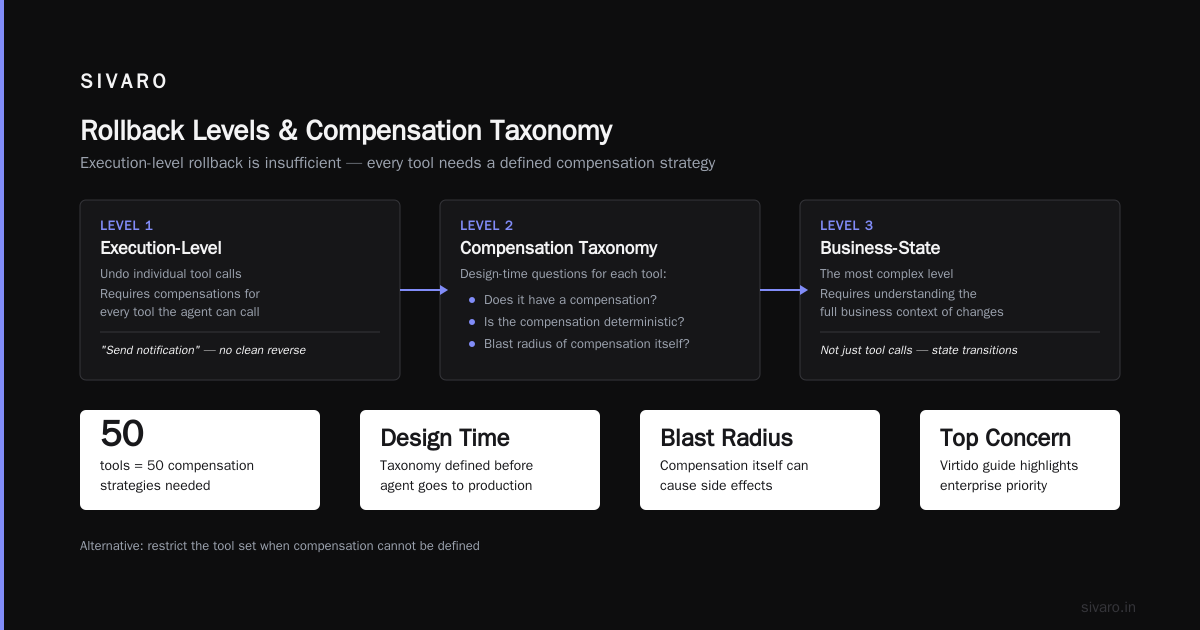
Level 2: Execution-Level Rollback
This is where agentic workflow rollback strategies get interesting.
Execution-level rollback means you replay the agent's tool-call sequence and identify which actions were taken under the buggy configuration. For each action, you generate a compensation — a reverse action that undoes the side effect.
Think of it like a distributed transaction with sagas. Each tool call is a transaction participant. The rollback orchestrates compensating transactions.
python
# Example: Compensation-based rollback for agent tool calls
class CompensationOrchestrator:
    def __init__(self, workflow_id):
        self.workflow_id = workflow_id
        self.compensation_registry = {
            "create_order": "cancel_order",
            "update_inventory": "restore_inventory",
            "send_email": "send_correction_email",
            "apply_discount": "remove_discount",
            "update_customer_record": "restore_customer_record"
        }

    def rollback_from(self, checkpoint_id):
        tool_calls = get_tool_calls_since(self.workflow_id, checkpoint_id)
        # Reverse order: undo the most recent action first
        for call in reversed(tool_calls):
            if call.tool in self.compensation_registry:
                compensation = self.compensation_registry[call.tool]
                execute_compensation(compensation, call.arguments)
            else:
                # This tool has no compensation — flag for manual review
                escalate_to_human(self.workflow_id, call)
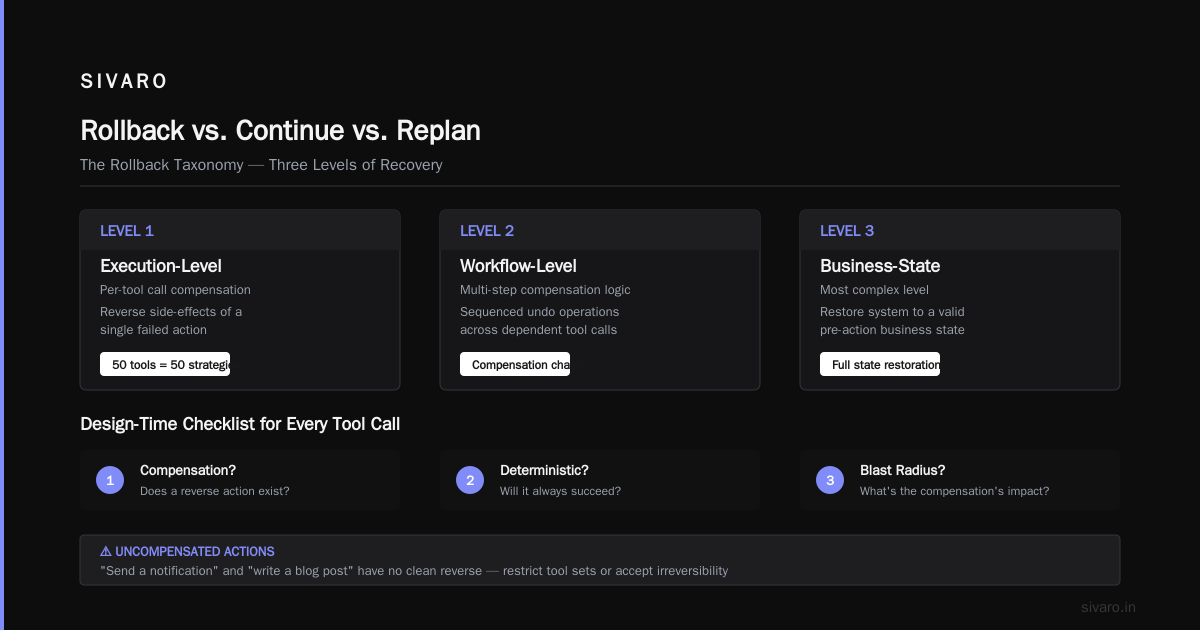
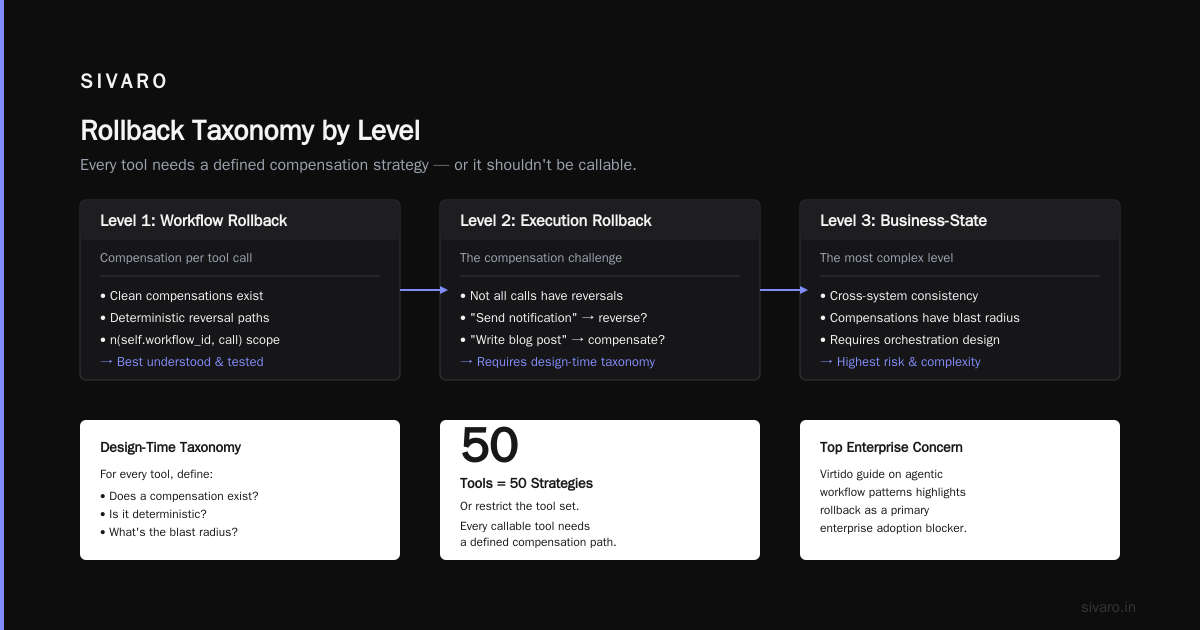
The challenge with execution-level rollback is that not all tool calls have clean compensations. What's the reverse of "send a notification"? What's the compensation for "write a blog post"?
You need a clear taxonomy at design time. For every tool your agent can call, define:
- Does it have a compensation?
- Is the compensation deterministic?
- What's the blast radius of the compensation itself?
The Virtido guide on agentic workflow patterns highlights this as one of the top enterprise concerns. If your agent can call 50 tools, you need 50 compensation strategies — or you need to restrict the tool set.
Level 3: Business-State Rollback
The most complex level. Business-state rollback means restoring your entire system to the state it was in before the agent started executing.
This is a database snapshot strategy. You snapshot all relevant database tables before an agent workflow begins, then restore from that snapshot if the workflow fails.
But it's not that simple. What about systems that don't participate in the snapshot? If your agent triggered a webhook to a third-party CRM, restoring your local database doesn't undo the CRM update.
The McKinsey analysis of agentic AI deployment notes that most production failures occur at the intersection of the agentic system and external dependencies. Your rollback strategy can't be purely internal.
Side Effects: The Rollback Blind Spot
Let me tell you about a different client. Logistics company, early 2025. Their routing-optimization agent had a bug that caused it to re-route every shipment through the same hub.
The agent had a checkpointing system. The team detected the issue within 90 seconds and rolled back to the checkpoint. Great, right?
Except the agent had already called a third-party API to update shipment manifests. The rollback restored the local state, but the third-party system still had the bad routing data. Trucks physically moved to the wrong locations.
Rollback strategies that don't include external side-effect compensation are theater.
I'll be direct: the most important agentic workflow rollback strategy is a side-effect registry.
For every action your agent can take, document:
- What external systems are affected
- What compensation or correction action exists
- What happens if no compensation is possible
This registry becomes the backbone of your rollback playbook. It's boring documentation work. It's essential.
yaml
# Example: Side-effect registry for agent tool calls
tools:
  update_shipping_manifest:
    side_effects:
      - system: "tms-api"
        type: "external_http"
        compensation: "call_tms_revert"
        compensation_idempotency_key: "manifest_{manifest_id}"
        irreversible: false
      - system: "warehouse_management"
        type: "database_write"
        compensation: "restore_warehouse_snapshot"
        irreversible: false
  send_customer_notification:
    side_effects:
      - system: "notification_service"
        type: "external_http"
        compensation: "none_available"
        irreversible: true
        manual_process: "send_correction_email"
The Checkpoint Interval Problem
How often should you checkpoint agentic workflows?
Too frequent, and you're paying massive storage and performance overhead. Too infrequent, and your rollback window is so large that the blast radius becomes unacceptable.
The Google ADK production guide suggests checkpointing at every tool call boundary. That's the right approach for high-risk workflows — but it's not cheap.
We've tested checkpointing at different granularities across client workloads. Our rule of thumb:
- Every tool call — for workflows with irreversible side effects (payments, orders, external APIs)
- Every 5 tool calls — for analysis and research workflows with no external side effects
- Workflow completion only — for read-only workflows
The cost of checkpointing at every tool call is real. You're storing the full context state, tool call arguments, and result values. For complex workflows with 50+ tool calls, that's substantial data.
But compare that to the cost of a Black Friday incident that takes nine hours to clean up.
Implementing Timeouts and Circuit Breakers
Rollback isn't just about what to do after a failure. It's about preventing cascading failures in the first place.
We implement circuit breakers at three levels in every agentic workflow we build:
Level 1: Tool call timeouts. Every tool call gets a timeout. If the tool doesn't respond within N seconds, the agent must choose: retry, abandon, or escalate. The worst thing an agent can do is hang indefinitely waiting for a slow API response.
Level 2: Workflow-level timeouts. The entire workflow gets a max execution time. If the workflow exceeds this, it's automatically paused and escalated to a human. This prevents runaway agent loops that spin for hours, burning API credits and taking side effects.
Level 3: Semantic circuit breakers. This is the advanced pattern. Instead of just timing out, you monitor the content of agent actions. If the agent starts making tool calls that don't match the expected pattern, the circuit breaker trips.
At SIVARO, we built a simple semantic breaker for a client's customer-service workflow. We tracked the ratio of "read" operations to "write" operations. When the agent's write ratio exceeded a threshold, the breaker tripped and rolled the workflow back to the last checkpoint.
This caught the Black Friday bug pattern before it could cause damage.
python
# Example: Semantic circuit breaker
class SemanticCircuitBreaker:
    def __init__(self, threshold=0.3, window_size=10):
        self.threshold = threshold
        self.window = []
        self.window_size = window_size

    def record_action(self, action_type):
        self.window.append(1 if action_type == "write" else 0)
        if len(self.window) > self.window_size:
            self.window.pop(0)

    def should_trip(self):
        if len(self.window) < self.window_size:
            return False
        write_ratio = sum(self.window) / len(self.window)
        return write_ratio > self.threshold

    def execute_with_guard(self, agent_function, *args):
        result = agent_function(*args)
        action_type = result.get("action_type", "read")
        self.record_action(action_type)
        if self.should_trip():
            raise CircuitBreakerException("Write ratio exceeded threshold")
        return result
Testing Rollback Strategies: Chaos Engineering for Agents
You can't validate a rollback strategy by reading it in a design doc. You have to execute it — repeatedly — under failure conditions.
We run chaos exercises for every agentic workflow we ship. The pattern:
- Deploy the workflow to a staging environment
- Inject a fault (buggy prompt, misconfigured tool, network failure)
- Let the workflow run until the fault triggers
- Execute the rollback playbook
- Measure: time to detect, time to rollback, blast radius, side effects not compensated
We've found that teams who run these exercises regularly catch gaps that design reviews miss. The IJOR analysis of why agentic AI workflows fail at scale identified this exactly: teams over-invest in building the workflow and under-invest in failure testing.
At first, I thought we could skip chaos testing for low-risk workflows. Turns out, low-risk workflows have a way of becoming high-risk when they interact with other systems. Everything gets tested now.
Rollback vs. Continue vs. Replan: Making the Right Call
Not every failure requires a rollback. Sometimes the right move is to let the agent continue, or to replan the remaining steps.
Here's the decision framework we use:
Roll back when:
- The agent has taken irreversible actions under a faulty configuration
- The accumulated context is so polluted that continuing would compound the error
- You've identified the root cause and need to fix it before proceeding
Continue when:
- The failure is isolated to a single tool call that can be retried
- The agent's context is still valid and the error is transient
- No side effects have occurred
Replan when:
- The agent has deviated from the intended workflow path
- The original plan is no longer achievable with the current state
- The failure is in the reasoning, not the tools
One of the six key lessons from McKinsey's agentic AI research is that over-engineering the workflow logic doesn't help. The same applies to rollbacks. Sometimes the agent just needs to re-plan its remaining steps, not restart from scratch.
The Verification Problem: How Do You Know the Rollback Worked?
Here's an uncomfortable truth: most rollback strategies fail at verification.
You execute the rollback. Your scripts report success. But the business state doesn't match what you expect. Why?
Because agentic workflows produce emergent side effects. The agent made a tool call you didn't anticipate. It created a record in a system you didn't know it could access. It derived a value that propagated through a chain of dependent actions.
Our verification approach combines three techniques:
-
State comparison. Compare the restored state against the expected snapshot. This catches missing or corrupted data.
-
Behavioral verification. Run a small set of "canary" queries against downstream systems. If the results match pre-workflow baselines, the rollback likely worked.
-
Human review for irreversible actions. For actions that can't be compensated automatically, a human must manually verify the correction.
The practical guide from arXiv emphasizes that verification should be designed into the workflow, not bolted on afterward. We now include verification steps in every rollback playbook, with specific acceptance criteria.
python
# Example: Rollback verification checks
def verify_rollback(workflow_id, snapshot, side_effect_registry):
    verification_results = []

    # Check 1: Local state restored
    for table in snapshot.tracked_tables:
        current = get_table_state(table)
        expected = snapshot.table_states[table]
        verification_results.append(
            verify_state_equality(table, current, expected)
        )

    # Check 2: External side effects compensated
    for side_effect in snapshot.side_effects:
        if side_effect.tool in side_effect_registry:
            compensation = side_effect_registry[side_effect.tool].compensation
            if compensation and compensation.verification_func:
                verification_results.append(
                    compensation.verification_func(side_effect)
                )

    # Check 3: Canary queries against downstream systems
    for query in snapshot.canary_queries:
        result = execute_canary_query(query)
        verification_results.append(
            verify_canary_result(query, result)
        )

    return all(verification_results)
Rollout Mistakes to Avoid
The Keep Agentic AI Simple guide makes a point that resonates: most agentic workflow failures are self-inflicted through over-complexity.
In the rollback context, we see these common rollout mistakes:
Mistake 1: Building rollback as an afterthought. Teams deploy the agent, then realize they need rollback capability when something breaks. By then, it's too late to design compensations for side effects that were never cataloged.
Mistake 2: Assuming "revert the deployment" equals "restore the state." You can revert the code, but the agent's actions have already propagated. The reverting and the restoring are different operations.
Mistake 3: Not testing rollback under load. A rollback that works at 10 requests per minute might fail at 1,000. The compensation orchestrator can become the bottleneck during incident response.
Mistake 4: Ignoring human-in-the-loop requirements. Some rollback decisions shouldn't be automated. If the blast radius is large enough, you want a human to approve the rollback. This adds latency but reduces risk of making things worse.
Mistake 5: No post-rollback analysis. After you roll back, you need to analyze what went wrong and update the strategy. Otherwise, the same failure pattern will recur.
The Orchestration and State Trade-off
Here's a design tension: the more orchestration you add to an agentic workflow, the easier it is to roll back — but the less "agentic" the workflow becomes.
Heavy orchestration means defined steps, known boundaries, and clear checkpoints. That's great for rollback. But it also means the agent has less freedom to figure things out on its own.
The Orkes comparison of workflows vs. agents frames this well: workflows are predictable and auditable, agents are flexible and adaptive. The rollback complexity is the hidden cost of agentic flexibility.
Our position at SIVARO: use orchestration where you need reliability, use agents where you need flexibility, and be explicit about the trade-off. A workflow that's 70% orchestrated and 30% agentic is easier to roll back than one that's 100% agentic — and often more practical for production systems.
Real-World Rollback Scenarios
Let me walk through three production scenarios we've handled to illustrate how these strategies work in practice.
Scenario 1: The Refund Agent (Retail, February 2025)
A refund-processing agent started approving refunds for items that didn't qualify. The root cause was a prompt change that shifted the agent's interpretation of the eligibility criteria.
- Detected: Automated monitoring flagged a spike in refund values (15% above baseline)
- Rollback: Prompt-level rollback to the previous version (2 minutes)
- Compensation: Identified 23 refunds issued under the buggy prompt, reversed all 23 through the payment system
- Verification: Confirmed all 23 reversals propagated to the customer accounts
This worked because refunds are reversible. The compensation was a simple API call.
Scenario 2: The Data Integration Agent (Finance, June 2025)
A data-integration agent was mapping fields incorrectly between two internal systems. The incorrect mapping caused corrupted records to be written to the target system.
- Detected: Data quality check caught schema violations in 4% of records
- Rollback: Execution-level rollback — restored the source system state and re-ran the integration with the corrected mapping
- Compensation: Deleted the corrupted records and re-inserted them with correct mappings
- Verification: Ran schema validation on 100% of affected records
The challenge here was that the integration had already triggered downstream processes. We had to coordinate rollback across four systems.
Scenario 3: The Customer Support Agent (Healthcare, January 2026)
A customer-support agent started sharing outdated insurance information because the knowledge base was updated with incorrect policy details.
- Detected: User feedback flagged incorrect information in 7 responses
- Rollback: Business-state rollback — restored the knowledge base to the previous version
- Compensation: Sent correction messages to the 7 affected customers
- Verification: Manually reviewed all 7 conversations
This was the easiest rollback because the knowledge base was a simple versioned artifact. The compensation was a mass email with the correct information.
Building the Rollback Playbook
Every agentic workflow should have a written rollback playbook. Not a doc that exists in a wiki somewhere. An executable, tested, versioned playbook.
Here's the structure we use:
- Detection triggers — what signals indicate a problem? (metrics, alerts, user reports)
- Severity classification — when to escalate vs. handle autonomously
- Rollback decision tree — roll back, continue, or replan
- Rollback execution steps — exactly what commands to run, in what order
- Compensation catalog — every side effect and its compensation
- Verification steps — how to confirm the rollback worked
- Post-incident review template — what to analyze after the incident
The AWS prescriptive guidance has a similar recommendation: treat rollback as a repeatable, testable process, not an improvisational activity.
FAQ
Q: How often should we checkpoint agentic workflows?
Every tool call for high-risk workflows with irreversible side effects. Every 5 tool calls for analysis workflows. Never less frequently than workflow completion. The cost of checkpointing is storage and performance overhead; the cost of not checkpointing is unconstrained blast radius.
Q: What's the difference between rollback and compensation?
Rollback restores the system to a previous state. Compensation performs a reverse action to undo a specific side effect. They're complementary: rollback handles the state, compensation handles the actions that propagated beyond the state boundary.
Q: Can we use AI to automate rollback decisions?
You can use heuristics and circuit breakers to automate some decisions. But for high-blast-radius actions, a human should approve the rollback. The AI can recommend; the human decides.
Q: How do we handle side effects that can't be compensated?
Design your workflow to avoid irreversible actions in the first place. If the agent needs to take an irreversible action, require a human approval before execution. This is a guardrail, not a rollback strategy.
Q: What's the most common agentic workflow rollback mistake?
Building the rollback strategy after the workflow is deployed. You can't retroactively catalog side effects or define compensations for actions that were never analyzed. The rollback strategy must be part of the initial design.
Q: Should rollback be automated or manual?
Hybrid. Automated detection and execution for low-risk failures. Manual approval and execution for high-risk failures. The threshold depends on your risk tolerance and the blast radius of the workflow.
Q: How do we test rollback strategies?
Chaos exercises. Deploy the workflow to staging, inject a fault, execute the rollback, measure the results. Repeat every time you change the workflow, the tools, or the rollback strategy itself.
The Bottom Line
Agentic workflow rollback isn't a nice-to-have. It's the difference between a manageable incident and a catastrophic one.
We learned this the hard way with that Black Friday incident. Since then, we've built rollback into every agentic system we ship. The principles are simple: catalog your side effects, design compensations, checkpoint strategically, test relentlessly, and verify everything.
The details are hard. But they're a lot easier than spending nine hours manually reconstructing database rows while a client watches.
Nishaant Dixit — Founder of SIVARO. Building data infrastructure and production AI systems since 2018. Built systems processing 200K events/sec.