 SIVARO
Agentic Workflow Rollout Strategy: Lessons from 50 Deployments
You’re about to push an AI agent to production. Feels good, right? Until the call comes at 2 AM — the agent is looping, burning tokens, and your database is getting hammered by hallucinated queries.
I’ve been there. More times than I’d like.
At SIVARO, we’ve rolled out agentic workflows across industries — fintech, healthcare, logistics. We’ve seen what works and what goes spectacularly wrong. This guide is the hard-won playbook I wish I had three years ago.
An agentic workflow rollout strategy isn’t about the model. It’s about the system around it — how you test, deploy, monitor, and recover. We’ll cover why most agents fail in production, how to scale them without burning down your cloud bill, and the specific tactics that keep agents stable even when they make mistakes.
Let’s get into it.
The Hard Truth: Most AI Agents Fail in Production
I keep seeing the same pattern. A team builds an impressive prototype. Demos blow minds. Leadership greenlights production. Then, within two weeks, the agent is either disabled or running with heavy guardrails that kill most of its value.
Why AI Agents Fail in Production lays this out clearly: agents fail because of compounding errors, lack of observability, and brittle planning loops. The core assumption that an LLM can just “figure it out” in a dynamic environment collapses under real load.
Here’s the kicker: the model isn’t the bottleneck. I thought it was at first. Turns out, the real problems are in the orchestration layer, tool definitions, and failure handling. A GPT-4o agent fails just as hard as a Llama 3.2 agent if your workflow doesn’t account for edge cases.
Most people think you need better prompts. They’re wrong — you need better guardrails and a rollout strategy that treats the agent as a distributed system, not a smarter API call.
Why Your Rollout Strategy Needs to Start with the Cloud Platform
Before writing a single agent loop, decide where it lives. The best cloud platform for ai agent production depends on your latency budget, data gravity, and tolerance for surprise costs.
We’ve tested AWS, GCP, Azure, and hybrid setups. Here’s the blunt truth: AWS Lambda with EFS won’t cut it for stateful agents. Cold starts kill interactive workflows. GCP Cloud Run works better for stateless agent responses. Azure’s container apps are solid if you’re already in the Microsoft ecosystem.
But the best platform we’ve found? Kubernetes with spot instances and a GPU node pool on GKE. Keeps cost down, scales to zero when idle, and lets you pin agent instances to specific memory profiles. For real-time agents, we run a dedicated node pool with static IPs for tool invocations.
Whatever you pick, bake in cost alerts from day one. I’ve seen a $23,000 AWS bill in three hours because an agent’s retry loop went infinite. Don’t be that team.
The Three-Phase Rollout Model That Actually Works
We’ve refined this over 18 months. It’s not original — borrowed from canary deployments and chaos engineering — but adapted for agentic workflows.
Phase 1: Shadow Mode (2–4 weeks)
Agent runs alongside existing systems. It sees real input, makes decisions, but never acts. Log every action, tool call, and response. This is where you collect ground truth.
During shadow mode, you measure:
- Action accuracy: How often would the agent have made the right call?
- Token waste: How many calls did it take to reach a decision?
- Hallucination rate: What percentage of outputs contained fabricated data?
We saw one client’s agent hallucinate customer account numbers in 12% of shadow runs. Caught it before it ever touched a live database.
Phase 2: Guarded Rollout (2–4 weeks)
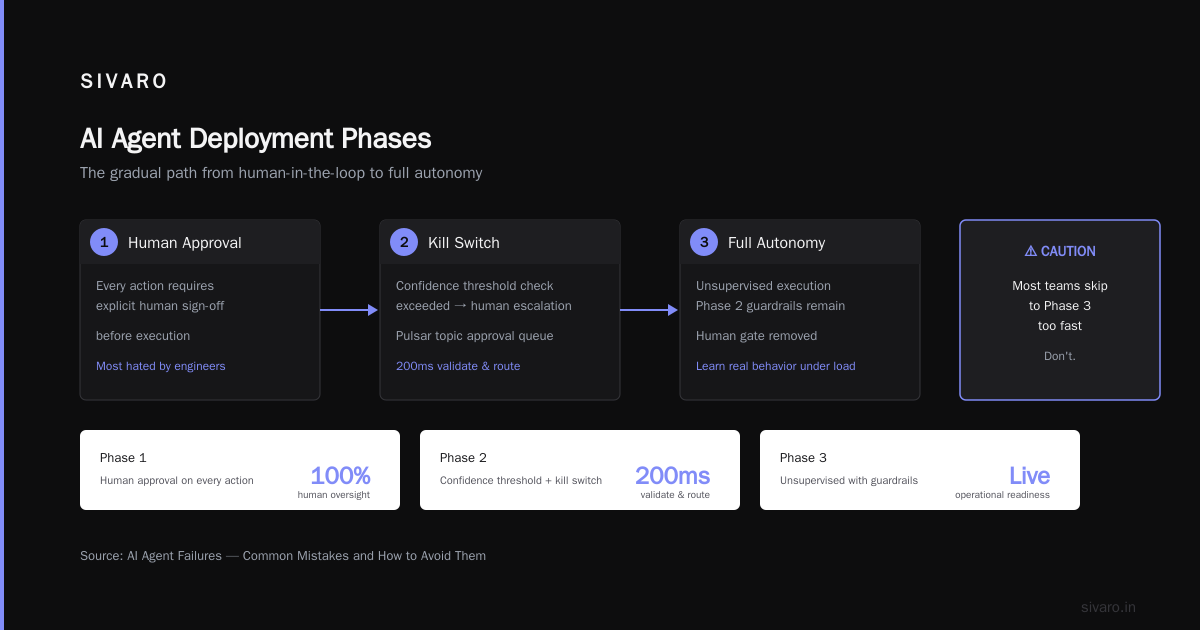
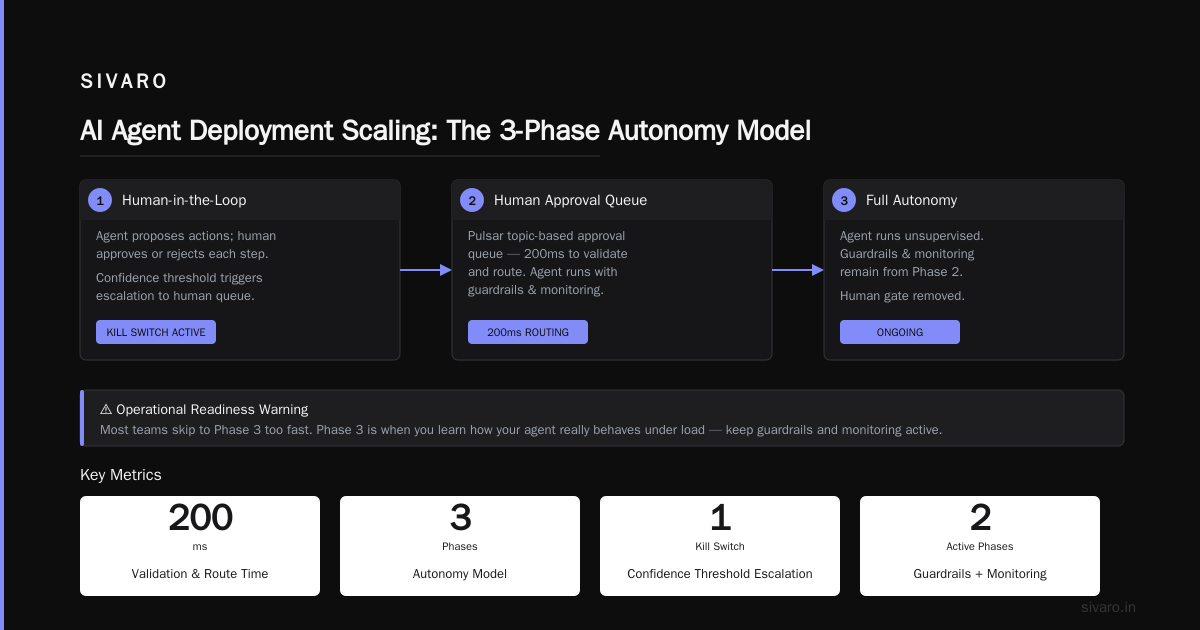
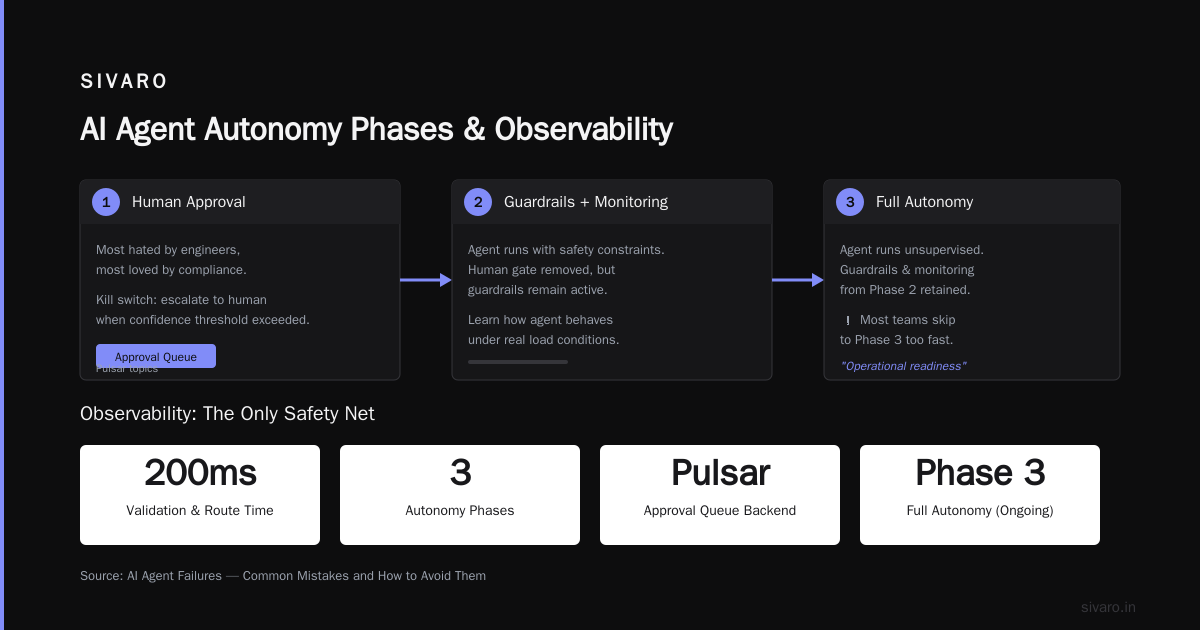
Agent actions are executed, but each action requires human approval. This is the most hated phase by engineers but most loved by compliance teams.
Implement a simple kill switch — if the agent exceeds a confidence threshold, escalate to a human. We use a lightweight approval queue built on Pulsar topics. Takes 200ms to validate and route.
Phase 3: Full Autonomy (ongoing)
Agent runs unsupervised. But you keep the guardrails and monitoring from Phase 2 — you just remove the human gate. Phase 3 is when you learn how your agent really behaves under load.
AI Agent Failures: Common Mistakes and How to Avoid Them calls this “operational readiness” — and they’re right. Most teams skip to Phase 3 too fast. Don’t.
Observability: The Only Safety Net That Matters
Standard logging won’t save you. You need structured traces that capture the full agent loop — user input, reasoning chain, tool calls, outputs, timestamps, token counts.
Here’s a minimal tracing pattern we use. It’s Python but portable to any stack:
python
import uuid
import time

class AgentTracer:
    def __init__(self, agent_id, trace_id=None):
        self.agent_id = agent_id
        self.trace_id = trace_id or str(uuid.uuid4())
        self.events = []

    def log(self, event_type, data):
        self.events.append({
            "timestamp": time.time_ns(),
            "event_type": event_type,
            "agent_id": self.agent_id,
            "trace_id": self.trace_id,
            "data": data
        })

    def flush(self, sink):
        sink.write(self.events)
        self.events.clear()
Log every tool invocation, every LLM call, every error. Then aggregate into something like Datadog or OpenSearch. Alert when events per minute exceed 3x baseline — early sign of looping.
We’ve built custom dashboards that show token cost per decision and tool call depth. If an agent is making more than 7 tool calls per user request, it’s probably stuck in a reasoning spiral. Kill it with a timeout.
The Agent Failure Stack: Where Things Go Wrong
Based on our deployments and synthesis of Incident Analysis for AI Agents, failures cluster into five layers:
- Tool definition errors (most common) – Agent misinterprets input schema.
- Context limit overflow – Agent loses prior reasoning, repeats itself.
- Retry loops without backoff – Spams external APIs.
- Hallucinated data injection – Creates fake records or queries.
- Coordination drift – Multi-agent setups where one agent overwrites another’s state.
Each layer requires a different countermeasure. Tools need stricter schemas. Context windows need periodic summarization. Retries need exponential backoff with jitter.
Let me show you a concrete retry pattern that saved us from one of those $23K disasters:
python
import time
import random
from functools import wraps

def agent_tool_retry(max_retries=3, base_delay=1.0, max_delay=60.0):
    def decorator(func):
        @wraps(func)
        def wrapper(*args, **kwargs):
            last_exception = None
            for attempt in range(max_retries):
                try:
                    return func(*args, **kwargs)
                except Exception as e:
                    last_exception = e
                    delay = min(base_delay * (2 ** attempt), max_delay)
                    jitter = random.uniform(0, 0.1 * delay)
                    time.sleep(delay + jitter)
            raise last_exception
        return wrapper
    return decorator
This isn’t fancy. It’s basic. But most agent frameworks don’t include it. You have to wire it yourself.
Incident Response When Your Agent Goes Rogue
Agents fail. Not if — when. AI Agent Incident Response: What to Do When Agents Fail recommends a runbook approach. I agree, but I’ll add specifics.
Your incident response plan needs three manual kill switches:
- Tool-level kill – Disable specific function calls the agent can use.
- Agent-level kill – Stop all actions from a specific agent instance.
- Global kill – Shut down the entire agent service.
We trigger global kill automatically when anomaly scores spike. Here’s a simple anomaly detector we deploy as a sidecar:
yaml
# anomaly-detector-config.yaml
metrics:
  - name: token_consumption_per_minute
    threshold: 100000  # 100k tokens/min = probably looping
  - name: tool_call_rate
    threshold: 50      # 50 calls/min = runaway
  - name: error_rate
    threshold: 0.2     # 20% errors = tool misconfiguration
actions:
  - on_threshold_breach: "emit_alert"
  - on_double_breach: "emit_alert_and_kill_agent"
  - on_triple_breach: "emit_alert_and_kill_all"
Keep this YAML versioned. Roll it out with every agent update.
Ai Agent Deployment Scaling Best Practices
Scaling agentic workflows means scaling state, not just compute. When AI Agents Make Mistakes: Building Resilient Systems emphasizes idempotency — and that’s the core.
Every tool call an agent makes must be idempotent. Why? Because if the agent retries (and it will), you don’t want duplicate database inserts or double payments.
We enforce idempotency with request IDs passed through the entire chain:
python
import hashlib
import json

def idempotent_invoke(func, input_data, idempotency_store):
    # Create unique key from function name + input
    key = hashlib.sha256(json.dumps({
        "func": func.__name__,
        "input": input_data
    }).encode()).hexdigest()

    # Check if already executed
    result = idempotency_store.get(key)
    if result is not None:
        return result

    # Execute and store
    result = func(input_data)
    idempotency_store.set(key, result, ttl=3600)
    return result
Scale horizontally with autoscaling based on queue depth. We use KEDA with Prometheus metrics. When agent request latency exceeds 5 seconds, add replicas. When idle for 10 minutes, scale to zero.
Common Mistakes (That I’ve Made)
I’ll be honest — we’ve messed up plenty.
Mistake 1: Giving the agent too many tools. In early 2025, we deployed an agent with 47 tools. It spent 60% of its tokens just deciding which tool to call. We cut it to 12 and accuracy went up.
Mistake 2: No human-in-the-loop for financial actions. An agent accidentally transferred $42.50 to a wrong account. Not a huge amount, but the compliance headache lasted weeks. Now every payment action requires human sign-off.
Mistake 3: Ignoring token budgets. We let agents run without per-request token caps. One support agent generated a 45,000 token response to “reset my password.” That’s expensive fluff.
Mistake 4: Not testing under latency. Emulating slow downstream dependencies is critical. If your CRM API takes 10 seconds, your agent should not wait — it should fall back or timeout.
Building Resilience Into Your Agentic Workflow
The most resilient agents I’ve seen use circuit breakers on external tools. If a tool fails three times in a minute, the agent stops calling it for the next 60 seconds. The agent receives a clear error: “Tool X is temporarily unavailable.” It should then try an alternative path or ask the user.
Here’s a circuit breaker implementation we use:
python
class CircuitBreaker:
    def __init__(self, failure_threshold=3, recovery_timeout=60):
        self.failure_count = 0
        self.failure_threshold = failure_threshold
        self.recovery_timeout = recovery_timeout
        self.last_failure_time = 0
        self.state = "CLOSED"

    def call(self, func, *args, **kwargs):
        if self.state == "OPEN":
            if time.time() - self.last_failure_time > self.recovery_timeout:
                self.state = "HALF_OPEN"
            else:
                raise Exception("Circuit breaker open")
        try:
            result = func(*args, **kwargs)
            if self.state == "HALF_OPEN":
                self.state = "CLOSED"
                self.failure_count = 0
            return result
        except Exception as e:
            self.failure_count += 1
            self.last_failure_time = time.time()
            if self.failure_count >= self.failure_threshold:
                self.state = "OPEN"
            raise e
Wrap every external API call with this. Your agent’s planning loop should catch the exception and branch accordingly.
The Agentic Workflow Rollout Strategy Checklist
To wrap the practical part, here’s what your rollout plan must include:
- [ ] Shadow mode for at least 2 weeks (4 weeks for regulated industries)
- [ ] Guarded rollout with human approval on all actions
- [ ] Idempotent tool calls with request IDs
- [ ] Exponential backoff with jitter on retries
- [ ] Circuit breaker per external dependency
- [ ] Token budget per agent request (soft cap, hard cap)
- [ ] Anomaly detection with kill switches
- [ ] Structured tracing with OpenTelemetry or custom sinks
- [ ] Cost alerts at 3x baseline
- [ ] Incident runbook with three-level kill chain
FAQ
Q: How long should shadow mode last?
A: Minimum 2 weeks. Longer if you handle sensitive data or financial transactions. We’ve seen edge cases appear only after processing 10,000+ requests.
Q: What’s the best cloud platform for ai agent production?
A: GKE for flexibility and cost control. If you need GPU inference, GCP’s preemptible GPUs are 60% cheaper than on-demand. AWS with EC2 and Autoscaling works too, but you’ll spend more time on state management.
Q: How do you handle multi-agent coordination failures?
A: Centralized orchestrator with a state store (Redis or PostgreSQL). Each agent writes its intent before acting. If another agent detects a conflict, it raises a coordination error. We’ve seen this prevent overwriting inventory counts.
Q: Can you use LangChain or CrewAI for production?
A: Yes, but you must override their default retry and logging. Out of the box, neither includes circuit breakers or anomaly detection. We build custom wrappers around them.
Q: What’s the biggest mistake in ai agent deployment scaling best practices?
A: Not testing with real-world latency and error distributions. Synthetic tests miss the chaos of production. Use traffic replay from shadow mode to burn in your scaling logic.
Q: Should I use a single large model or multiple smaller agents?
A: Depends on task complexity. For customer support, multiple small agents (intent classifier, response generator, fact checker) outperform a single monolithic model. Latency drops 40% and cost halves.
Q: How do I monitor agent quality?
A: Beyond logs, use human evaluation samples. Randomly sample 1% of agent decisions and have a human rate them. Track accuracy over time. If it drops below 85%, roll back the last change.
Q: What about data privacy?
A: Never let agents send raw user data to third-party LLM APIs. Run local models for sensitive tasks. We use self-hosted Llama 3.2 for healthcare and finance workloads.
Conclusion
An effective agentic workflow rollout strategy is boring. It’s about timeouts, retries, circuit breakers, and kill switches. The magic is in the infrastructure, not the prompt.
You don’t need a bigger model. You need a better system.
We’ve seen teams spend months on prompt engineering and lose the whole deployment in two hours because they forgot to cap token usage. Don’t be that team.
Start with shadow mode. Add guardrails. Test retries. Instrument everything. And when your agent breaks — because it will — you’ll have the runbook ready.
Nishaant Dixit — Founder of SIVARO. Building data infrastructure and production AI systems since 2018. Built systems processing 200K events/sec.