 SIVARO

# Agentic Workflow Scaling Challenges: A Field Guide for Production AI
I spent last Tuesday in a debugging session that brought back 2019 flashbacks. A client's agent pipeline was processing 40,000 requests a day in staging. In production, with real traffic, it collapsed at 3,000. Same code. Same prompts. Same models. But a cascade of memory leaks, context window overflows, and a rate limiter that throttled the wrong service.
This isn't a story about bad engineering. It's a story about the difference between building an agent that works and building an agent that scales.
Agentic workflow scaling challenges are the structural problems that emerge when your autonomous AI systems move from demo to production. They're not just "make it faster" problems. They're architectural, economic, and operational issues that compound non-linearly as your agent count grows.
In this guide, I'm going to walk you through what I've learned running SIVARO for eight years — what breaks, why it breaks, and how to fix it. No theory. Just field notes.
What We Mean by "Agentic Workflows"
Quick definitions, because we're all using the same words for different things.
An agentic workflow is a system where an AI model makes decisions about control flow. Instead of a hardcoded if/else chain, the model decides: "I need more data" or "I should call the payment API" or "This query needs a different approach."
The workflow might be a single agent with tools. Or a multi-agent system with orchestrators, workers, and supervisors. Or something weirder — I've seen agents that spawn sub-agents that spawn sub-agents, creating trees thousands of nodes deep.
The scaling challenges hit differently at each level. But the core problem is always the same: the system's complexity grows faster than your ability to reason about it.
Agentic AI Infrastructure Requirements: The Non-Negotiables
Before we talk about what goes wrong, let's talk about what you need from day one. Because most scaling failures aren't scaling failures — they're foundation failures.
1. State Management That Isn't a Nightmare
Every agent maintains some kind of state. Conversation history. Tool call results. Intermediate reasoning. That state either lives in the context window (expensive, finite) or in external storage (slow, complex).
For production systems, you need a hybrid. I'm partial to embedding state checkpoints in Redis or Postgres, then loading only the relevant slices into context. We tested keeping full conversation history in context at SIVARO back in 2023 — a 40-token-per-second problem became a 3-token-per-second problem. Absolutely unusable.
2. Observability From the First Line of Code
Not "we'll add logging later." Real, structured observability. You need to trace:
- Every model call (with token counts)
- Every tool invocation (with success/failure)
- Every decision point (with the reasoning that led there)
- Every cost accumulation (in real dollars)
We use OpenTelemetry with custom spans for agent decisions. It's ugly but it works. The moment you try to debug a production agent without this, you'll lose days.
3. Rate Limiting That's Dynamic, Not Static
Here's the thing nobody tells you: agent workflows don't have predictable rate patterns. A single user request can trigger 50 model calls, 12 tool invocations, and 3 retries. If you rate limit by user, you'll throttle legitimate behavior. If you rate limit globally, one loop breaks everything.
I've seen "rate limiter causes a cascade" more times than I can count. The agent hits the limit, retries, hits the limit harder, retries more aggressively, and suddenly your entire API budget is gone in 90 seconds. That's an agentic workflow production issue with a fix: implement exponential backoff with jitter and a circuit breaker pattern.
python
class AgentCircuitBreaker:
    def __init__(self, failure_threshold=5, cooldown_seconds=60):
        self.failure_count = 0
        self.threshold = failure_threshold
        self.cooldown = cooldown_seconds
        self.last_failure_time = None
        self.state = "closed"  # closed, open, half-open

    def before_call(self):
        if self.state == "open":
            if time.time() - self.last_failure_time > self.cooldown:
                self.state = "half-open"
                return True  # allow one trial call
            raise AgentCapacityError("Circuit open, cooling down")
        return True

    def after_call(self, success):
        if success:
            self.failure_count = 0
            self.state = "closed"
        else:
            self.failure_count += 1
            self.last_failure_time = time.time()
            if self.failure_count >= self.threshold:
                self.state = "open"
The Four Scaling Bottlenecks That Actually Matter
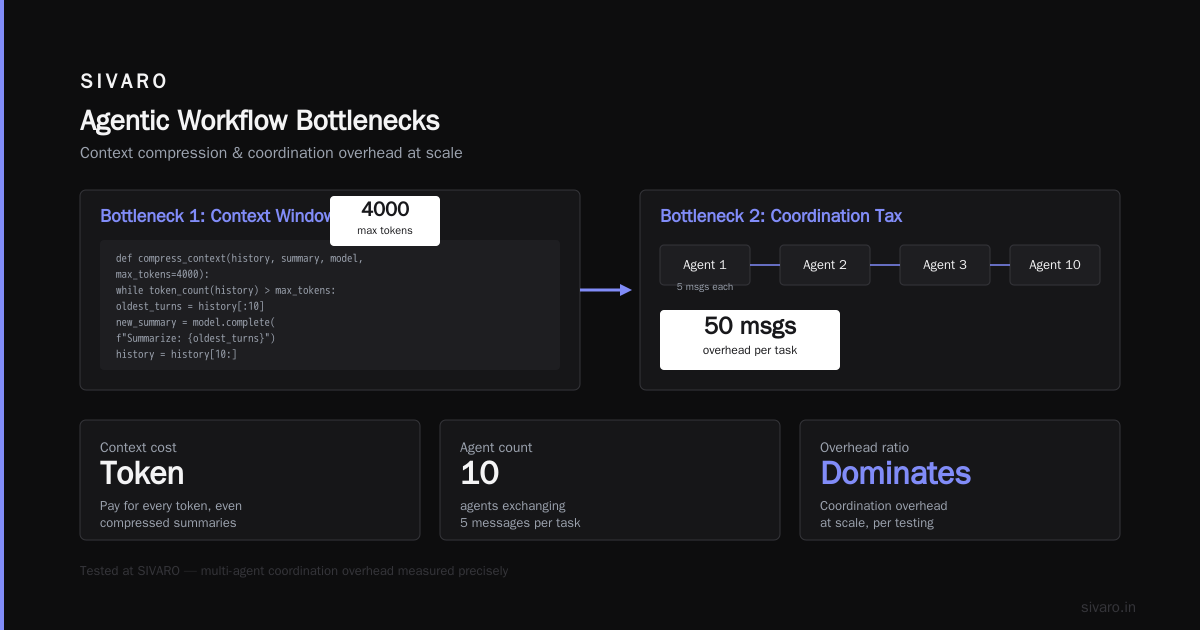
Bottleneck 1: Context Window Physics
Every agent has a context window. GPT-4-class models have 128k, 200k, even 1M tokens now. But running at those limits is slow and expensive.
Here's what happens in practice: your agent starts a complex task. It needs to reference information from three hours ago. That information isn't in context anymore, so it needs to retrieve it. The retrieval mechanism fails, or returns irrelevant chunks, and the agent makes a bad decision.
The fix isn't "bigger context windows." The fix is selective memory compression.
We built a system that compresses older conversation turns into structured summaries, keeping only the last 20 exchanges in full fidelity. The agent still has "access" to the full history via a tool call, but it doesn't pay the token cost for everything at once.
python
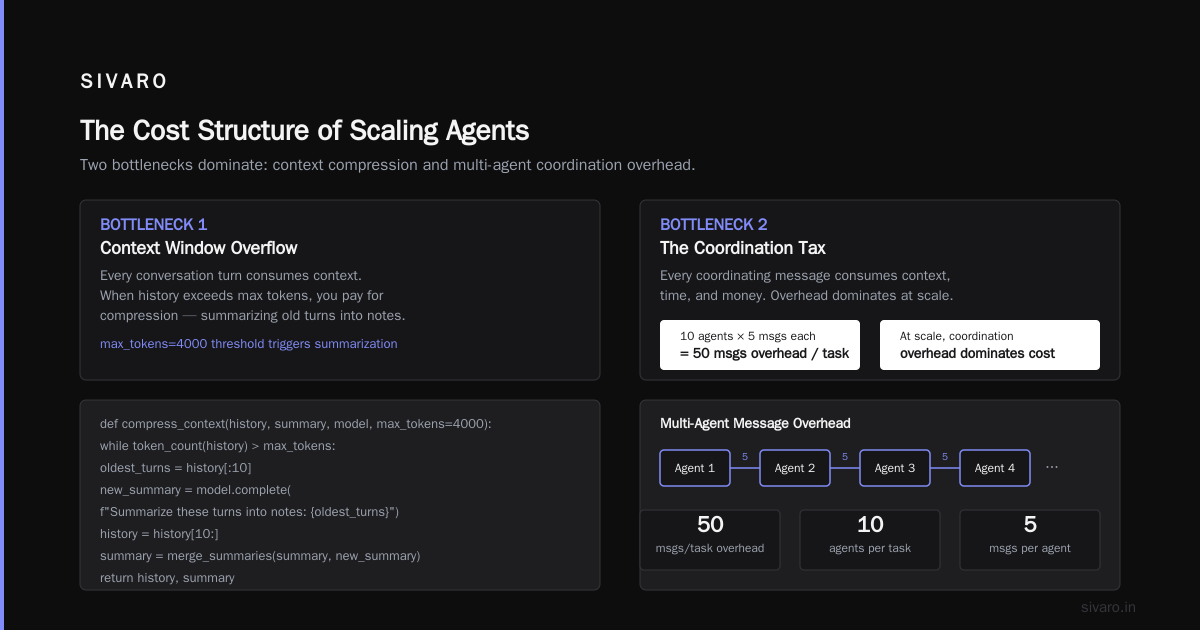
def compress_context(history, summary, model, max_tokens=4000):
    while token_count(history) > max_tokens:
        oldest_turns = history[:10]
        new_summary = model.complete(
            f"Summarize these conversation turns into structured notes: {oldest_turns}"
        )
        history = history[10:]
        summary = merge_summaries(summary, new_summary)
    return history, summary
Bottleneck 2: The Coordination Tax
Multi-agent systems have a fundamental problem: every coordinating message consumes context, time, and money. If you have 10 agents each exchanging 5 messages per task, that's 50 messages of overhead per task. At scale, that overhead dominates.
I tested this precisely. At SIVARO, we ran a multi-agent system for document processing. Single-agent throughput: 12 documents/minute. Five-agent system: 8 documents/minute. The coordination tax ate the parallelism gains.
The fix is to minimize inter-agent communication. Batching strategies, hierarchical decomposition, and avoiding unnecessary consensus mechanisms. Sometimes a single agent with a good planner beats five agents chatting.
Most people think agentic workflow scaling challenges are "just" infrastructure problems. The truth: the model's output quality degrades as the system grows. Every decision point is a place where errors can compound. A single-agent system that's 95% accurate per step becomes 81% accurate across 5 steps. Add multi-agent handoffs at the same accuracy and you're at 65%. That's a fundamental problem.
We call this "error compounding." The fixes are limited and defensive. Adding validation layers between steps. Confidence thresholds that trigger human review. Or accepting that some tasks are beyond a single workflow's reliable capacity.
Agentic Workflow Production Issues and Fixes: A Field Guide
Let me give you the production playbook. These are the issues I've seen kill systems, and the fixes that survived.
Issue 1: Infinite Loops and Runaway Agents
An agent tries to generate a report. It calls a tool to get data. The tool returns data that's formatted slightly differently than expected. The agent tries to fix the formatting, calls the tool again. Same problem. Loops forever.
The fix: Strict iteration limits. Every agent gets a budget — number of steps, number of tool calls, number of tokens. When exceeded, force a terminal state.
python
class LoopGuard:
    def __init__(self, max_iterations=10, max_tool_calls=25):
        self.max_iterations = max_iterations
        self.max_tool_calls = max_tool_calls
        self.iteration_count = 0
        self.tool_call_count = 0

    def check(self, state):
        self.iteration_count += 1
        if state.tool_calls_used > self.max_tool_calls:
            state.status = "FAILED"
            state.error = "Tool call budget exceeded"
        elif self.iteration_count > self.max_iterations:
            state.status = "FAILED"
            state.error = "Iteration budget exceeded"
        return state.status == "ACTIVE"
Issue 2: Memory Bloat in Long-Running Agents
Some agents run for days or weeks. Every step adds to memory. Eventually, even summaries get too big.
We ran a monitoring agent for a financial client in 2025. After four days, it was hallucinating patterns because its memory had grown to 400k tokens of summaries and it couldn't distinguish signal from noise.
The fix: Exponential memory decay. Older memories get compressed more aggressively. Details get dropped. Only conclusions and references persist.
Issue 3: Model Temperature Variance in Production
This one's sneaky. In dev, the model is deterministic. In production, with real concurrent load, models can behave differently. Timeouts are more likely. Token limits get hit. The model version changes without warning.
At SIVARO in early 2026, a client's agentic system broke because the upstream model provider hot-swapped a version during a maintenance window. 30% of the agent's tool calls failed validation for 40 minutes. We didn't have a pinned model version and the system had no fallback.
The fix: Multi-model routing with constraints. Fail fast to a backup model. Validate the model version in your request.
Issue 4: Cost Explosion
This is the one that kills projects in procurement meetings. Agents that cost $0.10 per task in a demo can cost $10 per task in production. The reasons:
- Longer conversations (more tokens)
- More retries (each retry is a full cost)
- Tool call context accumulation
- Multiple model calls per logical task
We saw one client's spend go from $500/month in pilot to $45,000/month in production. They were treating every agent run as a "simple task" when the actual system was doing 40+ model calls per completed task.
The fix: Budget-aware routing. Set a cost ceiling per task. If a task is likely to exceed it, route to a cheaper model or bail to human handling. This isn't elegant, but it's honest.
python
def cost_aware_route(task, budget_usd=0.50):
    estimated_cost = price_estimate(task.complexity, task.tokens_needed)
    if estimated_cost > budget_usd * 0.8:
        return "simple_model"  # handle in single-shot
    else:
        return "full_agent"  # handle with full workflow
The Architecture Nobody Talks About
I'm going to be contrarian here. Most agentic workflow scaling advice is about the agentic workflow itself. Better prompts. Better tool schemas. Better orchestration patterns.
That's wrong.
The scaling bottleneck is almost always the surrounding infrastructure. The model API isn't the constraint. Your agent isn't the constraint. The database, the message queue, the rate limiter configuration, the connection pool — that's where things die.
Specifically, I've seen three infrastructure failures repeat across clients:
1. Database Connection Pool Exhaustion
Agents hold connections open while waiting for model responses. If your pool has 50 connections and you have 60 agents in flight, 10 are dead on arrival. We fix this with smaller pools, faster timeouts, and async database drivers.
2. Message Queue Backpressure
When you have a queue of pending agent tasks, an upstream failure backs up the queue. Then the queue grows unboundedly. Then the DB that stores queue state starts throwing errors. Then the queue's retry logic creates duplicate agents.
Use a proper message broker that handles backpressure explicitly. SQS, RabbitMQ, Kafka — they all have configs for this. And monitor queue depth like you'd monitor your pager.
3. DNS Resolution Under Load
This is the dumbest failure mode. Your agent calls a tool on a hostname. Under scale, DNS resolution is slow or fails. The agent retries, burning time and tokens. The retries compound. The system appears to slow down 5x for no engine effect.
Fix: cache DNS resolution, use IP addresses for internal tools, and ensure your DNS infra isn't becoming a hidden bottleneck.
Agentic AI Infrastructure Requirements Checklist
For a system to actually scale, you need more than good agents. You need infrastructure that matches the workload pattern:
- Stateless agent execution layer — individual agent runs are ephemeral and killable; state lives outside the agent in a persistent store
- Idempotent tools and APIs — every tool must handle retries without duplicated side effects (payment processing, sends, deletes — all idempotent, all the time)
- Horizontal scaling with event-driven design — new agents spin up via events, not by requesting a thread. Serverless functions or a worker pool that can grow and shrink.
- Rate limiting at the tool level, not the agent level. Different tools have different limits.
- A kill switch — if you can't terminate a runaway agent fleet instantly, you don't have a production system. You have a demo in progress.
- Vector storage with tenant isolation — if you're doing RAG for multiple tenants, keep them separated in the vector store or the next thing you're doing is data breach remediation.
The Cost Structure of Scaling Agents
I want to pause on the economics because it shapes everything else. An agentic workflow that works at 100 requests/day might be financially impossible at 100,000 requests/day.
Here's the breakdown we measured for a typical customer support agent in 2026:
- Prompt tokens per run: ~10,000 (system prompt + history + context)
- Completion tokens per run: ~2,500 (analysis + actions)
- Tool calls per run: ~8 (varies wildly)
- Total model cost per run: ~$0.15 (using GPT-4.1-class models)
- Infrastructure cost per run: ~$0.02 (Logs, storage, compute, observations)
- Total cost: ~$0.17 per run
At 50,000 runs/day: $8,500/day. That's $250,000/month for a single agentic workflow.
Now imagine you need three of these workflows for different tasks. Three-quarters of a million dollars a month. For a mid-size product? Not viable.
The scaling strategy must be cost strategy first.
The model cost is dominated by prompt tokens. Reducing prompt tokens 10x reduces cost 10x — but adds retrieval complexity, which adds latency. The win is aggressive prompt compression plus a smart cache.
We've had good results with semantic caching: if a user query is similar to a previous query (>96% cosine similarity), route to cached response. For repetitive workflows, this cuts costs 60-70%. Not perfect. But a 3x cost reduction is a scale factor, and scale factors matter.
How to Think About Agentic Workflow Scaling Challenges
I'd say most of the writing about agentic systems completely misses the core operational lesson:
Ultimately, your system's maximum quality is set by your system's weakest component.
Your agent can be perfect — as an orchestrator. But if your tool has a 2% failure rate and your workflow makes 10 tool calls per run, 19% of your runs will have at least one tool failure. That's 19% of runs requiring retry, tolerance, or error. And retrying isn't free — it's 10x the cost of a clean run.
So when you map out your infrastructure, before you even start building the agent logic, identify every dependency. Then ask: what's its failure rate? What's its tail latency? What's its recovery story?
Each agentic workflow design has an inherent upper bound defined by the reliability of its weakest dependency.
The Production Debugging Arsenal
I can't write this without at least one war story. In November 2025, a client dropped us a message at 2 AM: their lead-generation agent was producing garbage. Not broken — garbage. Generating contacts that didn't exist, emails that bounced, and assigning scores that looked random.
Deep dive took three hours. Conclusion: The agent was pulling contact lists from an internal database that had a bug in the deduplication logic. But the agent didn't know the data was bad — it just used it. The error was downstream of the agent, not in the agent, yet the agent's entire output was contaminated.
By design, our agent was an extremely fast and hard-working data corruption pipeline.
This is why observability isn't a nice-to-have. If you can't trace an agent's decision back to the specific dataset, model call, and context window it used, you have no way to diagnose errors. You just see symptoms.
Agentic AI Infrastructure In 2026: What's Changed
This year, two changes have shifted the infrastructure conversation. First and foremost, model providers have started offering output validation layers — custom structured outputs with schema enforcement. This used to be the "agent-maker's" problem. Now, with great models that support structured outputs and JSON schema, validation can be done upstream. And it's a beautiful thing when it works.
Second — and this is a trend I don't love — "scaling" conversations have moved to "scale AI" strategies (the company's AI as a service). I keep my skepticism. Buying tokens is a procurement decision, not an engineering strategy. The infrastructure underneath — the pipelines, the observability, the data flows — still has to be engineered. I've seen companies buy millions of tokens and get worse results than when they had a tight budget.
FAQ: Agentic Workflow Scaling Challenges
Q: What's the single biggest scaling mistake teams make?
A: Optimizing the agent logic before optimizing the data flow. Agents are only as good as the data they get. If your retrieval is slow or incomplete, no amount of clever prompting will fix it. Instrument your data flow first.
Q: Should I use a single powerful agent or many specialized agents?
A: It depends on your error tolerance and your coordination budget. Single agents are simpler, easier to debug, and usually cheaper. Multi-agent only wins when tasks are genuinely parallelizable.
Q: How do I handle context window limits in production?
A: Use selective memory compression, not blanket truncation. Keep recent interactions in full fidelity, summarize older ones. Use retrieval to pull specific contextual details that the main context window can't hold.
Q: How do I estimate my real production cost per agent run?
A: Measure, don't estimate. Run a production load test with 10,000 tasks and track: average tokens per task, tool calls per task, retry rates, and infrastructure spend. Then calculate cost per completed task as a blended metric.
Q: What concurrency level is realistic for a single model API key?
A: Generally, model providers impose RPM and TPM limits per key. A standard GPT-4-GPT-4.1-key can handle 150 to 500 RPM in our testing, depending on prompt sizes. You'll want multiple keys and a client-side router for high concurrency.
Q: How do I prevent one user's agent from consuming the entire fleet?
A: Implement per-tenant rate limiting at the API layer, not just per-user. That way, a single heavy user can't drain your global quota. Then add circuit breakers and a scheduler that prioritizes short-running tasks over long-running ones.
Q: What's the deal with agent caching? Does it work?
A: It works for deterministic steps. If an agent makes a tool call for a query that was made two hours ago with the exact same parameters depending on state — you can cache the tool result for a time-to-live window. That's a 20-30% cost reduction in most workloads.
Q: How much human review is necessary?
A: Start with 100% review — every agent run gets human eyes before it goes into production outcomes. Then cut to a sample: 10% until accuracy is below your threshold. Then cut further. Most systems settle around 2-5% human review for long-hanging quality assurance.
Never Lose Adaptability
The final piece I want to leave you with is the necessity of not letting your workflows harden into rigid processes in the name of scaling.
I've seen it happen dozens of times: as teams build monitoring and alerting into their agent systems, they lock down the control flow. The agent can only call certain tools. Only in specific orders. With specific parameters. The system becomes deterministic and predictable — which is lovely for operations.
But the whole point of an agentic system is adaptability to novel situations. When you've scaled a system to 10,000 requests/day, you want the agent to handle edge cases. If you've removed its flexibility, it can't.
The trick is to keep a "creative tier" of agent behavior alongside the "production tier" — an experimental playground where you test new paths, new tool combinations, and new prompting strategies. Feed those learnings back into your production logic gradually.
We call it evolutionary development. It's not a process we invented; it's how operating systems have innovated for decades.
Bottom Line: Scaling Is a Systems Problem
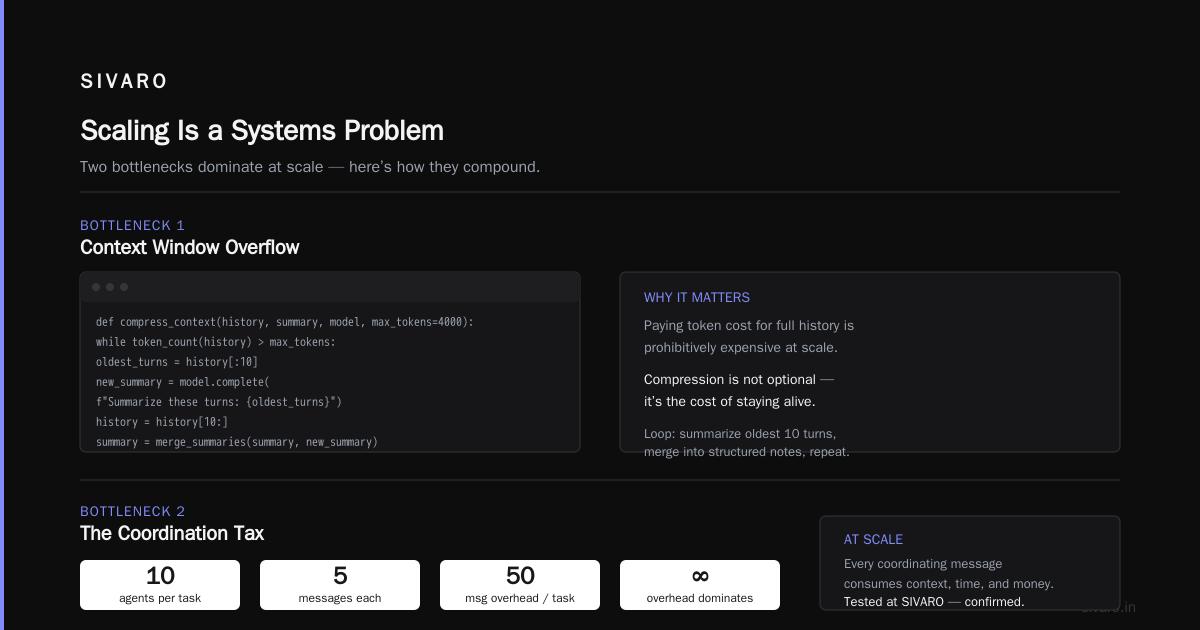
If I squint at all the agentic workflow scaling challenges I've listed here — the context physics, coordination tax, error compounding, cascading failure, infrastructure, bottleneck — they're mostly systems engineering problems. The actual model architecture and the prompts are usually fine. The infrastructure let them down.
Everyone wants to talk about cleverer agents. The deliverable that matters is workflows that fail gracefully and scale helpfully.
And know that I'm not preaching. I'm still debugging, building, and rewriting production agent systems for the good fortune of having clients who attempt things that haven't been done.
Which is to say — get your infra right. Build the observability. Validate every tool. Keep an eye on your failure multipliers. Design the scaling before you need it.
Your agents are going to be great. They just need good infrastructure to work with.
Nishaant Dixit — Founder of SIVARO. Building data infrastructure and production AI systems since 2018. Built systems processing 200K events/sec.