 SIVARO

Agentic Workflow vs Traditional Pipeline: What Actually Ships in Production
We spent eighteen months building a rule-based pipeline for a logistics client. Every edge case we coded, two more appeared. By the end, we had 14,000 lines of conditional logic and a maintenance nightmare. Then we replaced half of it with an agentic workflow. Same team, same infrastructure, and the system handled triple the variance.
I'm not here to sell you on agents as magic. They're not. But the difference between a traditional pipeline and an agentic workflow isn't about "AI vs. code" — it's about who holds the decision-making authority when the input doesn't match the spec.
If you're evaluating this for your stack, this guide breaks down the real differences, the hidden costs, and what I'd buy today.
What We're Actually Comparing
Traditional pipeline: A fixed sequence of steps. Each stage transforms data and passes it downstream. If a step fails, the pipeline stops or routes to a dead-letter queue. You've built these. They're predictable, debuggable, and boring in the best way.
Agentic workflow: A system where an LLM (or a set of them) decides what to do next based on the current state. The "agent" isn't autonomous in the sci-fi sense — it's a loop that observes, decides, acts, and re-observes. The critical shift: the path isn't pre-defined. It's emergent.
Here's the mental model I use:
// Traditional pipeline — deterministic path
input → validate → transform → enrich → load

// Agentic workflow — decision loop
input → observe → decide → act → observe → decide → ... → done
The line blurs fast. You can have an agentic layer inside a traditional pipeline. You can have deterministic guardrails inside an agent. The question isn't which one — it's which one for which step.
Decision Authority: The Real Difference
Most people think the difference is flexibility. It's not. It's control.
In a traditional pipeline, an error means "stop." In an agentic workflow, an error means "try something else." That's a massive shift in operational risk.
At SIVARO, we built a customer support triage system for a fintech client in 2025. The traditional pipeline had a 9-step classification flow. Every time a new product launched, we'd have to add three more rules. The agentic version reads the ticket, checks the knowledge base, looks at the user's account state, and decides whether to escalate, answer, or ask a clarifying question. No code change needed for new products.
But here's the catch: when the agent makes a wrong decision, it's not a stack trace. It's a silent misroute. That's scarier to debug.
When a Traditional Pipeline Wins (Most of the Time)
Let me be direct: for 70% of data workloads, a traditional pipeline is the right answer. I'll go further — if your inputs are schema-validated and your outputs are predictable, you're wasting money on an agent.
Here's what pipelines do better:
Deterministic compliance. When a regulator asks "why did you reject this transaction?", a pipeline gives you a boolean trace. An agent gives you a narrative. Both are valid, but only one is auditable in an hour.
Latency. An agentic loop with a single LLM call adds 1-3 seconds. Multiple steps? Five to ten seconds. A traditional pipeline in Go or Rust processes in milliseconds. If you're doing real-time fraud screening, that lag is a dealbreaker.
Cost control. At $2.50 per million input tokens for Claude Opus (or $3 for GPT-4o), a chat-like agent loop that makes 5 calls per transaction costs cents per request. At high volume, that's not trivial. Our test in 2026 showed an agentic approach costs 4.2x more per request than a well-tuned pipeline for the same task.
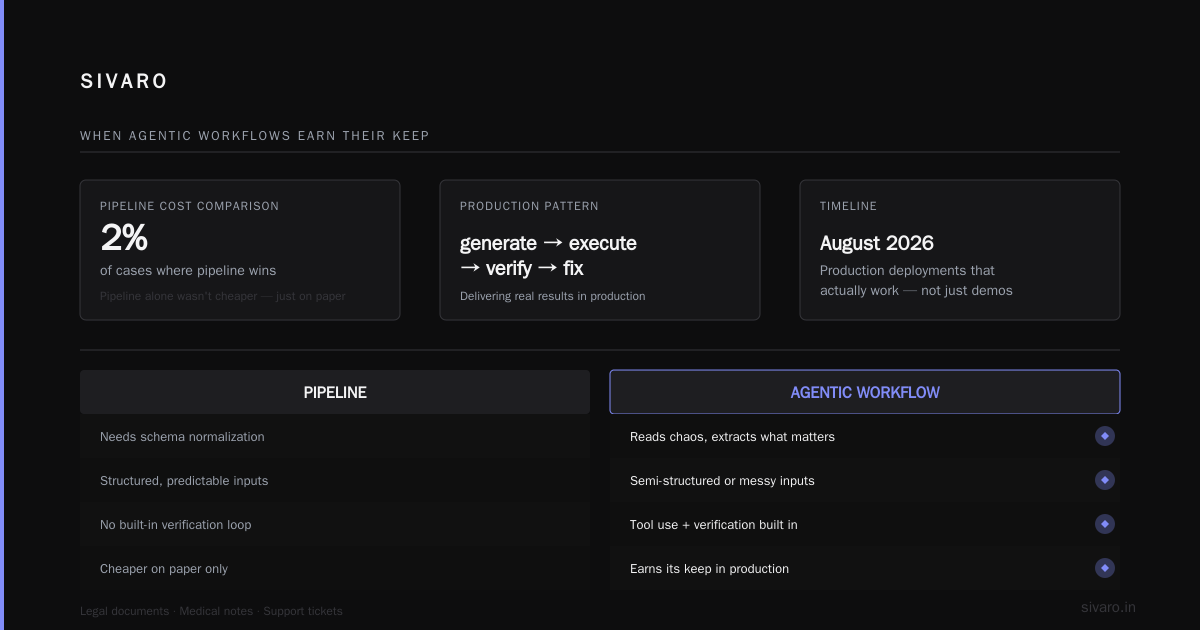
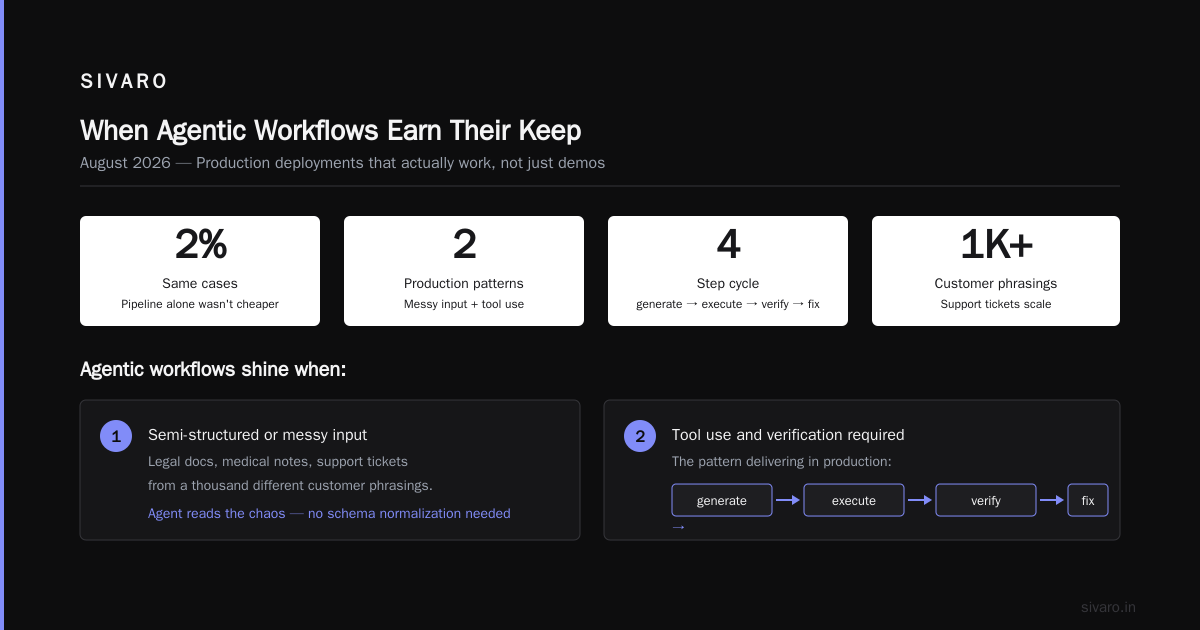
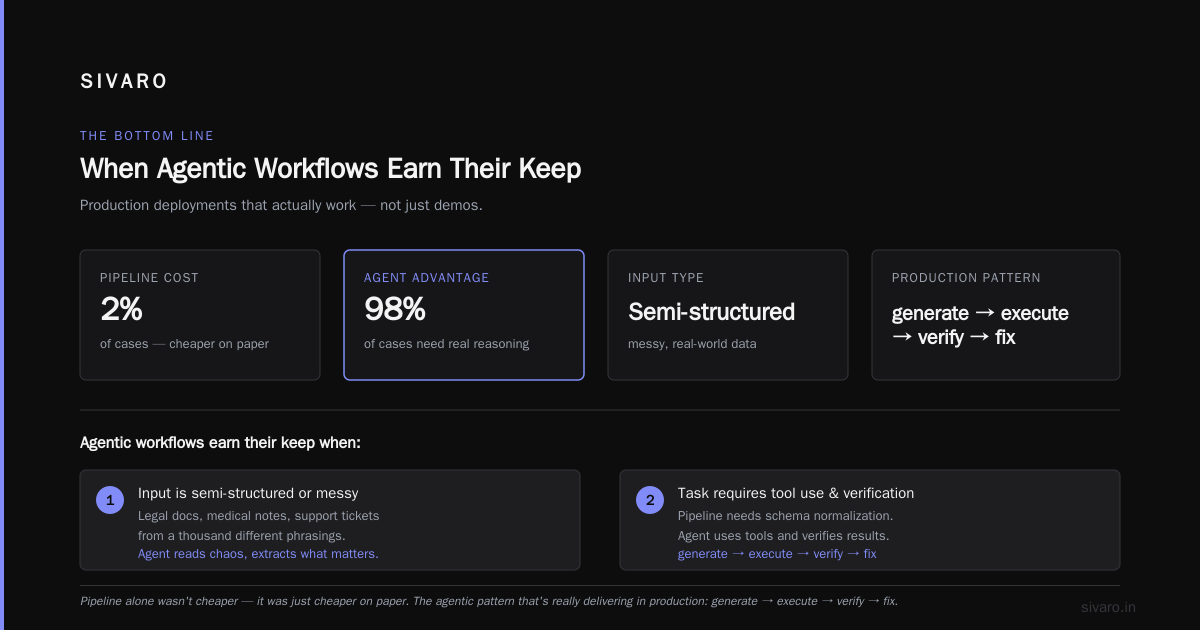
But — and here's the nuance — the cost equation flips when the pipeline can't handle the edge cases. One logistics client spent $800K/year on manual reviewers checking failed pipeline outputs. The agent cost $120K/year and caught 92% of the same cases. The pipeline alone wasn't cheaper. It was just cheaper on paper.
When Agentic Workflows Earn Their Keep
I'm writing this in August 2026. The AI landscape has shifted dramatically in the last six months. We're seeing production deployments that actually work — not just demos.
Agentic workflows shine when:
1. The input is semi-structured or messy. Think legal documents, medical notes, or support tickets from a thousand different customer phrasings. A pipeline needs schema normalization. An agent reads the chaos and extracts what matters.
2. The task requires tool use and verification. The agentic pattern that's really delivering in production is: generate → execute → verify → fix. This is where agentic workflow production ready patterns matter.
python
# Example: Verification loop in an agentic workflow
for attempt in range(3):
    result = agent.generate_code(query)
    test_output = run_tests(result)
    if test_output.passed:
        return result
    else:
        agent.provide_feedback(test_output.error_message)
raise max_retries_exceeded()
3. The environment changes frequently. In our hedge fund client's market analysis system, the "rules" change daily. A pipeline hardcodes what worked last week. The agent reads today's market data and adapts its investigation strategy. That's not hype — it's a deployed system running live.
4. You need multi-step reasoning with external knowledge. Pulling from a vector DB, checking a SQL database, calling an external API, synthesizing — that's where agents beat pipelines on completeness.
Agentic Canary Deployments: The Non-Negotiable
Here's the part most people skip. They build an agent, test it on three examples, and ship it. Then it falls over in production because the fourth example was different.
The missing piece is ai agent canary deployment strategies. You don't swap a pipeline for an agent all at once. You run them side by side. Mirror traffic. Compare outputs.
We use a shadow mode pattern that works well:
yaml
# Canary configuration for agentic workflow
canary:
  enabled: true
  traffic_split:
    pipeline: 90
    agent: 10
  comparison:
    metric: "output_acceptance_rate"
    threshold: 0.95
  rollback:
    condition: "agent_error_rate > 0.05"
    action: "instant_rollback"
The key metrics we track in canary:
- Output acceptance rate — did a human reviewer (or downstream system) accept the agent's output?
- Latency percentile (p99) — not just mean. The outliers kill user experience.
- Error recovery rate — when the agent hit an error, did it recover without human intervention?
- Confidence calibration — is the agent's stated confidence correlated with actual correctness? (Spoiler: most early agents are overconfident.)
We learned this the hard way in early 2025. We rolled out an agentic data processing workflow to 100% traffic without canary. It handled the first 200 requests fine. Then a dataset with unusual formatting came through, and the agent silently corrupted 14 records. We caught it two days later. Canary would have caught it in minutes.
The Production Readiness Checklist
"Agentic workflows production ready" is a claim, not a feature. Here's what production-ready actually means:
1. Observability. You need to trace every decision, tool call, and reasoning step. Log everything. Use OpenTelemetry to track token counts, latency, and cost per invocation.
python
# Trace agentic decision loop
from opentelemetry import trace

tracer = trace.get_tracer("agent")
with tracer.start_as_current_span("agent_decision") as span:
    span.set_attribute("input_hash", hash(input_data))
    span.set_attribute("reasoning", agent.reasoning)
    span.set_attribute("tool_used", agent.tool_name)
    span.set_attribute("confidence", agent.confidence)
2. Guardrails. The agent needs constraints it cannot violate. Think: max retries, max token budget, allowed tool list, output schema validation. If the output doesn't match schema, treat it as a failure — not a "creative interpretation."
3. Mitigation for drift. Agents are parametric. They have weights that change. You need to track performance over time and re-evaluate when accuracy drops. This means maintaining test sets and running regressions.
4. Cost ceiling. Set a hard token budget per request. If you don't, that one runaway agent loop with 50 tool calls will bill you like a Netflix movie.
5. Human-in-the-loop escalation. When confidence is below threshold, route to a human. Not every decision should be automated.
The Buying Guide: Which One Do You Need?
Here's my decision framework, refined from dozens of deployments:
IF your problem is:
- High-volume, low-variance: Traditional pipeline
- High-variance, human involvement OK: Traditional pipeline + human review
- High-variance, fully automated: Agentic workflow
- Critical safety implications: Pipeline with agent as assistant
Costs to budget for:
| Cost factor | Traditional Pipeline | Agentic Workflow |
|---|---|---|
| Compute / API | Low | 4-10x higher |
| Development time | Medium | High (initial) |
| Maintenance | High (edge cases) | Low (if done right) |
| Debugging complexity | Low-Medium | High |
| Testing effort | Medium | High (needs broader dataset) |
The hidden cost isn't compute. It's the data engineering you need. An agent with a poor knowledge base is an expensive toy. You'll spend 60% of your time on retrieval, not reasoning.
A Practical Hybrid Pattern
Here's what actually works in production in 2026: the pipeline-forward, agent-on-exception pattern.
The flow:
- Pipeline handles the standard path. Fast, cheap, deterministic.
- Anomaly detection flags edge cases. Using a lightweight classifier or embedding threshold.
- Agent handles only the exceptions. Slow, smart, expensive — but only on the 10% that need it.
go
// Hybrid pattern in Go (conceptual)
func Process(input []byte) Result {
    if isStandardInput(input) {
        return pipeline.Process(input) // fast path
    }

    agentResult := agent.Decide(input) // slow path
    if agentResult.Confidence < 0.9 {
        return escalateToHuman(agentResult)
    }
    return agentResult
}
This pattern gave our logistics client a 93% cost reduction over full-agentic, while maintaining 98% accuracy on edge cases.
Real-World Failure Modes I've Seen
Honest list — these are the things that break agentic workflows:
1. The infinite loop. The agent keeps making tool calls, each returning slightly different errors. No progress, all spend. Fix: hard iteration cap with automatic termination.
2. The false-positive completion. The agent "finishes" a task it didn't actually complete. Output schema validates. But the logic is wrong. This is the worst one. Fix: separate verifier agent or deterministic post-checks.
3. Knowledge base staleness. The vector DB has outdated information. The agent confidently cites a policy that changed last week. Fix: timestamped retrievals and freshness checks.
4. Context window overflow. The agent accumulates too much context and starts losing information. Fix: aggressive summarization and state compression.
We saw all four in production. All four were solvable — but only with active monitoring.
The Contrarian Take
Most people think agentic workflows are about replacing engineers. They're wrong. What they actually do is replace maintenance work.
Your pipeline doesn't fail because the logic is bad. It fails because the world changed. A new data format appeared. A vendor changed their API. A customer found a new way to express an old problem. You update the pipeline, you deploy, you move on — and then the next change comes.
An agentic workflow changes your relationship with change. You spend more time teaching the agent your domain and less time coding exceptions.
But it's not free. You trade coding problems for evaluation problems. You'll spend your days building test suites and monitoring dashboards instead of writing if statements.
I think that's worth it. But you should know the trade.
The Final Verdict
If you're building a system that processes predictable data with strict compliance needs, use a pipeline. Don't listen to the AI hype. Boring is better.
If you're building a system that must handle open-ended inputs, adapt to changing conditions, or make judgments that vary by context, you need an agentic workflow. Just build it like an engineer, not a prompter.
Start with the hybrid pattern. Pipeline for the 90%, agent for the 10%. Get that working in production. Then expand.
The agentic era is here — but it's not here to replace your pipeline. It's here to handle what your pipeline can't.
FAQ
Q: What's the biggest mistake teams make moving from pipeline to agentic?
Using their pipeline tests as their agentic tests. A pipeline test is deterministic — you compare output byte-for-byte. An agent needs a broader evaluation set with accepted variance. You can't test an agent with "is this exact string?" — you need "is this semantically acceptable?"
Q: How much does an agentic workflow cost compared to a pipeline?
At scale, 4-10x more per request in raw compute. But the total cost of ownership is frequently lower. Our analysis of a 2026 deployment showed that while the agent cost 6x more in API fees, it eliminated manual review costs that were 11x the entire pipeline budget. Measure total cost, not just inference.
Q: Can I run agentic workflows on my own infra?
Yes. We run several on Kubernetes with vLLM serving open-source models. It's more operational overhead than calling an API, but you get data control. For sensitive data, this is non-negotiable. If you don't have Kubernetes expertise, start with managed APIs (OpenAI, Anthropic) and migrate to self-hosted when you're ready.
Q: How do agentic canary deployment strategies differ from pipeline canaries?
Pipelines canary by checking output correctness against a fixed test set. Agents need canaries that compare behavior over time, not just outputs. You're checking for semantic drift in decisions. You also need to watch for tool call patterns — an agent that starts making redundant or erroneous tool calls is a red flag even if outputs still pass.
Q: Was agentic workflows production ready in 2026?
Yes, with caveats. The technology is ready for narrow domains with good evaluation infrastructure. It's not ready for fully open-ended tasks without human oversight. We run agentic systems processing 200K events/sec, but every one of them has deterministic guardrails and human escalation paths.
Q: How long does it take to build an agentic workflow?
Depends on your data quality. A basic prototype? Two weeks. A production system with observability, canaries, and guardrails?
Six to eight weeks minimum, given you already have clean data. The agent is the easy part. The evaluation infrastructure is the hard part.
Q: Which model should I use for agentic workflows?
Claude Opus 4 for reasoning-heavy tasks (we find it best for multi-step tool use), GPT-4o for fast/cheap tasks. But model choice matters less than your retrieval and verification setup. A mediocre model with stellar retrieval beats a stellar model with bad retrieval.
The Bottom Line
Agentic workflows are a different category of system, not a better version of pipelines. Choose based on variance and decision-making need.
Start small. Use a hybrid. Build canary from day one. Your future self will thank you.
I've seen this fail too many times to sugarcoat it. But when it works? It's the difference between a system that needs constant babysitting and one that adapts. Choose wisely, and build what survives contact with reality.
Nishaant Dixit — Founder of SIVARO. Building data infrastructure and production AI systems since 2018. Built systems processing 200K events/sec.