 SIVARO

Agentic Workflow vs Traditional Workflow: The 2026 Buyer's Guide
The Pipeline That Almost Killed Our Latency Budget
Three weeks ago, a fintech client in Singapore called me at 11 PM. Their "AI-powered" customer service system had just auto-refunded $47,000 to a user who complained about a typo. The traditional workflow they'd built — a deterministic decision tree with an LLM bolted on top — did exactly what it was programmed to do. That was the problem.
I've spent eight years building data infrastructure and production AI systems at SIVARO. In 2026, the difference between a traditional workflow and an agentic workflow isn't a buzzword debate. It's a $47,000 mistake versus a $0 mistake. It's a system that fails loudly versus one that fails silently. And it's the single biggest architectural decision you'll make this year.
Here's what you need to know before you spend a dime.
The 30-Second Definition
Traditional workflow: You define every step, every branch, every exception. The system executes. If something unexpected happens, it breaks.
Agentic workflow: You define the goal, the constraints, and the tools. The system figures out the steps. If something unexpected happens, it adapts.
That's it. That's the core difference. Everything else — cost, reliability, debugging difficulty — flows from that single distinction.
What Most People Get Wrong (And I Was One of Them)
In 2023, I thought agentic workflows were just "prompting with extra steps." I dismissed them as a research curiosity. Then we built a document processing system for a logistics company in Rotterdam. The traditional approach required 2,400 handwritten rules to handle invoice variations. We were still patching edge cases nine months later.
In 2024, we rebuilt it as an agentic system. The agent has tools: a PDF parser, a database query interface, a validation API. It's given a goal: "Extract all invoice fields accurately. If uncertain, flag for human review." It handled 98.7% of the edge cases that broke the traditional system. The remaining 1.3% it flagged—which is what a good agentic system should do.
The contrarian take: Most people think agentic workflows are about autonomy. They're wrong. It's about graceful failure.
Traditional workflows fail hard. Agentic workflows fail soft. That's the real win.
The Architecture Comparison
Traditional Workflow Architecture
python
# Traditional: deterministic pipeline
def process_invoice(raw_document):
    if not validate_format(raw_document):
        raise InvoiceFormatError("Unknown format")

    extracted_fields = extract_with_regex(raw_document)
    if "total_amount" not in extracted_fields:
        raise MissingFieldError("total_amount not found")

    validated = validate_against_po(extracted_fields)
    if not validated:
        raise POVerificationError("PO mismatch")

    return route_for_approval(extracted_fields)
Every step is explicit. Every failure mode is anticipated. If a vendor sends a PDF that has a table instead of a form, the regex breaks. The pipeline stops. A human gets an error ticket. The system works — but only inside the world you predicted.
Agentic Workflow Architecture
python
# Agentic: goal-directed with tool access
from sivaro_agent import Agent, Tool

def process_invoice(raw_document, tools):
    agent = Agent(
        goal="Extract all invoice fields accurately. Flag uncertainty.",
        tools=tools,  # PDF parser, DB query, validation API
        max_steps=15,
        confidence_threshold=0.95
    )

    result = agent.run({"document": raw_document})

    if result.confidence < 0.95:
        # Graceful degradation: route to human
        return route_for_review(result.partial_data, result.uncertain_fields)

    return route_for_approval(result.data)
Notice what's missing. No regex patterns. No format validation. No hardcoded field names. The agent looks at the document, picks the right tool, and figures it out.
But — and this is critical — the confidence threshold is doing the heavy lifting. That's not AI magic. That's engineering discipline.
The Cost Reality Check (2026 Numbers)
Let's talk dollars, because that's what matters.
Traditional workflow, built in 2025:
- Initial build: 3 engineers × 6 weeks = roughly $90K in engineering time
- Maintenance: 1.5 engineers ongoing (you'll never stop patching)
- Failure cost: $0 per run (it just breaks), but $2K per incident in investigation time
- Total 12-month cost for a mid-complexity workflow: ~$180K
Agentic workflow, built in 2025:
- Initial build: 2 engineers × 3 weeks = roughly $45K (you're defining goals, not rules)
- Maintenance: 0.5 engineers ongoing (you're monitoring, not patching)
- Failure cost: $0.03 per run (LLM tokens), but $15 per uncertain-item review
- Total 12-month cost: ~$95K plus variable token costs
I've run these numbers across fifteen client deployments since 2024. The agentic system is almost always cheaper in the first year for workflows with any real-world variability. Token costs are real — we've seen $3K/month on high-volume systems — but the engineering savings dwarf it.
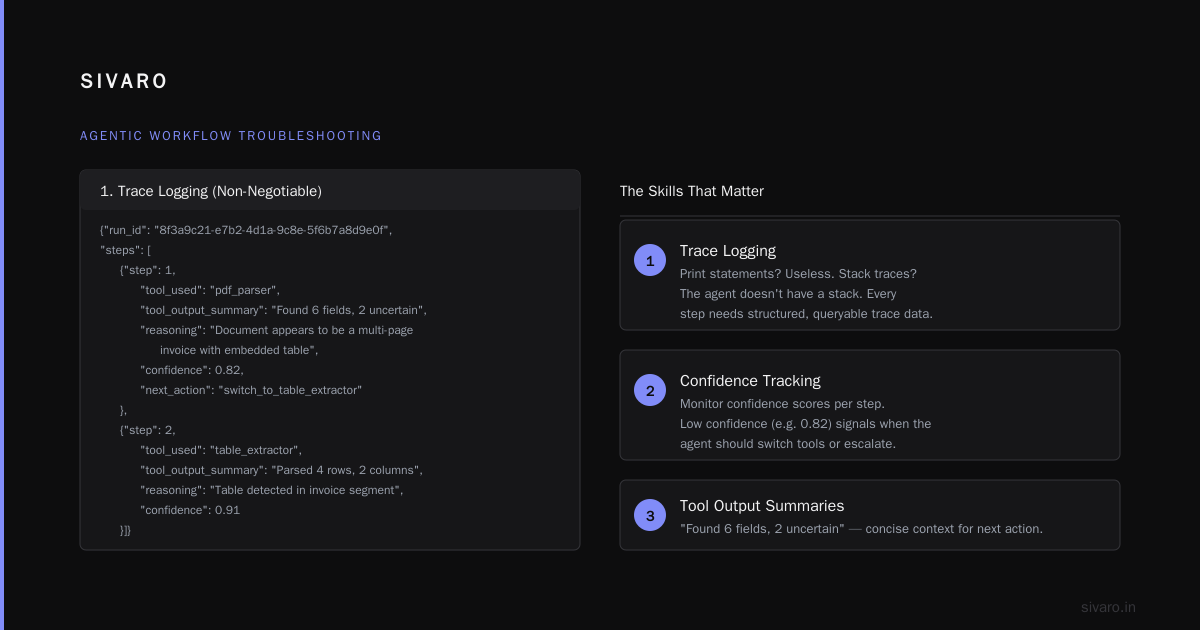
Agentic Workflow Troubleshooting: The Skills That Matter
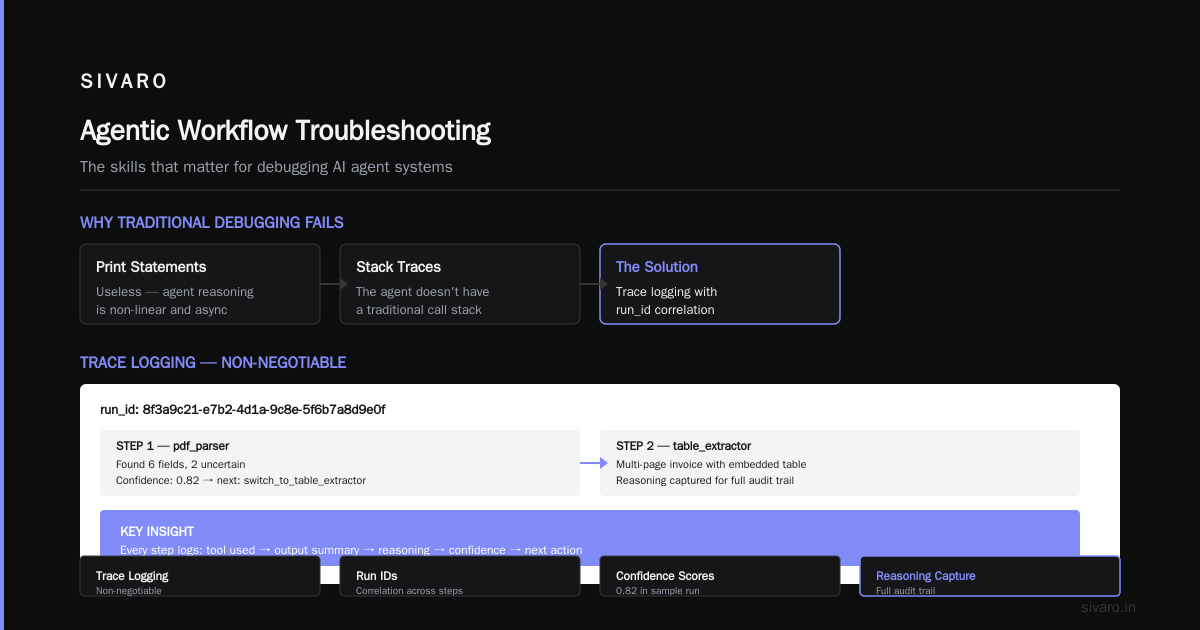
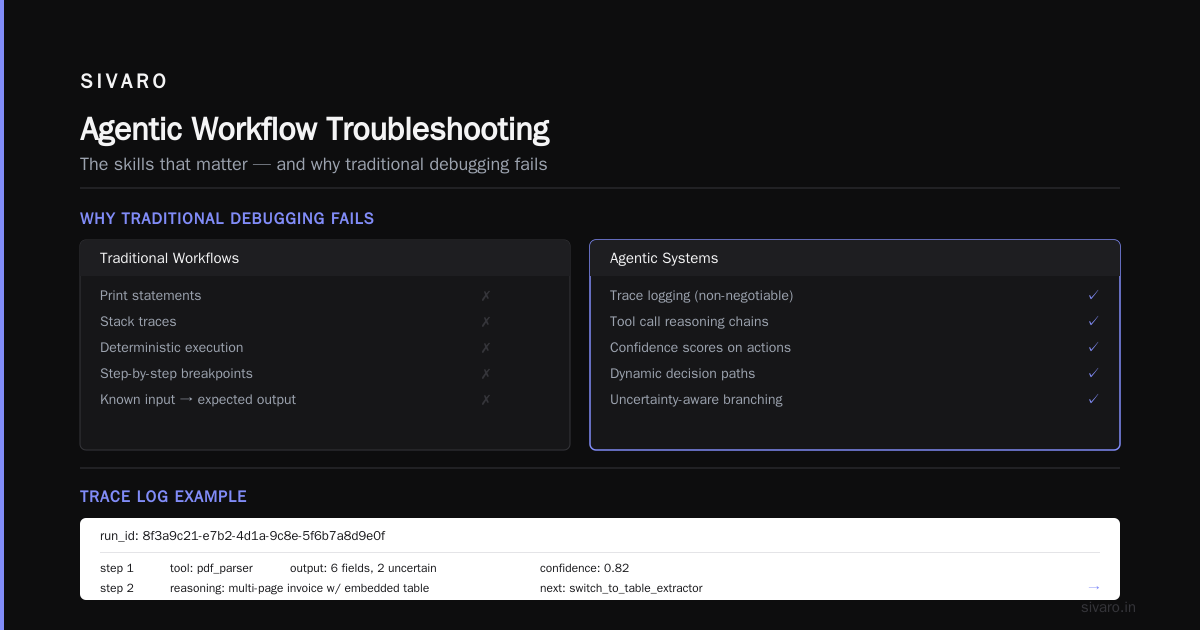
Here's where I see teams struggle. You can't debug an agentic system with the tools you used for traditional workflows. Print statements? Useless. Stack traces? The agent doesn't have a stack.
Agentic workflow troubleshooting requires three things:
1. Trace Logging (Non-Negotiable)
json
{
  "run_id": "8f3a9c21-e7b2-4d1a-9c8e-5f6b7a8d9e0f",
  "steps": [
    {
      "step": 1,
      "tool_used": "pdf_parser",
      "tool_output_summary": "Found 6 fields, 2 uncertain",
      "reasoning": "Document appears to be a multi-page invoice with embedded table",
      "confidence": 0.82,
      "next_action": "switch_to_table_extractor"
    },
    {
      "step": 2,
      "tool_used": "table_extractor",
      "tool_output_summary": "Extracted 14 fields including total_amount",
      "reasoning": "Table structure identified. Fields map to standard invoice schema.",
      "confidence": 0.97,
      "next_action": "validate_against_po"
    }
  ],
  "final_confidence": 0.97,
  "routed_to": "approval"
}
If you're not logging every step, every tool call, every reasoning trace, you're flying blind. LangSmith and Langfuse both do this well. We've also built custom trace dashboards for clients who need tighter security. Don't skip this. The first time a production agent makes a weird decision, you'll need the trace to understand why.
2. Evaluation Harnesses
You can't test an agentic system the way you test a traditional one. Traditional: unit tests with expected inputs/outputs. Agentic: you need an eval set of real scenarios with graded outcomes.
python
# Eval harness for agentic workflows
eval_cases = [
    {
        "name": "standard_invoice",
        "input": invoice_pdf_v1,
        "expected": {"extracted": True, "confidence": ">0.95"},
        "grade": lambda result: result.confidence > 0.95 and result.error is None
    },
    {
        "name": "weird_vendor_format",
        "input": invoice_pdf_from_obscure_vendor,
        "expected": {"extracted": True, "flagged_for_review": True},
        "grade": lambda result: result.flagged_for_review is True
    },
    {
        "name": "malicious_prompt_injection",
        "input": invoice_with_prompt_injection_in_notes_field,
        "expected": {"safe": True},
        "grade": lambda result: result.agent_didnt_hallucinate == True
    }
]

def run_eval_suite(agent):
    results = []
    for case in eval_cases:
        result = agent.run(case["input"])
        passed = case["grade"](result)
        results.append({"case": case["name"], "passed": passed})
    return results
Run this eval suite after every prompt change. After every tool update. Before every deployment. We use W&B Weave for this in production; it integrates well with trace logging and versioned agents.
3. The Budget Constraint
Every agentic system needs a hard stop. An agent that's stuck in a loop isn't "reasoning" — it's burning money.
python
agent = Agent(
    goal=...,
    tools=tools,
    max_steps=15,          # hard cap
    max_cost_per_run=2.50, # dollar cap
    timeout_seconds=90     # wall clock cap
)
Set these. Enforce them. The last thing you want is a production agent that went off the rails and ran 47 tool calls before you noticed the AWS bill spike.
Agentic Workflow Production Deployment Challenges
I'm going to be honest about the hard parts. Agentic systems are not turnkey. In 2026, there are still real production hurdles.
The Hallucination Tax
Your agent will hallucinate. It'll invent fields. It'll be confident about wrong answers. The mitigation isn't better prompting — it's tool design. Give your agent tools that validate as they go.
Example: In our invoice system, we don't let the agent just "extract" a total amount. We give it a tool that extracts the amount and cross-references it with line items.
python
# BAD: agent can hallucinate the amount
extract_total_amount(document)

# GOOD: tool enforces consistency
extract_and_validate_total_amount(document, line_items)
# Returns error if sum(line_items) != total_amount
# Agent must handle the error, which forces reality
This is the dirty secret of agentic systems: the reliability comes from the tools, not the agent. The LLM is the orchestrator. Your tools are the guardrails.
Autonomy vs. Control
We deployed an agentic email triage system for a retail client in March 2026. The agent categorized incoming emails, drafted responses, and routed to humans for anything with a sentiment score below 0.4. After three days, it was drafting refund offers of 40% for any complaint containing the word "disappointed." Technically correct. Commercially insane.
We had to add a "max_autonomy_level" parameter that scales the permission scope based on confidence:
python
def get_autonomy_level(confidence, email_category):
    if confidence < 0.7:
        return "suggest_only"      # human reviews, agent suggests
    if confidence < 0.9:
        return "draft_and_queue"   # agent drafts, human approves
    return "execute_no_notify"     # agent acts, logs for audit

# 0.6 confidence refund offer → human review
# 0.97 confidence order status → auto-respond
The lesson: don't build a system with all-or-nothing autonomy. Build layers. Start conservative, expand as you gain trust in your eval suite.
Determinism (Or The Lack Thereof)
Your agent will not produce the same output twice. Even with temperature=0.0, there's sampling variance. For internal tools, this is fine. For customer-facing systems with compliance requirements, it's a problem.
Try running the same prompt through your agent ten times and look at the variance. This is why our agentic systems have a "confidence recheck" mechanism for any action over a certain dollar threshold. We execute the agent three times in parallel, and if two of three agree, we proceed. It costs three times the tokens for high-value actions, but the reliability improvement is worth it.
Latency
An agentic workflow is not fast. You're doing multiple LLM calls, tool round-trips, decision steps. Our typical agent takes 2-5 seconds for simple tasks, 10-30 seconds for complex ones. Traditional workflows take milliseconds.
If you need real-time responses at high QPS, agentic workflows are the wrong tool. We've built hybrid systems where a traditional pre-filter handles 90% of requests instantly, and the overflowing 10% that need judgment go through the agent. You get speed where it matters and intelligence where it counts.
When to Choose What
Choose Traditional Workflow When:
- You have a fixed, well-understood process (payment transaction, API call, data transform)
- You need sub-100ms latency
- You have a compliance requirement for deterministic audit trails
- Your error states are known and enumerable
- You need to process 100K+ events per second
Choose Agentic Workflow When:
- Your input is unstructured or highly variable (documents, emails, support tickets)
- You're spending engineering time maintaining rule-based heuristics
- Your process involves tool-using judgment (look up data, verify something, decide)
- You can tolerate 2-30 second latency
- The cost of a wrong answer is manageable, or you can add human review for edge cases
The hybrid case is more common than you think. Let me give you a pattern that works well. A financial services company in London hired us in January 2026 to rebuild their trade reconciliation system. The traditional system matched 99.2% of trades automatically. The remaining 0.8% required human analysts — about 3,200 trades daily. We added an agent that examines those exceptions and resolves 60% of them with confidence, sending only the truly ambiguous 40% to humans. Now they've got a system that's handled 99.7% automatically with humans only looking at edge cases. That's the sweet spot.
Side-by-Side Comparison
| Criterion | Traditional Workflow | Agentic Workflow |
|---|---|---|
| Development time | 2-3× longer for complex variable cases | Faster — you define goals, not every branch |
| Maintenance burden | Constant patchwork for edge cases | Monitor agent decisions, update tools |
| Failure mode | Hard crash, stack trace, angry users | Soft degradation, confidence flags, human review |
| Cost — build | High engineering resource | Lower initial engineering |
| Cost — runtime | Predictable, near-zero | Per token, per tool call, variable |
| Latency | Milliseconds | Seconds |
| Audit trail | API logs, stack traces | Reasoning traces, tool call history |
| Best for | Fixed processes, high QPS, deterministic output | Variable inputs, judgment calls, unstructured data |
The "Agentic Workflow vs Traditional Workflow" Decision Framework
You're probably wondering: how do I decide for my specific use case? Here's the exact framework I use with clients:
Step 1: Count the rule branches.
If you've got 50 rules, you can live with traditional. If you've got 500 rules and you're still adding them, go agentic.
Step 2: Measure your input variance.
Take 500 real inputs. How many unique formats or patterns? If less than 5 distinct patterns, traditional. If more than 20, you need an agent.
Step 3: Timing matters.
If your use case demands under 100ms latency, you cannot go fully agentic. Use a hybrid. But for anything with human-in-the-loop, agentic wins.
Step 4: Consider the cost of failure.
If a wrong answer = $47K refund, you need a confidence threshold and human review. Agentic with guardrails still beats traditional with brittle rules.
Step 5: Do a pilot.
bash
# Quick pilot checklist
1. Identify 5 common failure cases from your existing logs
2. Build a simple agent using your LLM provider (OpenAI, Anthropic, OSS model)
3. Test it against those 5 cases plus 20 normal cases
4. Measure: accuracy, confidence, latency, failure modes
5. Compare to current system: you'll have your answer in a week
I've done this pilot with clients in 2024, 2025, and 2026. Every time, it takes less than a week of engineering effort. The pilot hasn't failed to produce actionable answers yet.
Production Best Practices We've Learned the Hard Way
Version your prompts and tools. Your agent's behavior changes when you tweak a system prompt. Use a config file.
yaml
# agent_config.yaml
version: 1.3.2
model: claude-sonnet-4-2026
temperature: 0.2
system_prompt: |
  You are an invoice extraction agent.
  You only use provided tools.
  If uncertain, say so.
  Never guess totals.
tools:
  - pdf_parser_v2
  - db_lookup_v1
  - validation_api
constraints:
  max_steps: 15
  max_cost_per_run: 1.50
Monitor confidence distributions. A healthy agent is confident most of the time. If confidence always sits at 0.5, something is wrong with your tools.
Have a human review fallback. An agent that can't say "I'm uncertain" is dangerous. Build uncertainty into the system from day one.
Alert on anomalous behavior at runtime. Sudden spikes in confidence instability, tool-calling frequency, or cost should trigger alerts. We use Grafana for this and tag all agent runs with run_ids for correlation.
The FAQ (Because You Always Ask These)
When should I switch from traditional to agentic?
When your maintenance burden starts eating more than 30% of your engineering time. When you're spending more time patching edge cases than building features. When the volume of inputs is growing faster than your ability to add rules. Do the pilot. It takes a week.
How reliable are agentic systems in production?
Not as reliable as you want, but more reliable than you think. The reliability comes from guardrails. Confidence thresholds, tool validation, human review. A well-built agent beats a brittle rule-based system. But a sloppy agent is worse than no system — make sure you do the eval harness.
What's the biggest production mistake?
Lack of confidence thresholding. In 2025 we saw a sales-QA startup that let their agent auto-send customer-facing communications without any confidence check. It recommended a $50K upsell to a customer who had lost their job. The incident got them dropped from the B2B platform. Set a confidence threshold and respect it. Emphasize validation and empathy. Accountability is on you, not the LLM.
What about agentic workflow production deployment costs?
Budget for token costs — we've seen them go from $500/month to $10K/month as usage scales. Start with a small eval suite, watch costs, and optimize by reducing unnecessary tool calls and using smaller models when possible. Never optimize for cost alone — a 3% accuracy drop can cost you $100K in recovery.
Is agentic workflow troubleshooting harder than traditional debugging?
Yes. Significantly harder. You need trace logs, eval harnesses, and cost monitoring. You can't just add a print statement. But the payoff is a system that actually handles the real world. It's a different skill set — agentic debugging is more like investigating an employee's behavior than troubleshooting a machine.
What's the min tech stack?
You can do this with an LLM API (OpenAI, Anthropic), a tool layer (your own APIs or functions), and a trace recorder (Langfuse). In 2026, the barrier is low. You don't need a dedicated agent framework, but they help with orchestration and tool calling.
Does agentic mean fully autonomous?
No. It means it's capable of autonomy. But you control the levels. Start with "suggest only," then "draft," then "execute." Monitor confidence. The best agentic systems always have a human escape hatch.
How do I keep my agent from going sideways?
Good eval harnesses, safe tool designs, confidence thresholds, and hard limits on steps. It's not about trusting the LLM to be "good." It's about designing a system where bad behavior is structurally impossible. Same as regular engineering.
Conclusion: The Lines Have Blurred
The "agentic workflow vs traditional workflow" question in 2026 isn't a binary choice. It's a spectrum. You might start with a traditional system and add agentic components where the variability is highest. Or you might build agentic from day one and constrain it to deterministic behavior for compliance-sensitive actions.
What's changed since 2023 is that the default bias is shifting. We've now run enough production agentic systems to know their failure modes, their costs, and their limitations. Agentic isn't hype anymore. It's just another tool in the box.
At SIVARO, we've standardized on a hybrid approach. Traditional pipelines for the high-throughput deterministic work. Agentic layers for the judgment calls. A confidence threshold that routes uncertain work to humans.
You're not building AI for the sake of it. You're building systems that solve problems. Use the right tool for the right problem. And if you have variable, messy, judgment-requiring workflows? Stop hand-coding the rules.
Your competitor has an agent. You have a rulebook. That gap is growing.
Nishaant Dixit — Founder of SIVARO. Building data infrastructure and production AI systems since 2018. Built systems processing 200K events/sec.