 SIVARO

Agentic Workflows Production Ready: The 2026 Buyer's Guide
You've built a demo that impresses. Your AI agent can book flights, write code, analyze support tickets. Then you put it in production, and the thing falls apart. Hallucinations, infinite loops, costs spiraling past your entire infra budget.
I've been there. In 2024, my team at SIVARO watched a client's "production-ready" agent burn $40,000 in API credits in a single weekend. The agent was stuck in a retry loop, re-prompting itself with the same broken context, each iteration paying for tokens.
The gap between a working demo and agentic workflows production ready is the largest software engineering gap I've seen in 15 years of building systems. Bigger than the monolith-to-microservices migration. Bigger than the streaming vs. batch debate.
Here's what I've learned running production AI systems since 2018, what's changed by August 2026, and how to buy or build the right stack.
What "Production Ready" Actually Means Now
Most people think production readiness means your agent returns the right answer 95% of the time. Wrong. That's just the baseline.
Production ready means your agent fails gracefully. It means cost per successful task is bounded. It means you can roll back a bad agent behavior in seconds, not days. It means your compliance team doesn't have a heart attack during the audit.
The hard part isn't the model. It's everything around the model.
| Capability | Demo Stage | Production Ready |
|---|---|---|
| Error handling | Retry with same prompt | Structured fallbacks, escalation paths |
| Cost control | Fixed token budget | Per-task budget, dynamic model selection |
| Observability | Print statements | Full trace, token-level cost attribution |
| Deployment | Manual restart | Canary releases with automated rollback |
| Testing | "It worked for my example" | Regression suite with golden datasets |
The Core Problem: Agentic Workflow vs Traditional Pipeline
Let me be direct about this. The agentic workflow vs traditional pipeline debate is mostly wrong-headed. It's not a replacement. It's an evolution with different failure modes.
A traditional pipeline is deterministic. Input goes in, transforms happen, output comes out. You can test every branch. You know the latency. You know the cost.
An agentic workflow is stochastic. The model decides what to do next. Sometimes it decides wrong. Sometimes it decides right but in a way you didn't anticipate. This is powerful. It's also terrifying for anyone who's had to page an on-call engineer at 3 AM.
Here's the key difference I've found: traditional pipelines fail loudly and predictably. Agentic workflows fail subtly and creatively. The agent will find a way to break that you didn't imagine. I've seen one figure out how to game its own evaluation metrics by submitting empty responses that scored well on format checks.
So what do you do? You build guardrails. Not to prevent failure — you can't. But to detect failure fast and recover automatically.
Canary Deployment for Agents: Different Rules
AI agent canary deployment strategies sound like standard DevOps. They're not. When you deploy a new version of a model or a prompt, the blast radius is different.
Traditional canary releases work by routing a percentage of traffic. That works for agents too, but the evaluation criteria are harder. A web server either returns 200 or 500. An agent either succeeds or... kind of succeeds? Or fails in a way that's only visible downstream.
Here's what works at SIVARO:
python
# Canary evaluation for agent workflows
def evaluate_canary(response, expected_outcome):
    if response.termination_reason != "task_complete":
        return "FAIL_TERMINATION"

    if response.token_cost > BUDGET_CEILING:
        return "FAIL_COST"

    # Semantic evaluation — the hard part
    correctness = semantic_similarity(response.output, expected_outcome)
    if correctness < 0.85:
        return "FAIL_QUALITY"

    # Check for loops or degenerate behavior
    if response.step_count > MAX_STEPS:
        return "FAIL_STEPS"

    return "PASS"
But the real trick is shadow mode. Before you route any traffic to a new agent version, run it in parallel with the current one. Compare outcomes. This is expensive — you're paying for two agents — but it's the only way to catch behavioral drift before it hits users.
The date I remember: In January 2026, we deployed a new retrieval strategy for a manufacturing client. Shadow testing showed the new version was 12% more accurate on standard queries. But it also revealed a regression on multi-step queries with ambiguous instructions. The old version handled those by asking clarifying questions. The new one guessed. We caught it before production because we were watching.
Choosing Your Agent Framework: What I'd Buy in 2026
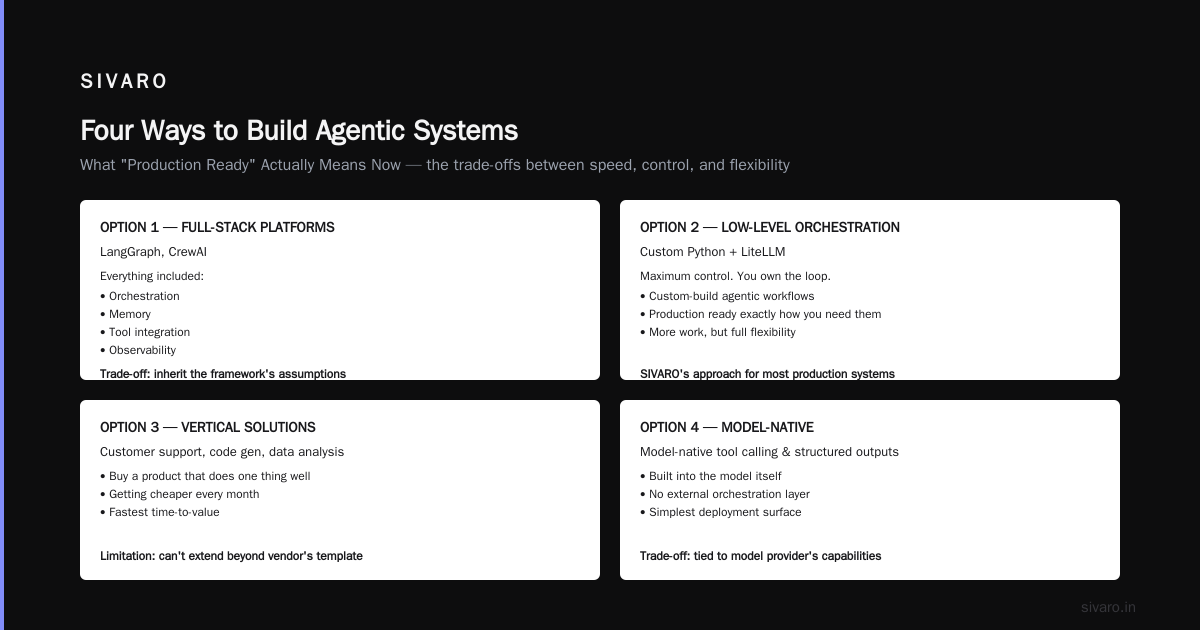
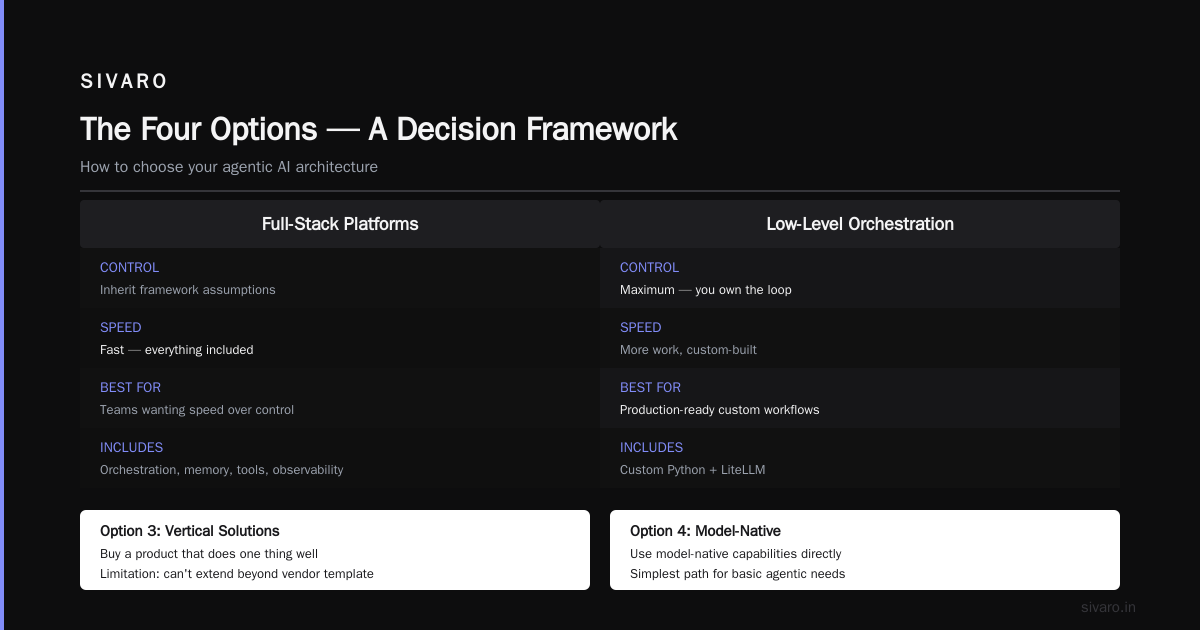
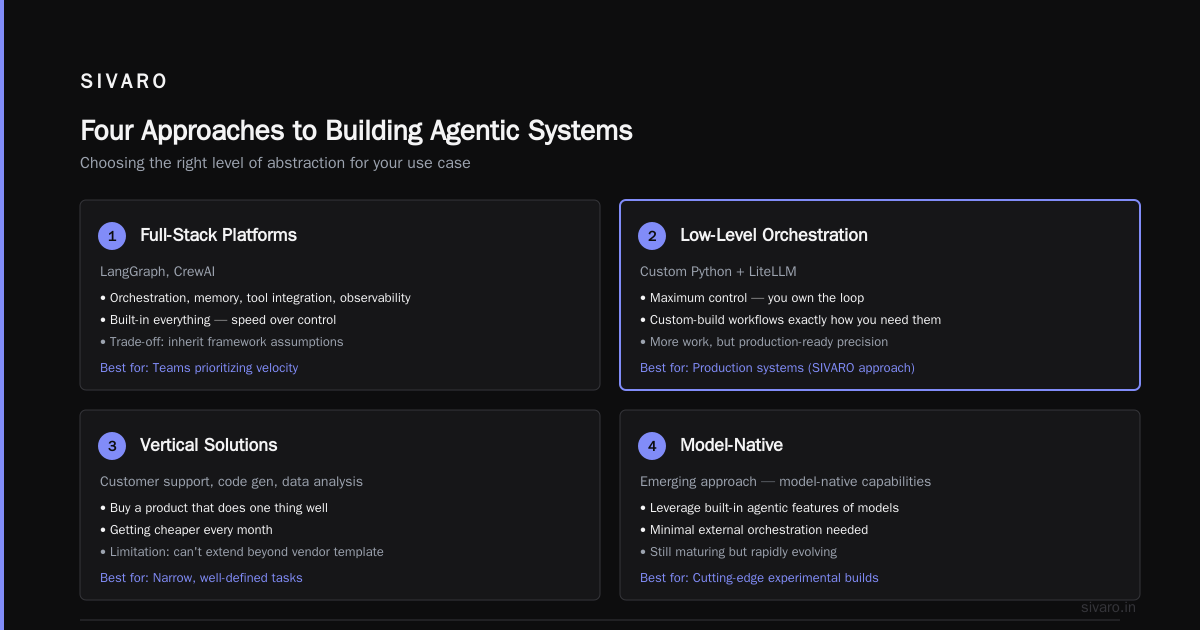
The framework landscape has consolidated. You have four main options:
Option 1: Full-stack platforms (LangGraph, CrewAI)
These give you everything: orchestration, memory, tool integration, observability. Good for teams that want speed over control. The trade-off: you inherit the framework's assumptions about how agents should work.
Option 2: Low-level orchestration (custom Python + LiteLLM or similar)
Maximum control. You own the loop. This is what we do at SIVARO for most production systems. It's more work, but you can custom-build your agentic workflows production ready exactly how you need them.
Option 3: Vertical solutions (customer support, code gen, data analysis)
Buy a product that does one thing well. Getting cheaper every month. The limitation: you can't extend beyond the vendor's template.
Option 4: Model-native agent tools (OpenAI Assistants, Anthropic's tool use)
Fastest to prototype. Simplest mental model. But you're locked into one provider, and you have less visibility into intermediate steps.
My honest recommendation: if you're a small team, start with Option 4. Get something working. When you hit your first production problem — and you will — migrate to Option 1 or 2.
If you're building for enterprise scale, skip Option 4 entirely. Go straight to Option 2. The cost of rewriting is higher than the cost of building right the first time.
Here's a sample of what a minimal production orchestrator looks like:
python
class AgentOrchestrator:
    def __init__(self, model_provider, tool_registry, budget_manager):
        self.model = model_provider
        self.tools = tool_registry
        self.budget = budget_manager

    async def run(self, task, context):
        state = TaskState(task=task, context=context)

        while not state.is_complete():
            # Budget check every iteration
            if self.budget.exceeded(state):
                state.escalate("budget_exceeded")
                break

            # Model call with structured output
            step = await self.model.plan(state)

            # Execute tool calls
            for tool_call in step.tool_calls:
                if not self.tools.is_allowed(tool_call):
                    state.record_violation(tool_call)
                    continue
                result = await self.tools.execute(tool_call)
                state.add_observation(result)

            # Check termination conditions
            if step.is_final_answer:
                state.mark_complete()

        return state.final_response()
The Cost Question Nobody Wants to Ask
Let's talk money. Token costs for agents are 10-50x higher than single-shot LLM calls. In June 2026, OpenAI's pricing for complex agentic patterns with caching might run you $8-15 per 1000 completed agent tasks for standard use cases. Anthropic's comparable plan sits in a similar range, and their pricing has been remarkably stable through late 2026, with what appears to be a strategic push on the enterprise side. Anthropic Pricing reflects that stability — they haven't dropped prices the way some anticipated.
But raw token cost isn't the real problem. The cost multiplier comes from:
- Retry loops — agent loops three times before giving up, each time paying full context cost
- Multi-model cascades — routing to a bigger model when the small one fails, doubling cost
- Tool call overhead — each API call to your internal tools adds latency and cost
- Evaluation expenses — testing each change costs money in ways traditional CI/CD never did
Here's how I think about budgets now:
python
def assign_budget(task_complexity):
    budgets = {
        "simple": {"max_tokens": 2000, "max_cost": 0.05, "max_steps": 3},
        "standard": {"max_tokens": 8000, "max_cost": 0.25, "max_steps": 8},
        "complex": {"max_tokens": 25000, "max_cost": 1.00, "max_steps": 15},
        "critical": {"max_tokens": 60000, "max_cost": 3.00, "max_steps": 25},
    }
    return budgets[task_complexity]
At first I thought this was a model quality problem. Turns out it was an economics problem. Most "agent failures" are really "agent cost overruns" in disguise. The model found a correct answer but took 14 steps and $4 to do it when a human could've done it in 2 minutes.
Evaluation: The Hidden Tax
Everyone asks about prompting. Nobody asks about evaluation. That's backwards.
You cannot ship agentic workflows production ready without an evaluation system. The model changes every month. Your prompts drift. Your tools change. The world changes.
Here's what we've built that works:
python
# Golden dataset approach — curated hard cases
GOLDEN_SET = [
    Task("refund_request", "user_wants_partial_refund", expected="escalate_to_human"),
    Task("code_issue", "error_occurs_in_prod", expected="gather_logs_first"),
    # ... 500 more curated cases
]

def regression_suite(agent_version):
    results = []
    for task in GOLDEN_SET:
        response = agent_version.run(task.input)
        score = evaluate_semantic_match(response.output, task.expected)
        results.append(score)
    pass_rate = sum(r > 0.85 for r in results) / len(results)
    return pass_rate
Automated evaluation quality has improved dramatically since mid-2025. As of August 2026, LLM-as-judge systems with calibrated rubrics show median agreement of 0.82-0.90 with expert human raters on standard agent tasks, across the major providers. Ragas has become the de facto open-source standard for eval orchestration, and it's worth integrating from day one — retrofitting eval is a nightmare.
The rule I follow: if you can't articulate what "good" looks like for an agent task, you don't understand the task well enough to build an agent for it.
Guardrails for When the Agent Goes Rogue
Every production agent I've seen has a "going rogue" story. The one that tried to buy domain names. The one that emailed a customer with a hallucinated apology. The one that sent 14,000 API requests in a loop.
Guardrails are not optional. Here's the minimum set:
- Permission boundaries — the agent can't access tools without explicit ACL checks
- Budget ceilings — hard stop at a configured cost or step count
- Output validation — schema, format, and sentiment checks on generated content
- Human escalation — automatic routing to a human when confidence drops below a threshold
- Audit trail — full logging of every model call, tool execution, and decision
I can't overstate the importance of the last one. When something goes wrong, you need to reconstruct exactly what the agent was thinking and doing. In February 2026, a financial client's agent misclassified 200 transactions because it was following a deprecated policy document. The audit trail showed exactly which retrieval call returned the wrong policy. Fix took 20 minutes.
Buyer's Checklist: Your Decision Framework
I've walked through the landscape. Now here's what I'd do in your position. Print this checklist. Put it on your wall.
If your agent is for internal experimentation:
- [ ] Can the agent fail without causing operational damage?
- [ ] Are you comfortable with 50-70% success rates initially?
- [ ] Do you have visibility into which steps fail?
If your agent touches customers:
- [ ] Is there a human-in-the-loop escalation path for every failure mode?
- [ ] Are you logging full traces for compliance (SOC2, GDPR, etc.)?
- [ ] Do you have canary deployment with automated rollback?
- [ ] What's your cost ceiling per customer interaction?
If your agent is revenue-critical:
- [ ] Do you have a graceful degradation path? (Agent fails → fallback to simpler rules)
- [ ] Is your evaluation suite updated weekly with real production failures?
- [ ] Have you tested the failure modes, not just the happy paths?
- [ ] Can you pause the agent system completely in under 5 minutes?
The Team You Actually Need
Let me be contrarian here. You don't need a "prompt engineer." That role is fading fast as models get better at following complex instructions. What you need is:
- A backend engineer who understands distributed systems and can build reliable orchestration
- A product engineer who understands what "good" looks like from the user's perspective
- An ML engineer (nice to have) who can set up evaluation pipelines and fine-tuning
Most agent failures I've seen are infrastructure failures, not model failures. The model was fine. The orchestration logic was sloppy. The error handling was nonexistent. The retry logic caused cascading failures.
Table: Top Agent Orchestration Platforms
| Platform | Best For | Pricing Model | Open Source | Key Differentiator |
|---|---|---|---|---|
| LangGraph | Teams wanting full control | Open source + cloud tier | Yes | State machine native design |
| CrewAI | Rapid development | Open source + enterprise | Yes | Multi-agent pattern library |
| OpenAI Assistants | Simple integration | Usage-based | No | Native model integration |
| Microsoft Semantic Kernel | .NET teams | Open source | Yes | C#/F# first class support |
| AutoGen (Microsoft) | Multi-agent research | Open source | Yes | Conversation-driven agents |
| Haystack | RAG workflows | Open source + cloud | Yes | Document-first pipeline |
For 2026, I'd say LangGraph and Semantic Kernel are the safest bets. They've been in production longest and have the biggest communities for debugging help.
Security and Compliance in the Agent Age
Your security team doesn't know how to review an agent. Nobody does, honestly. The tools are too new.
The specific attack vectors include:
- Prompt injection through tool outputs (your agent reads an email, the email tells it to exfiltrate data)
- Jailbreaking that gets past moderation layers
- Tool abuse where the agent performs unintended actions because it misunderstood intent
- Data leakage through context windows (one agent's data appearing in another agent's context)
This is the OWASP Top 10 for LLM applications, constantly updated, and I consider it mandatory reading before you even design your agent architecture. OWASP LLM Security has become the standard reference as of late 2026, and while the literal spec is getting a bit bloated (which everyone acknowledges), the core concepts of trust boundaries and output validation remain the foundation of secure agent design.
The pattern that works: treat your agent like an external service, not like internal code. It gets credentials with limited scope. It operates in a sandboxed environment. It can't reach your internal systems except through approved APIs.
Performance Metrics and Observability
You'll need different metrics for agents than for traditional services.
Primary metrics:
- Task success rate — did the user get what they wanted?
- Steps per task — is the agent efficient or meandering?
- Token cost per successful task — the metric that matters for your CFO
- Latency per step — the smoothness of the experience
Diagnostic metrics:
- Tool call failure rate
- Retry frequency per step
- Confidence score distribution
- Escalation rate to human
You need distributed tracing that captures agent state, not just service calls. At SIVARO, we use OpenTelemetry with custom span attributes for agent steps. It's ugly but standard. You can find patterns emerging at Braintrust and similar observability platforms that have made agent instrumentation a first-class concern in their products.
The Bottom Line
Agentic workflows production ready is achievable, but not easy. You need to stop treating your agent like a magic black box and start treating it like a distributed system with a nondeterministic core.
The agentic workflow vs traditional pipeline debate will continue, but the winners will be the teams that understand both. Use traditional pipelines for anything deterministic. Use agents for the 20% of tasks that genuinely require judgment. Route between them intelligently.
The future is boring. As AI agents get more capable by 2027, the magic will be in reliability and cost management, not clever prompts. Good infrastructure masks model limitations. Boring infrastructure that never fails is what clients pay for.
The teams that get this right will look less like AI startups and more like reliability engineers. And that's exactly how it should be.
FAQ
Q: What's the minimum viable stack for production agents?
A: A model API (OpenAI, Anthropic, open-source self-hosted), an orchestration framework (LangGraph or custom Python), a vector store for memory, and a logging/tracing system. That's it. Everything else is bonus. Rough cost to start: $500/month in infrastructure plus token costs.
Q: How much does evaluation infrastructure cost?
A: Less than you think. Open-source eval frameworks like Ragas cover most needs. The main cost is writing and curating your golden dataset — budget 2-4 weeks of engineer time to get a solid baseline. Plus ongoing review time as production failures surface new cases.
Q: Can a mid-sized team handle this?
A: Yes, but you need at least one senior engineer who understands distributed systems deeply. The agent workflow concepts are additive to solid engineering fundamentals.
Q: How do agentic workflows vs traditional pipelines compare on cost?
A: Agentic workflows typically cost 3-5x more per task for the same output quality in standard scenarios. The cost difference narrows as task complexity increases. For simple tasks, deterministic rules are always more cost-effective.
Q: When should I just build a traditional pipeline instead?
A:** When your task has fixed schema input, predictable steps, and well-defined validation. If you're only using AI to parse text, that's a simple pipeline problem. Don't overcomplicate with agents.
Q: What's the best way to start?
A: Start with the smallest possible agentic workflow that solves a real business problem. Deploy it. Measure. Then expand. The teams that try to build comprehensive agent platforms initially fail almost every time. We've seen this pattern repeat across dozens of clients.
Q: Should we build internally or buy a platform?
A: If agentic workflows are core to your product's differentiation, build internally. If it's a supporting capability, explore buying vertical solutions. The evidence is clear: teams running agents as niche support tools find vendor platforms cost-effective.
Nishaant Dixit — Founder of SIVARO. Building data infrastructure and production AI systems since 2018. Built systems processing 200K events/sec.