 SIVARO

Agentic Workflows vs Traditional Automation
I spent last week with a fintech team that'd built a beautiful LangGraph pipeline. Orchestrated agents, tool calls, reflection loops. The demo was flawless. Then they put it in production and watched it burn through 14,000 tokens per transaction while hallucinating a wire transfer amount.
Traditional automation would've solved their problem in two hours.
But that's not the whole story. Because six months earlier, I watched a different team hit a wall with traditional automation that no amount of if-then logic could break through. They needed agents. They just didn't know it yet.
Here's the thing nobody tells you: this isn't a technology decision. It's a predictability decision.
Let me walk you through what I've learned building and deploying both systems at SIVARO since 2018.
What We're Actually Comparing
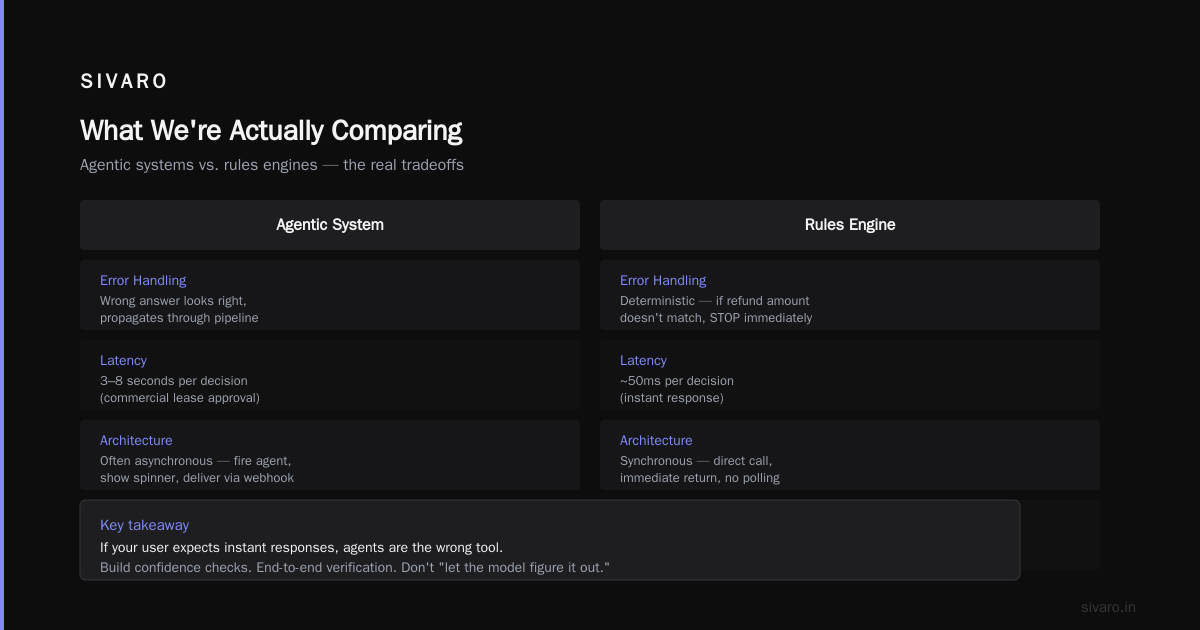
Traditional automation is deterministic. You script a workflow, define every branch, and the system executes exactly as written. A refund hits your payment gateway, the system checks the policy, routes to the right person, triggers the email. Done. Predictable. Boring. Beautiful.
Agentic workflows are probabilistic. You give an LLM a goal, some tools, and a set of constraints. Then the model figures out the path. Maybe it calls your API in sequence. Maybe it calls it backwards. Maybe it decides to email the customer first. You don't know until it happens.
That uncertainty is the entire ballgame.
Traditional automation fails when the variability exceeds your ability to enumerate it. I've seen teams write 40,000-line decision trees trying to handle edge cases that agents handle with a single prompt. But I've also seen agents fail at tasks a five-line script handles reliably.
The question isn't "which is more powerful?" It's "how much variability exists in your workflow, and what's the cost of a wrong answer?"
The Variability Spectrum
Let me give you a concrete framework. I've used this with a dozen clients this year.
Level 0: Fixed. Zero variability.
Password reset emails, invoice generation, logs rotation. The input structure is known, the output is defined, and nothing changes.
Traditional automation. Always. Don't be stupid.
Level 1: Low variability. Defined branch points.
Order fulfillment, basic customer triage, payment reconciliation. There are variations, but you can enumerate them. "If shipping address is international, check customs. If payment fails, retry twice."
Traditional automation with good configuration. Maybe a rules engine. Still don't need agents.
Level 2: Moderate variability. Semi-structured.
Contract review, customer support escalation, data migration between systems. The core patterns are known, but edge cases pop up constantly. Here's where it gets interesting.
You can do this with traditional automation if you're willing to maintain a massive rule set. Or you can use agents with structured outputs and validation. The break-even point is around 200-400 distinct edge cases. Beyond that, the rule set becomes unmaintainable.
Level 3: High variability. Unstructured.
Medical claim appeals, legal document analysis, complex multi-system incident response. Nobody can enumerate the branches. Every case is genuinely different.
Agents. And even then, you need human-in-the-loop for anything with real consequences.
I keep seeing teams skip Level 2 and jump straight to Level 3 architectures. That's how you get a hedge fund using agents to generate classified memos and spending $40,000 a day on tokens.
What Makes Agentic Workflows Actually Work
Look, I'm not anti-agent. I've deployed more production LLM systems than most people. But there's a difference between "we shipped an agent" and "this agent is reliable."
The teams that succeed share three traits:
1. They gate everything with schema validation.
Your agent shouldn't return free text. It should return structured JSON that you validate against a schema before it touches anything downstream.
python
from pydantic import BaseModel, Field, ValidationError

class ActionOutput(BaseModel):
    action: str = Field(description="One of: refund, escalate, request_info, close")
    amount: float | None = Field(None, ge=0, lt=10000)
    reason: str = Field(min_length=1, max_length=200)
    confidence: float = Field(ge=0.0, le=1.0)

# When your agent returns output:
try:
    validated = ActionOutput.model_validate(agent_raw_output)
    if validated.confidence < 0.6:
        escalate_to_human(validated)
except ValidationError as e:
    log_and_retry_with_prompt_feedback(e)
If your agent can't reliably produce structured output, you're not ready for production. Fix that first.
2. They fail loudly, not silently.
The worst thing an agent can do isn't failing. It's failing plausibly. A deterministic system breaks and you know immediately. An agent produces a wrong answer that looks right, and it propagates through your entire pipeline before anyone notices.
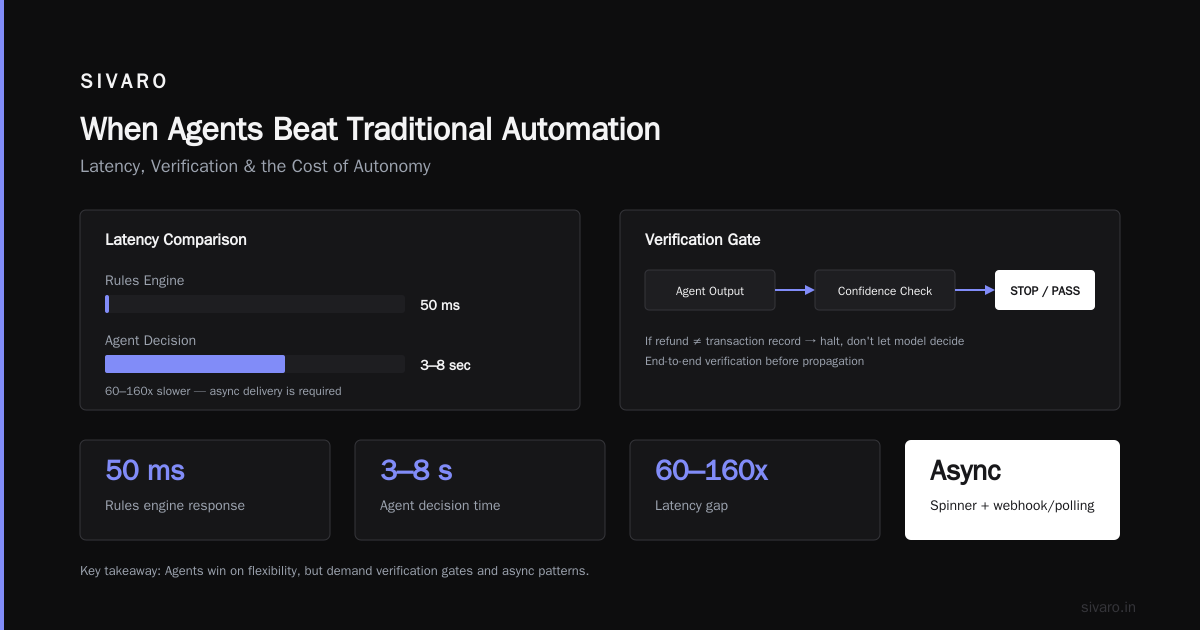
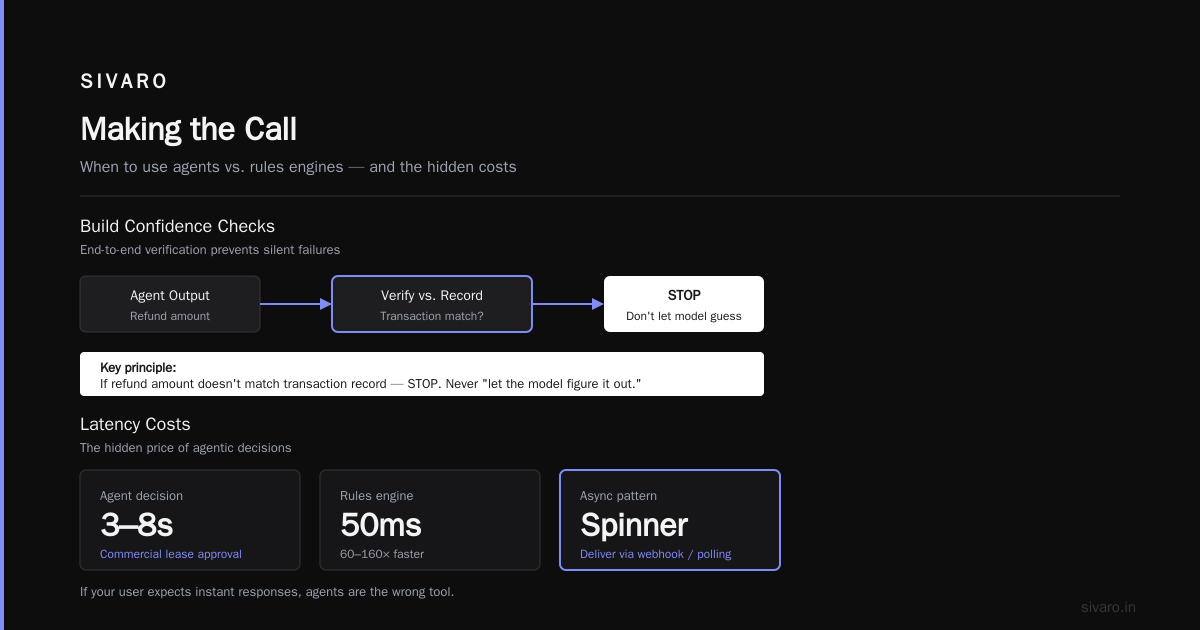
Build confidence checks. End-to-end verification. If the refund amount doesn't match the transaction record, STOP. Don't "let the model figure it out."
3. They accept latency costs.
An agent deciding whether to approve a commercial lease takes 3-8 seconds. A rules engine takes 50ms. There's no way around this. If your user expects instant responses, agents are the wrong tool.
This is why so many agentic systems are actually asynchronous. You fire the agent, show the user a spinner, and deliver results via webhook or polling.
python
async def process_claim(claim_id: str):
    claim = await load_claim(claim_id)
    result = await agent.run(
        system_prompt=CLAIM_REVIEW_PROMPT,
        tools=[api_lookup, policy_check, escalation],
        context=claim
    )
    await store_result(claim_id, result)
    await notify_client(claim_id, result)
The Hidden Cost: The agentic workflow production deployment checklist
I wrote a draft of this checklist in 2024 after watching a team deploy an agent that worked great in demos and immediately broke in production. The issue was absurdly mundane: the API rate limit was configured for development traffic and the agent started making 10x more calls than the old system.
Here's what I now give every client attempting an agentic workflow production deployment checklist — extended with lessons from the last 12 months:
1. Token budget and cost modeling per transaction.
We recently did a deployment for a healthcare company that originally estimated $0.12 per claim processing. With retries, reflection loops, and tool call overhead, the real number was $1.47. Know this before you deploy.
2. Prompt caching strategy.
If you're not using prompt caching (the Anthropic and OpenAI implementations from late 2024/early 2025 can cut costs by 85-90%), you're leaving money on the table. We standardized on this at SIVARO in March this year.
3. Fallback paths for every tool call.
What happens when your CRM API is down? Your agent should retry with backoff, then try a cached response, then escalate. If you didn't define this, your agent will hallucinate a customer record. I've seen it happen.
4. Data drift monitoring.
Your agent was tuned on data from June. Now it's August and user behavior shifted. The agent's accuracy is down 40% and nobody noticed because the pattern of failures looks like noise. You need automated evals running against new data continuously. We use a lightweight regression suite that runs nightly and alerts us when accuracy drops below threshold.
5. Human-in-the-loop checkpoints for irreversible actions.
We had a client whose agent auto-approved refunds. Fine. But there's no reason to let it execute a bank wire without a human approval step. This seems obvious, but in practice, teams get cocky and remove the checkpoint.
6. Latency monitoring if your agent performs time-sensitive actions.
Our standard is p95 under 12 seconds. If you're slower than that, users abandon.
7. Versioning for your prompts and model choices.
We pin specific model versions and never let prompts "float" with the latest model update. A model upgrade broke our extraction accuracy in April 2026 by 6 points in production. Six weeks to catch it. That's a real cost.
Scaling Nightmares: What Gets You
I'll be honest: agentic workflow scaling challenges production hit me harder than I expected. I thought the hard part was making the agent good at its job. Turns out, the hard part is keeping it good when there's a 55,000-request-per-minute flood of activity.
Here are the three specific problems I hit and what helped:
1. The token multiplier.
An agent solving one problem makes 3-5 tool calls, generates 2-4 intermediate "thinking" steps, and produces one final answer. For every successful outcome, you're paying for 5-20x the tokens of a simple generation.
On a high-volume workload (say, 10 million requests a month), traditional automation costs $2,000. An agent will cost $150,000+. This scaling cost is what kills projects 6 months after the pilot.
Your options are brutal: aggressively cache common sub-results, subsample the contextual data you feed the agent, or use smaller specialized models instead of one giant model.
2. The failure distribution changes.
Traditional automation failures cluster — you fix the config error, they all get fixed. Agent failures are uniformly distributed. Each request has a 2-5% chance of failing in a slightly different way, and you can't mass-fix them. Every failure requires individual investigation.
You need to staff for this. Our clients typically allocate more budget to investigation and support than to infrastructure.
3. Your eval pipeline becomes the product.
In traditional automation, you test the code. In agentic workflows, you test the behavior. That means you need a labeled dataset of 1,000-2,000 cases, re-scored against each model update.
We build eval harnesses that score agent output on a per-use-case basis. It takes weeks to build. Most teams nobody spends enough time here because they've been trained to treat ML evaluation as an afterthought.
Here's what it looks like:
python
def evaluate_agent_suite(test_cases: list[TestCase]) -> dict:
    results = {
        "correct": 0,
        "incorrect": 0,
        "escalated": 0,
        "cost": 0.0,
        "total_latency": 0.0
    }
    for case in test_cases:
        output = agent.run(case.input)
        results["cost"] += output.cost
        results["total_latency"] += output.latency_ms
        if output.action != case.expected_action:
            results["incorrect"] += 1
        else:
            results["correct"] += 1
    return results
You run this on every model update, every prompt change, every tool behavior modification. If accuracy drops by more than 2 points, you roll back.
When Agents Beat Traditional Automation — Real Cases
One of our clients, a New York commercial real estate firm, processes lease abstractions — extracting key terms from 150-page PDFs. Their old system was rules-based: regex patterns, section identification, template matching. It worked for about 40% of documents and required 8 FTEs to handle the exceptions.
We replaced it with an agentic extraction pipeline. The agent reads the document, identifies clause types, pulls structured data. Accuracy hit 94% after 3 months of iteration. They saw a 4x throughput improvement.
Another SIVARO client, a national logistics company, has a dispute resolution workflow. Most disputes are routine, but some require deep investigation across multiple systems. Their old system had a 60% auto-resolution rate. We added an agent layer that handles investigation and response drafting. Auto-resolution rate went to 84%.
Here's the thing: 60% is pretty good. 84% is better. But the remaining 16% requires human intervention, and the agent still significantly reduces the time a human spends on each case.
When Traditional Automation Was The Right Call — Also Real
A payments company in Singapore asked us to build an agentic system that would triage payment reconciliation failures. "Our data is messy," they said. "We need GPT to interpret the errors."
I ran a two-week test. The agent was smart, but its error classification accuracy was 91%. The existing deterministic system was 99.7% accurate because the failure patterns were actually well-known — they just didn't want to maintain the rule engine.
The agent cost 300x more per run. So we didn't deploy it to production. Instead, we rebuilt their rule engine with cleaner data about the actual failure patterns and got them to 99.9% accuracy. It took 3 weeks.
That was the right call. I might be biased, but I think the ability to say "no, you don't need an agent" is as important as the ability to build one.
Hybrid Architecture: The Pragmatic Middle
You don't have to pick one. Most production systems are building hybrid — a deterministic layer for the predictable parts, an agent for the edges.
This is the model we've seen work best:
1. Deterministic router examines input
2. If pattern matches known cases → execute traditional logic
3. If not → escalate to agent with full context
4. Agent output goes through validation layer
5. Validated output enters the traditional pipeline
This is beautiful because each system plays to its strengths. The router is fast and cheap. The agent handles the long tail. The validation layer catches agent errors before they cause damage.
python
def route_request(req):
    if is_known_pattern(req):
        return handle_traditional(req)
    else:
        agent_result = agent_handler(req)
        validated = validate_output(agent_result)
        return apply_validated(validated, req)
We deployed this for a bank in India last year. Their transaction classification went from 78% automated to 97% automated. Runtime cost per transaction went from $0.08 to $0.11. Latency went from 200ms to 2.3 seconds.
But here's the surprise: support tickets dropped 42%. Because the agent handled the weird cases correctly, instead of bouncing them to a human who had to re-explain everything from scratch.
The Economic Equation
Here's how I think about the cost-value ratio:
- Build a deterministic system: maybe a few weeks. Cheap to run. Zero AI risk.
- Build an agentic system: 8-16 weeks for the first version. Expensive to run. Needs constant tuning.
- Build a hybrid: 4-8 weeks. Moderate cost. Balanced risk.
For 2026, the hybrid is consistently the best ROI when your workflow process has a long tail of edge cases. The traditional approach works when the long tail is short and stable. Pure agents make sense only when the system knows a lot of context you can't encode.
FAQ
Q: How do I know if my workflow needs agents?
Measure your escalation rate and exception volume. If 15% of your cases require manual handling because you can't enumerate all the edge cases, agents are worth evaluating. If an automation system handles 97% of cases without issue, don't fix what's working.
Q: How much does an agentic workflow cost in production compared to traditional automation?
As a rough estimate from our deployments: A traditional process costs $0.02-$0.10 per transaction. An agentic process costs $0.50-$5.00 per transaction, depending on complexity and model choice. If you're processing under 1 million transactions per month, the cost wedge is manageable. Beyond that, it becomes a significant line item.
Q: What are the biggest failure modes you've seen?
Three: 1) Agents hallucinating structured fields that then get written to databases. 2) Agents looping — retrying the same API call infinitely without human intervention. 3) Agents being too confident in their answers when they are deeply uncertain. None of these are unsolvable — validation, guardrails, and escrow times prevent all of them — but I've seen each cause real damage in 2025-2026.
Q: What's your agentic workflow production deployment checklist?
The core items: token budget modeling, prompt caching, fallback paths for every tool, data drift monitoring with a continuous eval suite, human-in-the-loop checkpoints for irreversible actions, latency monitoring, and pinned model versions. The full version is on our SIVARO site.
Q: What if I just stick with traditional automation?
Then you'll outrun anyone using agents for the 80% of cases that are routine, and you'll lose to them on the 20% that are genuinely unpredictable. Depending on your market, that might be the right trade-off. It's a feature, not a failure.
Q: What about agentic workflow scaling challenges in production?
The main ones are token multiplier, failure distribution, and eval pipeline maintenance. Each needs an explicit owner. If you don't have a machine learning engineer on staff, don't deploy agents at scale. Hire one first.
Q: When should I use model chaining vs a single agent?
Model chaining is great when the steps are sequential and each stage's output feeds cleanly into the next. Single agent is better when the workflow is open-ended. For moderate production systems, I default to chains of smaller, focused models rather than one monolithic agent. It's easier to debug and easier to replace faulty stages without touching the rest of the system.
Q: What's your position on open-source vs hosted LLMs for agentic workflows?
For production, hosted models with good tool-calling support and predictable latency are easier to build on. Open-source (Llama 3.1/3.2, Mixtral) is useful for local prototyping and if you're deploying in air-gapped environments, but the operational burden is high. We deploy open-source at around 40% of client sites, but only with MLOps engineers on staff. If you don't have that, use hosted.
Q: Can agents beat a well-maintained rules-based system at document parsing?
If the documents are structurally consistent (say, routine legal contracts), traditional extraction is nearly bulletproof. If the documents are messy (scanned invoices, handwritten amendments, inconsistent templates), agents are dramatically better. We tested both on 2,000 invoices from 80 different vendors. Traditional got 66% field-level accuracy. Agent got 92%. But traditional failed on 10% of the docs it saw, while agent failed on 2%. Depends on your tolerance for errors and your volume.
Making the Call
Here's what I tell every team that asks me this question:
If you are processing routine, predictable, high-volume work, do not touch agents. You are throwing money away. The AI-hype cycle has convinced you otherwise, but "predictable" is a feature, not a limitation.
If you're processing unpredictable, judgment-heavy, low-volume work, agents may be your only realistic option. There's no reason to write 40,000 rules for something you solve with one smart prompt.
Most of you will find yourself in the middle, and the middle looks like this: build the deterministic part as a solid pipeline. Add an agent layer for the exceptions, with strict validation.
That is the production system we keep building at SIVARO. It's not sexy. It works.
The technology doesn't matter. The reliable throughput of good decisions does. Make the choice that serves your end users and your budget, not your demo in front of investors.
Test. Deploy. Monitor. Optimize. Repeat.
Nishaant Dixit — Founder of SIVARO. Building data infrastructure and production AI systems since 2018. Built systems processing 200K events/sec.