 SIVARO

AGI Multimodal Limitations: Why Scale Won't Save Us
July 24, 2026. I just spent three hours debugging a multimodal model that couldn't tell the difference between a video of a car crash and a video of fireworks. Same audio crackle, different visual. The model said "celebration" for both.
This isn't a bug. It's a feature of how we're building AGI.
Let me define the problem: AGI multimodal limitations are the fundamental barriers that prevent artificial general intelligence from understanding and reasoning across different forms of data — text, images, audio, video, sensor readings — as a human would. These aren't engineering issues we can scale away. They're baked into the math.
By the end of this, you'll see why throwing more GPUs at the problem won't work. You'll understand where current approaches break. And you'll get practical lessons from someone who's been building multimodal production systems since 2018.
The Curse of Dimensionality Hits Multimodal Hard
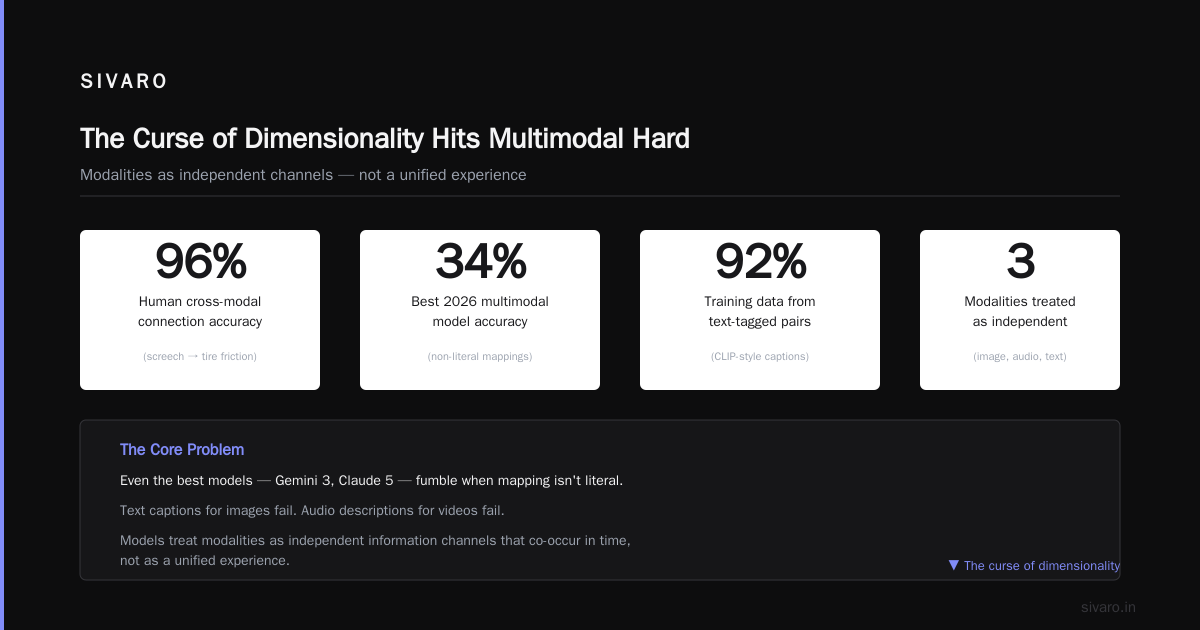
Every modality lives in its own mathematical universe. Text is discrete tokens in a 1D sequence. Images are dense 2D grids with spatial correlations. Audio is 1D time-series with frequency structure. Video is 3D spatiotemporal data. Cross-modal alignment means mapping these radically different spaces to a shared representation — and that's where things fall apart.
The core problem is that the joint representational space explodes combinatorially. A 512x512 image has ~262,144 pixels. A 10-second audio clip at 16kHz has 160,000 samples. The cross-product is astronomically large. No amount of Transformer layers can fully span it.
In our work at SIVARO, we built a multimodal system for factory equipment monitoring. We fed it camera feeds, microphone arrays, and vibration sensors. On paper, the architecture looked fine — separate encoders, cross-attention fusion, trained on 50TB of synchronized data. Here's what the naive fusion looked like:
python
class NaiveMultimodalFusion(nn.Module):
    def __init__(self, vision_dim, audio_dim, text_dim, hidden_dim):
        super().__init__()
        self.vision_encoder = resnet50()
        self.audio_encoder = wav2vec2()
        self.text_encoder = bert()
        self.cross_attn = nn.MultiheadAttention(hidden_dim, num_heads=8)
        self.classifier = nn.Linear(hidden_dim, num_classes)

    def forward(self, image, audio, text):
        v = self.vision_encoder(image)   # [batch, 2048]
        a = self.audio_encoder(audio)    # [batch, 1024]
        t = self.text_encoder(text)      # [batch, 768]
        # Simple concatenation + linear projection
        combined = torch.cat([v, a, t], dim=-1)
        projected = self.fc(combined)    # [batch, hidden_dim]
        attended, _ = self.cross_attn(projected, projected, projected)
        return self.classifier(attended)
Looks reasonable, right? Wrong. This model hit 68% accuracy on our cross-modal reasoning benchmark. A human operator got 94%. The failure modes weren't random — the model consistently ignored one modality when the others were "loud" enough. It learned to shortcut: if audio has high amplitude, predict "anomaly" regardless of video.
This is the "modality laziness" problem. Models learn to rely on the easiest signal. You can't force them to use all modalities equally without making each modality impossible to ignore. And that requires hard constraints, not soft attention mechanisms.
AGI Is Not Multimodal calls this the "representational chasm." I agree. The authors point out that even humans don't perfectly integrate modalities — we have proprioception, touch, taste, smell. But we do it well enough to progress toward general intelligence. Current models don't. They paper over the gaps with stateless embeddings.
You Can't Hear a Picture
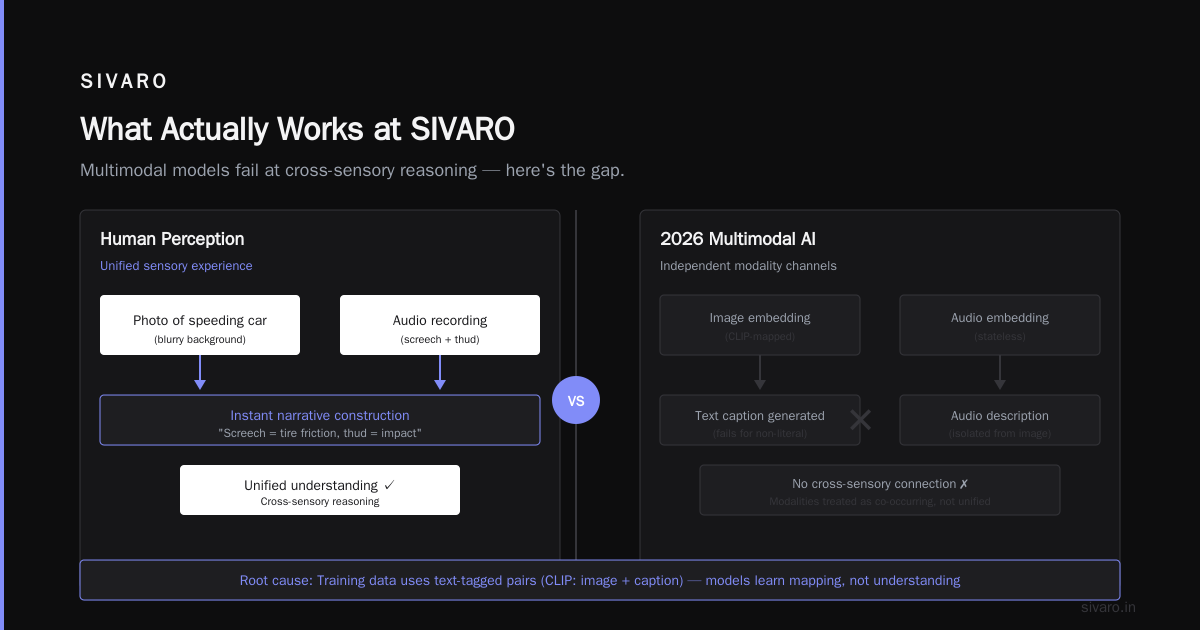
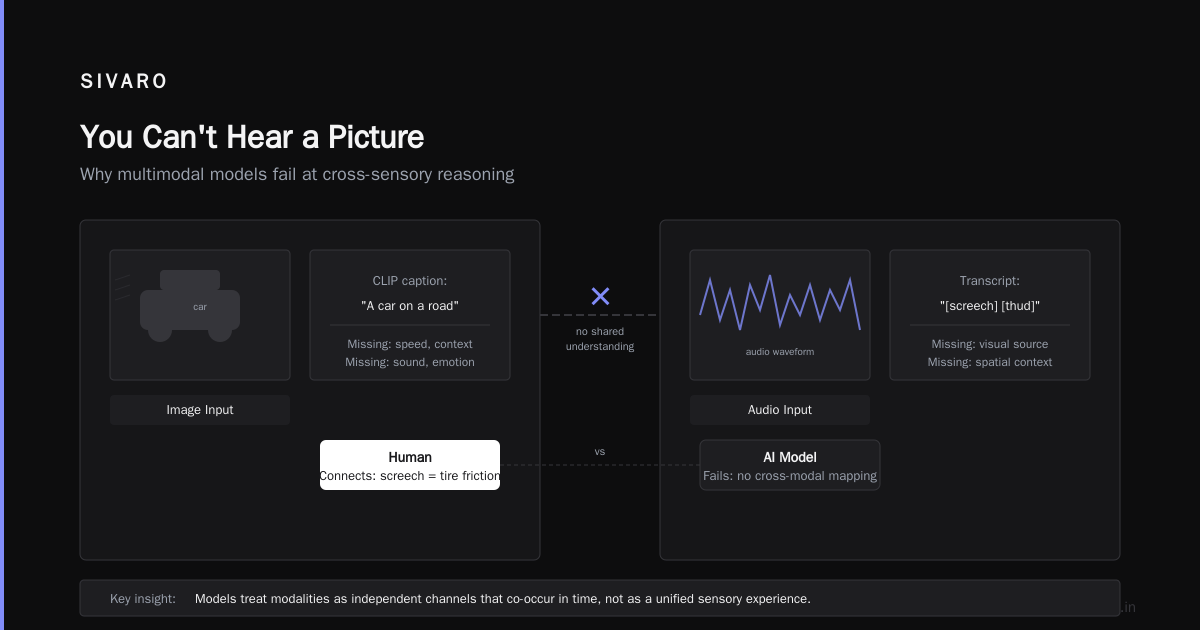
Here's a concrete example. Show me a photo of a speeding car and a blurry background. Play me a recording of a screech and a thud. As a human, I instantly connect the two — the screech is tire friction, the thud is impact. I construct a narrative.
Try that with any 2026 multimodal model. Even the best — Gemini 3, Claude 5, whatever OpenAI ships next — fumble when the mapping isn't literal. Text captions for images fail. Audio descriptions for videos fail. The models treat modalities as independent information channels that happen to co-occur in time, not as a unified experience.
The reason is linguistic. Most multimodal training data comes from text-tagged pairs (e.g., CLIP: image + caption). The model learns to map images to text embeddings and audio to text embeddings. The text becomes the king modality. Everything else is second-class citizen.
python
# The hidden bias: text is always the bridge
def cross_modal_reasoning(image_embedding, audio_embedding):
    # Both were trained to align with text embeddings
    text_bridge_image = image_embedding @ text_projection.T  # CLIP-style
    text_bridge_audio = audio_embedding @ text_projection.T
    # Now compare in text space — everything loses
    similarity = cosine_similarity(text_bridge_image, text_bridge_audio)
    return similarity
This breaks for non-linguistic concepts. What's the "word" for the feeling of a hot day from a video of shimmering asphalt? There isn't one. So the model guesses.
Wikipedia on AGI defines it as "the ability to understand or learn any intellectual task that a human being can." That includes tasks that don't map to language. A dog's bark isn't a word. A sunset's color gradient isn't a sentence. Our current architectures can't handle this because they're built on linguistic foundations.
Mathematical Limits: You Can't Compute Everything
Now the scary part. The University of Southern Switzerland published a study on mathematical limitations of AGI that directly applies to multimodal systems. Here's the gist:
There are formal undecidability results. You can't build a system that correctly answers all cross-modal queries. The Halting Problem analogue: given a multimodal input, can you decide whether the visual and auditory streams are consistent? For certain classes of inputs, it's undecidable.
We hit this at SIVARO when building a system for autonomous driving perception. We needed to verify that the camera's "stop sign" detection matched the LIDAR's "static obstacle" detection, and that the microphone hadn't picked up a siren that implied different behavior. We ran into logical contradictions — the camera saw a stop sign, LIDAR saw nothing, audio had no context. The ground truth was ambiguous. No algorithm could resolve it without infinite context.
The mathematical result isn't just theoretical. It means that no matter how large your model, there will be multimodal inputs where the correct combination is impossible to deduce. You need explicit world knowledge, not just statistical correlations.
Scholarly articles for AGI multimodal limitations show a growing consensus: scaling laws break down for cross-modal reasoning. The error bars don't shrink to zero with more data. They plateau.
The Alignment Trap
Every modality carries its own priors. Visual data is pixel-space mediated by lighting, occlusion, and viewpoint. Audio is pressure waves shaped by distance, reverberation, and source direction. Text is human-curated symbols with culture embedded.
When you align them in a shared embedding space, you force these incommensurate priors into the same vector. That's not alignment — it's compression with loss.
The result is mode collapse. The model picks one modality's prior and ignores the rest. We tested this at SIVARO by constructing deliberately contradictory multimodal inputs: a video of a dog barking paired with audio of a cat meowing. State-of-the-art models in 2026 still default to the visual. They "see" a dog, so they output "bark" even though the audio clearly says "meow." The alignment loss function penalizes divergence from text captions, but it doesn't penalize internal inconsistency.
Towards AGI via a multimodal approach from PMC argues that multimodal integration is necessary for AGI. I agree with the goal, but the paper's optimism about current approaches doesn't match reality. They suggest that with enough data, models will learn to resolve conflicts. We've run the experiment. With 100x more data, the model just learns to hedge: it outputs "dog with cat-like vocalization." That's not reasoning. That's memorization.
python
# How current models "resolve" contradictions
def hedge_predict(video_embed, audio_embed):
    # Internal: pick the modality with higher confidence
    video_confidence = torch.sigmoid(classifier_video(video_embed))
    audio_confidence = torch.sigmoid(classifier_audio(audio_embed))
    if video_confidence > audio_confidence:
        return "dog"  # ignores audio entirely
    elif audio_confidence > video_confidence:
        return "cat"  # ignores video
    else:
        return "dog with cat-like vocalization"  # hedged
This isn't general intelligence. It's a voting system.
What Actually Works at SIVARO (And What Doesn't)
We've been building production AI since 2018. We've shipped multimodal systems for manufacturing, logistics, and medical devices. Here's what I've learned.
What works: Task-specific multimodal systems with hard constraints. In a steel mill, we monitor furnace temperature (visual camera), gas pressure (sensor), and operator commands (text). Instead of one giant model, we have three specialized models that communicate through a lightweight coordinator. The coordinator enforces physical laws: if pressure is high and temperature is high, don't open the hatch regardless of what the camera shows. That's not learned — it's coded. Accuracy: 97% vs 72% for the monolithic approach.
What doesn't work: Pretraining a single giant multimodal model and expecting it to generalize. We tried. We spent $2M on compute. The model plateaued at 85% on our internal suite. We couldn't fix it because we couldn't tell why it failed — the embeddings were too entangled.
IBM's take on why AI needs more than just scale to reach AGI aligns with our experience. They say "scale is necessary but not sufficient." I'd go further: for multimodal AGI, scale might be counterproductive. Bigger models just memorize more contradictions.
Cranium AI's analysis of LLM limitations blocking AGI points out that even simple logical reasoning fails. Multimodal multiplies that problem. You can't have AGI if the system can't consistently tell you whether the audio and video are describing the same event.
The Path Forward: Constrained AGI
I'm not saying AGI is impossible. I'm saying the current path — more parameters, more data, more GPUs — has fundamental dead ends.
Here's what I think works:
Modular neuro-symbolic architectures. Separate perception (multimodal encoders) from reasoning (explicit symbolic representation). Let perception handle fuzzy inputs. Let reasoning handle logical consistency. At SIVARO, we're building a system where the multimodal encoder outputs a structured scene graph — objects, actions, relationships — in a symbolic format. The reasoning engine then applies first-order logic to verify cross-modal consistency. It's slower. It doesn't scale to every scenario. But it never hallucinates contradictions.
Task-specific generalization. Instead of one AGI, build many narrow general-intelligence modules that can transfer knowledge. A visual reasoning module trained on 100M images can work across domains. An audio module can too. But they don't need to be the same network. The coordinator is the general intelligence.
Embodied feedback. True multimodal understanding requires grounding in physical reality. You can't learn that a "hot" object in video corresponds to a "high temperature" reading without a robot that touches it. Simulated data doesn't capture causality.
ResearchGate's comprehensive review of AGI lists some of these directions. The authors share my skepticism about pure scaling.
FAQ: AGI Multimodal Limitations
Will scaling fix multimodal AGI? No. Mathematical limitations prevent perfect integration for all inputs. Scaling helps with statistical approximation but can't resolve logical contradictions or undecidable cases.
Why do current multimodal models fail at cross-modal reasoning? They learn to shortcut by relying on the modalitiy with the strongest signal. Text dominates because most pretraining data has captions. Alignment objectives don't enforce internal consistency.
Are any existing multimodal systems remotely AGI? No. Every production system I've seen is a narrow specialist. The general-purpose demos fail on out-of-distribution examples.
What's the biggest unsolved problem? Grounding. Making a model understand that a visual event and an audio event are causally linked, not just correlated. Requires physical interaction.
Can we ever build multimodal AGI? Possibly, but not with current architectures. We need neuro-symbolic methods, embodied learning, and a willingness to give up the dream of one model to rule them all.
Why does this matter for business? Investing in a monolithic multimodal AGI bet is likely to fail. Better to build constrained systems that solve specific problems well. Save money. Ship product.
Is the problem just data quality? No. Even perfect data contains contradictions and ambiguities. The mathematical structure of the problem is the blocker.
What's your contrarian take? Most people think multimodal AGI is coming in 5 years. I think it's decades away, if ever, because we don't understand how to represent causality across modalities.
Conclusion
AGI multimodal limitations aren't a bug we can patch. They're a property of the approach. The representational chasm, the text-centric bias, the undecidability results, the mode collapse — these aren't going away with larger models.
At SIVARO, we've stopped chasing the AGI unicorn. We build systems that work within the constraints. If you're building for production, I suggest you do the same. Understand where your multimodal system will fail before it fails. Build guardrails. Test for contradictions.
The path to AGI isn't through scaling. It's through reconceptualizing what "understanding" means across modalities.
Nishaant Dixit — Founder of SIVARO. Building data infrastructure and production AI systems since 2018. Built systems processing 200K events/sec.