 SIVARO
AI Agent Architecture for Distributed Systems Explained
You don't need another diagram of boxes and arrows. You need to know what happens when your agent stack hits production and the region fails. I've spent the last three years at SIVARO building production AI systems, and the gap between demo architectures and deployed ones is enormous.
Here's the definition you actually need: ai agent architecture for distributed systems explained is how you design autonomous AI workers that coordinate across multiple machines, services, and failure domains while maintaining consistency, observability, and cost control.
In this guide, I'll walk through the patterns that work, the ones that fail spectacularly, and the infrastructure decisions that determine whether your agents scale or collapse.
Why Most Agent Architectures Fail in Production
Most people think agent failures come from bad prompts. They're wrong.
I've seen more agent systems die from queue backpressure than from hallucination. A single misbehaving agent with a retry loop can saturate your entire event bus. We saw this with a fintech client in early 2026 — their research agent entered a retry loop after a schema change, and it consumed 40% of their API quota in under four hours.
The problem isn't intelligence. It's coordination.
When you run agents across distributed systems, you face three problems you never see in a monolith:
State consistency. Your agent started a workflow on machine A, but the callback landed on machine B. Where's the context?
Failure isolation. One agent's bug shouldn't take down the fleet. But with shared infrastructure, it often does.
Observability. Traditional logging breaks when an agent's decision path spans fifteen services.
The solution isn't smarter agents. It's dumber infrastructure.
The AWS Infrastructure Layer
Let's talk compute, because that's where distributed agents start.
AWS offers a spectrum of options, from general-purpose instances to specialized accelerators. The Amazon EC2 G4 Instances are your entry point for inference workloads — they give you NVIDIA T4 GPUs at reasonable cost. For training or heavy batch inference, the Recommended GPU Instances - AWS Deep Learning AMIs guide breaks down the full hierarchy.
But here's the thing I tell every client: GPU selection is a cost problem, not a performance problem.
An agent that calls a model 50 times per task will spend more on inference than on compute. So your architecture needs to account for that. Use smaller models for routing, larger models for generation, and cache aggressively.
For those doing serious training runs, AI Accelerator - AWS Trainium is worth investigating. AWS's Project Rainier demonstrates the scale they're building for. But for most agent workloads, you don't need a supercomputer. You need predictable latency.
The What is Compute? - Enterprise Cloud Computing Explained page covers the basics. Understanding AWS acronym meaning in cloud computing helps when you're deciphering EC2, ECS, EKS, and the rest of the alphabet soup.
Event-Driven Agent Communication
Agents should talk through events, not direct calls.
The moment you let agents call each other synchronously, you've built a distributed monolith. One slow agent blocks everything downstream. You get cascading timeouts, thread exhaustion, and eventually a pager alert at 3 AM.
Here's the pattern that works:
Agent → Event Bus → Queue → Worker → Result Store → Next Agent
Each agent reads from its input queue, processes, and writes to an output topic. No direct connections. No synchronous waits. Just messages flowing through a pipeline.
This is what ai agent architecture for distributed systems explained actually means in practice — you're designing for asynchrony from the start.
Code Example: Work Queue Schema
python
# Agent message schema for distributed coordination
{
  "agent_id": "researcher-07",
  "task_id": "8f3a2b91-7c4d-4e5f-9a1b-2c3d4e5f6a7b",
  "parent_task_id": None,
  "event_type": "task_created",
  "payload": {
    "query": "analyze Q3 revenue trends",
    "context_window": "last 90 days",
    "max_tokens": 4096,
    "required_sources": ["data_warehouse", "financial_reports"]
  },
  "retry_count": 0,
  "deadline": "2026-08-07T18:00:00Z",
  "priority": "high"
}
The task_id is your correlation ID. It travels through every subsequent event, so you can trace an agent's entire decision path.
State Management: The Hard Part
Here's where most architectures fall apart.
Agents need state. They need memory of previous steps, context from parent tasks, and results from sub-agents. But distributed systems are stateless by design. So you must externalize that state.
At SIVARO, we use a combination of Redis for ephemeral state and DynamoDB for persistent state. The rule is simple: if the process dies, the state must survive.
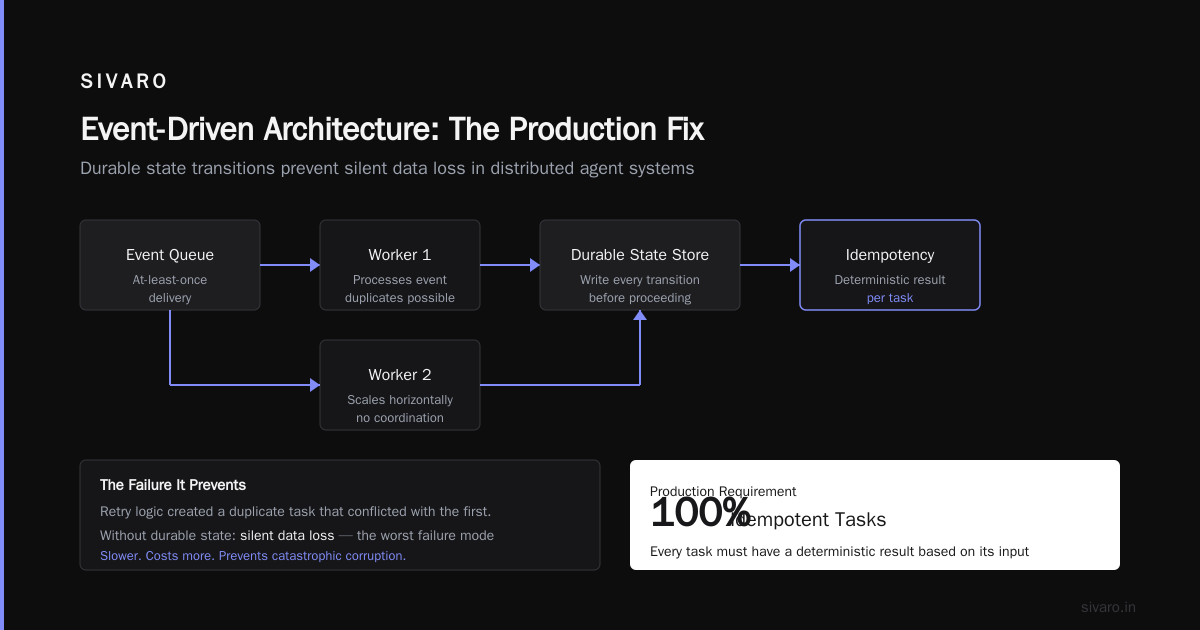
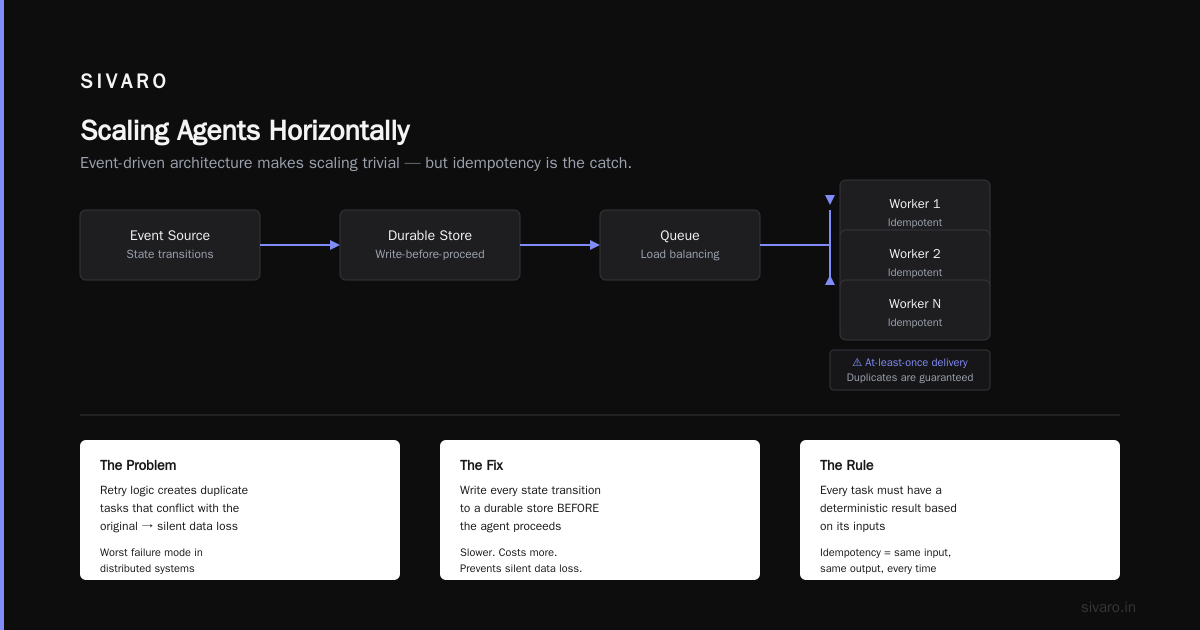
We learned this the hard way. In November 2025, one of our agents was mid-workflow when its EC2 instance was terminated during a spot price spike. The task vanished. The user saw an infinite spinner. The retry logic created a duplicate task that conflicted with the first.
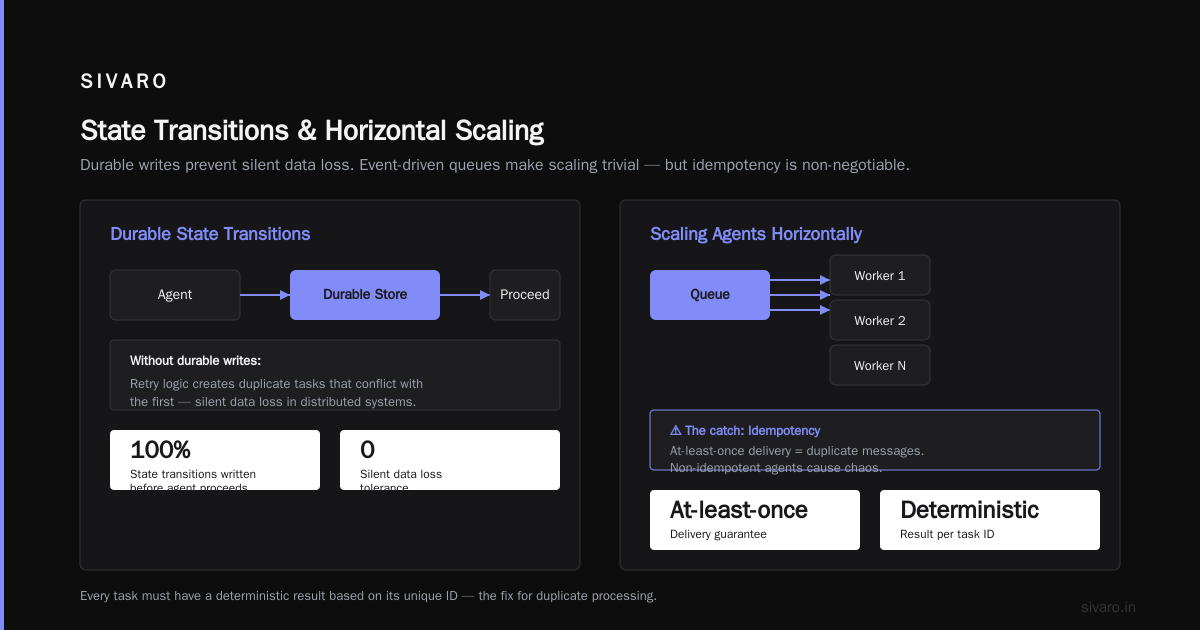
Now we write every state transition to a durable store before the agent proceeds. It's slower. It costs more. But it prevents the worst failure mode in distributed systems: silent data loss.
Scaling Agents Horizontally
The beauty of event-driven architecture is that scaling becomes trivial.
Need more capacity? Spin up more workers. The queue handles the load balancing. No coordination required.
But there's a catch: idempotency.
When you scale horizontally, you'll get duplicate messages. At-least-once delivery guarantees mean your workers will process the same event multiple times. If your agent isn't idempotent, duplicates cause chaos.
The fix is simple: every task must have a deterministic result based on its input. If the agent processes the same task twice, the second execution should be a no-op.
Code Example: Idempotency Key
python
def process_task(task):
    # Check if already processed
    existing = state_store.get(task["task_id"])
    if existing:
        return existing["result"]

    # Acquire distributed lock
    lock = redis.lock(f"task:{task['task_id']}", timeout=60)
    if not lock.acquire():
        return None  # Another worker has it

    try:
        result = agent_execute(task)
        state_store.put(task["task_id"], {"status": "done", "result": result})
        return result
    finally:
        lock.release()
This pattern prevents duplicate execution without adding significant overhead.
The Model Inference Layer
Your agents are only as good as the models they call.
In a distributed system, model inference becomes a shared resource. One agent's long-running generation task can starve another's quick classification. You need separation.
We run two tiers of inference:
Fast tier: Small models (7B-13B parameters) for routing, extraction, and classification. Latency under 200ms.
Slow tier: Large models (70B+ or proprietary APIs) for generation, reasoning, and complex tasks. Latency 2-10 seconds.
The fast tier runs on dedicated instances. The slow tier runs on a separate cluster with its own autoscaling.
Here's the cost data from our production system at SIVARO: a 13B parameter model on a G4 instance handles 80% of our agent's calls. The remaining 20% go to a frontier model. By keeping the small model on dedicated hardware, we cut inference costs by 60% compared to routing everything through a single API.
Security Boundaries for Autonomous Agents
I need to be direct here: most people underestimate what their agents can do.
When you give an agent tools — web browsing, API access, code execution — you've given it power. In a distributed system, that power multiplies because the agent can spawn sub-agents across machines.
We use three security layers:
Tool sandboxing. Every tool runs in a container with no network access unless explicitly granted.
Permission scoping. Each agent gets a service account with least-privilege access. The researcher agent can't write to the database. The writer agent can't access the payment API.
Audit logging. Every action is logged with the task_id, agent_id, timestamp, and tool used.
The audit log is crucial. When something goes wrong — and it will — you need to reconstruct exactly what happened. We built a trace visualizer that shows the full agent decision tree from root task to leaf action. It's saved us weeks of debugging.
Observability: Tracing Agent Decisions
Traditional monitoring breaks with agents.
A single user request can spawn 20 agent actions across 10 services. You need distributed tracing that captures the entire journey.
We use OpenTelemetry with custom spans for agent activities. Each span captures:
- Agent ID and task ID
- Model called and parameters
- Input tokens, output tokens, latency
- Decision rationale (the prompt that led to this action)
- Child task IDs
The output looks like this when you query it:
Code Example: Tracing Integration
python
from opentelemetry import trace

tracer = trace.get_tracer("agent.tracer")

def agent_execute(task):
    with tracer.start_as_current_span(
        f"agent.{task['event_type']}",
        attributes={
            "agent.id": task["agent_id"],
            "task.id": task["task_id"],
            "model": task["model"],
            "tokens.input": count_tokens(task["payload"])
        }
    ) as span:
        result = run_inference(task)
        span.set_attribute("tokens.output", count_tokens(result))
        span.set_attribute("task.success", result["success"])
        return result
This gives you the full picture. When an agent goes off the rails, you can see exactly where and why.
Testing Distributed Agents
Testing agents is fundamentally different from testing software.
Your code has known inputs and expected outputs. Your agent has ambiguous inputs and variable outputs. You can't assert that the agent returns 42 — you need to assert that the agent's behavior is reasonable.
We built an evaluation harness that tests agents across four dimensions:
Correctness. Did the agent produce the right answer?
Efficiency. Did it make a reasonable number of calls?
Safety. Did it avoid prohibited actions?
Recovery. Did it handle failures gracefully?
The last one is critical. You need fault injection testing. Kill the process mid-task. Simulate a database timeout. Duplicate a message. Your agent should survive all of these.
Code Example: Evaluation Harness
python
def evaluate_agent(agent, test_cases):
    results = []
    for case in test_cases:
        # Inject fault before execution
        if case.get("inject_fault"):
            inject_fault(case["fault_type"])

        start = time.time()
        output = agent.execute(case["input"])
        latency = time.time() - start

        results.append({
            "case_id": case["id"],
            "success": validate_output(output, case["expected"]),
            "latency": latency,
            "calls_made": count_agent_calls(output),
            "fault_handled": output.get("fault_recovery") is not None
        })

    return results
Run this in CI. Every time you change the agent's prompt, model, or tool access, the full test suite runs.
Cost Optimization for Agent Fleets
Let's talk money, because this is where projects die.
A distributed agent system burns through compute and API credits faster than you expect. We had a client in the healthcare space whose pilot project cost $18,000 in inference fees in the first month. Most of it was wasted on redundant calls.
Here's what works:
Model routing. Use cheap models for simple tasks, expensive models for hard ones. A classifier can decide which tier each request needs.
Caching. Cache responses for identical or similar inputs. For many agent tasks — data extraction, classification, summarization — you see the same inputs repeatedly.
Batching. Group similar requests and process them in a single inference call. This works well for embedding generation and simple extraction.
Early termination. If the agent's confidence drops below a threshold, stop and ask for human help. Don't burn tokens on increasingly improbable attempts.
We cut that healthcare client's costs to $6,400 by implementing these optimizations. Not by reducing quality — by reducing waste.
The Million Token Context Problem
I need to address something directly here.
There's been a lot of hype about million-token context windows. The idea is that your agent can process entire codebases or books in a single call. But as I wrote in AWS Million Token Context Window: The Hard Truth Nobody's, the reality is different.
Long context windows degrade retrieval accuracy. The model attends more strongly to tokens at the beginning and end of the context, and information in the middle gets lost. Your agent might "see" the full document but miss the critical detail that was buried in paragraph 37.
The fix is to keep context windows focused. Give your agent the relevant chunk, not the entire corpus. Use retrieval to find what's relevant, then feed that to the model.
In distributed agent architectures, this becomes even more important. If every sub-agent passes along a massive context, you'll hit memory limits and latency targets. Keep contexts lean.
The Role of Specialized Hardware
At some point, you'll need more than general-purpose instances.
AWS's Project Rainier is their bet on massive-scale training infrastructure. For inference-heavy agent workloads, specialized accelerators can cut costs substantially.
But here's my contrarian take: don't optimize for hardware until you've optimized your architecture.
Most agent systems waste 50%+ of their compute on redundant calls and poor routing. Fix that first. Then, if you're still constrained by inference latency, look at specialized hardware.
The AWS Deep Learning AMIs make it easy to test different instance types. Use them to benchmark your actual workload, not synthetic benchmarks.
AWS Acronym Meaning in Cloud Computing
For newcomers, the AWS ecosystem is a wall of acronyms.
EC2, ECS, EKS, S3, SQS, SNS, Lambda, DynamoDB, RDS, VPC, IAM, CloudWatch. It's overwhelming.
AWS acronym meaning in cloud computing — you don't need to memorize all of them. You need to know what each service does at a conceptual level:
- EC2: Virtual machines
- ECS/EKS: Container orchestration
- S3: Object storage
- SQS: Message queues
- SNS: Notifications
- Lambda: Serverless functions
- DynamoDB: NoSQL database
- VPC: Virtual network
- IAM: Access control
That's 80% of what you'll use for agent architectures.
Deploying Agents Across Cloud Providers
Most people assume AWS is the default. It's not always the best choice.
The Deploying AI in The Cloud: AWS vs Azure vs GCP comparison covers the differences. Here's what I've learned from multi-cloud deployments:
AWS wins on maturity and breadth of services. If you need every possible tool, AWS has it.
Azure wins on enterprise integration. If you're already a Microsoft shop, Azure's Active Directory integration is worth the friction.
GCP wins on data and ML tooling. BigQuery and Vertex AI are excellent for data-heavy workloads.
For distributed agents, the choice matters less than you think. The principles are the same across clouds. You're designing for asynchrony, state management, and failure isolation.
Common Failure Patterns
Let me share the failures I see most often, so you can avoid them.
The retry storm. An agent fails, retries immediately, fails again, retries faster. Within minutes, it's generated thousands of requests. The fix: exponential backoff with jitter, plus a max retry count.
The orphan task. A parent agent spawns sub-agents then dies. The sub-agents complete their work, but nobody collects the results. The fix: a sweeper process that finds orphaned tasks and handles them.
The dependency cycle. Agent A waits for Agent B, which waits for Agent A. Deadlock. The fix: enforce acyclic dependencies in the task graph.
The poisoned context. One bad result gets cached and re-used by multiple agents. The error propagates. The fix: validate results before caching, and include confidence scores.
These patterns are consistent across every distributed agent system I've built or consulted on.
Building the Right Team
This isn't a solo project.
Building production agent systems requires a team with four skills: software engineering, distributed systems, ML operations, and product thinking. The first two are non-negotiable. The last two determine whether you build something useful or something technically impressive but useless.
At SIVARO, we've found that the best team structure is:
- 2-3 backend engineers focused on the infrastructure layer
- 1-2 ML engineers focused on model selection and prompt design
- 1 product engineer focused on user-facing behavior
- 1 SRE to keep the whole thing running
You don't need a 20-person team. You need the right five people.
The Future of Distributed Agents
I'm going to make a prediction: within 12 months, most serious agent deployments will be event-driven, state-externalized, and observable.
The current wave of agent hype is focused on what individual agents can do. The next wave is about what fleets of agents can do together. That requires distributed systems thinking.
The tools are getting better. AWS and others are investing heavily in infrastructure for AI workloads. But the fundamentals remain: async communication, durable state, failure isolation, and observability.
Conclusion
Ai agent architecture for distributed systems explained comes down to this: design for failure, not for success.
Your agents will fail. Your infrastructure will fail. Your models will produce bad outputs. The question isn't whether these things happen — it's whether your architecture handles them gracefully.
Start with events, not direct calls. Externalize state. Implement idempotency. Add distributed tracing. Test with fault injection. Optimize costs through routing and caching.
If you do these things, you'll have an agent system that survives contact with production. If you don't, you'll have a demo that falls apart under load.
I've built these systems. I've watched them fail. And I've fixed them. The patterns in this guide are the ones that work in production, not just in presentations.
FAQ
Q: What is the difference between a single agent and a distributed agent system?
A: A single agent runs in one process and handles tasks sequentially. A distributed agent system runs multiple agents across multiple machines, coordinating through message queues and externalized state. The latter scales horizontally but introduces coordination complexity.
Q: Why use event-driven architecture for agents?
A: Event-driven architecture decouples agents from each other. Each agent reads from a queue and writes to a topic, so no agent needs to know where other agents are running. This enables horizontal scaling, failure isolation, and async processing.
Q: How do you ensure agents don't duplicate work?
A: Use idempotency keys and distributed locks. Each task has a unique ID. Before executing, check if the task was already processed. If so, return the existing result. This prevents duplicates even with at-least-once delivery.
Q: What's the best AWS instance type for agent workloads?
A: It depends on your workload. For inference, Amazon EC2 G4 Instances offer a good price-performance balance. For training, consider AI Accelerator - AWS Trainium. Start with G4 instances and benchmark.
Q: How do you trace an agent's decision path across services?
A: Use distributed tracing with OpenTelemetry. Pass a trace ID and task ID through every event. Each agent action creates a span with attributes like agent ID, model, token count, and task ID. This allows you to reconstruct the full decision tree.
Q: How do you handle model failures in distributed agents?
A: Use circuit breakers and fallbacks. If a model call fails, try a cheaper model, then a cached result, then fail gracefully. Don't retry endlessly. Your agent should have a defined failure path.
Q: What's the biggest mistake in agent architecture?
A: Synchronous coupling. When agents call each other directly, you create a distributed monolith. One slow agent blocks everything. Always use async communication through message queues.
Q: How do you test distributed agents?
A: Use an evaluation harness with fault injection. Test for correctness, efficiency, safety, and recovery. Kill processes mid-task, simulate timeouts, and duplicate messages to verify your agent handles failures gracefully.
Nishaant Dixit — Founder of SIVARO. Building data infrastructure and production AI systems since 2018. Built systems processing 200K events/sec.