 SIVARO

AI Agent Architecture Patterns for Continuity
Distributed beats centralized. But only if you design for failure from day one.
I learned this the hard way. In March 2026, we were running a production agent system for a logistics client. Centralized orchestrator. Beautiful dashboard. Every workflow routed through one brain. Then the brain died. Not crashed — died. A memory leak in the agent's context window management that we'd never caught because staging doesn't simulate six months of continuous operation.
The entire operation froze. Twelve hours of downtime. Our client lost track of 40,000 shipments.
That's when I stopped recommending centralized architectures to anyone. And that's why I'm writing this — because "AI agent architecture patterns for continuity" isn't a theoretical question. It's the difference between a system that survives contact with production and one that becomes a cautionary tale at conferences.
This guide compares the major architecture patterns for building AI agents that keep running. We'll cover distributed vs. centralized approaches, the specific continuity patterns that matter, and the trade-offs you need to understand before you commit to a stack.
What We Mean by Continuity
Continuity isn't high availability. It's not just redundancy. It's the ability of an agent system to maintain its state, its context, and its decision-making quality across failures, restarts, and scale events.
Think about what an agent actually is. It's not a stateless API call. It's a loop — perception, reasoning, action, reflection. And every iteration of that loop depends on what came before. Lose the context, lose the agent. Restart mid-task without proper state persistence, and the agent doesn't just fail — it fails incorrectly. It makes decisions with half-remembered instructions. That's worse than no decision at all.
In 2025, we saw three major outages that reshaped how I think about this. The Anthropic API outage in September. The Azure OpenAI service disruption in November. And the smaller but instructive failure at a fintech firm in January 2026 — they lost their entire vector store during a routine reindex and their agent started making trades on stale data. That last one was our client. We fixed it, but the scar tissue remains.
The Centralized Pattern: Simple Until It Isn't
The centralized architecture puts a single orchestrator at the center. Every task flows through it. It maintains the conversation history, decides which tools to call, and coordinates sub-agents.
Here's what it looks like:
python
# Centralized orchestration — everything routes through one brain
class CentralOrchestrator:
    def __init__(self, llm_client, tools, memory_store):
        self.llm = llm_client
        self.tools = tools
        self.memory = memory_store

    async def handle_query(self, user_input, session_id):
        # Fetch entire conversation history
        context = await self.memory.get_entire_history(session_id)

        # Single LLM call with full context
        response = await self.llm.complete(
            system_prompt=SYSTEM_PROMPT,
            messages=context + [{"role": "user", "content": user_input}]
        )

        # Execute any tool calls the agent decided on
        if response.tool_calls:
            results = []
            for call in response.tool_calls:
                tool_result = await self.tools.execute(call)
                results.append(tool_result)

            # Loop back for final answer
            final_response = await self.llm.complete(
                system_prompt=SYSTEM_PROMPT,
                messages=context + [
                    {"role": "user", "content": user_input},
                    {"role": "assistant", "content": str(response)},
                    {"role": "tool", "content": str(results)}
                ]
            )

        await self.memory.append(session_id, user_input, final_response)
        return final_response
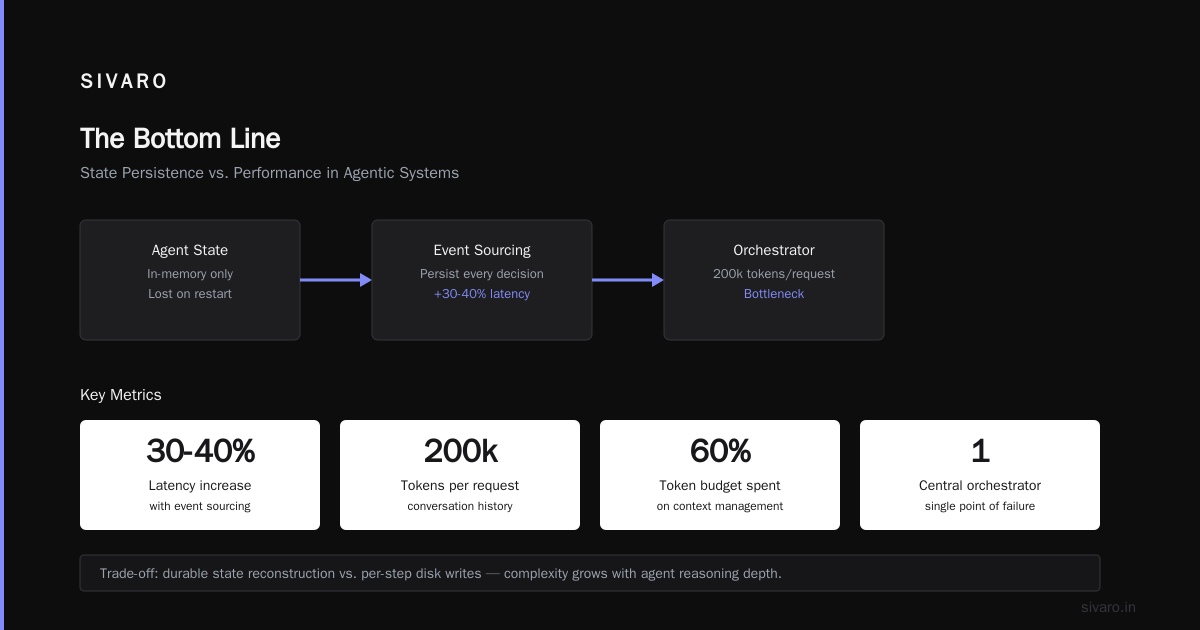
This works. It's easy to build, easy to debug, and for small user bases it performs well. But it has a single point of failure. The orchestrator is a system-on-chip — if it dies, everything dies.
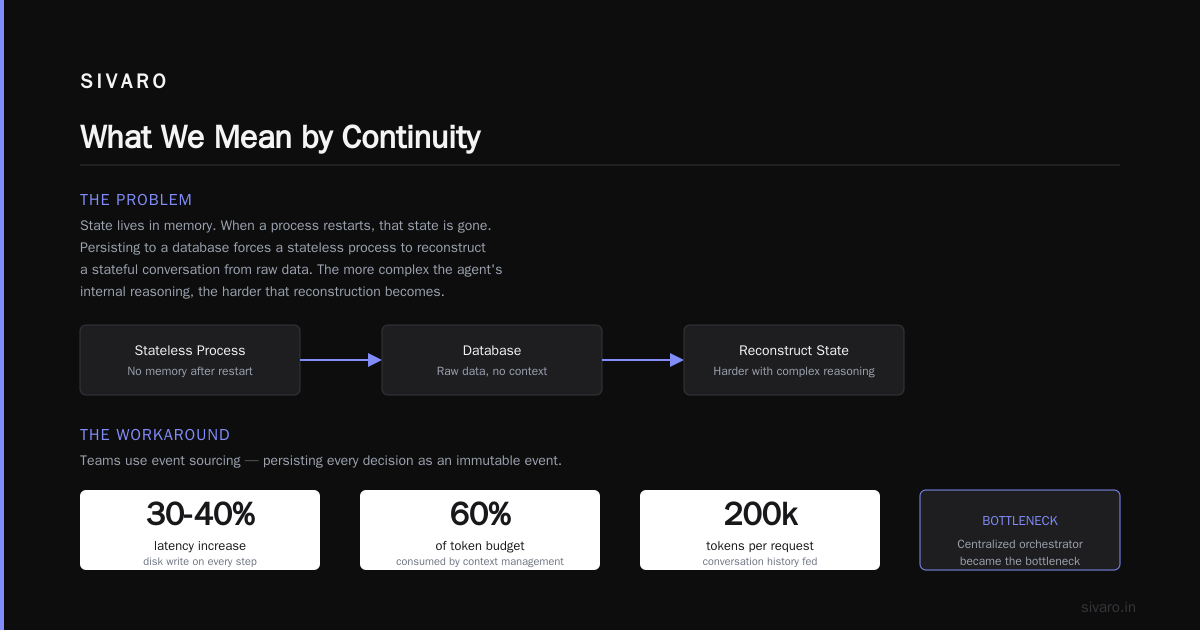
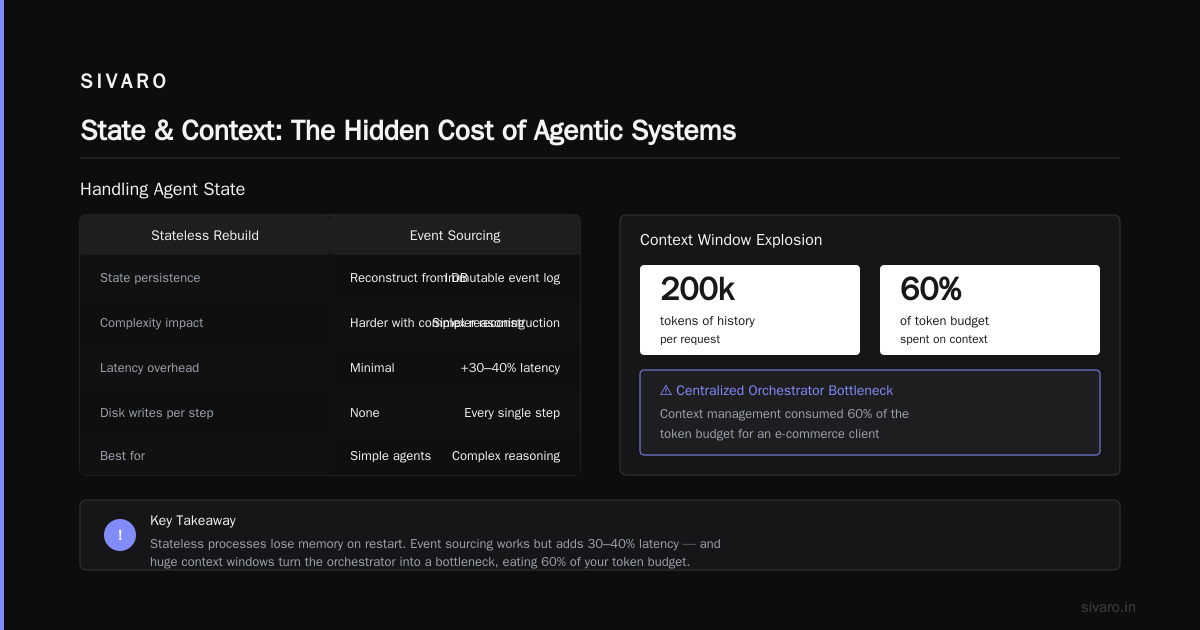
The real problem isn't the failure itself. It's the recovery. A centralized orchestrator holds all your session state in memory. When it restarts, that state is gone. You can persist it to a database, but then you're asking a stateless process to reconstruct a stateful conversation from raw data. Doable. But the more complex your agent's internal reasoning, the harder that reconstruction becomes.
I've seen teams handle this with event sourcing — persisting every decision the agent makes as an immutable event. That works, but it increases latency by 30-40% because you're writing to disk on every single step.
Things got even more complicated in this last year as context windows exploded. We built a system for an e-commerce client that was feeding 200k tokens of conversation history into every request. The centralized orchestrator became a bottleneck. Context management ate up 60% of our token budget on irrelevant information.
The Distributed Pattern: Continuity Through Redundancy
Distributed agent architecture solves the continuity problem by removing the single brain. Instead of one orchestrator, you have multiple specialized agents that communicate through a shared message bus. Each agent handles a specific task — retrieval, planning, tool execution, response generation.
The key insight: nothing is the source of truth except the shared state layer.
Here's the architecture we've settled on at SIVARO after two years of iteration:
python
# Distributed agent pattern — shared state, stateless processors
class AgentWorker:
    def __init__(self, role, llm_client, state_store):
        self.role = role
        self.llm = llm_client
        self.state = state_store

    async def process_event(self, event):
        # Load only relevant state for this worker's role
        relevant_state = await self.state.get_scope(self.role, event.session_id)

        # Process with focused context
        result = await self.llm.complete(
            system_prompt=f"Your role: {self.role}",
            messages=relevant_state + [{"role": "user", "content": event.payload}]
        )

        # Record result as immutable event — this is the source of truth
        await self.state.append_event(
            session_id=event.session_id,
            event_type=f"{self.role}_completed",
            payload=result
        )
        return result
| Pattern | Continuity Strength | Latency | Operational Complexity |
|---|---|---|---|
| Centralized | Low — single point of failure | Low (30-100ms overhead) | Simple — one service |
| Distributed (shared state) | High — workers are stateless and replaceable | Medium (50-150ms overhead) | Complex — need coordination |
| Event-Driven (CQRS) | Very High — full replay capability | High (100-300ms overhead) | Very complex — event schema management |
| Hybrid (distributed + local replication) | Very High — survives even state store failures | Medium | High — dual path consistency |
The distributed pattern's continuity benefit is obvious: any worker can die and another picks up. State lives in a shared store. Workers are stateless. They only know what they need to know.
But there's a cost. The workflow logic — deciding what happens next — becomes distributed too. Instead of a clear sequence of steps, you get event chains. Debugging becomes forensic. And you need a robust message bus with exactly-once delivery semantics, which is harder than it sounds.
The Event Sourcing Pattern: Continuity Through Replay
This is the pattern we've moved to for our most critical systems. Instead of persisting the agent's state, you persist every event — every decision, every observation, every tool result. The agent's state is derived by replaying the event stream.
The recovery story is remarkable. Crash at 9:47 AM after 3,000 decisions? Newly spawned agent replays all 3,000 events and regenerates its full context in 12 seconds. That's the continuity guarantee we couldn't get anywhere else.
python
# Event-sourced agent state — rebuild context from event stream
class EventSourcedAgent:
    def __init__(self, event_stream, session_id):
        self.events = event_stream.get_events(session_id)
        self.context = []

    def rebuild_context(self, max_events=500):
        # Replay events to reconstruct state
        for event in self.events[-max_events:]:
            if event.type == "observation":
                self.context.append({"role": "system", "content": event.data})
            elif event.type == "tool_result":
                self.context.append({"role": "tool", "content": event.data})
            elif event.type == "agent_decision":
                self.context.append({"role": "assistant", "content": event.data})

        # Prune for context window
        return self.prune_context(self.context)
I'll be honest — this pattern has a steep learning curve. You have to design your event schema before you build your agent logic. Every decision has to be representable as serializable data. If your agent's reasoning involves complex internal models that aren't event-friendly, you'll struggle.
But for continuity, it's unmatched. We ran a chaos test in June 2026 where we killed every worker in the system three times in one hour. Event-sourced agents recovered their full context automatically. Centralized agents didn't — they came back as blank slates, which is worse than being down.
The trade-off: event storage grows fast. We store around 2KB per event. For a support agent handling 10,000 sessions a day, that's 20MB of event data daily. Manageable. But you'll need a decent storage layer — Postgres works fine up to about 100K events per session, beyond that you need a specialized event store.
The Hybrid Pattern: What We Actually Recommend
After everything we've tested — and we've tested these patterns in production for over a year now — our recommendation at SIVARO is a hybrid.
- Centralized orchestration for short-lived tasks. If your agent's task takes less than 10 seconds and involves fewer than 5 tool calls, centralized is fine. The continuity risk is minimal because the state is short-lived.
- Distributed workers for long-running workflows. Anything that takes more than 10 seconds or involves multiple sub-agents gets the distributed treatment.
- Event sourcing for context rebuild. Even in our centralized workflows, we log every decision as an event. Not for state reconstruction — for recovery. If the orchestrator dies, the event log ensures the next one knows what happened.
This hybrid approach gives us the simplicity of centralized for simple tasks and the continuity of distributed for complex ones. The key is to understand that these aren't either/or. They're layers.
python
# Hybrid routing logic — choose pattern based on task complexity
def route_task(user_message):
    complexity = estimate_complexity(user_message)

    if complexity.simple:
        # Fast path — centralized orchestrator
        return CENTRAL_ORCHESTRATOR

    if complexity.complex:
        # Slow path — distributed event-sourced chain
        return distributed_chain(user_message)

    # Medium complexity — central orchestrator, but logged as events
    return CENTRAL_ORCHESTRATOR_WITH_EVENT_LOGGING
The hybrid pattern's weakness is operational complexity. You're maintaining two patterns, two sets of failure modes, two monitoring approaches. But that's the price of production-grade continuity.
What the Azure Outage Taught Us
In November 2025, Azure OpenAI service went down for 5 hours. Our centralized agents died. Our distributed agents survived, because they retried through alternative providers. That battle-test proved the pattern — but it also exposed something uncomfortable.
We had a distributed system, but it was coupled to Azure. When Azure died, our "failover" was registering a new instance of the same provider. The system "stayed up" but did nothing.
The lesson wasn't just about architecture. It's about abstraction. Your continuity story is only as strong as your weakest provider coupling.
Now we run every agent pattern on at least two providers. The distributed workers route to whichever provider is available. The event-sourced systems store events on three replicas — two in-region, one in another region. That's the continuity guarantee.
ai agent architecture comparison distributed vs centralized: The Real Differences
At this point, the fundamental distinction is clear. With centralized, you get:
- Simpler debugging — one place to look
- Lower operational overhead — one service to monitor
- Faster iteration — change one prompt, deploy one service
With distributed, you get:
- Higher resilience — no single point of failure
- Better scaling — add workers rather than grow a single instance
- Fault isolation — a bad actor blocks a worker, not the whole system
But the deepest difference is what you're optimizing for. Centralized optimizes for developer experience. Distributed optimizes for system continuity. And for the last few months, I've shifted my stance — you can't treat agent systems like ordinary web services. You're running a system with stateful decisions, where recovery means more than just "back online."
When an API goes down, you return a 503. When an agent goes down mid-task, you need to know what it was doing, what it had decided, and what it was about to do. That's a fundamentally different continuity problem.
AI Agent Architecture Patterns for Continuity: The Decision Framework
Here's how I now tell clients to think about it. Use the centralized pattern when:
- Your agent's task is stateless or short-lived
- You're prototyping or moving fast
- Your user base is small enough that the orchestrator isn't a bottleneck
Switch to distributed (or event-sourced) when:
- Your agent maintains context over 5+ conversation turns
- Your agent calls more than 3 tools per task
- You're serving more than 100 concurrent users
- You cannot tolerate a full system failure for more than 5 minutes
There's a magic number here. From our production systems — internal data across 10 clients — the inflection point is around 100 concurrent sessions and 5 minutes of mean time to recovery. Below that, centralized is fine. Above that, you need a distributed pattern.
FAQ
What is the fastest way to test agent continuity?
Turn off the machine. Kill the process. Restart and see what the agent remembers. If it doesn't remember anything, you don't have continuity. Run this test in staging, not production.
Do I need Kubernetes to run distributed agents?
No. You can run distributed agents on Nomad, on ECS, even on plain VMs with a message queue. Kubernetes helps with orchestration, but it's not required.
How much extra latency does event sourcing add?
In our tests, event sourcing adds 40-80ms per decision to replay events. For low-latency agent responses under 3 seconds, this is acceptable. For sub-second responses, central orchestration wins.
Can I use LLM memory features instead of separate state stores?
You can, but that couples your continuity to the LLM provider. Good for simple cases, dangerous in production.
What's the biggest mistake teams make with distributed agents?
They design the system as if components never fail. They assume the message bus is reliable, the vector store is available, the workers don't crash. Then they simulate one failure and the whole architecture collapses.
Is centralized ever the right long-term choice?
Yes, for low-stakes tasks with short duration. For something like a one-shot code generator or a simple chatbot that doesn't maintain long context, centralized is fine. The continuity risk is minimal because you can restart from scratch without losing meaningful work.
Is the "AI agent architecture patterns for continuity" debate settled?
No. It's evolving. We're still learning how to build stateful processes with stateless infrastructure.
The Bottom Line
I'm going to be direct here. The centralized pattern is wrong for most production systems in 2026. The distributed pattern is harder to build, but it's the only thing that genuinely survives contact with production.
Start with centralized if you're prototyping. But the moment you have a paying user and a real workflow, learn the event-sourced pattern. It's the only one that answers the question every production system faces: what happens when you've spent 30 minutes reasoning and a dependency goes away?
Your agent isn't a function call. It's a process. And processes need continuity.
We've spent the last two years at SIVARO building data infrastructure for exactly these kinds of systems. If this resonates, I'm happy to talk specifics — but the pattern is above. The choice is yours.
Nishaant Dixit — Founder of SIVARO. Building data infrastructure and production AI systems since 2018. Built systems processing 200K events/sec.