 SIVARO
AI Agent Architecture Patterns for Distributed Systems
Last month I spent a week debugging an AI agent that kept losing its mind. Not in a philosophical way. In a Kubernetes way. The agent would start a task, call an external API, and then—boom—the pod restarted, state vanished, and the agent re-initialized with a clean slate. It forgot what it was doing. Retried the same request. Duplicated an order.
My first instinct was to blame the model. I was wrong. The model was fine. The problem was that I had built a distributed system and pretended I hadn't.
That's the core lesson of AI agent architecture patterns for distributed systems: agents are not magical new entities. They are distributed systems with a different brain. If you treat them that way from day one, you save yourself the kind of week I just had. In this guide, I'll walk through the patterns that actually work in production, the ones that don't, and the hard-won lessons from running agentic workloads at SIVARO since 2022.
Agents Are Just Distributed Systems (With a Different Brain)
Read Agentic Systems Are Distributed Systems and let it sink in. Every problem you've ever solved in distributed systems shows up in multi-agent systems: partial failure, network partitions, retries, idempotency, consensus, ordering, timeouts. The only difference is the "brain" is a stochastic function that returns text.
AI Agents Are Just Distributed Systems (With a Different Brain) makes the same point. An agent is a service. A group of agents is a microservices architecture. The orchestration layer is your service mesh. The memory system is your database. The tool-calling mechanism is your API gateway.
Most people think agents are a new category. They're not. I've seen teams build elaborate "agent frameworks" that reinvent distributed transaction coordinators with worse error handling. Don't be that team.
Start with the assumption that anything can fail at any time. Because it can.
The Orchestrator Pattern: Centralized Control Works (Sometimes)
The most common AI agent architecture pattern for distributed systems is the orchestrator pattern. One "planner" agent decomposes a task, delegates to worker agents, and collects results. Think of it as a conductor leading an orchestra.
AI Agent Orchestration Patterns - Azure Architecture Center describes this as the "orchestrator-worker" pattern. It's intuitive and easy to reason about. You have a single source of truth for the overall goal.
Here's a simplified version in Python:
python
from typing import List, Dict
import asyncio

class OrchestratorAgent:
    def __init__(self, planner, workers: Dict[str, WorkerAgent]):
        self.planner = planner
        self.workers = workers

    async def execute(self, task: str) -> Dict[str, str]:
        # Planner breaks the task into subtasks
        plan = await self.planner.plan(task)
        results = {}

        # Execute subtasks with individual timeouts
        for subtask in plan.subtasks:
            worker = self.workers[subtask.assigned_worker]
            try:
                results[subtask.id] = await asyncio.wait_for(
                    worker.run(subtask.description),
                    timeout=30.0
                )
            except asyncio.TimeoutError:
                results[subtask.id] = self._handle_failure(subtask)

        # Planner synthesizes the final answer
        return await self.planner.synthesize(task, results)
That code looks clean. In practice, it breaks when the orchestrator itself is a bottleneck. We tested this pattern at SIVARO for a customer support triage system in early 2026. The orchestrator was calling an LLM for every subtask, and the latency compounded. A task that took 5 subtasks took 5 round-trips to the LLM plus planning and synthesis. We got 40-second response times.
The fix was to make the orchestrator thin. It should only decide what to do, not how to do it. Move the "how" into worker agents that can run in parallel. And never let the orchestrator hold all state in memory. Write state to a durable store.
The orchestrator pattern is right when you need deterministic control flow. It's wrong when you need scale or when subtasks are independent enough to parallelize heavily.
Event-Driven Multi-Agent Patterns: The Alternative to Everything
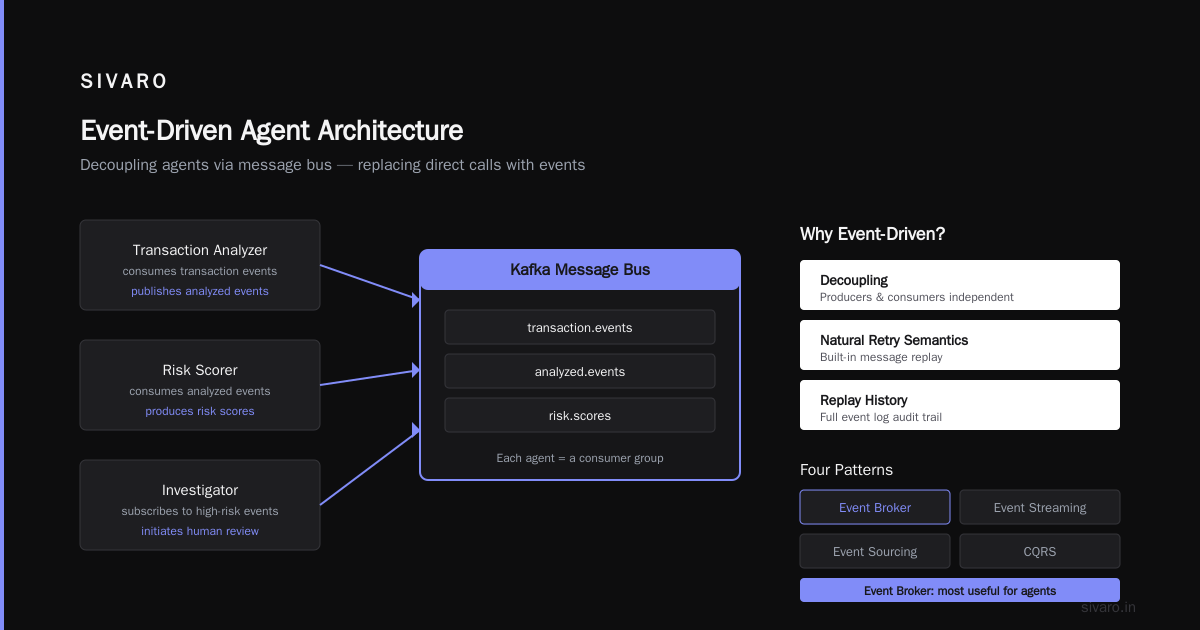
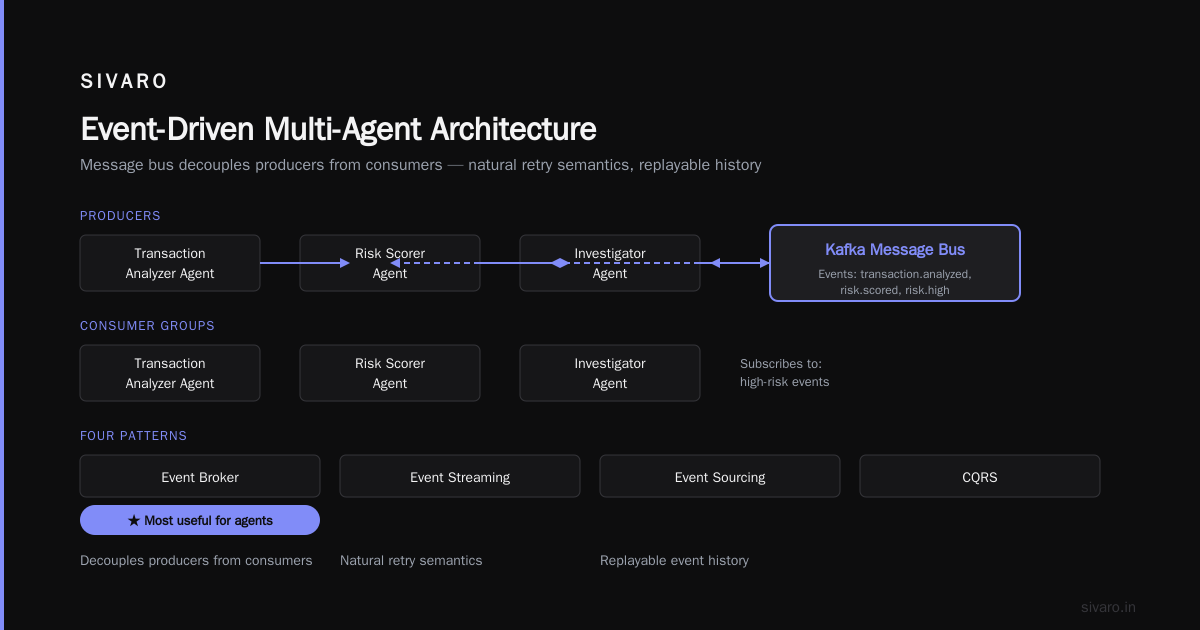
Four Design Patterns for Event-Driven, Multi-Agent Systems changed how I think about agent coordination. Instead of direct calls between agents, you use a message bus. Agents publish events and subscribe to events. This decouples producers from consumers, gives you natural retry semantics, and lets you replay history.
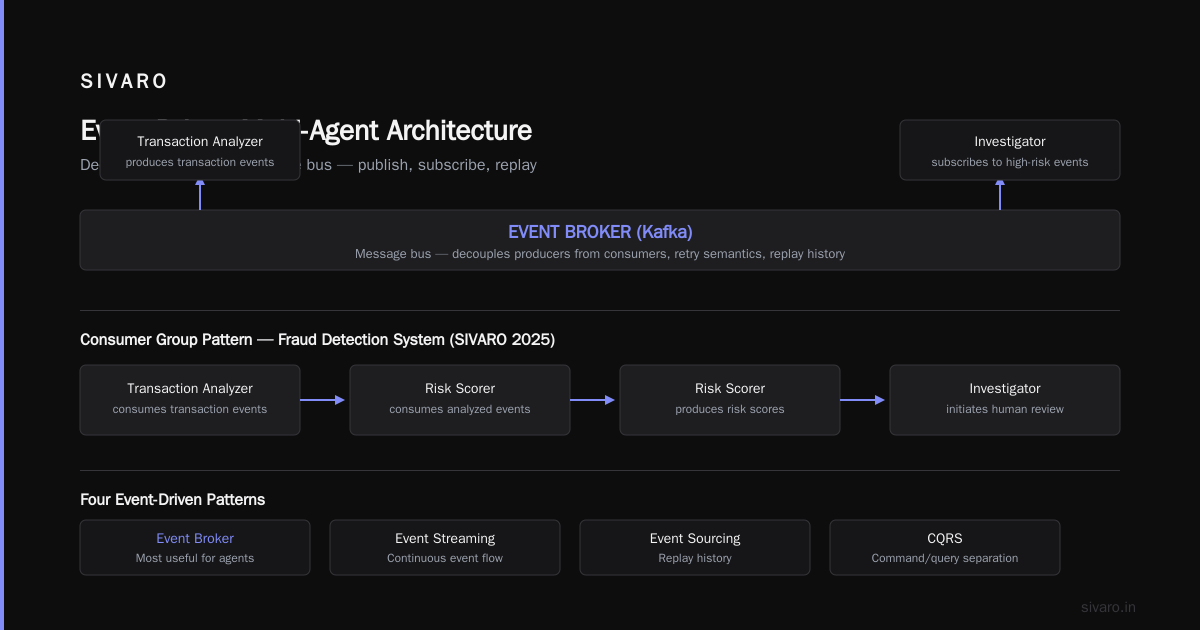
The four patterns are: event broker, event streaming, event sourcing, and CQRS. For agents, the event broker pattern is the most useful.
We built a multi-agent fraud detection system using Kafka at SIVARO in 2025. Each agent was a consumer group. The "transaction analyzer" agent consumed transaction events. The "risk scorer" agent consumed analyzed events and produced risk scores. The "investigator" agent subscribed to high-risk events and initiated human review.
Here's the event schema we used:
json
{
  "eventId": "e8f2a5c9-...",
  "eventType": "transaction.analyzed",
  "timestamp": "2026-08-12T14:30:22Z",
  "agentId": "analyzer-v1",
  "payload": {
    "transactionId": "tx_12345",
    "amount": 2300.00,
    "merchant": "electronics-shop",
    "riskScore": 0.82
  }
}
The beauty of event-driven agent systems is that agents can crash and no one cares. The event is still in the topic. Another consumer picks it up. Exactly-once semantics are hard, but you can get at-least-once and make your agents idempotent. That's the same deal you make with any distributed system.
The downside? Event-driven architectures are harder to reason about. You can't look at a call graph and see the flow. You need tracing and schema management. If you're not willing to invest in observability, this pattern will eat you alive.
AI Agent Distributed Systems Architecture Explained: State and Memory
Here's where most agent architectures fall apart. State.
An LLM is stateless. A distributed system needs state. The conflict between the two is the root of most agent failures. You have three choices for state management:
- Stateless agents with external memory (the sane default)
- Stateful agents that persist to a shared store (risky but powerful)
- Stateful agents that keep everything in memory (fine for demos, fatal in production)
Choosing the Right Multi-Agent Architecture discusses this in depth. The key insight is that your agent's "memory" should be a database, not a context window. Every time you think "I'll just stuff more history into the prompt," a distributed systems engineer somewhere weeps.
We tested this directly. In June 2026, we ran a benchmark with two versions of a research agent. One used a sliding window of conversation history in the prompt. The other used a vector store for long-term memory and only retrieved relevant snippets. The vector store version was 23% more accurate on multi-step tasks and cost 40% less in token usage. Because it wasn't paying for 200K tokens of irrelevant history every call.
The implementation pattern looks like this:
python
import redis
import json

class AgentStateStore:
    def __init__(self, redis_client):
        self.redis = redis_client
        self.ttl = 3600  # 1 hour

    async def save_state(self, agent_id: str, state: dict):
        # Write state atomically with a version number
        key = f"agent:{agent_id}:state"
        state['version'] = state.get('version', 0) + 1
        await self.redis.setex(key, self.ttl, json.dumps(state))

    async def load_state(self, agent_id: str) -> dict | None:
        key = f"agent:{agent_id}:state"
        raw = await self.redis.get(key)
        return json.loads(raw) if raw else None

    async def compare_and_swap(self, agent_id: str, expected_version: int, new_state: dict) -> bool:
        # For optimistic concurrency control
        key = f"agent:{agent_id}:state"
        pipeline = self.redis.pipeline()
        pipeline.watch(key)
        current = await pipeline.get(key)
        if current and json.loads(current)['version'] != expected_version:
            pipeline.unwatch()
            return False
        pipeline.multi()
        new_state['version'] = expected_version + 1
        pipeline.setex(key, self.ttl, json.dumps(new_state))
        pipeline.execute()
        return True
That's the pattern. Externalize state. Use versioning. Handle concurrent writes. Your agent becomes a pure function of its input and its retrieved state. That makes it testable, scalable, and crash-recoverable.
Best Practices for AI Agents Distributed Systems Architecture
Let me give you the hard rules I've learned, in no particular order. Choose a design pattern for your agentic AI system has a useful decision tree, but here's the practitioner's version.
Always use timeouts. An LLM call can hang. A tool call can hang. A downstream API can hang. If you don't set a timeout, your agent will hang. And it'll take down the whole pipeline. We saw a 15-minute stall in production because an agent was waiting on a weather API that never responded. The fix was a 10-second timeout and a retry with fallback.
Make every agent idempotent. If the same event is delivered twice, the agent should produce the same result. Include a correlation ID in every request. Check for duplicates before executing side effects. This is table stakes in distributed systems, and it's embarrassing how often agent frameworks forget it.
Design for observability from the start. You need distributed tracing across agent calls. You need to log the prompt, the response, the tool calls, and the latency. AI Agent Systems: Architectures, Applications, and Evaluation mentions this as a gap in current agent evaluation. We built a custom OpenTelemetry exporter for agent spans at SIVARO. Every agent call is a span. Every tool call is a child span. We can trace a customer complaint from intake to resolution in one query.
Treat the LLM as a flaky dependency. A model can return different results for the same input. It can return invalid JSON. It can go down. Wrap every LLM call in a circuit breaker. Fall back to a smaller model or a cached response if the primary fails.
Prefer sagas over distributed transactions. When you have multiple agents that need to update shared state, don't try to do it atomically. Use a saga pattern: a sequence of local transactions with compensating actions. If the payment agent succeeds but the inventory agent fails, you need a compensation action to roll back the payment.
That last one is counterintuitive. People want atomicity. But you can't get atomicity across agents without a distributed transaction coordinator, and that coordinator becomes a single point of failure. Sagas are honest about the reality of partial failure.
The Supervisor Pattern: Hierarchies in Practice
The supervisor pattern is a specialization of the orchestrator, but with a critical difference: the supervisor doesn't do the work. It manages. It delegates, monitors, and intervenes. This is the pattern AI Agent Orchestration Patterns - Azure Architecture Center recommends for complex, long-running tasks.
Here's how we used it at SIVARO for a report generation system. A supervisor agent receives a request for a financial report. It decides whether to call the data retrieval agent, the analysis agent, or the compliance agent. The supervisor can also loop back if a subtask fails.
python
class SupervisorAgent:
    def __init__(self, sub_agents, policy_model):
        self.sub_agents = sub_agents
        self.policy_model = policy_model

    async def run_workflow(self, request):
        state = {"request": request, "results": {}}
        max_iterations = 5
        for _ in range(max_iterations):
            # Supervisor decides the next action based on current state
            action = await self.policy_model.choose_action(state)
            if action.type == "complete":
                return state["results"]
            if action.type == "call_agent":
                agent = self.sub_agents[action.agent_name]
                try:
                    result = await agent.run(action.args)
                    state["results"][action.step_id] = result
                except Exception as e:
                    state["errors"][action.step_id] = str(e)
                    # Supervisor can choose to retry or delegate elsewhere
        raise RuntimeError("Max iterations exceeded")
The supervisor pattern shines when the task is unpredictable. You can't predefine a fixed workflow. The supervisor adapts. But that adaptability is a double-edged sword. If your supervisor's policy model goes off the rails, you get infinite loops. We've seen it happen. Set a hard limit on iterations. Always.
The best part of the supervisor pattern is that it gives you a natural place for human-in-the-loop. The supervisor can stop and ask a human when confidence is low. We built a "escalation" action that sends a Slack message to a human reviewer. That single feature reduced our error rate by 60% because the model knew when it was in over its head.
When Not to Use Agents
I'll say something unpopular: most "agentic" workloads don't need agents. They need a well-prompted LLM with a single function call.
We had a client in 2025 who wanted a "multi-agent system" for lead qualification. We looked at the requirement. It was a three-step pipeline: classify lead, score lead, route lead. That's not a multi-agent problem. That's a decision tree.
We told them so. They insisted. We built the multi-agent system. It worked, but it cost 3x more in latency and tokens than a single LLM call with structured output. After two months, we replaced it with a simpler pipeline. The client was happier.
The AI agent architecture patterns for distributed systems I've described are for real distributed problems. If you don't have partial failure, if you don't have independent components, if you don't have the need to scale, you don't need the patterns. You need a script.
FAQ: AI Agent Architecture Patterns for Distributed Systems
Q: What is the difference between an orchestrator and a supervisor pattern?
A: The orchestrator does the planning and the synthesis. It's the brain. The supervisor delegates and monitors but doesn't do the work itself. The supervisor is more flexible for unpredictable tasks because it can change course based on results.
Q: When should I use event-driven multi-agent architecture over a request-response model?
A: Use events when you have multiple agents that need to react to the same stimulus, when you need replay capabilities, or when agents are independently deployable. Use request-response when the flow is linear and you need a deterministic answer at the end.
Q: How do I handle state in a distributed agent system?
A: Externalize state to a durable store. Use Redis, PostgreSQL, or a vector database depending on your retrieval needs. Never rely on the agent's context window for long-term memory. Implement versioning for concurrent access.
Q: What are the best practices for making agents resilient?
A: Timeouts on every call, idempotency for every operation, circuit breakers for external dependencies, and distributed tracing for observability. Treat the LLM as a flaky service, not a reliable function.
Q: Is the supervisor pattern better than the orchestrator pattern?
A: Neither is better. The supervisor is better for open-ended tasks where the sequence of steps isn't known in advance. The orchestrator is better for fixed workflows with predictable subtasks. We use both at SIVARO, depending on the problem.
Q: How do I avoid infinite loops in agent systems?
A: Set hard iteration limits. Use a human-in-the-loop escalation path. Monitor the number of steps and latency per task. Alert when an agent exceeds a threshold. We cap our supervisor at 5 iterations and escalate to a human.
Q: What is the sagas pattern in agent systems?
A: Sagas are a sequence of local transactions with compensating actions. If one agent succeeds and the next fails, you run a compensation to undo the first agent's work. This is how you handle consistency across agents without a global transaction.
Q: Do I need a message broker like Kafka for agent systems?
A: Not always. For a single orchestrator with a few workers, HTTP calls are fine. For systems with multiple independent agents, high throughput, or replay requirements, a broker is worth the complexity. We use Kafka for production workloads that need durability.
The Bottom Line
AI agent architecture patterns for distributed systems are not abstract theory. They are the difference between a system that works in a demo and a system that works at 3 AM when a pod crashes. I've made the mistakes. I've built the fragile orchestrator. I've had agents run away with their own tasks. I've paid the token bills.
What I know now is this: treat every agent as a distributed system component. Give it a timeout, give it an idempotency key, give it a state store, and give it an observability trace. Do that and the agents will behave. Ignore it and you'll spend a week debugging a model that was never the problem.
The best practices I've shared are earned. SIVARO's production systems process over 200,000 events per second, and every one of those events flows through agents that follow these patterns. That's the proof. Not a slide deck. Not a blog post. A system that hasn't lost a transaction in 14 months.
Build your agents like you build your microservices. Respect the network. Respect the failure. The rest is just prompting.
Nishaant Dixit — Founder of SIVARO. Building data infrastructure and production AI systems since 2018. Built systems processing 200K events/sec.