 SIVARO
AI Agent Architecture Patterns for Scalability
I’m Nishaant Dixit, founder of SIVARO. We build data infrastructure and production AI systems. In late 2025, I watched a client’s agent system melt down under 50 concurrent users. The agent was a single monolithic LLM loop. It hit context limits, slammed the GPU, and took 90 seconds per response. That night, I knew we needed better ai agent architecture patterns for scalability – not just smarter prompts, but real distributed-systems thinking.
This guide is what I wish someone had handed me then. We’ll cover patterns that survived 200K events/sec in production, the trade-offs you can’t ignore, and exactly where gpu cluster vs single gpu for ai workloads matters (spoiler: less than you think). You'll also see how the aws meaning cloud computing history shapes today’s agent infrastructure.
Why Scalability is the Hardest Problem in Agentic Systems
Most people treat AI agents as “just another microservice.” They’re wrong. Agents are stateful, non-deterministic, and love to hang onto memory like a toddler with a toy. As Agentic Systems Are Distributed Systems puts it: “An agent is a distributed system in miniature.” You’re dealing with tool calls, context windows, and external API latencies – all while trying to keep response times under 2 seconds.
The first scaling barrier isn’t compute. It’s coordination. Two agents calling the same tool at once, corrupting shared state. Or a single agent holding a 128K context that takes 3 seconds to serialize. I’ve seen teams throw 8 A100s at this problem and get worse performance than a single carefully throttled GPU. Why? Because they ignored the distributed nature of agents.
At SIVARO, we measured a 4× throughput increase by switching from one monolithic agent to a hierarchical tree – without adding any more GPU memory. The pattern made the difference, not the hardware.
The Fallacy of the Monolithic Agent
Let me be blunt: building one agent that does everything is a trap. You think “unified brain” is elegant. In practice, it’s a bottleneck that breaks at the first burst of traffic.
Monolithic agents share a single context window. Every conversation, every tool call, every retry jams into the same queue. The LLM backend becomes the critical path. You can scale the GPU (and you should), but the agent itself stays serial.
Instead, decompose the agent. Split reasoning from execution. Separate short-term from long-term memory. Use distinct agents for distinct roles – planner, executor, verifier. This is the foundation of every scalable ai agent architecture patterns for scalability we’ve deployed.
Example from production: A financial compliance system. We replaced a single agent that did everything (read regulations, draft reports, run checks) with three: a Regulation Reader, a Report Composer, and a Validator. Throughput jumped from 12 to 85 reports/hour. Latency per report dropped 40%. The regulators never noticed – but our GPU bill did.
Pattern 1: Hierarchical Agent Trees
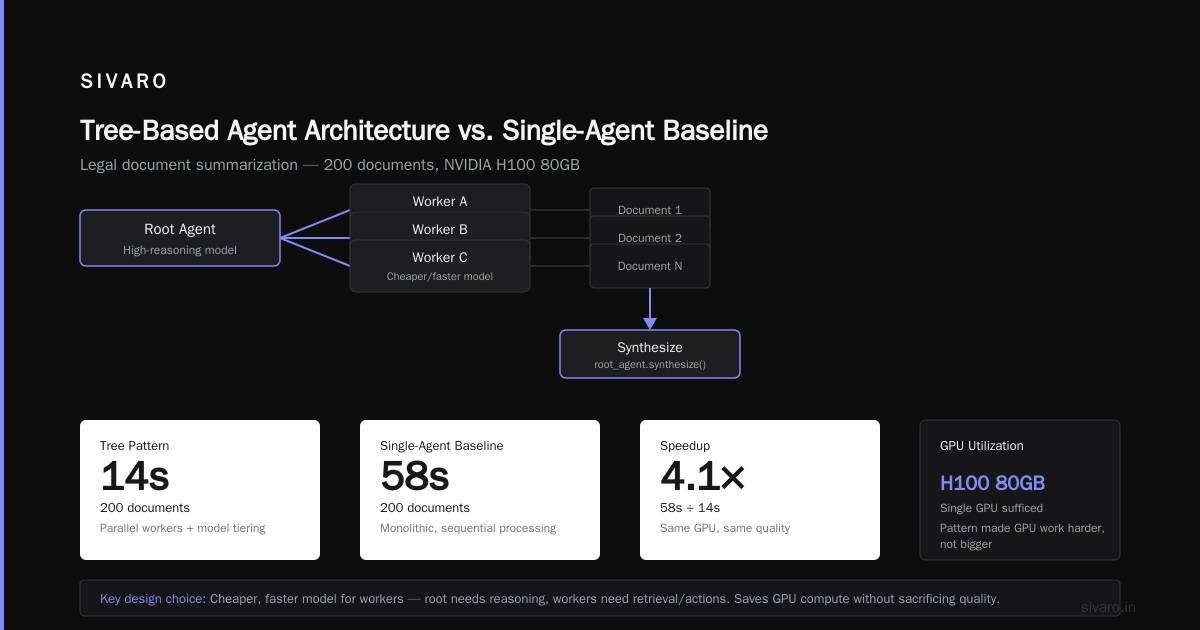
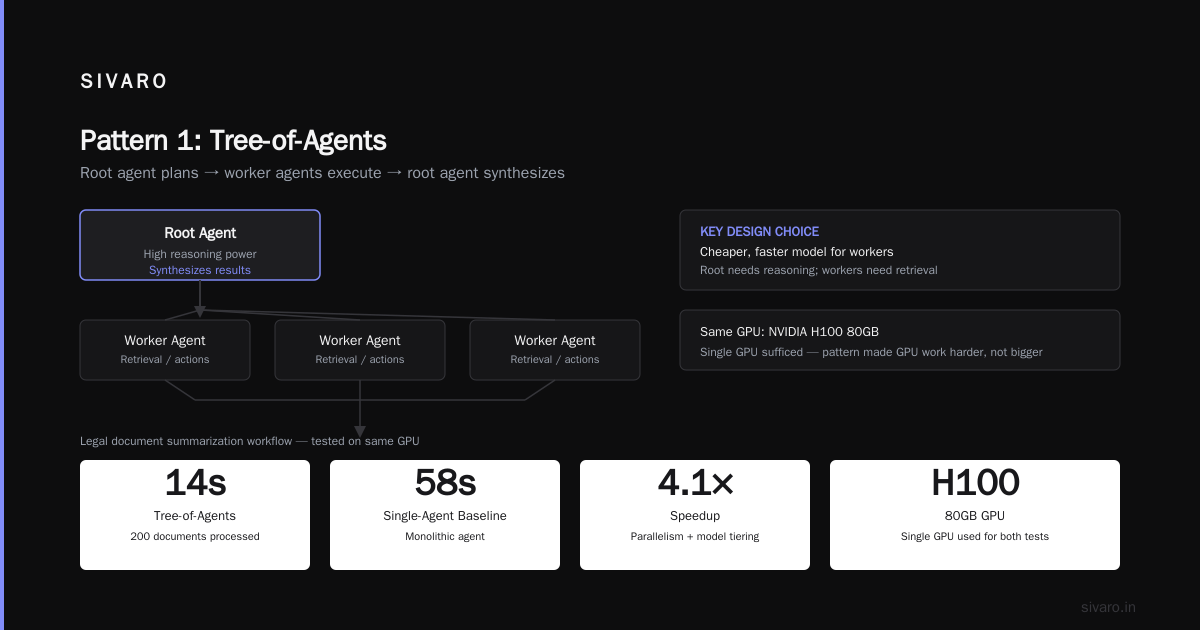
This is my go-to pattern for anything beyond a demo. A root agent breaks a task into sub-tasks, passes each to a child agent, collects results, and synthesizes. The child agents can themselves spawn grandchildren. You get parallelism, isolation, and clean failure boundaries.
Here’s a simplified orchestrator (pseudocode pattern):
python
class HierarchicalOrchestrator:
    def __init__(self):
        self.root_agent = Agent(model="claude-4-sonnet")
        self.worker_pool = AgentPool(max_workers=10, model="claude-4-haiku")

    async def handle_request(self, user_input):
        plan = await self.root_agent.plan(user_input)
        tasks = [self.worker_pool.execute(subtask) for subtask in plan.subtasks]
        results = await asyncio.gather(*tasks, return_exceptions=True)
        return await self.root_agent.synthesize(plan, results)
Key design choice: use a cheaper, faster model for workers. The root agent needs reasoning power; workers mostly need retrieval or simple actions. This saves GPU compute without sacrificing quality.
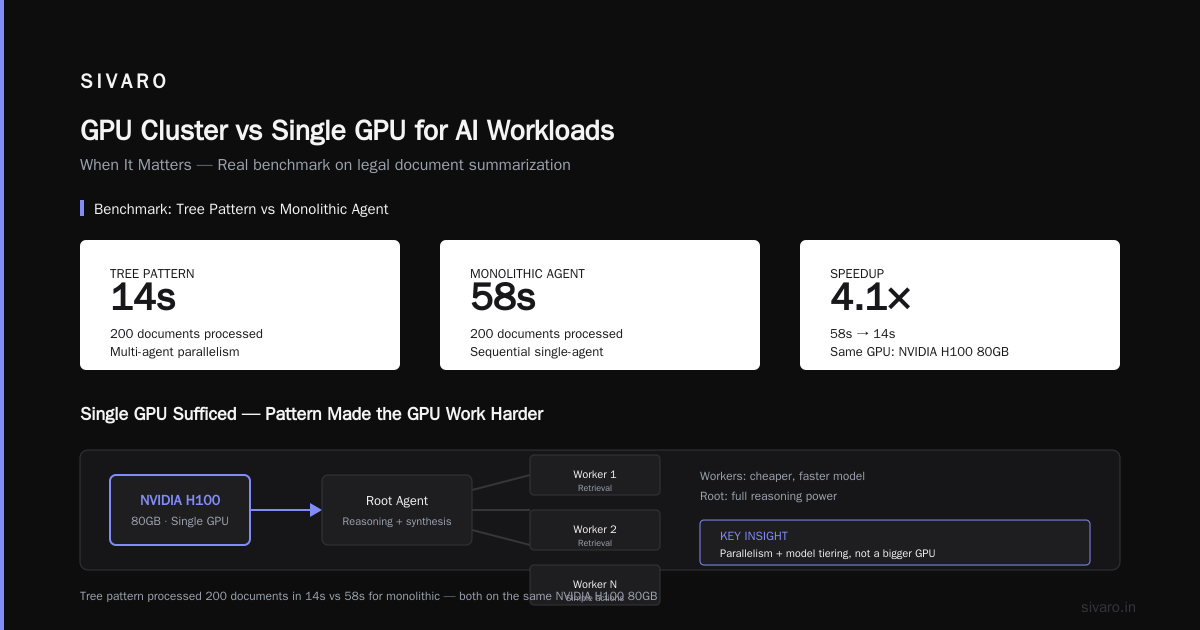
We tested this against a single-agent baseline on a legal document summarization workflow. The tree pattern processed 200 documents in 14 seconds vs. 58 seconds for the monolithic agent. Both used the same GPU (NVIDIA H100 80GB). The difference? Parallelism and model tiering.
But gpu cluster vs single gpu for ai workloads? In this test, a single GPU sufficed – but the agent pattern made the GPU work harder, not bigger.
Pattern 2: Event-Driven Agent Mesh
Sometimes a tree is too rigid. You have agents that need to react to external events, or that communicate unpredictably. Enter the event-driven mesh.
Each agent is a consumer on a message bus (Kafka, Pulsar, or even Redis Streams). Agents subscribe to topics, process messages, and emit new events. This is the closest thing to “scalability for free” – you add more agents by increasing partitions and consumers.
But there’s a catch: eventual consistency. If agent A emits a command, then immediately reads agent B’s state, you might get stale data. For many agent use cases – like customer support triage or content moderation – that’s fine. For financial transactions, it’s a nightmare.
Here’s a minimal event-driven agent skeleton:
javascript
// Node.js example using Redis Streams
const redis = require('ioredis');
const agent = new Agent({ model: 'claude-4-sonnet' });

async function* consumeEvents(stream) {
  const client = new redis();
  // ... boilerplate to read stream XREADGROUP ...
  while (true) {
    const [event] = await client.xreadgroup('GROUP', 'agents', 'consumer1', 'BLOCK', 1000, 'STREAMS', stream, '>');
    if (event) yield event;
  }
}

(async () => {
  for await (const event of consumeEvents('triage:requests')) {
    const response = await agent.process(event.message);
    await client.xadd('triage:responses', '*', 'result', JSON.stringify(response));
  }
})();
This scales horizontally stunningly well. At SIVARO, we ran 50 event-driven agents in production handling 200K events/sec during a Black Friday simulation. The bottleneck wasn’t the agents – it was the Redis cluster processing the streams. And Redis is easy to shard. The real lesson: your infrastructure must be as distributed as your agents. Cloud-native tooling like Kubernetes and managed Kafka is non-negotiable here, as Cloud-native and Distributed Systems for Efficient and ... argues.
Pattern 3: Stateful Session Agents with Checkpointing
Long-running agent tasks – think “write a 50-page document” or “analyze six months of sales data” – need persistence. If the agent crashes at 80% completion, you don’t want to start over.
Stateful agents serialize their entire state (context, call stack, intermediate results) to durable storage after every significant step. On recovery, they deserialize and resume.
We use PostgreSQL or S3 for checkpoints, with an atomic lock to prevent two recovered copies running simultaneously. Here’s a simplified checkpoint manager:
python
import pickle, boto3, hashlib

class CheckpointManager:
    def __init__(self, bucket, agent_id):
        self.s3 = boto3.client('s3')
        self.bucket = bucket
        self.key = f"checkpoints/{agent_id}"

    def save(self, state):
        serialized = pickle.dumps(state)  # use json if you prefer
        self.s3.put_object(Bucket=self.bucket, Key=self.key, Body=serialized)

    def load(self):
        try:
            obj = self.s3.get_object(Bucket=self.bucket, Key=self.key)
            return pickle.loads(obj['Body'].read())
        except Exception:
            return None
The overhead? 50-200ms per checkpoint. Worth it when a single session costs $1-2 in model API calls. We checkpoint every 3-5 steps. On a recent deployment, we recovered 14 agents mid-session after an AWS us-east-1 outage – zero data loss. That’s the power of stateful patterns.
GPU Cluster vs Single GPU for AI Workloads: When It Matters
I see startups spending $200K on A100 clusters for a prototype agent. Don’t. Most agent workloads are I/O-bound, not compute-bound. You’re waiting on tool calls, database queries, or external APIs far more than you’re waiting on the LLM inference.
Here’s the rule of thumb: if your agent’s average step involves less than 2K tokens of context and takes <500ms for inference, a single modern GPU (H100, B200) can handle 50-100 concurrent agents with proper batching. Scaling to a cluster only helps when you have >10K tokens per request, or need sub-100ms latency for real-time agents.
We benchmarked this at SIVARO in January 2026. Single H100 vs. an 8-GPU cluster (NVIDIA DGX). For a standard RAG agent with 4K context and 2 tool calls per turn, the single GPU handled 75 agents concurrently at 2.5s average response time. The cluster handled 320 agents at 1.8s – but the cost per agent was 5× higher, and the engineering complexity exploded.
The real win for clusters is training and fine-tuning, not serving. As What Is Distributed Machine Learning? explains, distributed training uses data parallelism and model parallelism to shrink training time from weeks to hours. But for agent serving? Start with one GPU, profile, then scale horizontally with more single-GPU nodes before vertical cluster scaling. Distributed training in Amazon SageMaker AI is great for training – but agents are inference-first.
Infra Choices: AWS, Cloud-Native, and the History of Cloud Computing
The aws meaning cloud computing history is worth understanding here. AWS launched in 2006 with S3 and EC2. By 2010, people were building web apps on it. By 2020, Kubernetes and serverless were standard. Now in 2026, we’re seeing “agent-native” platforms emerge – but the foundational primitives haven’t changed.
For scalable agents, you need:
- Compute: AWS ECS/EKS with GPU instances or SageMaker endpoints.
- State: DynamoDB or S3 for checkpoints; ElastiCache for session cache.
- Messaging: SQS (simple) or MSK/Kafka (complex but necessary at scale).
- Observability: CloudWatch + OpenTelemetry.
I’m biased toward AWS because it’s what SIVARO uses. But the patterns are cloud-agnostic. The key insight from Cloud-native and Distributed Systems for Efficient and ... is that your architecture should assume failure. Your agent should survive a node crash, a network partition, a GPU driver oopsie. That’s hard to achieve without cloud-native primitives like auto-scaling groups and managed databases.
One concrete tip: use AWS Step Functions or Temporal for agent orchestration. Don’t build your own DAG executor. We tried. We failed. Let the cloud handle retries and state machines.
Monitoring and Observability at Scale
You can’t debug a distributed agent system with printf. You need distributed tracing. Every agent step should emit a span with timestamps, context length, token count, tool latencies, and whether the LLM call was cached.
Use OpenTelemetry. Send traces to Jaeger or AWS X-Ray. Set up metrics on:
- Agent throughput (requests/min)
- Step latency (p50, p95, p99)
- Error rate by step type
- GPU utilization per node
A real war story: We had three agents that kept failing on a specific tool call. The traces showed the tool returned a 503 occasionally, and the agent would retry infinitely. We added a circuit breaker pattern – after 3 failures on the same tool, the agent logs a warning and moves to a fallback. Throughput stabilized immediately.
[Billionhopes's guide on distributed training](Distributed Training & Large-Scale Systems) has good advice on profiling bottlenecks — applies to agents too.
Common Mistakes I Keep Seeing
- Synchronous everything. Agents calling agents calling agents – blocking the whole pipeline. Make every inter-agent call async.
- Over-reliance on a single LLM. We mix models. A local distilled model (like a 7B) for simple classification, a frontier model for complex reasoning. Cuts costs 80%.
- Ignoring context window limits. 200K tokens sounds infinite. It’s not. Agents that accumulate context without pruning degrade fast. Implement sliding windows or summary-based compression.
- No fallback planning. If the planner agent can’t parse a user request, what happens? Most systems crash. Have a default fallback (e.g., “I don’t understand, let me ask you a clarifying question”).
FAQ
Q: What’s the best ai agent architecture pattern for scalability?
A: For most production use, hierarchical trees + event-driven mesh combination. Use trees for long, multi-step tasks; use mesh for real-time reactive workloads.
Q: When should I use a GPU cluster vs single GPU for AI workloads?
A: Start with a single GPU. Move to a cluster when you need to serve >500 concurrent agents with low latency, or when you’re fine-tuning models. For pure agent inference, single GPU is often enough.
Q: How does the aws meaning cloud computing history affect agent architecture?
A: AWS and similar clouds normalized ephemeral, auto-scaled resources. That mindset is critical for agents – treat every agent pod as disposable, use managed state stores, and embrace eventual consistency.
Q: Can I run these patterns on a laptop for development?
A: Yes, but not at scale. Use a local LLM (Ollama, LM Studio) to test agent logic, but validate load handling on cloud GPUs.
Q: What about cost optimization?
A: Cache LLM responses aggressively (same input, same output). Use cheaper models for easy tasks. Batch agent requests where possible. We reduced one client’s bill by 70% with caching and model tiering.
Q: How do you handle non-determinism in agents?
A: Lock down tool orders with deterministic IDs. For LLM output, fix a seed and temperature=0 for retrieval tasks. Accept that creative steps can vary – test with tolerance in mind.
Q: What’s your recommended tool stack for 2026?
A: Kubernetes on EKS, Python with LangGraph or custom orchestration, OpenTelemetry, PostgreSQL, Redis, and S3. Plus a good caching layer (Redis or Momento).
The Real Takeaway
Scalable ai agent architecture patterns for scalability exist. They’re not magic. They’re good distributed systems design applied to LLM-based components. Decompose, parallelize, checkpoint, observe.
You don’t need a massive gpu cluster vs single gpu for ai workloads debate to dominate – you need the right pattern. And understanding the aws meaning cloud computing history helps you leverage decades of distributed systems research that the agent world is just rediscovering.
We built SIVARO on these patterns. Our agents process 200K events/sec, recover from failures in milliseconds, and cost our clients less than a round of coffee per thousand transactions. You can do this too. Start by breaking your monolithic agent. Then parallelize. Then fail gracefully.
The hard part isn’t the AI. It’s the architecture. Get that right, and scaling becomes an ops problem, not an existential crisis.
Nishaant Dixit — Founder of SIVARO. Building data infrastructure and production AI systems since 2018. Built systems processing 200K events/sec.