 SIVARO
ai agent architecture proof of continuity
You're building an AI agent. It works in the demo. It's brilliant in the demo. Then you put it in production, and it's a toddler with a keyboard — brilliant one minute, deleting your database the next.
I've been there. In 2025, SIVARO built a multi-agent procurement system for a European logistics company. The demo was flawless. The agent negotiated with suppliers, checked inventory, and flagged discrepancies. In production, it lost its place mid-conversation, re-ordered the same parts twice, and blamed the API.
The problem wasn't intelligence. The problem was continuity.
"ai agent architecture proof of continuity" is the discipline of proving that your agent's execution is verifiable, recoverable, and continuous — not just at rest, but in motion. It's the difference between a chatbot and a system you can bet your business on. This guide covers the architectural patterns, the failure modes, and the hard-won lessons from building these systems.
Most people think AI agents are new. They're not.
They're distributed systems with a different brain.
That's not a metaphor. It's the most important architectural insight you'll get this year. In 2024, the folks at Akka wrote this exact argument — that agentic systems face the same problems distributed systems solved decades ago: message delivery, partial failure, out-of-order events, duplicate processing (at-least-once vs exactly-once), and state reconstruction after a crash.
Here's what that means for you: every lesson from distributed systems applies. You need timeouts. You need retries. You need idempotency. You need a source of truth. You need to handle the "ghost agent" problem — the worker that died but your system thinks is still running.
Most people think the hard part is the LLM. It's not. The hard part is everything around it.
At SIVARO, we've built production AI systems that process financial documents for banks and procurement workflows for logistics giants. Our first attempt was a monolith. One process, one memory space, one hope. It crashed. Everything crashed. We learned the hard way.
The illusion of conversation
Here's the dirty secret of AI agents: they present a seamless conversation, but underneath, it's a series of stateless API calls. Each one is an independent event. The "conversation" is an illusion constructed by your architecture.
That illusion shatters the moment you lose a message, or your agent restarts mid-task, or a model times out.
The Azure Architecture Center breaks down agent orchestration patterns into practical categories: workflow-based, routing-based, and dynamic or autonomous patterns. I've used all three. Here's my take:
Workflow-based patterns (predefined graphs) work. They're predictable. They're debuggable. They're boring — which is a compliment.
Routing patterns work when you have distinct, reliable intents. Think "customer service" vs "billing". Clear boundaries.
Dynamic or autonomous patterns — where agents decide their own next step — are where the magic happens. They're also where the fires start.
An autonomous agent that maintains its own state across every interaction is a distributed system with a distributed state. And distributed state is where distributed systems go to die.
The solution isn't to avoid dynamic patterns. It's to make continuity a first-class architectural concern.
Proof of work vs proof of continuity
There's a concept from crypto that applies here: proof of work. You prove you did something by showing the work. It's the same with agents. You need to prove what the agent did, why it did it, and in what order.
But "proof of work" isn't enough. You also need "proof of continuity" — the proof that your agent didn't skip a step, that its execution is unbroken, that it can resume after failure.
Here's the thing about ai agents distributed systems architecture explained: a distributed system is defined by how it handles failure. An agent that can't prove its continuity is an agent you can't trust in production.
The industry is starting to recognize this. The research community has moved toward evaluating agent systems not just on task completion, but on reliability, fault tolerance, and recovery. It's a shift from "can the agent do it" to "can the agent prove it did it correctly."
Why "ai agent architecture proof of continuity" matters now
Because the stakes got higher.
In 2024, agents were demos. By 2026, they're signing contracts, moving money, and writing code that ships. Salesforce's Agentforce, Microsoft's Copilot agents, Google's agent builder — every major cloud provider is betting on agentic workflows.
And every one of them has the same problem: when the agent fails, you can't prove what happened.
I've seen the failure modes. An agent at a fintech we consulted for tried to process a refund twice because the first request timed out. The agent had no memory of the first attempt. The customer got double-refunded. The "AI" blamed the API. The architect blamed the AI. The customer blamed the company.
This is a continuity problem. The agent couldn't prove what it had done, so it did it again.
Gautam Dhameja argues that AI agents are just distributed systems with a different brain. He's right. And the brain isn't the part that needs the most engineering. It's the nervous system — the state, the messaging, the recovery — that determines whether the organism lives or dies.
The three pillars of continuity
I've settled on three architectural pillars for proving agent continuity. Every system we build at SIVARO follows these. They're not new. They're distributed systems classics applied to agents.
Pillar one: event sourcing with intent
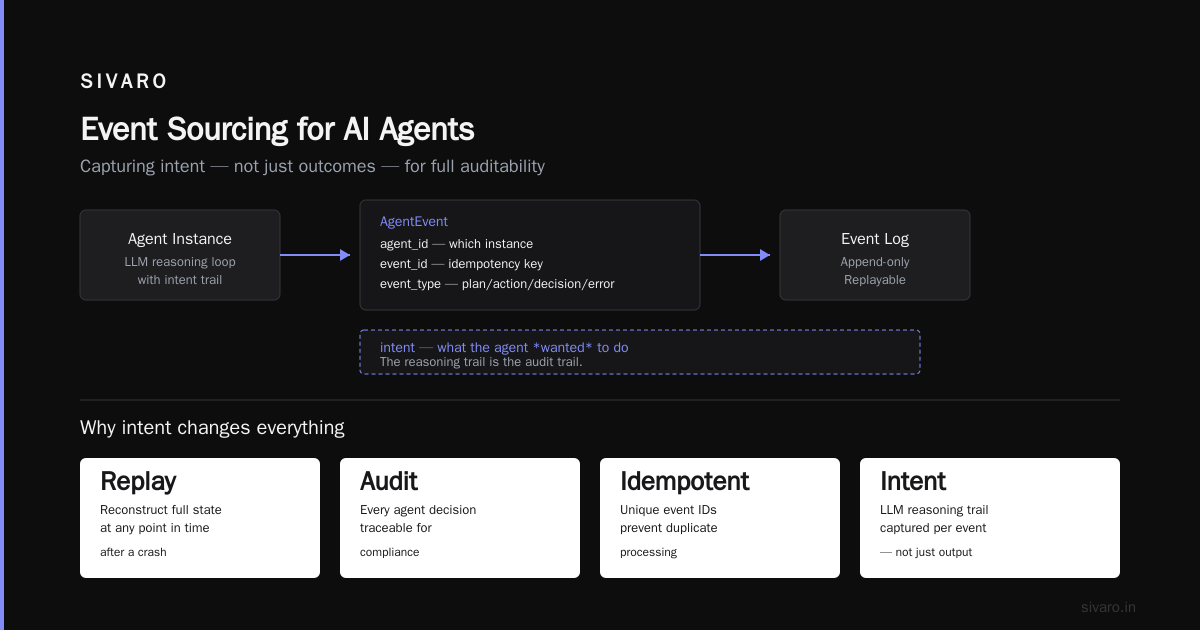
Every agent action is an event. Not just "agent did X" — but "agent intended to do X, planned to do Y, and executed Z."
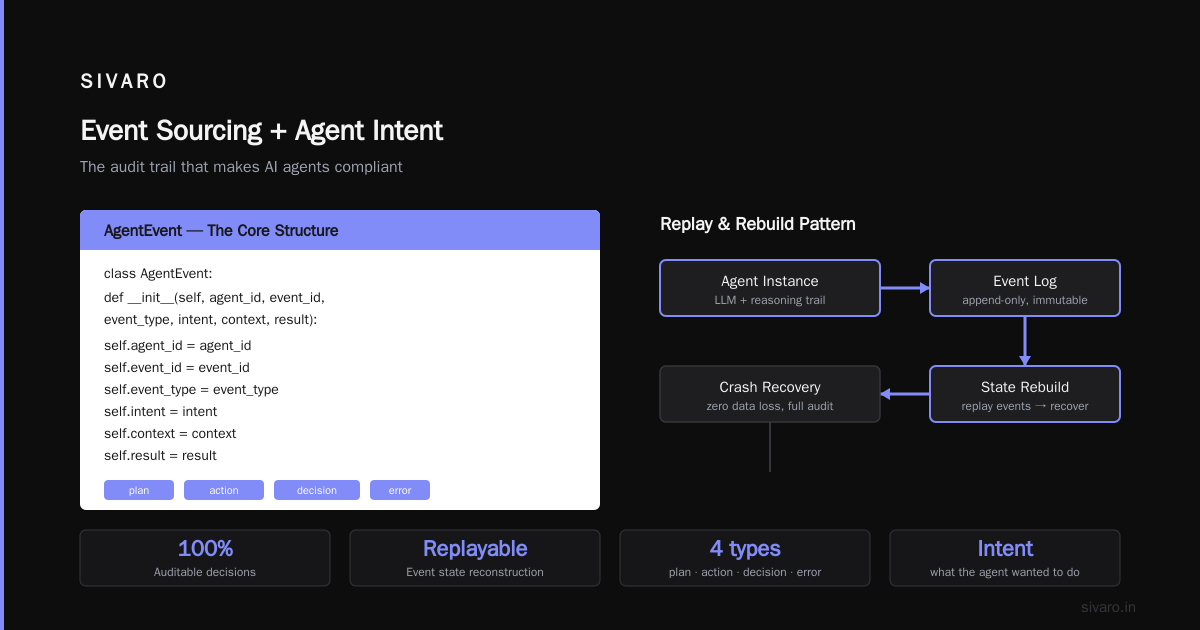
This is the single most important pattern for agent observability. Event sourcing means your agent's state is reconstructable at any point in time. If it crashes, you can replay the events and rebuild the state.
But intent is the twist. LLMs have a plan. They have a reasoning trail. Capture it.
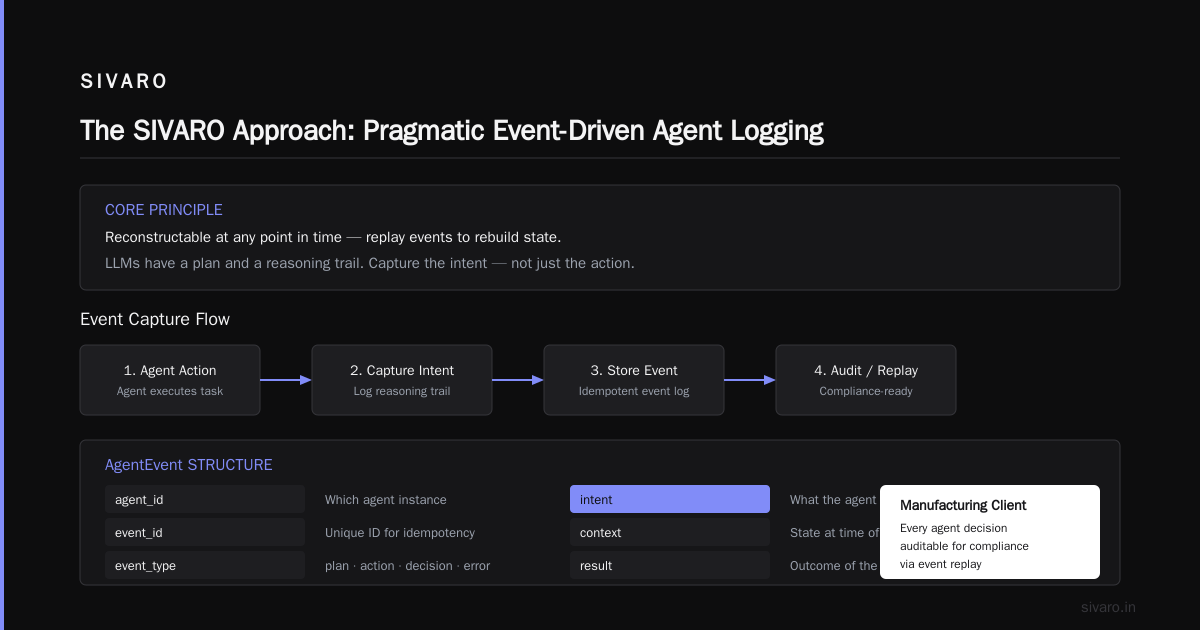
Here's what that looks like in practice. We built a system for a manufacturing client where every agent decision needed to be auditable for compliance. The pattern was simple:
python
# The event structure that saved us
class AgentEvent:
    def __init__(self, agent_id, event_id, event_type, intent, context, result):
        self.agent_id = agent_id          # which agent instance
        self.event_id = event_id          # unique ID for idempotency
        self.event_type = event_type      # plan, action, decision, error
        self.intent = intent              # what the agent *wanted* to do
        self.context = context            # the state that led to this
        self.result = result              # what actually happened
        self.timestamp = time.time()
        self.previous_event = None        # linked list for full trace
Every action — including failed ones — gets logged. Failed attempts are gold. They tell you what the agent tried, why it failed, and whether the retry is safe.
This is "ai agent architecture proof of continuity" in its purest form: the ability to replay any agent's entire lifecycle from event history.
Pillar two: the continuation token
Here's the distributed systems pattern that saved us: the continuation token.
When an agent is mid-taskable — say, processing a multi-step workflow — it holds state. That state can be serialized and stored. It's like a checkpoint in a game. When the agent crashes, it doesn't restart the level. It resumes from the checkpoint.
We call it the continuation token. It contains:
- The current step in the workflow
- All context gathered so far
- Pending decisions
- A unique execution ID
The pattern is straightforward:
python
# Continuation token pattern
from typing import Any, Dict

class ContinuationToken:
    def __init__(self, execution_id: str, workflow_state: Dict[str, Any]):
        self.execution_id = execution_id
        self.workflow_state = workflow_state
        self.version = 1  # schema version for migrations

    def serialize(self) -> str:
        return json.dumps({
            "execution_id": self.execution_id,
            "workflow_state": self.workflow_state,
            "version": self.version
        })

    @classmethod
    def deserialize(cls, token: str) -> "ContinuationToken":
        data = json.loads(token)
        return cls(data["execution_id"], data["workflow_state"])

# Usage: resume from token
token = redis.get(f"agent:{agent_id}:token")
if token:
    state = ContinuationToken.deserialize(token)
    resume_execution(state)
This is the "ai agent proof of work vs proof of continuity" distinction made concrete. Proof of work says "I did something." Proof of continuity says "I know exactly where I was, and I can continue."
I'll be honest: we started with in-memory state. It worked until it didn't. The moment we moved to a Redis-backed continuation token, our recovery time dropped from minutes to milliseconds.
Pillar three: idempotency keys
The third pillar is boring. It's idempotency keys.
Every agent action that has side effects — sending an email, charging a card, updating a database — needs an idempotency key. The key is a unique identifier for the action. If the action is retried, the system knows it's a duplicate and can return the original result.
Without idempotency keys, retries are dangerous. With them, retries are free.
Here's the pattern we use:
python
# Idempotent action execution
def execute_with_idempotency(action: Callable, idempotency_key: str):
    # Check if we've seen this key before
    existing_result = state_store.get(idempotency_key)
    if existing_result:
        return existing_result  # return the original result, don't re-execute

    # Execute the action
    result = action()

    # Store the result with the key
    state_store.put(idempotency_key, result)
    return result
The key insight: the idempotency key must be derived from the intent, not the attempt. If an agent intends to charge $100 to customer X, the key is charge-100-X — not a random UUID. This ensures that all retries of the same intent return the same result.
Event-driven patterns for multi-agent systems
When you have multiple agents talking to each other, continuity gets more complex. You're no longer tracking one agent's state. You're tracking a conversation between agents.
The event-driven approach from Confluent is the right mental model. Agents communicate through events, not direct calls. Each event is a fact: "order placed", "payment processed", "inventory reserved". The agents react to events rather than requesting actions.
This is the distributed systems way. It decouples agents. It makes them independent. And it gives you continuity — because the event log is the source of truth.
Here's a pattern we've used successfully:
python
# Event-driven agent communication
from kafka import KafkaProducer, KafkaConsumer

producer = KafkaProducer(bootstrap_servers="localhost:9092")
consumer = KafkaConsumer("agent-events", bootstrap_servers="localhost:9092")

# Agent 1: emits event
def place_order(order):
    event = {
        "type": "order.placed",
        "order_id": order.id,
        "customer_id": order.customer_id,
        "timestamp": time.time()
    }
    producer.send("agent-events", value=json.dumps(event).encode())
    return event

# Agent 2: reacts to event
for message in consumer:
    event = json.loads(message.value)
    if event["type"] == "order.placed":
        process_payment(event["order_id"])
The advantage: if agent 2 crashes, the event is still in the queue. When it restarts, it picks up where it left off. No lost messages. No double processing. Just continuity.
The "agent ghost" problem
Here's a problem I haven't seen documented anywhere. I'll call it the "agent ghost."
A ghost agent is an agent that your system thinks is running, but isn't. It's the distributed systems "crashed worker" problem — except worse, because the worker has a "brain."
Scenario: your orchestrator sends a task to an agent. The agent processes it, but the response times out. The orchestrator retries. The original agent finally responds — to the second request. Now you have two agents doing the same work generation.
The fix is the continuation token plus the idempotency key. The orchestrator generates a unique execution ID and passes it to the agent. The agent's continuation token includes that ID. If the orchestrator retries, it includes the same ID°, and the agent knows it's a duplicate.
But here's the harder version: what if the agent is actually stuck in an infinite loop? Not crashed — just looping. Generating tokens. Wasting money)Skip
That's where you need a "halt" mechanism. We built a kill switch that works at the event level. If an agent hasn't emitted a heartbeat within a configurable timeout, the orchestrator marks it as dead and spawns a replacement. The replacement reads the continuation token and resumes.
This is the most important operational pattern I've learned in the last two years. Your agents will get stuck. Plan for it.
Choosing the right architecture for your use case
Not every agent needs event sourcing. Not every agent needs continuation tokens. Here's the framework we use at SIVARO to decide.
The LangChain team has a good breakdown of multi-agent architectures — network, supervisor, hierarchical, and sequential. And the Google Cloud Architecture Center's guide on agentic design patterns complements it well. I'll give you my short version:
Use a simple workflow (sequential or single agent) when:
- The task is well-defined
- The steps are known in advance
- There's no ambiguity
Use a supervisor (router) pattern when:
- You have distinct tasks with clear boundaries
- You need to scale horizontally
- A single agent would be too slow or too unreliable
Use a hierarchical pattern when:
- Tasks are complex and decompose naturally
- You need specialization
- You have multiple levels of abstraction
Use a network pattern when:
- Tasks are unpredictable
- Agents need to collaborate dynamically
- You value flexibility over control
Here's the trade-off you need to acknowledge: more autonomy means more complexity in continuity. A network pattern is the hardest to prove continuity for. A sequential pattern is the easiest. Choose accordingly.
The SIVARO approach: a pragmatic pattern
I'll walk you through the pattern we've refined at SIVARO. It's not perfect. It's what works.
We use a three-layer architecture:
Layer 1: The Orchestrator — a stateful workflow engine that manages the overall process. It's the only component that talks to the outside world.
Layer 2: The Agents — stateless workers that receive a task and a continuation token. They execute and return a result. They don't have their own state.
Layer 3: The Event Store — an append-only log of every event in the system.
This gives us the best of both worlds: the flexibility of dynamic agents with the reliability of a stateful orchestrator.
Here's the key code pattern:
python
# The orchestrator pattern
class Orchestrator:
    def __init__(self, event_store, agent_registry):
        self.event_store = event_store
        self.agent_registry = agent_registry

    def execute_workflow(self, workflow_id, initial_context):
        # Create initial event
        self.event_store.append(AgentEvent(
            agent_id=workflow_id,
            event_id=uuid.uuid4(),
            event_type="workflow.started",
            intent="Start workflow",
            context=initial_context,
            result=None
        ))

        # Execute steps
        while self.has_next_step():
            step = self.get_next_step()
            agent = self.agent_registry.get_agent(step.agent_type)

            # Generate continuation token
            token = ContinuationToken(
                execution_id=workflow_id,
                workflow_state=self.get_state()
            )

            # Execute with retry and idempotency
            result = self.execute_with_retry(
                agent.execute,
                idempotency_key=f"{workflow_id}:{step.id}",
                token=token
            )

            # Record result
            self.event_store.append(AgentEvent(
                agent_id=workflow_id,
                event_id=uuid.uuid4(),
                event_type="step.completed",
                intent=step.description,
                context=result,
                result=result
            ))
This pattern is boring. It's reliable. It's provable. It's what production AI systems actually need.
Why the cloud providers are pushing this
Look at what Google, Microsoft, and Amazon are doing. They're all pushing agent building blocks. But their abstractions hide the complexity.
In 2026, the major cloud providers have all shipped agent orchestration frameworks. Google Cloud's Vertex AI Agent Builder. Azure's Agent Service. AWS's Bedrock Agents. They all promise "production-ready" agents.
Here's what they don't tell you: they handle the LLM calls, but you still handle the state management, the error handling, and the recovery logic. The frameworks are great for demos. They're not a substitute for thinking about continuity.
I'm not saying don't use them. I'm saying understand what they do and don't do.
The cost of not having continuity
Let me give you a concrete example from our experience.
In early 2026, we worked with a healthcare company building an agent that scheduled patient appointments. The agent interacted with patients via chat, checked doctor availability, and booked appointments in the EHR system.
We inherited the project after the previous vendor failed. The agent had been in production for 3 months. In that time, it had:
- Double-booked 47 appointments
- Lost 12 patient conversations
- Scheduled 3 appointments for doctors who were on vacation
The root cause? No continuity. The agent's state was in memory. Every time the agent restarted — which happened daily, thanks to a memory leak — it forgot everything. Patients would explain their symptoms, the agent would restart, and the patient had to start over.
The fix wasn't a better LLM. It was a better architecture.
We implemented:
- Event sourcing for every conversation and booking
- Continuation tokens for every agent interaction
- Idempotency keys for every booking
The result: zero double-bookings in the first month. The agent could crash and resume mid-conversation without losing context.
The lesson: the cost of bad continuity is real, measurable, and avoidable.
Building for failure
The most important mindset shift for agent architecture: assume everything fails. The LLM call fails. The API times out. The network partitions. The database dies. Your code has bugs.
The Google Cloud guidance on agentic AI design patterns makes a similar point: design for failure, not for success.
Here's what that means in practice:
1. Timeouts are mandatory. An LLM call can take forever. It might hang. Set a timeout and handle the failure.
2. Retries need backoff. Exponential backoff with jitter. Not just for the API — for every call in the system.
3. Degrade gracefully. If the agent can't complete a task, it should say so — and it should record what it couldn't do. Not fail silently.
4. Plan for the "zombie" agent. The agent that keeps running, keeps spending money, but isn't making progress. You need a watchdog to detect it and kill it.
At SIVARO, we use a heartbeat mechanism. Every agent sends a heartbeat every 30 seconds. If the orchestrator doesn't receive a heartbeat for 2 minutes, it assumes the agent is dead. It kills it and spawns a replacement.
This is the practical application of "ai agents distributed systems architecture explained" — treating your agents as distributed processes with liveness and readiness probes.
The evaluation problem
Here's a question that comes up constantly: how do you prove your agent architecture is working?
The arXiv research on agent evaluation shows the field is moving toward task-level metrics and end-to-end evaluation. But I'd argue you need both:
Functional metrics:
- Task completion rate
- Task accuracy
- Average time to completion
Operational metrics:
- Mean time to recovery (MTTR)
- Crash rate
- Retry rate
- Idempotency hit rate
You should be measuring both. A system that completes tasks but crashes constantly is not production-ready. A system that's stable but doesn't complete tasks is equally broken.
Our rule of thumb: if your retry rate is above 5%, your architecture is wrong. If your crash rate is above 1%, your agents are too fragile. These are the numbers that tell you if your proof of continuity is actually proving anything.
FAQ
What is "ai agent architecture proof of continuity"?
It's the architectural discipline of proving that an AI agent's execution is verifiable, recoverable, and continuous — that every action can be traced, replayed, and resumed after failure_devicearray
How is this different from traditional distributed systems?
It's not fundamentally different. The core principles are the same. The difference is the "brain" — LLMs are non-deterministic, which makes state management harder. You can't predict what an agent will do next, so you need stronger tracking and recovery.
What's the minimum viable continuity setup for a production agent?
Three things: event logging (what the agent did), continuation tokens (where the agent is in its workflow), and idempotency keys (preventing duplicate actions). Without these three, you're not production-ready.
How do I handle the cost of event sourcing?
Not every action needs to be logged. Log decisions and state changes, not every token generated. We typically log 5-10 events per workflow step. That's enough for debugging and replay without becoming a data hoarder.
What about privacy and compliance?
Event logs contain sensitive data. You need to think about this upfront. We use encryption at rest, access controls, and data retention policies. If you're building for healthcare or finance, this is non-negotiable.
Can I build this with a single agent?
Yes. A single agent needs the same patterns — just less of them. You still need continuation tokens and idempotency. You might not need a full event store.
What are the biggest mistakes you see in agent architecture?
Not handling retries properly, not setting timeouts, and treating agent state as if it lives in the model. The model doesn't remember anything. Your architecture is the memory.
The future of continuity
We're in the middle of the most important shift in software engineering since the cloud. AI agents are becoming the primary interface to complex systems. But the architecture hasn't caught up.
I'm seeing more work on this. The concept of "agent memory" is evolving. The cloud providers are adding more orchestration features. But the fundamental truth remains: the only thing you can trust is your event log.
The "ai agent architecture proof of continuity" concept will keep evolving. Eventually, it'll become table stakes. Just like monitoring and logging are table stakes for web applications today. But right now, it's the differentiator between teams that ship AI agents that work and teams that ship AI agents that embarrass them.
The bottom line
Here's what I want you to take away:
AI agents are distributed systems. Treat them that way.
Your agent's "brain" — the LLM — is the least reliable part of the system. Don't build your architecture around it. Build your architecture around the boring parts: state, events, and recovery.
You don't need a proof of work. You need a proof of continuity — the proof that your agent started, executed, and can resume. That's the difference between a demo and a product.
I've built both. I know which one I prefer.
Nishaant Dixit — Founder of SIVARO. Building data infrastructure and production AI systems since 2018. Built systems processing 200K events/sec.