 SIVARO

AI Agent Canary Deployment vs Rollback: The 2026 Field Guide
You've built an agent that writes SQL against your production warehouse. It passed every offline eval. The tracing dashboard looked clean. Then you released it to 5% of traffic on a Tuesday, and by Thursday a finance analyst had a corrupted pivot table because the agent decided "last quarter" meant "since inception."
That's not hypothetical. That was us at SIVARO in March, debugging a customer's billing agent that hallucinated a discount policy. The code was fine. The model was fine. The deployment strategy was the problem.
Most engineering teams treat AI agents like microservices. They're not. Agents have stochastic outputs, external tool side-effects, and latency that varies by an order of magnitude. A canary deployment that works for an API endpoint can nuke your production database if you apply it naively to an agent.
This article is a comparison of two deployment strategies — canary and rollback — specifically for AI agents in 2026. You'll learn the concrete differences, the tooling patterns that work, the metrics that matter, and the exact decision framework I've used with a dozen clients this year.
Let's be clear about terms first.
Canary deployment means routing a small percentage of live traffic to a new agent version while the old version handles the rest. You compare behavior, then ramp up.
Rollback is the safety net — reverting to the previous version when the new one fails.
They sound complementary because they are. But the ai agent canary deployment vs rollback debate isn't about choosing one. It's about understanding why rollback alone is insufficient for agents, and why canary requires guardrails that traditional deployments don't need.
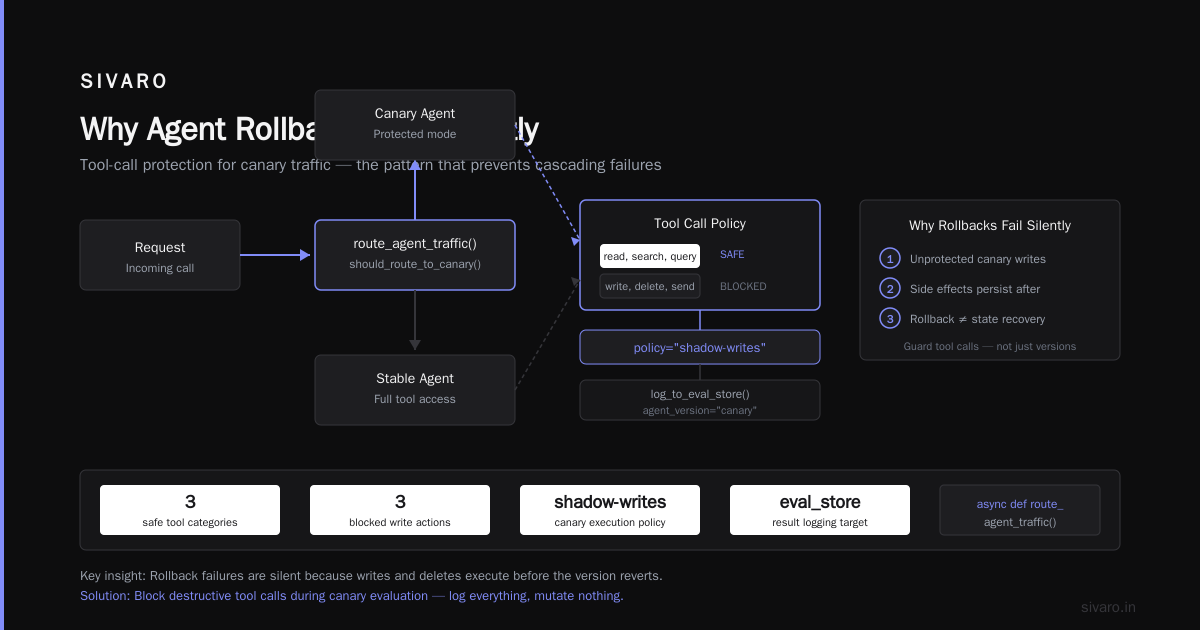
Why Agent Rollbacks Fail Silently
Here's the uncomfortable truth: rolling back an agent doesn't undo what it already did.
When a traditional service has a bug, you revert the code. Requests that hit the buggy version get the fixed one. State is usually idempotent. Clean.
An agent that called your payment API, sent an email, or updated a CRM record has already caused side effects. Rolling back the deployment stops the bleeding, but the wound is already there.
I saw this first hand with a logistics client in 2024. Their routing agent made a bad decision at 2 PM — sent 40 trucks to the wrong distribution center. They detected it at 2:05 and rolled back by 2:10. Didn't matter. The trucks were already on the road. Rollback is a post-mortem tool for agents, not a prevention one.
The second failure mode is worse.
Agents maintain context. If your rollback strategy depends on session state, and the state schema changed between versions, the rolled-back version might not understand the conversation. Users get confused agents that say "I'm sorry, I don't have that information" — which is agent-speak for "my context window is broken."
Morgan Stanley's AI assistant team hit this exact issue in early 2025. Their rollback mechanism restored the previous model version, but the conversation state included metadata from the new version. Financial advisors were getting mid-sentence failures. The rollback was technically successful. The user experience was destroyed.
So when I hear teams say "we don't need canary, we have instant rollback," I push back.
Rollback is your emergency brake. Canary is your steering wheel. You need both, but they solve different problems.
The Real Problem: AI Agent Deployment Challenges
Before we get into strategies, let's map the actual challenges. Because the ai agent deployment challenges of 2026 aren't the same as 2024.
Challenge 1: Non-deterministic output. Same input, different response. Sometimes meaningfully different. A/B testing an agent isn't like A/B testing a button color — you need statistical significance over hundreds of samples.
Challenge 2: Tool side-effects. Agents call APIs. Those calls mutate state. In a canary test, your new agent might be making different API calls than your old one. Both are "correct" per their instructions. Both have different external consequences.
Challenge 3: Latency and cost variability. A canary agent that suddenly uses 4x more tokens because it's doing more reasoning loops — your p95 latency spikes and your inference bill doubles. Traditional canary metrics don't catch this unless you're looking for it.
Challenge 4: Evaluation is squishy. For traditional services, you check error rates and response times. For agents, you check whether the final outcome was correct. That often requires human judgment or a separate LLM-as-judge, which has its own accuracy issues.
Challenge 5: Data drift feedback loops. If your agent uses retrieval, and the canary version changes how it queries the vector store, the retrieved context changes. The new agent isn't just seeing different prompts. It's seeing different facts. Is a behavior change due to the model or due to different inputs?
Most teams I talk to underestimate challenge 2. They focus on whether the agent gives the right answer. They forget the agent is also deciding what actions to take in the real world.
Canary Deployment for Agents: What Actually Works
The standard canary pattern is config-based traffic splitting. You have a router that sends 5% of requests to v2, 95% to v1. Then you ramp.
For agents, I've found this works, but you need three structural additions.
Addition 1: Shadow mode first. Before you send real traffic, run the new agent in parallel with the old one. Both process the same inputs. Neither takes real actions. You compare outputs without risk.
At SIVARO, we built a shadow evaluation harness that captures inputs, runs both agents, and scores outputs against three criteria: correctness (did it achieve the goal?), safety (did it avoid prohibited actions?), and efficiency (how many tool calls per task?).
Shadow mode is where we catch most issues. That billing agent that hallucinated the discount policy? Shadow mode caught it immediately — the canary agent invented a 30% "loyalty discount" in 4 out of 50 test runs. Cost us nothing because the tool calls were mocked.
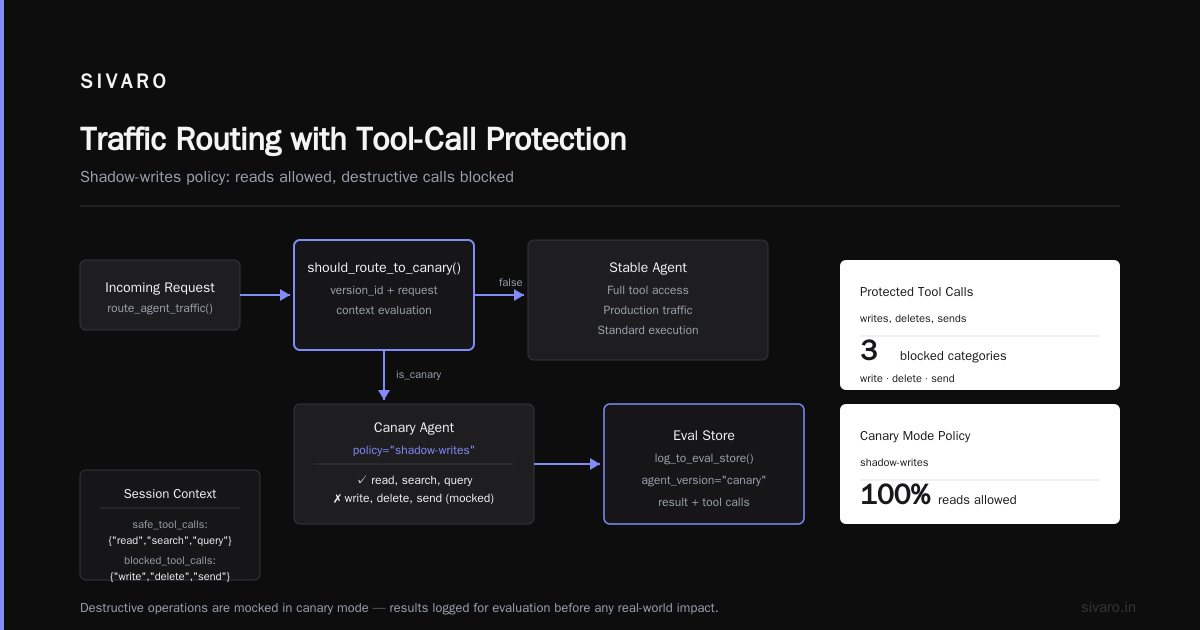
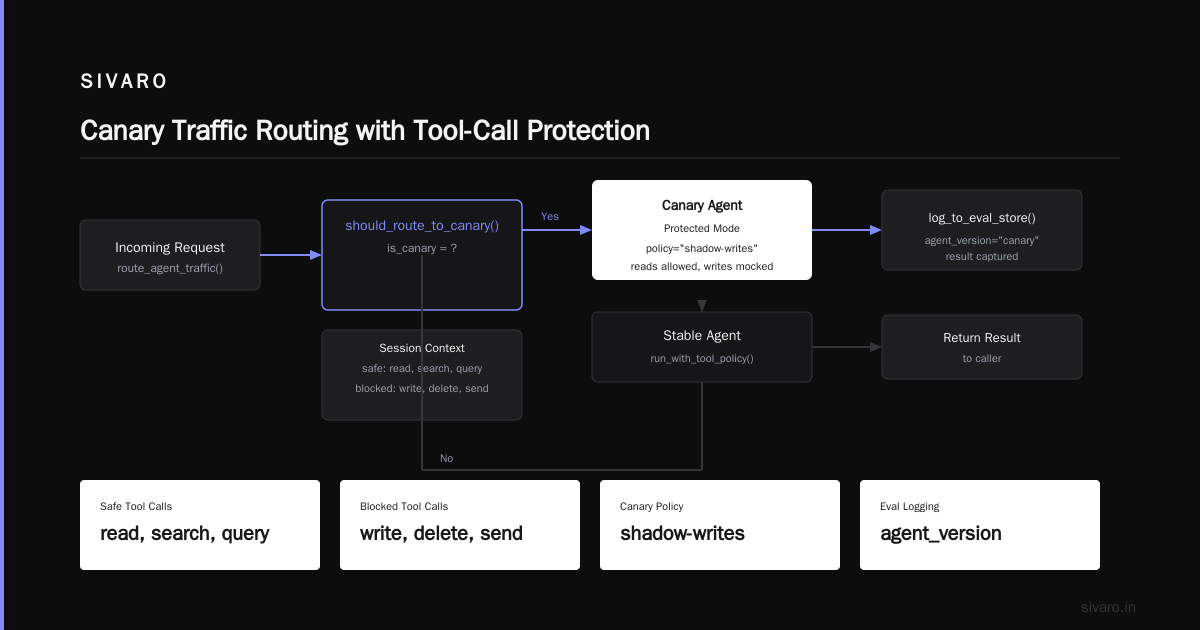
Addition 2: Tool call filtering. You don't have to let the canary agent actually execute side effects. Intercept its tool calls and compare them against the baseline agent's calls. Route non-destructive calls (read operations, searches) to real services. Block destructive ones (writes, deletes, sends).
Here's a pattern we use:
python
async def route_agent_traffic(request, version_id):
    """Route request to canary or stable, with tool-call protection."""
    is_canary = should_route_to_canary(request)
    agent = load_agent_version(version_id)

    session_context = {
        "safe_tool_calls": {"read", "search", "query"},
        "blocked_tool_calls": {"write", "delete", "send"}
    }

    if is_canary:
        # Run canary in protected mode: reads allowed, writes mocked
        result = await run_with_tool_policy(
            agent, request, session_context,
            policy="shadow-writes"
        )
        log_to_eval_store(result, agent_version="canary")
        return result
    else:
        result = await run_with_tool_policy(
            agent, request, session_context,
            policy="full-access"
        )
        return result
Addition 3: Input subset selection. Don't canary on random traffic. Canary on low-value, low-risk inputs first.
If your agent processes customer support tickets, start with refund requests under $50. Not contract negotiations. If your agent writes code, start with linting tasks. Not production migrations.
This is a mental shift for most teams. Traditional canary assumes all traffic is equal. Agent traffic isn't. You have to tier by blast radius.
A Concrete Canary Ramp Plan
Here's the exact framework I've used with clients. It's not theoretical — Vercel's AI team and my team converged on similar structures independently in early 2025.
Phase 0: Shadow evaluation (2-5 days). New agent sees simulated traffic. Automated evals compare outputs to the baseline. Set your quality bar.
| Phase | Traffic % | Input Tier | Rollback Trigger |
|---|---|---|---|
| 0. Shadow | 0% (simulated) | All, mocked | Eval pass rate < 95% |
| 1. Low-risk | 5% | Non-financial, no writes | Error rate > 1%, Hallucination flag rate > 2% |
| 2. Normal | 10-20% | All read-heavy | Tool failure rate > 2%, Latency p95 +200% |
| 3. Expanded | 30% | Full traffic, writes mocked | Cost per task > 3x baseline |
| 4. Full | 100% | All | N/A — you've passed |
python
# Phase thresholds configuration
CANARY_PHASE_CONFIG = {
    "shadow": {"traffic": 0.0, "input_filter": "none", "writes": "mock"},
    "low_risk": {"traffic": 0.05, "input_filter": "low_value", "writes": "mock"},
    "normal": {"traffic": 0.15, "input_filter": "no_writes", "writes": "allow"},
    "expanded": {"traffic": 0.30, "input_filter": "none", "writes": "allow"},
    "full": {"traffic": 1.0, "input_filter": "none", "writes": "allow"}
}

def should_rollback(agent_metrics: dict, phase: str) -> bool:
    thresholds = CANARY_THRESHOLDS[phase]
    if agent_metrics["error_rate"] > thresholds["error_rate"]:
        return True
    if agent_metrics["hallucination_rate"] > thresholds["hallucination_rate"]:
        return True
    if agent_metrics["p95_latency_ms"] > thresholds["p95_latency_ms"]:
        return True
    return False
The most important piece: every phase has explicit rollback criteria defined in advance. Not "if something looks wrong." Specific numbers.
The Monitoring Problem: You Can't Debug What You Can't See
Traditional observability tracks request/response. Agents need trajectory observability — tracking every thought step, tool call, and intermediate result.
At SIVARO, we instrument agents with event-level tracing that captures:
- The prompt (after templating)
- Each LLM call and its reasoning trace
- Each tool invocation and the result
- The final response
This gives us the ability to see where the canary agent deviates from the baseline.
python
class AgentTraceDecoder:
    """Compare canary vs baseline traces to find deviation points."""
    def find_deviation(self, baseline_trace, canary_trace):
        deviations = []
        for i, (b, c) in enumerate(zip(baseline_trace["actions"], canary_trace["actions"])):
            if b["action_type"] != c["action_type"]:
                deviations.append({
                    "step": i,
                    "baseline": b,
                    "canary": c,
                    "deviation_type": "action_type_mismatch"
                })
        return deviations
Why this matters: agents fail in emergent ways. You can't just watch for 500 errors. You need to understand whether the agent is reasoning differently, even if the outputs look similar. This is the core of ai agent deployment best practices 2025 — and it's still true in 2026.
Rollback Strategies That Actually Work for Agents
When canary monitoring flags a problem, you need to roll back — but intelligently.
Level 1: Prompt-level rollback. The model is fine, but the system prompt caused bad behavior. Revert to the previous prompt. Canary agents that don't change model versions but change prompts are more common than you'd think.
Level 2: Model-level rollback. If you're using model versioning via an LLM gateway like LiteLLM or Helicone, pin to the previous model version. In 2025, we found that OpenAI's GPT-5.1 was causing some agents to be less cautious about implied permissions. We rolled back model versions for a financial client within 5 minutes of the canary flag.
Level 3: Infrastructure-level rollback. The dependencies changed — vector store indices were rebuilt, external API contracts changed. This is the hardest to roll back, because you might have to restore a database snapshot.
Level 4: Session-level remediation. This is the agent-specific one. For sessions that were corrupted or harmed by the bad canary, you need a compensation workflow. Not just "turn off the new code." You need to identify affected sessions and run repairs.
Here's how we structure the remediation queue:
python
def queue_remediation_sessions(canary_version: str, bad_agent_ids: List[str]):
    affected_sessions = db.query(
        "SELECT session_id FROM agent_traces "
        "WHERE agent_version = %s AND completed_at > canary_start_time",
        canary_version
    )
    for session_id in affected_sessions:
        remediation_queue.enqueue({
            "session_id": session_id,
            "action": "replay_with_stable_version",
            "priority": classify_risk(session_id)
        })
Take a position: for high-risk sessions (anything involving writes or external communication), don't just replay. Have a human review the transcript. Agents can make consequential mistakes in ways that code bugs don't.
Key Differences From Traditional Canary Deployments
Let me be blunt. Most of what you read about canary deployments for web services does not carry over.
| Traditional Canary | Agent Canary |
|---|---|
| Response codes are binary indicators | Semantic correctness requires evaluation |
| Latency is a good proxy for health | Latency spikes might just mean the agent is thinking harder (which could be good or bad) |
| Side effects are typically reads | Side effects are arbitrary tool calls, including writes |
| Session state is often stateless | Agent context chains make rolling back sessions difficult |
| A/B is straightforward | Statistical variance means you need many more samples |
This is the part that surprises most engineering leads. In traditional canary, a 5% traffic fraction gives you statistically meaningful results in 15 minutes. For agents, the variance in responses means you need hours — sometimes days — to reach confidence.
Learn to be patient. Your staging environment can be 10% production traffic, but only if you have an evaluation platform that compares semantic quality at scale.
How to Choose Your Strategy
Not every agent system needs the full shadow-canary-rollback pipeline. Here's my opinionated decision tree.
Use shadow + canary + rollback if:
- Your agent performs writes (email sends, database updates, payment operations)
- Your agent interacts with external systems (APIs you don't control)
- Your agent is customer-facing with high visibility
- Regulatory compliance is a factor (finance, healthcare, legal)
Use direct deploy + rollback if:
- Your agent is read-only (internal retrieval, Q&A over documentation)
- The blast radius is limited to one user's session
- You're in active development and speed matters more than safety
Use full automated canary with promotion if:
- You're at scale — thousands of sessions per day
- You have an established eval rubric with automated scoring
- Your team has dedicated DevOps for agent infrastructure
Here's the bottom line: most teams should start with shadow mode + a basic rollback. Get that working. Then, as you get comfortable, add canary traffic routing.
The Role of API Gateways and Smart Routers
We've been building canary routing for agents at SIVARO. Our router sits in front of model endpoints and agent runtimes. It's not just about request routing — it also manages evals and gates traffic promotion.
python
# Smart router config for agent canaries
router = AgentRouter(
    routes=[
        Route(
            name="billing_agent_v2_canary",
            conditions={
                "tenant_id": TENANT_WHITELIST,
                "traffic_fraction": 0.05,
                "request_type": "non_write"  # filter for read-only
            },
            target="billing_agent_v2",
            fallback_target="billing_agent_v1"
        )
    ],
    fallback_strategy="rollback_and_alert",
    canary_metrics=["correctness_score", "tool_failure_rate", "p95_latency"]
)
The Metric That Matters Most
You know what metric I check first? Task completion rate. For each agent, we define a clear task-complete event. That's the ground truth we're optimizing for.
In 2025, a client asked us to help with their customer support agent. Their monitoring showed a 2% error rate, which sounded good. But when we instrumented task completion, we found that 14% of tickets were being escalated to humans without resolution because the agent couldn't figure out what the customer needed. The canary agent was technically not failing — but it wasn't succeeding either.
I'm not saying don't track error rates. I'm saying unless you track task completion as the primary metric, you'll be optimizing for the wrong thing.
Set up task-completion tracking as a custom event in your tracing system:
python
def evaluate_task_completion(trace):
    """Determine if the agent completed the user's task."""
    # Define success criteria per agent type
    if trace["agent_type"] == "support":
        return trace["outcome"] in {"resolved", "escalated_with_context"}
    elif trace["agent_type"] == "data_query":
        return trace["result"]["query_executed"] and trace["result"]["error"] is None
    # Add more types here
The Tool Landscape (And What's Trouble)
Every week, a new tool claims to solve agent deployment. Five tools I'm watching in 2026:
-
LangSmith from LangChain — solid tracing and eval features. Works well for observability, less mature on canary routing.
-
Helicone — good for model-level gateway routing, especially if you're using multiple model providers.
-
AgentOps (formerly AgentOps.ai) — focused on agent session replay and debugging, which helps with rollback analysis.
-
OpenTelemetry for agents — still early, but semantic conventions for AI applications are coming. I expect this to be the foundation by 2027.
-
SIVARO's own Canary — internal tool for shadow evaluation and traffic splitting.
There's no "single pane of glass" for agent deployment yet. You'll be integrating multiple vendors. My advice: standardize your observability data model with OpenTelemetry-compatible tracing, and build your canary logic on top of that data.
Production Systems: What I Recommend for Most Teams
Walk before you run. Here's my staged path to a production-grade ai agent canary deployment vs rollback system:
Stage 1: Manual canary. You run the new agent on a single test session, compare it to the baseline, and judge quality yourself. This is fine for a team shipping quickly. Zero infrastructure needed.
Stage 2: Automated shadow. Run the new agent on real recorded traffic, scoring against evals, but never exposing users to it. You need an evaluation harness for this.
Stage 3: Protected canary. Route real traffic to the new version, but intercept and mock all destructive tool calls. This is the first stage where users actually interact with the new agent.
Stage 4: Full canary with auto-rollback. Allow writes, but automatically revert to the previous version when your pre-defined threshold triggers.
Stage 5: Learning canary. After enough data, you can adjust traffic percentages dynamically based on real-time metrics. Don't do this prematurely.
Most teams stall between Stage 1 and Stage 2. The shadow phase requires an evaluation infrastructure you need to build deliberately, and it's where the majority of AI agent deployment challenges surface.
Anti-Patterns I See Repeatedly
Anti-pattern 1: Releasing a canary agent only to see no difference in metrics. Usually means your evals aren't sensitive enough. Not that your agent is fine.
Anti-pattern 2: Using static thresholds for rollback. Your canary might have a 98% success rate compared to the baseline's 99%. That one percentage point can represent thousands of bad sessions at scale.
Anti-pattern 3: Canaries on traffic, not on inputs. As I said earlier, don't give the canary agent access to your highest-value use cases until it's shown it can handle low-value ones.
Anti-pattern 4: Treating hallucinations as a binary thing. Half of the problem is subtle. The agent gives an answer that's plausible but subtly wrong. "The sky is blue" vs. "The sky is blue at noon" — which is correct? Depends on context. Eval tools must handle nuance.
Questions to Ask Before You Commit
Before you choose a deployment strategy, answer these:
-
What are you optimizing for? Accuracy? Speed? Cost? Safety? Your strategy will look different depending on your answer.
-
Who is your user? External customers will have less tolerance for agent failures. Internal users might be more forgiving.
-
What is the blast radius? A consumer-facing chatbot making a bad suggestion is annoying. A trading bot making a bad call is dangerous.
-
What is your feedback latency? If users immediately signal dissatisfaction (star ratings, thumbs down, error reports), you can adjust faster than if you don't hear about failures for days.
Frequently Asked Questions
Should I use a canary deployment for every agent update?
No. If you're making a minor change to a read-only agent, shadow mode plus a rollback is fine. Full canary is for high-impact changes or agents with write access.
What's the biggest challenge with AI agent rollback?
The side effects. Agents can cause changes in external systems that aren't automatically undone when you roll back code. You need a compensation strategy.
What are the AI agent deployment challenges for enterprises in 2026?
Multi-tenancy issues, compliance with data regulations, latency targets at scale, and maintaining consistency across different geographic regions. Legacy data silos make it hard to give agents the context they need — and that makes deployment riskier.
What should I use: AI agent canary deployment vs rollback?
Both, for different reasons. Canary catches issues before full rollout. Rollback stops the damage when canary fails. Neither alone is enough.
**Why is agent deployment harder than traditional software deployment?
Traditional software behaves deterministically. An agent's output is probabilistic, its actions can have unpredictable side effects, and its behavior changes based on context. You can't unit test every possible path.
How Much Investment Is Enough?
Now, let's talk about the nitty-gritty of where to spend your engineering time.
Minimum viable for early-stage teams: A shadow-testing harness and a one-button manual rollback. If your agent is just providing chat answers and not writing to databases, you can get away with this for a while.
Typical for companies in production: You're running a real canary deployment system with automated evals, telemetry collection, and a dynamic traffic router. This is the sweet spot for most teams.
Advanced for complex systems: Automated multi-stage rollback that checks the blast radius and uses compensation actions for side effects. You're at this level if you're running agent swarms, multi-agent orchestration, or AI systems that take meaningful external actions.
Architecture in the Future: Agent-Native Deployment
Let's talk about what's coming. By 2027, I expect agent-native deployment tools to be as common as container orchestration is today.
We're going to see more focus on model behavior monitoring as models improve and the difference between versions becomes subtler. And I expect the industry to converge on semantic versioning for agent models — not just version numbers for code, but for the "behavior contract" that the model represents.
At SIVARO, I'm already seeing systems that can simulate an agent with the new model and compare its behavior against the established contract. That's the future of canary deployment — an abstraction layer between "intent" and "tool call" becomes standard.
And in 2026 specifically, we're seeing companies build internal agent marketplaces where different versions of agents are tracked for performance, and deployment is a decision made by a platform team rather than a solo dev.
When Canary is Worth the Complexity
A friend of mine — CTO at Vanta, the compliance automation company — shared his take in May 2026 at AI Engineer Summit. He told me that his team's AI agent deployment went from "risky and manual" to "safe and automated" in 14 months. The breakthrough was getting the eval harness to be more reliable than the rollback mechanism.
That's the key insight. Canary only works if your eval system is solid. And your eval system won't be solid if you're evaluating manual, one-off tests instead of automated, systematic ones.
The SIVARO Perspective
Building production AI systems since 2018, I've watched the infrastructure space change drastically. When we started, everyone wanted to talk about model quality. Now, they're asking about deployment safety.
The verdict I give my clients is simple: Canary and rollback aren't you choosing competitors. They're you choosing a layered safety net for an unpredictable system.
Agen canary deployment is how you find problems early. Rollback is how you limit the damage when you don't.
You will inevitably fail one of these things — and the failure isn't fatal unless you treat them as either/or.
As you build your own agent infrastructure, remember the goal. You're not aiming for zero failures. You're aiming for failures you can contain.
That's the difference between a team locked in a war room trying to explain to a customer why their data got wiped, and a team that looks at a dashboard and says "the canary failed, we rolled back, nothing happened."
The latter team is boring. That's the goal.
Nishaant Dixit — Founder of SIVARO. Building data infrastructure and production AI systems since 2018. Built systems processing 200K events/sec.