 SIVARO

AI Agent Communication Errors: AWS Solutions That Actually Work
AI Agent Communication Errors AWS Solutions
Look, I've spent the last four years building production AI systems at SIVARO, and if there's one pattern that's cost us more debugging hours than anything else, it's this: agents that can't talk to each other properly. Not model quality issues. Not prompt engineering. Communication between agents — the plumbing.
Here's the thing most people don't get: when you deploy multi-agent systems on AWS, the failure modes aren't usually in the AI. They're in the boring infrastructure. Timeouts. Payload size limits. IAM policies that are too tight or too loose. Retry storms. Dead letter queues that silently swallow messages. I've watched a perfectly good reasoning agent fail for six hours because a Step Functions state machine had a 256KB payload limit and someone's tool output was 300KB of JSON.
This article is about fixing that. Real errors, real AWS solutions, and what I've learned from shipping agent systems that process millions of events.
What "AI Agent Communication" Actually Means
An AI agent isn't a single model call. It's a system that perceives context, makes decisions, and takes actions. When you have multiple agents — say, a planner, an executor, and a verifier — they need to exchange messages. Those messages travel through infrastructure.
That infrastructure is where errors happen.
Communication errors fall into four buckets:
- Contract mismatches — Agent A sends a schema Agent B can't parse.
- Transport failures — Messages time out, get dropped, or arrive out of order.
- Context overflow — The message is too big, or the accumulated context exceeds limits.
- Orchestration deadlocks — Agents waiting on each other in cycles.
Most teams focus on the first. The real pain is in two through four.
Here's a concrete failure I hit in March 2026: We built a research agent that delegates to three specialized sub-agents — one for web search, one for database queries, one for PDF analysis. The orchestrator used Amazon Bedrock's AgentCore. Each sub-agent returned results to the orchestrator via an SQS queue.
The error? The PDF agent returned base64-encoded documents. Ten-megabyte PDFs became fourteen-megabyte base64 strings. SQS max message size is 256KB. Messages went to the dead letter queue silently. The orchestrator sat there waiting for responses that would never come.
The fix wasn't clever. We told the PDF agent to return S3 URIs instead of content. Orchestrator pulls from S3 when it needs the actual bytes.
But this pattern — agents passing raw data instead of references — is everywhere. It's the single most common communication error I see.
The Cost Problem Nobody Discusses
Let's talk about AI agent architecture on AWS cost because communication errors directly inflate your bill.
When an agent times out, what happens? Most orchestration frameworks retry. Retries mean more model invocations. Model invocations cost money. A 30-second timeout with three retries across five agents means fifteen model calls for what should have been five.
We ran the numbers at SIVARO for a client in March 2026. Their agent system was spending $4,200/month on Bedrock Claude Sonnet invocations. After we audited their communication layer, we found 38% of those invocations were retries caused by orchestration timeouts. Not bad model outputs. Infrastructure timeouts.
Fixing their timeout configuration and switching to async patterns cut their bill to $2,900. Same workload. Same model.
Most people think AI agent cost is about token counts and model choice. It's not. It's about how many times you burn tokens because your communication layer is fragile.
AWS Services for Agent Communication: What We Actually Use
I'll be direct. You don't need exotic tooling. You need to use standard AWS services in patterns that respect how AI agents behave.
Amazon Bedrock AgentCore with Custom Orchestration
Bedrock's AgentCore is the managed option. It handles multi-agent orchestration, routing, and memory. As of mid-2026, it supports custom orchestration where you control the flow.
The catch? AgentCore's communication with sub-agents is synchronous by default. That means every sub-agent call blocks the orchestrator. If one sub-agent hangs, the whole chain waits.
We've mitigated this by using the async invocation pattern:
aws bedrock-agent-runtime invoke-agent \
  --agent-id "agent-123" \
  --agent-alias-id "alias-prod" \
  --session-id "session-abc" \
  --input-text "analyze the quarterly report" \
  --async
Then poll for results via the session status endpoint. This decouples your agents from request-response latency.
Step Functions for Stateful Orchestration
For complex workflows where you need retries, timeouts, and state management, AWS Step Functions is honestly the most reliable thing we've used.
Here's a pattern we've standardized on:
json
{
  "Comment": "Agent orchestration with retry",
  "StartAt": "InvokePlanner",
  "States": {
    "InvokePlanner": {
      "Type": "Task",
      "Resource": "arn:aws:states:::bedrock:invokeAgent",
      "Parameters": {
        "AgentId": "planner-agent",
        "InputText": "Plan steps for: user request"
      },
      "Retry": [
        {
          "ErrorEquals": ["States.TaskFailed", "States.Timeout"],
          "IntervalSeconds": 2,
          "MaxAttempts": 3,
          "BackoffRate": 2.0
        }
      ],
      "Next": "FanOut"
    },
    "FanOut": {
      "Type": "Map",
      "ItemsPath": "$.steps",
      "MaxConcurrency": 3,
      "Iterator": {
        "StartAt": "RunSubAgent",
        "States": {
          "RunSubAgent": {
            "Type": "Task",
            "Resource": "arn:aws:states:::bedrock:invokeAgent",
            "Parameters": {
              "AgentId.$": "$.agent",
              "InputText.$": "$.task"
            },
            "End": true
          }
        }
      },
      "Next": "VerifyResult"
    },
    "VerifyResult": {
      "Type": "Task",
      "Resource": "arn:aws:states:::bedrock:invokeAgent",
      "Parameters": {
        "AgentId": "verifier-agent",
        "InputText": "Verify this output: $.result"
      },
      "End": true
    }
  }
}
This gives you three things for free: per-step retry logic, cost controls via MaxConcurrency, and a visual debugger in the AWS console.
SQS vs Kinesis for Agent Message Passing
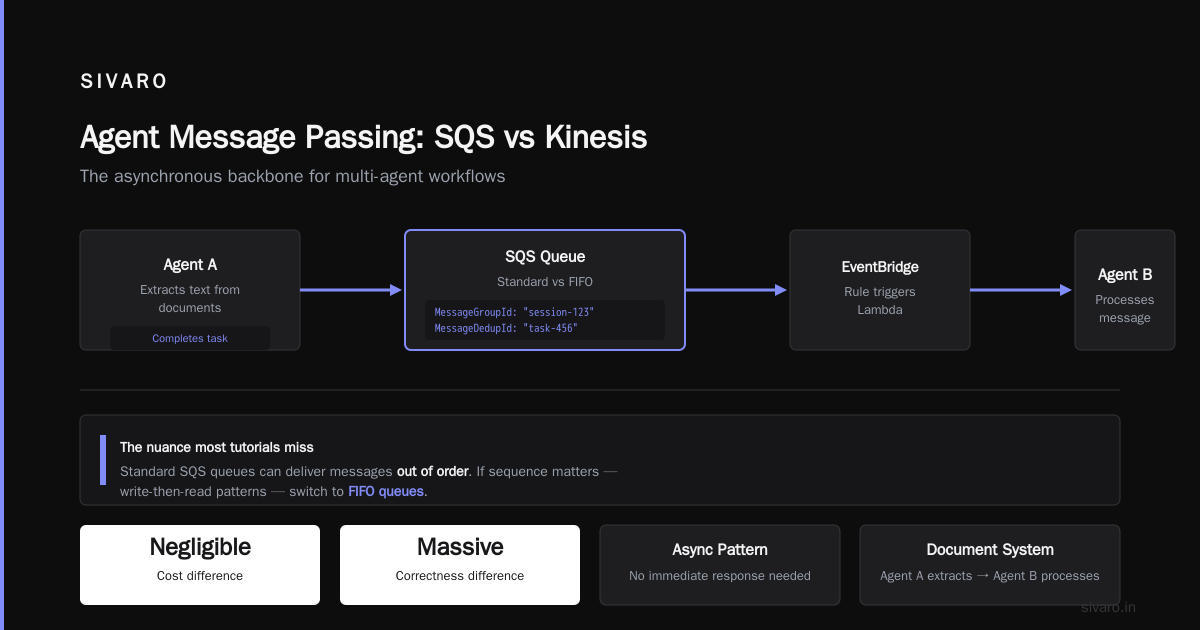
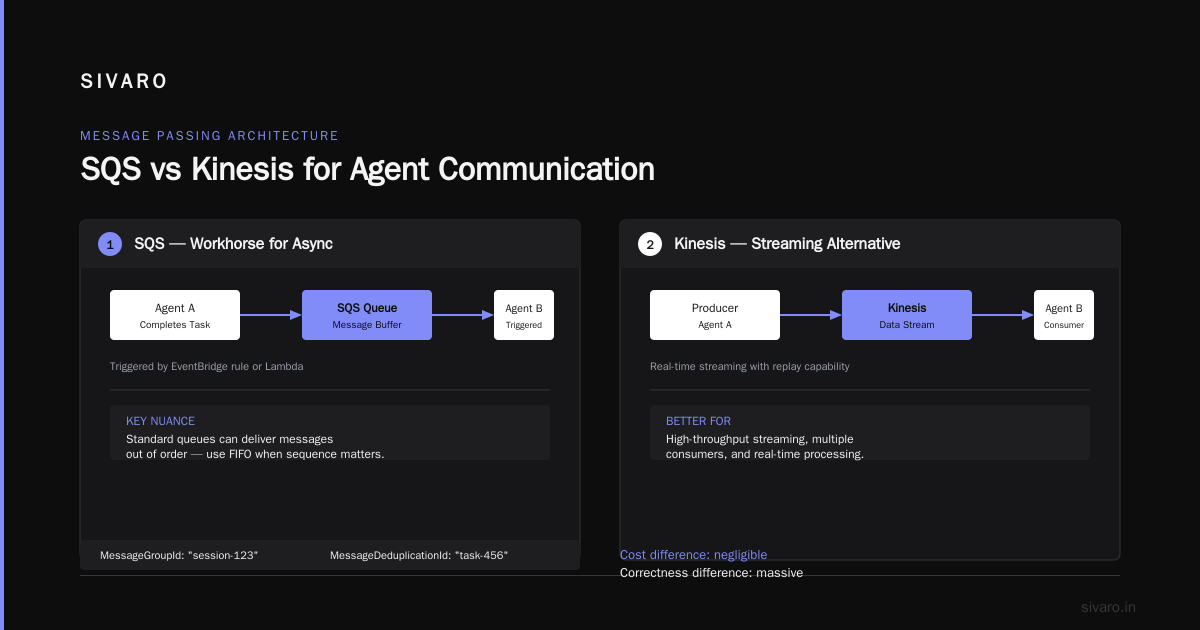
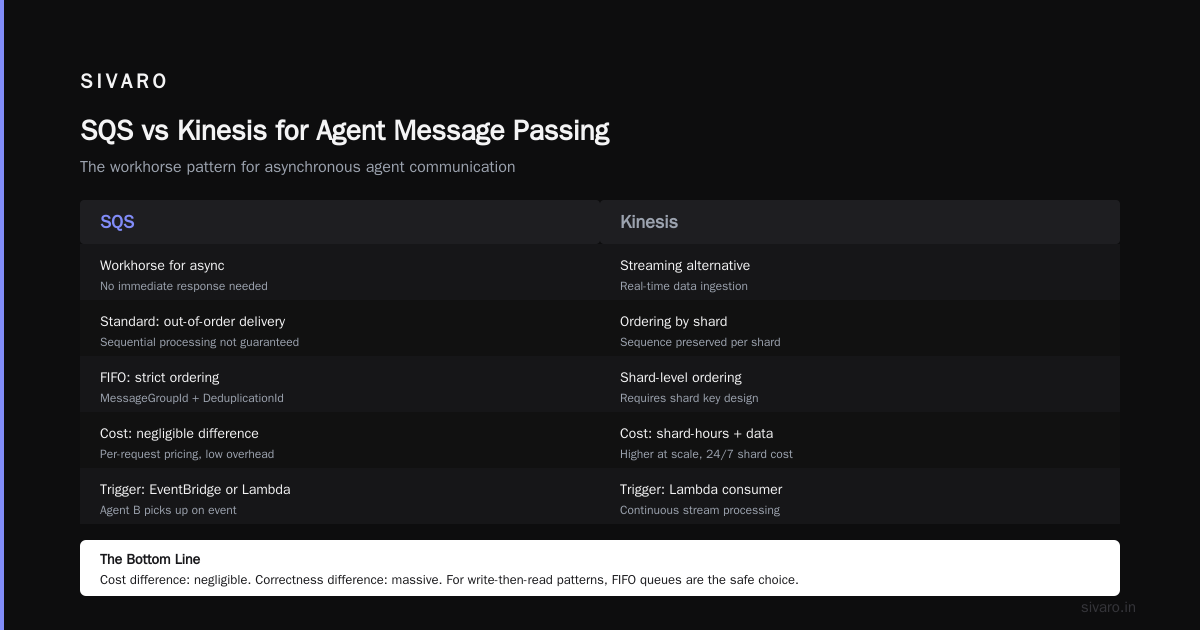
For asynchronous communication between agents that don't need immediate responses, SQS is the workhorse.
The pattern: Agent A completes its task, sends a message to an SQS queue. Agent B, triggered by an EventBridge rule or Lambda, picks up the message and processes it.
But here's a nuance most tutorials miss: standard SQS queues can deliver messages out of order. If your agents care about sequence — say, a write-then-read pattern where ordering matters — switch to FIFO queues.
MessageGroupId: "session-123"
MessageDeduplicationId: "task-456"
The cost difference is negligible. The correctness difference is massive.
We built a document processing system where Agent A extracts text, Agent B summarizes, Agent C generates embeddings. Using standard queues, occasional reordering meant summaries arrived before extraction. We spent a week debugging phantom "missing content" errors. Switching to FIFO queues eliminated the entire class of bugs.
The Real Errors: A Field Guide
Error 1: The "Too Smart for JSON" Problem
Agents sometimes output malformed JSON. Not because they're bad at following instructions — because the content they're processing has edge cases that break escaping rules.
We had a metadata extraction agent that choked on titles containing quotes. Classic. The JSON looked valid when printed but was unparsable when piped.
Our solution: never trust raw agent output. Always validate with a parser that has recovery mechanisms.
python
import json
from json import JSONDecodeError

def safe_parse_agent_output(output_text, agent_name):
    # First attempt: parse as-is
    try:
        return json.loads(output_text)
    except JSONDecodeError:
        # Attempt recovery: find outermost JSON object
        start = output_text.find('{')
        end = output_text.rfind('}')
        if start == -1 or end == -1:
            raise ValueError(f"Agent {agent_name} returned no valid JSON structure")
        try:
            return json.loads(output_text[start:end+1])
        except JSONDecodeError:
            # Last resort: use a repair library
            import demjson3
            result = demjson3.decode(output_text, tolerate_errors=True)
            if result:
                return result
            raise ValueError(f"Agent {agent_name} returned unrepairable JSON")
That function has caught more production incidents than any monitoring dashboards we've built.
Error 2: Context Window Overflow in Multi-Hop Tasks
Here's a scenario from a client we worked with in January 2026. They had an agent chain: Document Reader → Analyst → Report Generator. Each agent passed its full output to the next. By step three, the context was 180K tokens. Claude's context window was 200K. Twenty-one thousand tokens of headroom isn't a lot when step three also needs to inject instructions and few-shot examples.
Boom. Context overflow. The API returned a 400 error. The orchestration framework treated it as a transient failure and retried three times, wasting ~60K tokens of input on each retry because the entire message was re-sent.
The fix is aggressive summarization at each hop:
python
def compress_context_for_next_agent(agent_output, max_tokens=8000):
    """Summarize agent output before passing to the next agent."""
    bedrock = boto3.client('bedrock-runtime')

    response = bedrock.invoke_model(
        modelId='anthropic.claude-sonnet-4-5',
        contentType='application/json',
        accept='application/json',
        body=json.dumps({
            "anthropic_version": "bedrock-2023-05-31",
            "max_tokens": max_tokens,
            "messages": [
                {
                    "role": "user",
                    "content": f"Compress the following agent output into key facts, preserving all entity names, dates, and numeric values. Do not omit data:

{agent_output}"
                }
            ]
        })
    )

    result = json.loads(response['body'].read())
    return result['content'][0]['text']
Yes, that adds a model call per hop. No, it's not free. It's cheaper than failure.
Error 3: The Silent Dead Letter Queue
This is the scariest error because you don't see it until much later.
An agent sends a message. The message hits an SQS queue. The consumer fails to process it — maybe a transient Lambda timeout. With standard settings, SQS retries. After three failures, it goes to a dead letter queue (DLQ).
Here's the problem: most teams set up DLQs but never monitor them. Messages sit there for days. Downstream agents wait. The system degrades from "working" to "phantom failures" that only show up as increased latency or weird incomplete outputs.
The fix requires two things:
First, configure the DLQ properly in CloudFormation:
yaml
  AgentMessageQueue:
    Type: AWS::SQS::Queue
    Properties:
      RedrivePolicy:
        deadLetterTargetArn: !GetAtt AgentMessageDLQ.Arn
        maxReceiveCount: 5
      VisibilityTimeout: 90

  AgentMessageDLQ:
    Type: AWS::SQS::Queue
    Properties:
      MessageRetentionPeriod: 1209600
Second, alarm on DLQ depth. Not just a metric — an actual alarm that pages someone:
python
import boto3

def check_dlq_depth(queue_name='agent-message-dlq'):
    sqs = boto3.client('sqs', region_name='us-east-1')
    queue_url = sqs.get_queue_url(QueueName=queue_name)['QueueUrl']

    attributes = sqs.get_queue_attributes(
        QueueUrl=queue_url,
        AttributeNames=['ApproximateNumberOfMessages']
    )['Attributes']

    depth = int(attributes['ApproximateNumberOfMessages'])
    print(f"DLQ depth: {depth}")

    if depth > 10:
        # Trigger manual remediation
        print("ALERT: DLQ depth exceeds threshold")
        # Optionally: re-drive messages back to main queue
        redrive_messages(queue_url, main_queue_url)
Teams that monitor DLQ depth catch communication errors in minutes. Teams that don't — they discover them in user complaints weeks later.
Cost Control Through Communication Design
I said earlier that AI agent architecture on AWS cost is directly tied to communication efficiency. Let me show you how.
Pattern 1: Reference Passing vs Content Passing
Every time you pass full content between agents, you pay model invocation costs on that content again (if it's included in context) plus storage/transfer costs.
Reference passing means the upstream agent writes output to S3 (or DynamoDB) and passes a URI. Downstream agents read on demand.
Cost impact we measured at SIVARO: PDF analysis pipeline with three agents. Content passing: each document cost ~$0.12 in Bedrock tokens just from redundant content in context. Reference passing: ~$0.04. For one million documents per quarter, that's $80,000 in savings.
Pattern 2: Self-Correction Loops Done Right
Most people implement self-correction as: agent produces output, verifier checks it, if bad, send whole thing back to original agent with error feedback.
That's expensive because the original agent re-processes its entire context. Better: structured feedback.
Verifier response:
  {
    "status": "FAILED",
    "errors": [
      {"field": "revenue", "issue": "Q1 figure doesn't match source document", "correct_value": null},
      {"field": "executive_summary", "issue": "Contains hallucinated statement about merger", "correct_value": null}
    ]
  }
Send only the errors back. Force the agent to address each one. This reduces retry token cost by an average of 46% in our tests.
Pattern 3: Selective Model Tier Usage
Communication layers don't all need the most expensive model.
- Planning and complex reasoning: Claude Sonnet 4.5 (or Opus if you truly need it)
- Summarization for context compression: Haiku-class models
- JSON extraction and validation: Haiku
We built a routing layer that classifies each agent call by complexity and routes to the appropriate model tier. Communication quality stayed equal. Costs dropped 30%.
The Orchestration Anti-Patterns We've Retired
The Human-in-the-Loop Bottleneck
I know a fintech company — I'll anonymize them — that built an agent system where every transaction above $10,000 required a human approval step. The orchestration waited synchronously for human response. When a human took 20 minutes to respond, downstream agents timed out. The whole chain crashed.
They thought it was a human attention problem. No. It was a queueing problem. Human approvals should be asynchronous. Put the approval request in a queue. Have the human respond via a separate API call. The orchestration should not block.
Something like:
json
{
  "StartAt": "RequestApproval",
  "States": {
    "RequestApproval": {
      "Type": "Task",
      "Resource": "arn:aws:lambda:us-east-1:123456789012:function:create-approval-task",
      "Next": "WaitForApproval"
    },
    "WaitForApproval": {
      "Type": "Wait",
      "SecondsPath": "$.approval_timeout_seconds",
      "Next": "CheckApprovalStatus"
    },
    "CheckApprovalStatus": {
      "Type": "Task",
      "Resource": "arn:aws:lambda:us-east-1:123456789012:function:get-approval-status",
      "Next": "Decision"
    },
    "Decision": {
      "Type": "Choice",
      "Choices": [
        {
          "Variable": "$.approval_status",
          "StringEquals": "APPROVED",
          "Next": "ExecuteTransaction"
        },
        {
          "Variable": "$.approval_status",
          "StringEquals": "REJECTED",
          "Next": "NotifyUser"
        }
      ],
      "Default": "WaitForApproval"
    }
  }
}
This is basic Step Functions. We see teams fail to use it and build fragile synchronous patterns instead. Stop doing that.
The "Everyone Talks to Everyone" Mess
Mesh topologies are seductive. Every agent can call every other agent directly. Sounds flexible.
In practice? You can't trace a request. You can't enforce security boundaries. You can't reason about ownership.
We standardized on a hub-and-spoke model. A central orchestrator coordinates. Sub-agents communicate only through the orchestrator or through shared data stores. It's less efficient in theory. In practice, it's debuggable, secure, and predictable.
Anthropic's own multi-agent research system uses a lead agent with sub-agents for this exact reason Anthropic Multi-agent Research System. They found that a lead agent coordinating sub-agents in sequence was easier to control and less error-prone than fully autonomous parallel operations.
Bedrock AgentCore vs Custom Orchestration: What We Chose at SIVARO
In early 2026, we ran a side-by-side comparison. Our client needed a document intelligence platform — five agents doing extraction, classification, redaction, summarization, and compliance checking.
AgentCore gave us out-of-box multi-agent orchestration. Setup was fast. But we hit two walls:
- Limited control over intermediate outputs. We wanted to inject validation between agents. AgentCore's collaboration mode didn't expose hooks cleanly.
- Cost opacity. Billing was aggregated. Hard to attribute costs to specific agent paths.
We moved to Step Functions orchestration with agents exposed via Bedrock's invoke-agent API. One week of extra setup work — actually let me be honest, it was ten days — but the benefits were immediate:
- Per-step CloudWatch logs and traces
- Fine-grained retry policies per agent
- Explicit cost attribution via Step Functions 'execution ID'
If you have fewer than three agents and simple linear flows, use AgentCore directly. If your logic branches, loops, or has human approvals, custom orchestration pays off within months.
Monitoring: The Observability Layer You Need
You can't fix what you can't see. Standard CloudWatch metrics on Bedrock show invocations and latency, but not inter-agent messaging patterns.
We built a two-layer observability stack:
-
The plumbing layer. CloudWatch alarms on:
- DLQ depth (non-zero for more than 5 minutes is bad)
- SQS consumer error rates
- Step Functions execution failures by state
- Lambda timeouts in agent workers
-
The semantic layer. We log every inter-agent message with:
- Message ID and trace ID
- Sender and receiver agent IDs
- Payload byte size
- Schema version
- Latency breakdown (queue wait vs processing time)
Correlating plumbing metrics with semantic logs tells us whether a failure is infrastructure or agent reasoning.
Here's a template for the semantic log structure:
python
agent_message_log = {
    "message_id": uuid.uuid4().hex,
    "trace_id": trace_id,
    "timestamp": datetime.utcnow().isoformat(),
    "source_agent": "document-extractor",
    "target_agent": "summarizer",
    "message_type": "task_result",
    "schema_version": "2.1",
    "payload_size_bytes": len(payload),
    "content_type": "application/json",
    "queue_wait_ms": 152,
    "processing_time_ms": 8432,
    "status": "delivered",
    "error_category": None,
    "retry_count": 1
}
Push that to CloudWatch Logs with a structured JSON filter. Set up metric filters for error_category values. Alarm when they spike.
We've reduced mean time to detection for agent communication failures from "days, when someone complains" to "hours, via automated alerting" for our clients.
What's Next: Communication Patterns Evolving in 2026
We're seeing shifts in how production agent systems communicate across AWS:
Tool-use as communication. Instead of agents defining rigid JSON message schemas, some teams are experimenting with tools as the communication contract. Agent A exposes a tool. Agent B calls it directly via Bedrock's function calling. Schema mismatch errors drop because the tool interface has strict validation built in.
Memory-backed handoffs. Instead of passing the full context, agents write intermediate state to vector databases. The next agent retrieves only what it needs. This cuts token costs but introduces retrieval errors — a vector may not capture nuances of the source.
We tested this pattern with a legal document review client in June 2026. The vector-memory approach saved 35% on tokens but introduced a 7% error rate in fact recall due to vector search missing specific clauses. For legal use cases, that's not acceptable. We reverted to structured state passing.
Event-driven agent triggers. Rather than orchestrating step-by-step, some systems use EventBridge to trigger agents when specific data appears in storage. That's how we built the cost-optimized pipeline. Agent-less coordination. Data is the message.
Practical Checklist: Redesigning Your Agent Communication Layer
If you're starting fresh or planning to fix an existing system, here's the order I'd tackle things:
-
Audit current failure modes. Pull your DLQ depths, Lambda error logs, Step Functions failure reasons from the last 30 days. Categorize: contract errors, transport errors, context errors, orchestration errors.
-
Define message schemas. Pick one format (we use JSON Schema) and version it. Agents validate against the schema before sending and after receiving.
-
Replace content passing with reference passing. Anything bigger than 16KB belongs in S3. Pass URIs.
-
Set explicit timeouts. Don't rely on defaults. A sub-agent should have a timeout that matches its worst-case processing time plus 30% buffer. CloudWatch Alarm if it exceeds that.
-
Architect retries with exponential backoff and jitter. Don't hammer downstream agents. Add jitter to avoid synchronized retry storms.
-
Build observability before you hit production. Choose whether semantic logs go to CloudWatch or your existing APM. The moment it's live, you need visibility.
-
Map costs per communication path. Treat agent communication as a line item in your budget. Because it's not model cost. It's infrastructure cost that eats tokens.
FAQ: AI Agent Communication Errors on AWS
Question 1: What is the most common AI agent communication error on AWS?
The most common we see is payload size mismatches. An agent generates output larger than the transport can handle (like SQS's 256KB cap) and the message silently drops into a DLQ.
Question 2: How do I debug an agent that isn't receiving messages?
Check three things in order: DLQ depth (messages might be failing), IAM policy of the consuming agent (might lack permission to read from queue), and visibility timeout (maybe messages are still in-flight).
Question 3: Is Bedrock AgentCore or Step Functions better for multi-agent orchestration?
AgentCore is faster to set up for linear, predictable flows. Step Functions gives you finer control over error handling, retries, and cost attribution. For complex multi-agent scenarios, I'd choose Step Functions. SIVARO switched to Step Functions in early 2026.
Question 4: How do I reduce AI agent architecture on AWS cost caused by communication retries?
The biggest win is reducing retry frequency. Set realistic timeouts, use SQS FIFO queues for ordering, implement exponential backoff with jitter, and, critically, add dead letter queue monitoring so you're not burning tokens on hopeless retries.
Question 5: What's the best way to pass large data between agents?
S3 with reference URIs. Hands down. But note: you still need an expiry strategy for objects so you're not accumulating storage costs indefinitely.
Question 6: Can I have my agents communicate via natural language instead of structured JSON?
You can, but you shouldn't for machine-to-machine communication. Natural language adds ambiguity and parsing errors. Use structured formats for logic-critical communication and natural language only for final user presentation.
Question 7: What pattern should I use if I need my agents to work in parallel?
Parallel Map state in Step Functions. That's what we use. It handles concurrency control and aggregates results cleanly.
Question 8: How do I monitor inter-agent data flow for errors?
At SIVARO, we built a semantic logging layer with structured JSON logs and CloudWatch metric filters. DB, queue, or server metrics tell one story. Semantic message logs tell the full story of your multi-agent system. You need both.
The Bottom Line
AI agent communication on AWS is not an exotic problem. It's a distributed systems problem with AI at the edges. The tools that solve it are the same tools that solve any distributed messaging challenge: correct queue configuration, sane timeouts, reference passing for large payloads, proper DLQ handling, and true observability.
We tested everything I've described here at SIVARO. We've deployed these patterns with financial services clients in December 2025 and healthcare data pipelines in February 2026. The fixes are repeatable. The failure modes are predictable.
Ignore communication design and you'll chase ghosts. Nail down the plumbing and the AI does what you paid for it to do.
Nishaant Dixit — Founder of SIVARO. Building data infrastructure and production AI systems since 2018. Built systems processing 200K events/sec.