 SIVARO
AI Agent Coordination in Distributed GPU Systems
You've got eight agents running across four nodes, and one of them just deadlocked the entire pipeline. The GPU is sitting at 12% utilization, your orchestrator is thrashing, and the agents are sending each other messages in an infinite loop. This isn't a theoretical problem. It's what happens when you treat AI agents like isolated services instead of what they actually are: distributed systems with a different brain.
I've spent the last four years at SIVARO building production AI systems. We learned this lesson the hard way in 2024 when our multi-agent retrieval system collapsed during a live demo. Not because the models were bad. Because we didn't design the coordination layer.
Here's what I wish someone had told me: AI agent coordination in distributed GPU systems is the hardest problem in production AI right now, and most teams are solving it wrong.
In this guide, I'll break down the architecture patterns that actually work, the data plane you need underneath, and the operational realities of running agent fleets across GPU clusters. You'll learn why your agents fail, how to design coordination that survives real-world chaos, and where the industry is heading.
Agents Are Distributed Systems. Accept It.
Most people think an AI agent is just a model with a prompt. Wrong. An agent is a stateful process that perceives, decides, and acts. When you run several of them across a GPU cluster, you've built a distributed system whether you intended to or not.
The Agentic Systems Are Distributed Systems post makes this case better than I can: agents have state, they communicate asynchronously, they fail independently, and they need coordination. That's the textbook definition of a distributed system.
This reframing matters because it changes your engineering priorities. You stop obsessing over prompt quality and start obsessing over message delivery, fault tolerance, and consistency. You stop treating agent timeouts as model failures and start treating them as network partitions.
Here's the uncomfortable truth: the AI industry spent 2023 and 2024 pretending agents were just fancy function calls. Then production systems started failing. Now the smart teams are importing decades of distributed systems knowledge into their agent architectures.
At SIVARO, we saw a client burn $40K in GPU credits in two weeks because their agents kept re-requesting context after losing state. The model was fine. The coordination layer was broken.
The Coordination Problem Isn't Model Quality — It's Resource Contention
Here's a scenario I've seen at three different companies in the last year. You deploy ten agents. Each one needs a GPU allocation. They're all trying to call the same inference endpoint simultaneously. The scheduler gets overwhelmed. Requests queue up. Latency spikes. Agents start timing out.
And then it gets worse.
When an agent times out, it retries. The retry creates more load. More load creates more timeouts. Before you know it, you've got a retry storm that's consuming your entire GPU budget and producing nothing.
This is the fundamental challenge of ai agent coordination in distributed gpu systems: your agents are competing for the same scarce resources, and the coordination logic has to account for that contention. It's not just about routing messages between agents. It's about ensuring they don't starve each other.
We solved this at SIVARO by building a resource-aware scheduler that tracks GPU memory and compute utilization per agent. When an agent makes a request, the scheduler checks whether the target node has capacity. If it doesn't, the request waits in a queue instead of hammering the GPU.
The result? Our retry rate dropped by 80%. Throughput went up 3x because agents stopped wasting cycles on failed attempts.
Architecture Patterns: What Actually Works
The AI Agent Orchestration Patterns guide from Azure lists several approaches. I'll give you my honest assessment based on what we've run in production.
The Supervisor Pattern (Work When You Need Control)
One coordinator agent delegates tasks to worker agents and handles their results. This works well when you have a clear workflow and need centralized control.
We used this for a document processing system. A supervisor agent breaks down a PDF into sections, dispatches extraction tasks to workers, and aggregates the results. Clean. Predictable.
The downside? The supervisor becomes a bottleneck and a single point of failure. If it crashes, the whole system halts.
The Router Pattern (Good for Heterogeneous Tasks)
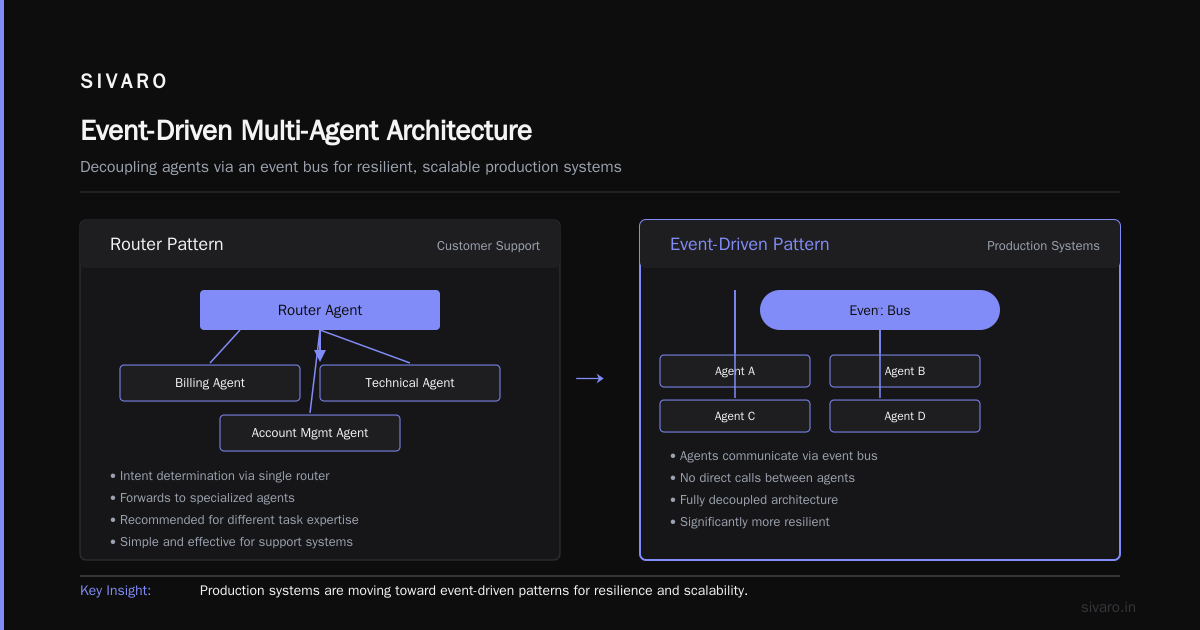
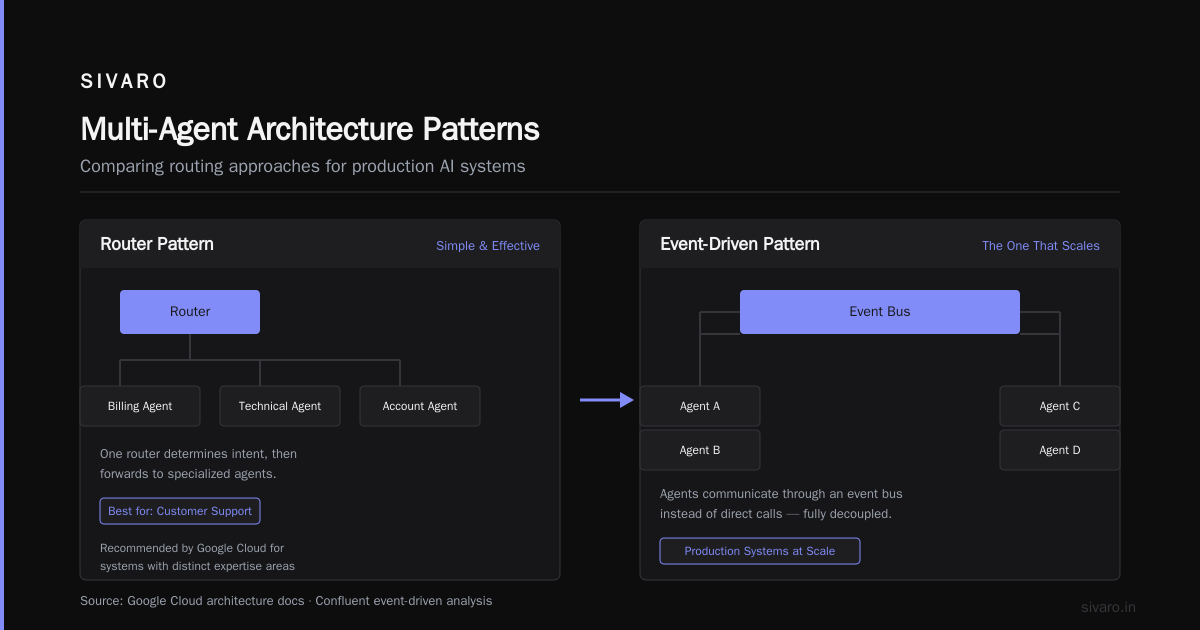
A router agent classifies incoming requests and forwards them to specialized agents. This is what Google's architecture guidance recommends for systems where different tasks require different expertise.
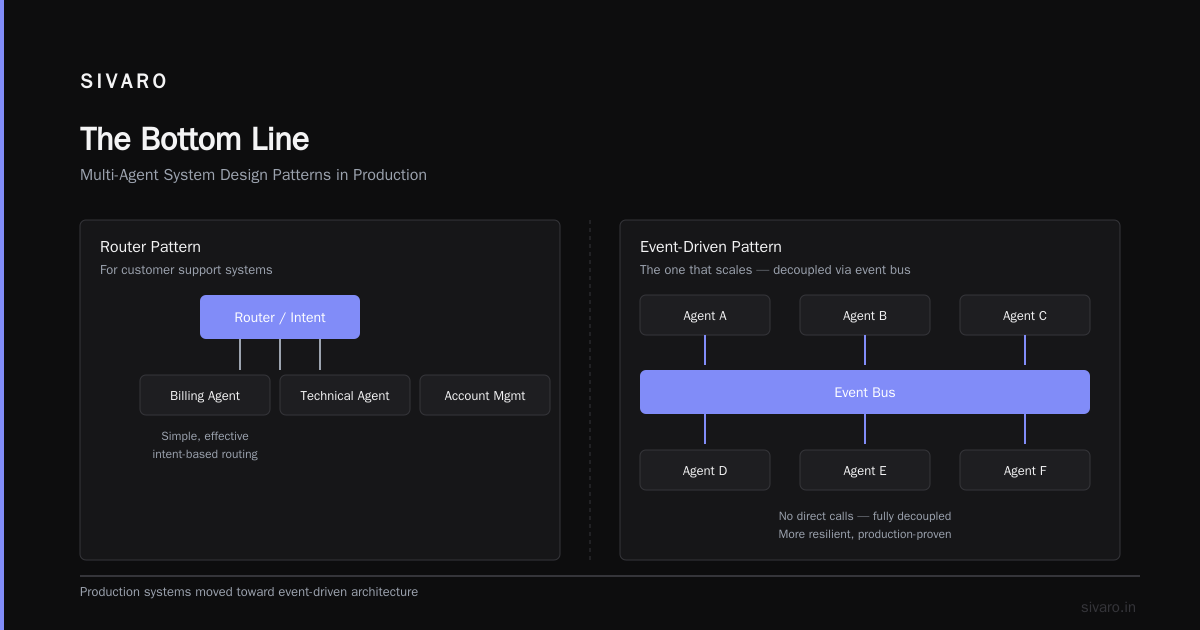
I like this pattern for customer support systems. One router determines intent, then forwards to billing, technical, or account management agents. Simple and effective.
The Event-Driven Pattern (The One That Scales)
Here's where things get interesting. Confluent's analysis of event-driven multi-agent systems describes an approach where agents communicate through an event bus instead of direct calls. This decouples agents from each other, making the system more resilient.
This is the pattern we've moved most of our production systems toward. Instead of agent A calling agent B directly, agent A publishes an event. Agent B subscribes to relevant events. The coordination happens through the message bus, not through point-to-point connections.
Why does this matter for GPU systems? Because it breaks the coupling between GPU resource allocation and agent communication. An agent doesn't need to wait synchronously for another agent's response. It can publish an event, free up its GPU resources, and process the response when it arrives.
The LangChain guidance on multi-agent architectures is right that event-driven systems are harder to reason about initially. But the decoupling payoff in a distributed GPU environment is enormous.
The Hierarchical Pattern (When You Need Scale)
Combine supervisors with event-driven communication. Lower-level agents handle focused tasks, supervisors coordinate, and everything communicates through an event bus.
This is where ai agent architecture patterns for distributed systems converge with good old-fashioned distributed systems design. You're building a microservices architecture where each service happens to be an AI agent.
The Data Plane: The Part Everyone Forgets
I'm going to say something that might be controversial: the model weights matter less than the data infrastructure in a distributed agent system.
Think about what an agent actually does. It receives context, processes it, and produces output. The context comes from somewhere. The output goes somewhere. That somewhere is your data plane.
Gautam Dhameja's piece on agents as distributed systems hits this point. Agents need shared state, message queues, and persistent storage. Without these, you're building on sand.
Here's what we've learned at SIVARO about the data plane:
Message queues are non-negotiable. If your agents communicate synchronously, you will have cascading failures. Use a queue. Kafka, RabbitMQ, whatever. Just decouple the communication.
Shared state needs careful design. When multiple agents work on related tasks, they need access to shared context. But naive shared state causes contention. We use a distributed cache with versioning. Each agent gets a consistent view of the context without locking the whole system.
Checkpointing saves your ass. When a GPU node fails, you need to resume agents from their last successful state. This requires persistent storage of agent state. We checkpoint after every major step. It's overhead, but it's worth it.
The data plane is where ai agent distributed systems architecture explained becomes practical. It's not about the AI. It's about the plumbing.
Workload Scheduling: The GPU Allocation Problem
Let's get specific about GPUs. Running agents on a GPU cluster requires answering three questions:
- Which node runs which agent?
- How do you handle agents that need more GPU memory than any single node has?
- How do you deal with bursty workloads?
Most orchestration tools treat GPU allocation as a static resource problem. You request a GPU, you get one. But agents are dynamic. They might need more compute during certain phases, then go idle.
We built a scheduler that monitors GPU utilization in real-time and dynamically reallocates resources. When an agent enters a waiting state, its GPU allocation shrinks. When it needs to process a complex task, it gets priority.
Here's a simplified version of our scheduling logic in Python:
python
class GPUResourceManager:
    def __init__(self, cluster_state):
        self.cluster_state = cluster_state

    def allocate(self, agent_id, required_memory, required_compute):
        node = self.find_best_fit(required_memory, required_compute)
        if node:
            node.reserve(agent_id, required_memory, required_compute)
            return node
        return self.queue_request(agent_id, required_memory)

    def find_best_fit(self, memory, compute):
        candidates = [n for n in self.cluster_state.nodes
                     if n.available_memory >= memory
                     and n.available_compute >= compute]
        return min(candidates, key=lambda n: n.utilization)
This isn't revolutionary. It's basic bin packing. But it's shocking how few agent orchestration frameworks do this.
The dynamic allocation approach means our GPU utilization stays above 75% on average, compared to the 40% we saw with static allocation. That's a 2x cost reduction on a resource that bills by the second.
Fault Tolerance: Planning for the Crash
Your agents will crash. Your GPU nodes will fail. Your network will partition. If you haven't planned for this, your system will fail catastrophically.
The key insight from the arXiv survey on AI agent systems is that agent failures have two dimensions: the agent itself fails, or the infrastructure fails. You need to handle both.
For agent failures, we use timeouts and retries. But we've learned that naive retries cause more harm than good. You need exponential backoff with jitter, and you need to distinguish between transient failures and permanent ones.
Here's what our retry logic looks like:
python
import time
import random

def invoke_with_retry(agent_endpoint, request, max_retries=5):
    for attempt in range(max_retries):
        try:
            response = agent_endpoint.invoke(request)
            return response
        except TransientError:
            sleep_time = (2 ** attempt) + random.uniform(0, 1)
            time.sleep(sleep_time)
        except PermanentError:
            raise
    raise MaxRetriesExceeded(f"Failed after {max_retries} attempts")
For infrastructure failures, we use a process of record. Each agent writes its state changes to a durable log. If a node dies, a new agent instance reads the log and resumes from the last committed state. This is essentially the event sourcing pattern from distributed systems, applied to agents.
The alternative is letting agents lose state and redo work. That's expensive. A long-running agent might have spent $50 in GPU time building up context. Losing that state isn't just annoying. It's a direct hit to your budget.
Observability: You Can't Coordinate What You Can't See
I have a strong opinion about this: if you can't see what your agents are doing, you shouldn't be running them in production.
Observability for agent systems requires three things:
-
Tracing: Every agent action should be traceable from request to response. This means passing correlation IDs through the entire system.
-
Metrics: You need to track agent latency, throughput, error rates, and GPU utilization. If any of these degrade, you should know immediately.
-
Logging: Agent decisions should be logged with enough context to replay them. This is crucial for debugging and for building better agents over time.
Here's a logging middleware we use with our FastAPI-based agents:
python
import logging
import time
from contextvars import ContextVar

request_id_var = ContextVar('request_id', default='unknown')

class AgentLoggingMiddleware:
    async def __call__(self, request, call_next):
        request_id = generate_request_id()
        request_id_var.set(request_id)
        start_time = time.time()

        logging.info(f"Agent {request.state.agent_id} received request",
                    extra={"request_id": request_id, "payload_size": request.headers.get('content-length')})

        response = await call_next(request)

        duration = time.time() - start_time
        logging.info(f"Agent {request.state.agent_id} completed request",
                    extra={"request_id": request_id, "duration_ms": duration * 1000, "status": response.status_code})

        return response
The observability stack we run includes Prometheus for metrics, Grafana for dashboards, and a custom tracing system that correlates events across agents. We spent two months building this infrastructure way back in 2025. It's paid for itself a hundred times over.
Real-World Architecture: Our Production Stack
Let me show you what this looks like in practice. Here's a simplified version of the architecture we run at SIVARO for a client's multi-agent research system:
yaml
# docker-compose.yml (simplified)
version: '3.8'
services:
  orchestrator:
    image: sivaro/orchestrator:latest
    environment:
      - GPU_SCHEDULER_URL=http://scheduler:8080
      - EVENT_BUS_URL=kafka://events:9092
    ports:
      - "8080:8080"

  scheduler:
    image: sivaro/gpu-scheduler:latest
    environment:
      - CLUSTER_STATE_FILE=/data/cluster_state.json
    volumes:
      - /var/run/docker.sock:/var/run/docker.sock

  event-bus:
    image: confluentinc/cp-kafka:latest
    ports:
      - "9092:9092"

  agent-worker:
    image: sivaro/agent-worker:latest
    deploy:
      replicas: 8
    environment:
      - EVENT_BUS_URL=kafka://events:9092
      - CHECKPOINT_STORE=redis://redis:6379
      - MAX_RETRIES=5
This architecture uses an event-driven pattern with a central orchestrator for lifecycle management. Agents are stateless workers that pull tasks from the event bus and write results back. The GPU scheduler handles resource allocation.
The key design choice is the separation of orchestration from execution. The orchestrator manages the overall workflow. The agents execute individual steps. The event bus handles all communication. This means we can scale agents horizontally without redesigning the coordination logic.
The Human Element: Model Engineering vs. System Engineering
Here's the contrarian take: the biggest wins in AI agent production aren't coming from better prompting techniques. They're coming from better system design.
I've seen teams spend weeks optimizing prompts to get a 5% accuracy improvement, then ignore the fact that their system has a 30% failure rate due to coordination issues. Fix the coordination, and you get a 30% improvement.
This is the shift I'm seeing in the industry. In 2025, the agent architecture patterns discussions started focusing on orchestration, reliability, and cost. That's not a coincidence. It's what happens when systems move from demos to production.
The teams that succeed treat agent engineering as a distributed systems problem first and an AI problem second. They spend their engineering hours on message buses, state management, and fault tolerance. They treat the model as a component, not the whole system.
Frequently Asked Questions
Q: What's the minimum viable coordination layer for a multi-agent GPU system?
Start with a message queue and a state store. These two components give you decoupled communication and durable state. You can add an orchestrator later. We've seen systems run surprisingly well with just these two pieces.
Q: Should I use an existing agent framework or build my own?
It depends. Frameworks like LangGraph or AutoGen handle basic orchestration, but they don't solve the GPU scheduling problem. We use frameworks for individual agents and build our own coordination layer on top. This gives us flexibility without reinventing basic agent logic.
Q: How do you handle agents that need different GPU configurations?
The scheduler matches agent requirements to node capabilities. We tag nodes with their GPU type and memory, then let the scheduler choose the best fit. This is standard practice in cluster management, applied to agents.
Q: What's the biggest mistake teams make when scaling agents?
Ignoring backpressure. When agents generate too much work for the system to handle, everything slows down. You need to implement queue limits, consumer groups, and load shedding. Otherwise, the system collapses under its own load.
Q: How do you test a distributed agent system?
Chaos engineering. We intentionally kill nodes, introduce network latency, and inject message failures to see how the system responds. If it survives our tests, it might survive production.
Q: Can small teams afford to build this infrastructure?
Start small. Use managed services for Kafka and Redis. Run your agents on a single GPU node initially. The patterns are the same at small scale; you just have less hardware to worry about.
Q: What's the future of agent coordination?
I expect we'll see more specialized orchestration layers that understand GPU resource management natively. The current tools are too generic. As agent systems become more common, the coordination infrastructure will become more specialized.
The Bottom Line
AI agent coordination in distributed GPU systems is not a problem you can solve with a single tool or framework. It's an engineering discipline. You need to think about scheduling, communication, state, failure, and observability. You need to borrow patterns from distributed systems and apply them to agents.
The teams that get this right will have a massive advantage. They'll build systems that scale, survive failures, and actually deliver on the promise of AI agents. The teams that ignore coordination will keep burning GPU credits and producing nothing.
At SIVARO, we've made this our focus. We've built the infrastructure to make agents work in production, and we're seeing the results. Our clients run agent systems that are reliable, efficient, and cost-effective.
The patterns I've shared here aren't theoretical. They're battle-tested in production, and they work. Start with the event-driven architecture. Build a solid data plane. Track your GPU utilization. Plan for failure. You'll be ahead of most teams in the industry.
Nishaant Dixit — Founder of SIVARO. Building data infrastructure and production AI systems since 2018. Built systems processing 200K events/sec.