 SIVARO
AI Agent Coordination in Distributed Systems
We almost lost a production order at 2:47 AM on a Tuesday in March 2026. Our payment agent and inventory agent deadlocked over a shared database row. Each was waiting for the other to commit. The incident wasn't a model problem — the LLMs reasoned perfectly. The system failed because I had ignored a hard truth: AI agent coordination in distributed systems is just distributed systems engineering, with extra failure modes bolted on top.
Most teams building multi-agent systems today are doing it wrong. They obsess over prompt design and model choice, then wire agents together with ad-hoc HTTP calls and pray. That works in demos. In production, it falls apart. I've been building data infrastructure at SIVARO since 2018, and we've processed over 200,000 events per second through systems like this. The lessons were expensive.
This guide covers the real engineering behind multi-agent coordination: architecture patterns, event-driven design, state management, and failure handling. By the end, you'll know what patterns actually scale, which ones collapse under load, and why your "intelligent" system is only as good as its boring middleware.
Your AI Agent Is a Distributed System. Deal With It.
The phrase "AI agent" makes people imagine a single, autonomous brain. It's a convenient fiction. Agentic systems are distributed systems — collections of independent processes that must coordinate, communicate, and tolerate failures. The only real difference is that one component has an LLM as its "brain."
That distinction matters. LLMs introduce non-determinism. You can't reason about your system the way you reason about a traditional microservice, because the same input can produce wildly different outputs. But you can reason about the architecture around it.
The coordination layer is where your system lives or dies. I'm not talking about the quality of your agents' reasoning. I'm talking about message delivery, state consistency, retry semantics, and timeout handling. These are the boring parts that break.
At SIVARO, we spent 2025 building a system with six agents handling order fulfillment. Our initial architecture had each agent calling other agents directly. It worked in staging. In production, a network partition caused agent A to retry agent B, while agent C retried agent A. We hit a retry storm that took down the entire cluster. The agents weren't broken. The coordination was.
Before you write another agent, ask yourself: How does this system behave when a message is lost? When a node dies mid-task? When your LLM provider's API latency spikes from 200ms to 20 seconds? If you don't have answers, you don't have a system. You have a demo.
The Coordination Patterns That Actually Scale
Let me be blunt about the AI agent architecture patterns for distributed systems that people actually use in production. Most pattern guides are theoretical. Here's what I've tested under real load.
Orchestrator-Worker: The Boring Choice That Works
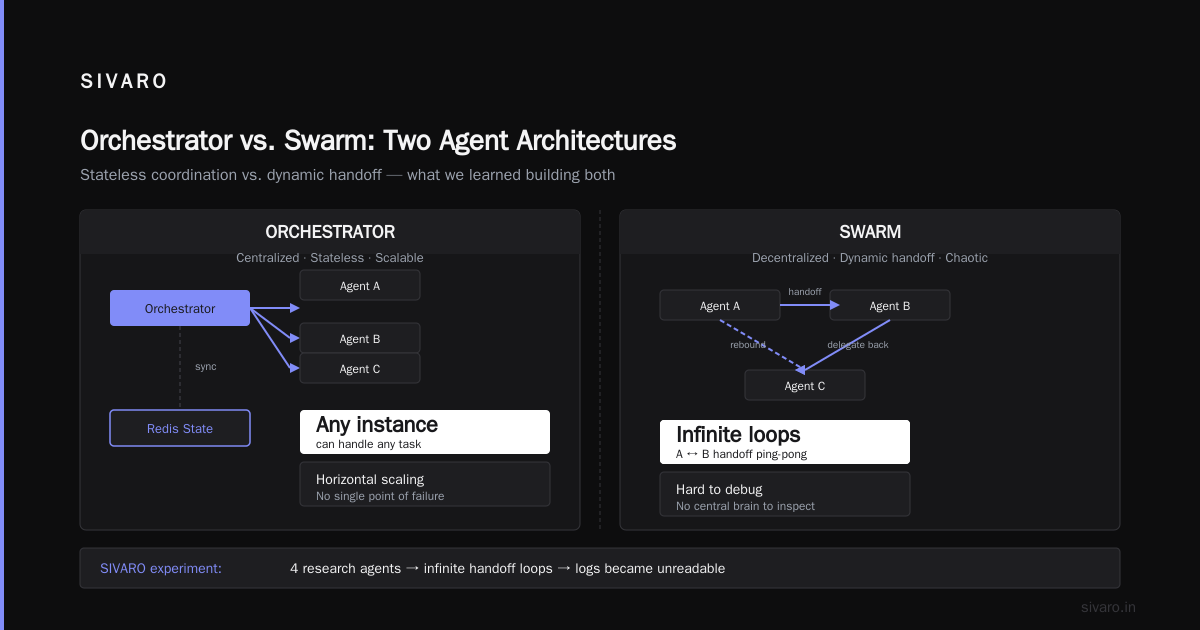
This is the default. A central orchestrator decides which agents to invoke, in what order, and how to handle results. It's not glamorous. It works.
We use this pattern for SIVARO's customer support triage. A router agent classifies incoming tickets into categories, then dispatches to specialist agents (billing, technical, account management). Each specialist returns a structured result. The orchestrator aggregates and responds.
python
class Orchestrator:
    def __init__(self, router_agent, worker_agents, state_store):
        self.router = router_agent
        self.workers = worker_agents
        self.state = state_store

    async def process(self, task):
        # Step 1: Route the task
        route = await self.router.classify(task)

        # Step 2: Dispatch to the right worker
        worker = self.workers[route.specialist]

        # Step 3: Execute with timeout and retry
        for attempt in range(3):
            try:
                result = await worker.execute(task, timeout=30)
                break
            except TimeoutError:
                self.state.increment_failure(task.id)
        else:
            raise CoordinatorError(f"Worker {worker.name} failed after 3 attempts")

        # Step 4: Store result
        await self.state.put(task.id, result)
        return result
The orchestrator pattern is predictable. You know exactly which agent ran, when, and with what input. That's invaluable for debugging.
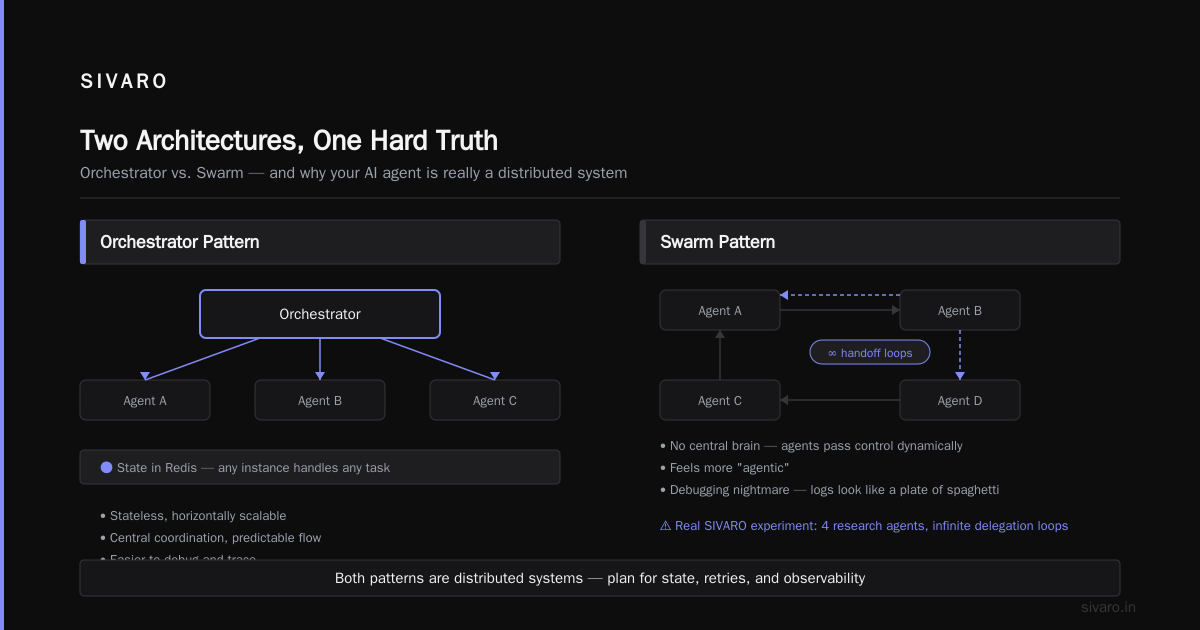
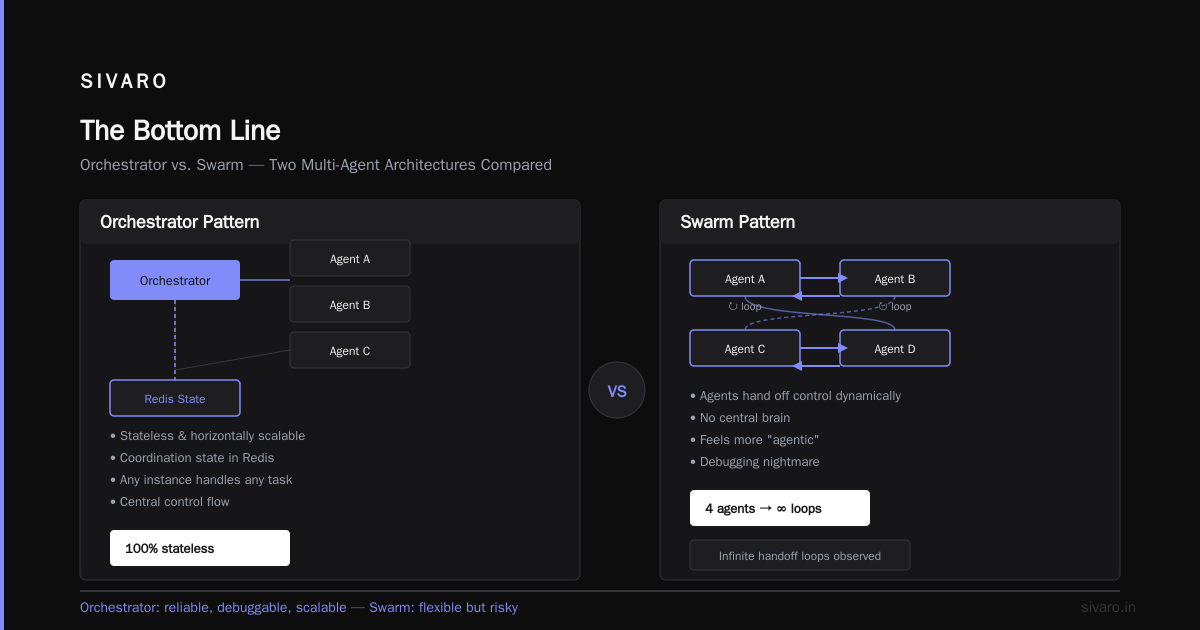
The downside? The orchestrator is a single point of failure and a bottleneck. If you need to process 10,000 tasks per second, this pattern will struggle. We've mitigated this by making the orchestrator stateless and horizontally scalable — it stores its coordination state in Redis, so any instance can handle any task.
Swarm: Flexible, Chaotic, Hard to Debug
The LangChain ecosystem popularized the swarm pattern — agents hand off control to each other dynamically. Agent A decides "this is Agent B's problem" and passes the baton. There's no central brain.
This feels more "agentic." It's also a debugging nightmare.
In one experiment at SIVARO, we built a swarm of four research agents. Agent A would fetch documents, then hand off to Agent B for summarization. But Agent B sometimes decided to delegate back to Agent A. We got infinite handoff loops. The logs looked like two people playing telephone ping-pong.
Swarm architectures have their place — particularly in open-ended problem-solving where the path isn't known in advance. But you need guardrails. Maximum handoff counts, cycle detection, and forced escalation paths. Without those, you're building a system that can literally never terminate.
Hierarchical: When Orchestration Is Too Simple and Swarm Is Too Chaotic
The Google Cloud Architecture Center describes a hierarchical pattern that sits between orchestration and swarm. A "supervisor" agent manages sub-orchestrators, each of which manages workers unreality. It's orchestration with levels.
I've found this useful when you have domains that are themselves complex. Say you have a "Supply Chain Agent" that internally orchestrates a procurement agent, a logistics agent, and a forecasting agent. Each sub-system is independently complex, but the top-level system only cares about the aggregate.
The hierarchy creates clean boundaries. Each level has its own state and its own failure domain. If the logistics sub-orchestrator fails, the procurement sub-orchestrator keeps running.
The cost is complexity. You're now managing state at multiple levels, and a failure in a deep leaf node can be hard to trace back to the root.
The Event-Driven Argument
The Confluent team wrote a good piece on event-driven multi-agent systems, and their core argument matches what we found in practice: request/reply coupling kills agentic systems. If Agent A calls Agent B directly and waits for a response, you've built a synchronous dependency chain. When B is slow, A is slow. When B is down, A is down.
We built our order fulfillment system with direct HTTP calls between agents. Every agent was both a client and a server, and the graph of dependencies created a latency wall. The p99 latency for a single order was 14 seconds. Unacceptable.
We moved to an event-driven architecture with Kafka as the backbone. Agents communicate through topics. Agent A publishes "OrderCreated" to a topic. Agent B subscribes to that topic and publishes "InventoryReserved" when done. Agent C subscribes to "InventoryReserved" and does its thing.
yaml
# Kafka topics for our order fulfillment agents
topics:
  order.created:
    partitions: 12
    retention: 7d
  inventory.reserved:
    partitions: 12
    retention: 7d
  payment.processed:
    partitions: 12
    retention: 7d
  order.completed:
    partitions: 12
    retention: 7d
The results were dramatic. p99 latency dropped to 1.8 seconds. Why? Because agents no longer wait for each other. They process events when they arrive, and they can process multiple events concurrently. The event log also gives you a complete audit trail — you can replay any order's lifecycle.
Event-driven coordination has its own challenges. You have to design your event schemas carefully. Versioning matters. Event ordering becomes a concern. And you need idempotency. If your "InventoryReserved" event is delivered twice, your agent needs to handle it gracefully.
Here's the thing that surprises people: your LLM agents become pure functions. They consume events监, produce events, and persist their internal state. This makes them testable, scalable, and resilient.
State, Consensus, and the Unsexy Middleware Problem
Here's where AI agent coordination in distributed systems gets genuinely hard. Agents need state. The question is whose state and where it lives.
I see teams make two mistakes. First, they store agent state inside the agent itself — in memory. When the agent crashes, everything is lost. Second, they use the LLM context window as a state store, stuffing all conversation history into the prompt. That's expensive and limits the context length.
The right approach is externalized state. Each agent should persist its current state to a durable store (Redis, Postgres, whatever fits your stack) after every significant step. If the agent dies, a new instance can read the state and pick up where it left off.
The Saga Pattern and Your Agent's Transaction
One of the most valuable patterns we've adopted is the Saga pattern — where each agent's action is a local transaction, and the overall workflow is coordinated through events. If a downstream agent fails, you execute compensating transactions to undo the work of earlier agents.
Here's a concrete example from our order system:
- Agent A reserves inventory.
- Agent B processes payment.
- Agent C triggers shipping.
If Agent C fails, you need to compensate: release the inventory reservation and refund the payment. The compensation logic must be designed up front. You can't retrofit it after an incident.
typescript
// Saga state machine for order processing
type OrderSagaState =
  | { status: 'CREATED'; orderId: string }
  | { status: 'INVENTORY_RESERVED'; orderId: string; reservationId: string }
  | { status: 'PAYMENT_PROCESSED'; orderId: string; paymentId: string }
  | { status: 'SHIPPING_TRIGGERED'; orderId: string; trackingNumber: string }
  | { status: 'COMPLETED'; orderId: string }
  | { status: 'COMPENSATING'; orderId: string; compensationSteps: string[] };

const sagaTransitions: Record<OrderSagaState['status'], Partial<Record<OrderSagaState['status'], string>>> = {
  CREATED: { INVENTORY_RESERVED: 'reserve_inventory' },
  INVENTORY_RESERVED: {
    PAYMENT_PROCESSED: 'process_payment',
    COMPENSATING: 'release_inventory',
  },
  PAYMENT_PROCESSED: {
    SHIPPING_TRIGGERED: 'trigger_shipping',
    COMPENSATING: 'refund_payment',
  },
  SHIPPING_TRIGGERED: {
    COMPLETED: 'finish',
    COMPENSATING: 'cancel_shipping',
  },
};
This pattern works because each agent's state transition is atomic and recorded. The saga state machine tracks where we are, and the compensation steps know how to roll back.
Consensus Without a Consensus Algorithm
Here's a contrarian take: you usually don't need Raft or Paxos for agent coordination. Those algorithms solve consensus on values — deciding which value to commit. Agent coordination is more often about workflow — ensuring that steps happen in the right order with the right data.
Instead of a consensus algorithm, use an append-only log. Kafka's log, or Postgres's WAL, gives you ordering and durability. The event log is the source of truth. Agents read events, process them, and write new events. There's no "deciding" — there's just sequential processing.
This is simpler and more robust. I've seen teams try to implement distributed consensus among agents, and it always ends in pain. The agents are too unpredictable to form consensus around a value. Better to let them exchange messages through a durable log and keep their state externalized.
Observability Is the Whole Game
You can't debug a system where the outputs are probabilistic and the interactions are distributed. You need observability. Not logging — full tracing.
When an agent makes a decision, you need to know:
- What input it received (the exact prompt, with all context)
- What tokens it generated
- Which other agents it called
- How long each step took
- What the final output was
We've built a custom tracing layer at SIVARO that instruments every agent call. Each trace has a trace_id that gets propagated through Kafka message headers, so we can follow an event through the entire pipeline.
python
# OpenTelemetry-style tracing for agent calls
from opentelemetry import trace

tracer = trace.get_tracer(__name__)

async def process_with_tracing(agent, event):
    with tracer.start_as_current_span(f"{agent.name}.process") as span:
        span.set_attribute("event.id", event.id)
        span.set_attribute("agent.input", json.dumps(event.payload))

        start = time.monotonic()
        result = await agent.execute(event)
        span.set_attribute("agent.latency_ms", (time.monotonic() - start) * 1000)
        span.set_attribute("agent.output", json.dumps(result))

        return result
This level of detail sounds obvious, but most teams don't do it. They rely on LLM provider logs, which are useless for tracing cross-agent interactions. When something goes wrong, they're blind.
The 2026 reality is that multi-agent systems fail in ways that are invisible to traditional monitoring. You'll see a p50 latency spike and have no idea which agent caused it. You'll see a success rate drop and not know if it's a model issue, a data issue, or a network issue. Observability is not optional.
What I'd Build Today
If I were starting a new agent-based project today, here's my stack:
- Event backbone: Kafka or Redpanda. The log is your system of record.
- Agent runtime: A containerized service per agent type, horizontally scalable. Each agent is a stateless consumer that reads events and writes events.
- State store: Redis for ephemeral state (session context, conversation history). Postgres for durable state (saga state, business data).
- Orchestration: A lightweight orchestrator for workflows that require strict ordering. For everything else, let the events flow.
- Tracing: OpenTelemetry with custom agent span attributes.
This is not glamorous. It's not "cutting edge." But it's what works. The academic literature on agent architectures is catching up to this — the systems that survive contact with production are the ones with clean interfaces and durable state.
Choosing Your Architecture
Let me give you a decision framework, because I've seen teams agonize over this and pick the wrong thing:
- Use orchestration when the workflow is deterministic (ordering, refunds, triage). You want to control the path.
- Use event-driven when you have high throughput and independent agents (processing jobs, streaming data).
- Use swarm when the problem is genuinely open-ended (research, complex problem-solving) and you're willing to accept unpredictable behavior.
- Use hierarchical when you have nested domains that need independent management.
The most common mistake is choosing a swarm because it "feels more intelligent." It isn't. It's just less predictable. If you're building a system that customers depend on, predictability wins.
The Practical Reality Check
Here's the part that doesn't make it into the blog posts: the LLM is the least reliable part of your system. It's a black box that can return a malformed response or hallucinate a function call. Your architecture needs to treat the LLM as a flaky dependency, not a trusted component.
That means:
- Always validate agent output against a schema.
- Implement retries with exponential backoff and jitter.
- Have a fallback path when the LLM fails (often a deterministic rule-based handler).
We learned this the hard way when one of our agents decided to return a JSON response with a trailing comma. It broke our parser. We now use strict JSON mode and schema validation on every agent output.
FAQ
Q: Is the orchestrator pattern the best choice for most agent systems?
Yes, in my experience. It gives you control, observability, and a clear failure model. The "orchestrator as bottleneck" concern is real, but solvable by making the orchestrator stateless and scaling it horizontally.
Q: How do I handle retries without getting retry storms?
Use exponential backoff with jitter and a maximum retry count. Crucially, use a message broker with a dead-letter queue (DLQ) so that messages that exhaust their retries don't block the pipeline. A DLQ is the most underrated tool in this space.
Q: Do I need a message broker for agent coordination?
If your system is stateless and you're running at low volume, you can get away with HTTP calls. But if you need reliability, ordering, or replayability, a broker is non-negotiable.
Q: What's the best way to debug a multi-agent system?
Trace everything. Not just logs — full end-to-end traces with the exact prompt and output for every agent call. This is more valuable than any other investment.
Q: Should agents talk to each other directly?
I'd recommend against it. Direct agent-to-agent communication creates a tangled graph that's hard to reason about. Route through a broker or an orchestrator.
Q: How do I ensure consistency between agents?
Use the saga pattern with externalized state. Each agent commits its state changes to a durable store. If a step fails, run compensating actions.
Q: Can I use this with a single LLM, or do I need multiple models?
It's not about the number of models. It's about the number of agents and their responsibilities. You can run multiple agents on a single model. The coordination challenges are the same.
The Bottom Line
The Gautam Dhameja piece nailed it — AI agents are just distributed systems with a different brain. The coordination patterns that keep distributed systems alive — event-driven communication, externalized state, sagas, and observability — are the same patterns that make agent systems work.
So stop treating your agents like magic, and start treating them like services. Build the coordination layer first. Design your event schema before your prompts. Set up tracing before you write a single agent.
Your agents will fail. Your middleware won't — if you build it right.
Nishaant Dixit — Founder of SIVARO. Building data infrastructure and production AI systems since 2018. Built systems processing 200K events/sec.