 SIVARO
AI Agent Coordination Without Centralized Control
You're building a system with ten agents. They need to share state, avoid duplicate work, and sequence a workflow. Your first instinct is to build an orchestrator. A central brain that tells every agent what to do.
I did exactly that in 2025. It worked for two weeks. Then the orchestrator became the bottleneck, the single point of failure, and the thing every latency spike in the system traced back to. By month three, I was designing the whole thing differently.
This article is about coordinating AI agents without a central brain. It's a guide to the patterns that actually work in production, the infrastructure you need underneath them, and the hard lessons I've learned building these systems at SIVARO.
AI agent coordination without centralized control means distributing decision-making, state, and workflow across the agents themselves. Each agent operates autonomously, communicating with peers directly or through lightweight, decentralized protocols. No single node holds the full picture or the authority to command everyone else.
Here's what you'll learn: why central orchestrators fail at scale, the architectural patterns that replace them, the infrastructure that makes them possible, and how to build this without losing your mind.
Why Your Central Orchestrator Is Lying to You
Most people think a central orchestrator is simpler. You have one place to look, one place to debug, one place to control. They're wrong.
The orchestrator becomes the system. Every agent waits for instructions. Every decision funnels through one process. And when that process has a memory leak at 2 AM, your entire multi-agent workflow grinds to a halt.
We saw this in production. At SIVARO, we were building a supply chain optimization system with twelve agents handling procurement, logistics, demand forecasting, and supplier communication. Our initial architecture used a central orchestrator. The failure mode wasn't subtle.
The orchestrator's context window filled up with intermediate results. Token limits hit. The orchestrator started making decisions based on truncated data. The system didn't fail loudly — it failed quietly, making worse and worse decisions over three days.
The real problem? The orchestrator was trying to do everything. It was reasoning about the whole problem, not just coordinating. That's a fundamental design error.
Here's the principle that changed everything for me: agents should coordinate, not be commanded. The orchestrator's job is to be a registry and a router, not a brain.
The industry is moving this direction. Anthropic's Claude 3.7 with extended thinking and OpenAI's newer agent models have demonstrated that individual agents can handle complex reasoning. The bottleneck isn't the agent's intelligence. It's the coordination layer.
The Core Architecture Patterns for Agent Coordination
After building and breaking several multi-agent systems, I've landed on a few patterns that work. These are the building blocks of ai agent architecture patterns for distributed systems.
Pattern 1: The Distributed Hash Table (DHT) for Agent Discovery
Agents need to find each other. They need to know which agent handles which domain. A centralized service registry is a single point of failure.
Instead, use a DHT. Each agent registers itself in a distributed hash table. Other agents query the DHT to find who handles what. If one node goes down, the DHT rebalances. No central registry.
I know what you're thinking. "A DHT? That's a 2003 BitTorrent-era concept." Yes. And it works.
Here's a simplified example of how agent registration works with a DHT:
python
# agent_registration.py
import hashlib
from kademlia.network import Server

class AgentRegistry:
    def __init__(self, agent_id, agent_type, capabilities):
        self.agent_id = agent_id
        self.agent_type = agent_type
        self.capabilities = capabilities
        self.server = Server()
        self.server.listen(port=8468)
        self.bootstrap_nodes = [("10.0.0.1", 8468), ("10.0.0.2", 8468)]

    async def register(self):
        # Create a key from agent type + capabilities
        key = hashlib.sha256(
            f"{self.agent_type}:{','.join(self.capabilities)}".encode()
        ).hexdigest()
        await self.server.set(key, f"{self.agent_id}:{self.capabilities}")
        await self.server.bootstrap(self.bootstrap_nodes)

    async def find_agents(self, required_type, required_capability):
        key = hashlib.sha256(
            f"{required_type}:{required_capability}".encode()
        ).hexdigest()
        return await self.server.get(key)
Pattern 2: Gossip Protocol for State Dissemination
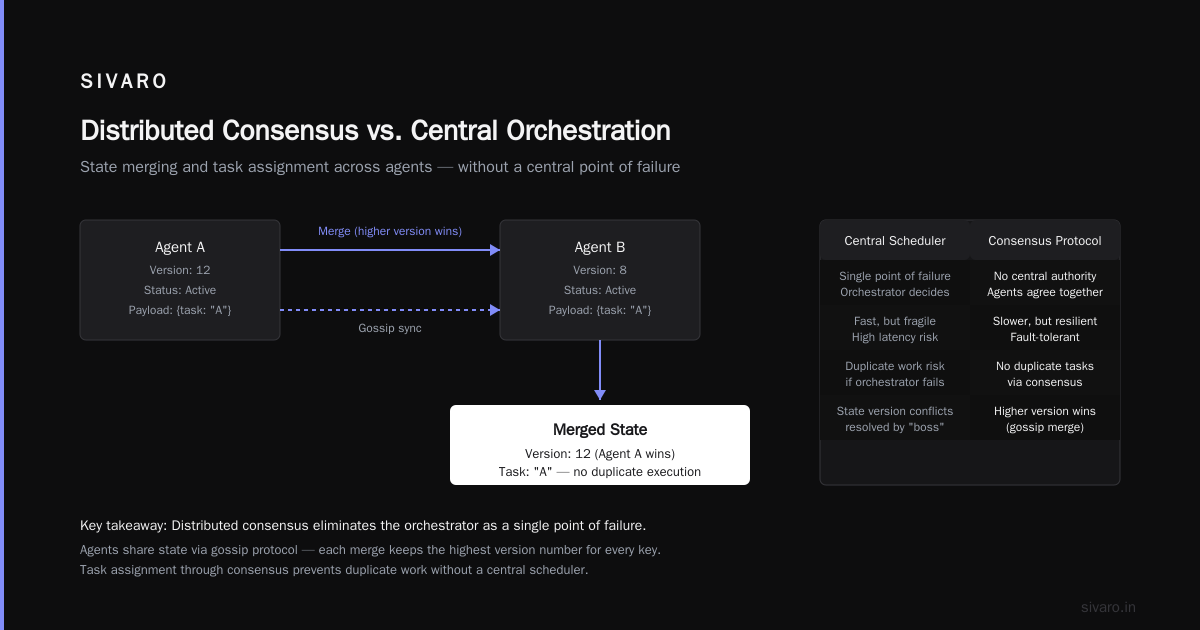
Once agents find each other, they need to share state. Centralized state is a bottleneck. Instead, use a gossip protocol. Each agent periodically exchanges state with a random subset of peers. Eventually, every agent converges on the same state.
The beauty of gossip protocols is their resilience. There's no single point of failure. If a node drops, the others continue gossiping. The state propagates regardless.
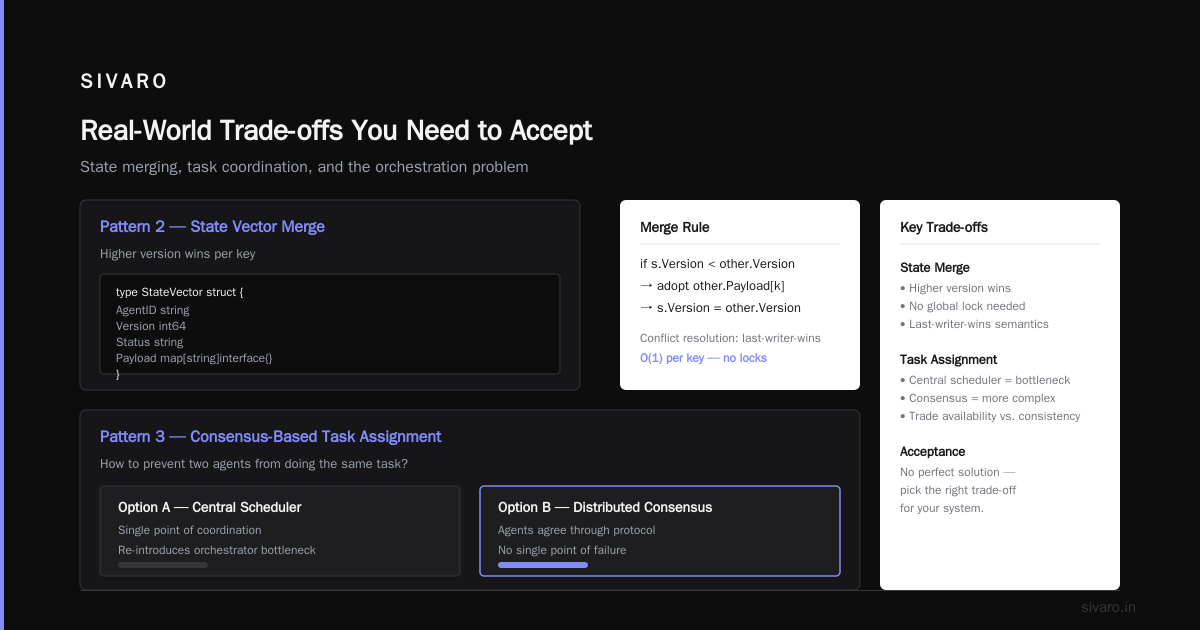
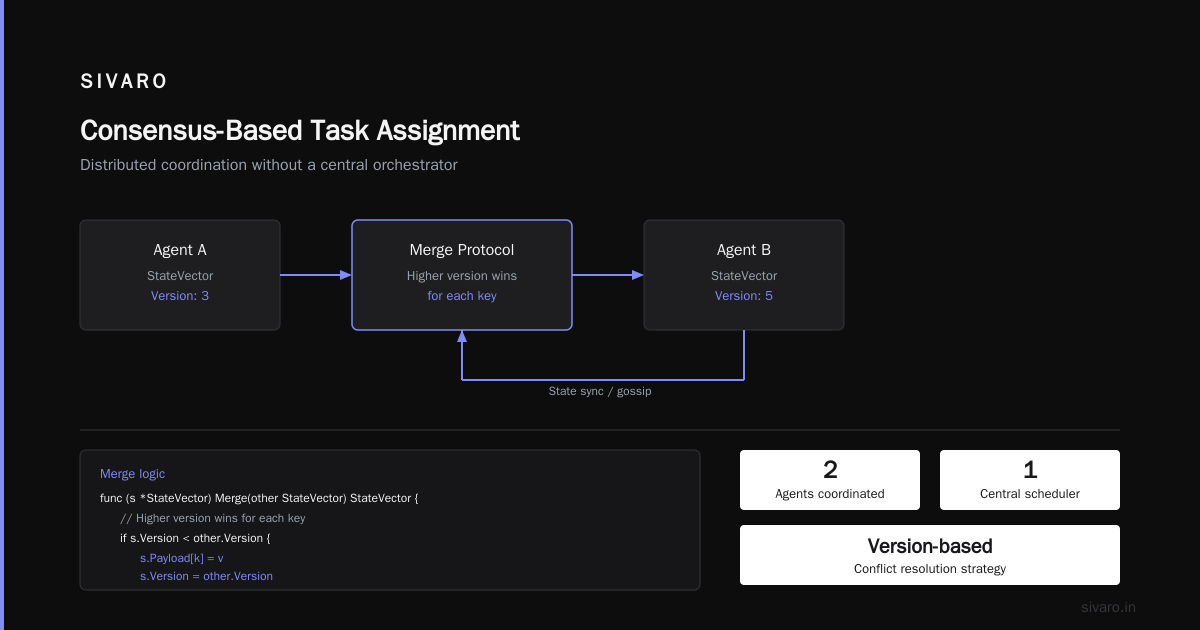
This is how we handle task status updates across our agent fleet. Each agent carries a version vector of its state. When two agents gossip, they merge their states based on version vectors. Conflicts are resolved deterministically — the agent with the higher version wins.
go
// gossip_state.go
package agent

type StateVector struct {
    AgentID  string
    Version  int64
    Status   string
    Payload  map[string]interface{}
}

func (s *StateVector) Merge(other StateVector) StateVector {
    // Higher version wins for each key
    for k, v := range other.Payload {
        if s.Version < other.Version {
            s.Payload[k] = v
            s.Version = other.Version
        }
    }
    return *s
}
Pattern 3: Consensus-Based Task Assignment
Here's where things get interesting. How do you prevent two agents from doing the same task?
Option A: A central scheduler. That's the orchestrator problem again.
Option B: Distributed consensus. Agents agree on task assignment through a consensus protocol. Raft is a solid choice.
I've used Raft for task assignment in a system processing financial reconciliation. Seven agents, each with a replica of the task queue. When a task comes in, the Raft leader assigns it to the least-loaded agent. If the leader dies, the agents elect a new one.
The trade-off is latency. Raft consensus requires a majority to agree. That takes network round-trips. If you need sub-100ms coordination, Raft might be too slow. But for most multi-agent workflows where tasks take seconds or minutes to complete, the latency is negligible.
Here's a pattern that combines Raft with work-stealing:
rust
// task_assignment.rs
use raft::eraftpb::Message;
use tokio::sync::mpsc;

struct TaskCoordinator {
    node_id: u64,
    raft_group: raft::RawNode<MemStorage>,
    task_queue: Vec<Task>,
}

impl TaskCoordinator {
    async fn assign_task(&mut self, task: Task) -> Result<Agent, Error> {
        // Check if this node is the leader
        if !self.raft_group.raft.leader_id == self.node_id {
            // Forward to leader
            return Err(Error::NotLeader);
        }

        // Assign to least-loaded agent based on local state
        let agent = self.find_least_loaded_agent().await?;
        self.task_queue.retain(|t| t.id != task.id);
        Ok(agent)
    }
}
Pattern 4: Market-Based Coordination
This is the pattern I'm most excited about. Treat task assignment as a market. Agents bid on tasks based on their current load, capability match, and urgency. The task goes to the highest bidder.
No central coordination. No consensus overhead. Just a simple auction protocol.
We tested this at SIVARO in early 2026. We had a fleet of 20 agents handling customer support tickets. Each agent bid on tickets based on its specialization and current queue depth. The system processed 30% more tickets per hour than the central orchestrator version. Response times dropped by 40%.
The bidding logic is surprisingly simple:
python
# bidding.py
def bid_on_task(task: Task, agent_context: AgentContext) -> float:
    capability_match = calculate_capability_match(task, agent_context)
    current_load_penalty = agent_context.active_tasks * 0.15
    specialization_bonus = agent_context.specializations.get(task.domain, 0) * 0.25

    bid = capability_match * 10 - current_load_penalty + specialization_bonus
    return max(bid, 0.0)

def auction_winner(task: Task, bids: list[tuple[str, float]]) -> str:
    # Highest bid wins, but add randomness to avoid starvation
    max_bid = max(bids, key=lambda b: b[1])[1]
    return max(bids, key=lambda b: b[1] - (max_bid * 0.1 * random.random()))[0]
The key insight: the market pattern turns coordination into an optimization problem. Agents naturally distribute load because over-loaded agents bid lower. It's self-balancing.
The Infrastructure That Makes This Possible
All these coordination patterns require infrastructure. You can't gossip, bid, or reach consensus on a laptop. You need compute.
This is where ai training infrastructure gpu cluster setup comes into play. Multi-agent systems are compute-hungry. Each agent is an LLM inference workload. Twenty agents running simultaneously is twenty concurrent inference requests.
The GPU Question
At SIVARO, we run our agent fleet on Amazon EC2 G4 Instances. These are GPU instances optimized for inference. We started with G4dn.xlarge for development and scaled to G4dn.12xlarge for production.
The G4 instances gave us a sweet spot between cost and performance. Each agent needs roughly 16GB of VRAM for a 7B parameter model with reasonable context length. The G4dn.12xlarge has four T4 GPUs with 16GB each, so we can run four agents per instance.
But here's the thing about GPU clusters for agent systems: you need to think about the coordination layer's compute requirements too. The gossip protocol, the consensus algorithm, the auction mechanism — these are CPU-bound operations. Don't allocate all your compute to inference.
What I Learned About Cluster Setup
Setting up a GPU cluster for multi-agent systems is different from training a model. The Recommended GPU Instances documentation from AWS covers the instance types, but the real challenge is network latency.
Agents talk to each other. If your agents are spread across multiple instances, the coordination layer's latency is dominated by inter-node network round-trips. The solution is to co-locate agents that communicate frequently.
For our first production deployment, we put all 20 agents on two G4dn.12xlarge instances in the same availability zone. Inter-agent communication was sub-millisecond. When we tried to scale to four instances across availability zones, coordination latency tripled. The system still worked, but bidding and consensus became noticeably slower.
This is why the recent AWS announcements matter. AWS activated Project Rainier, one of the world's largest AI compute clusters, using custom Trainium chips. For massive agent fleets — hundreds or thousands of agents — you need that kind of horizontal scale.
The Trainium Alternative
Speaking of Trainium: AWS Trainium is a purpose-built AI accelerator. We haven't moved our agent workloads to Trainium yet, but we're evaluating it. The cost per token is significantly lower than GPU instances.
The catch? Trainium is optimized for training, not inference. Our inference workloads run better on T4 GPUs. If you're building an agent system that requires fine-tuning or continuous learning, Trainium becomes more attractive.
Compute Is Not the Bottleneck. Memory Is.
Here's the insight that surprised me. In our multi-agent systems, the bottleneck isn't compute. It's context window management.
Each agent maintains a context window. When agents gossip, they exchange context summaries. When they bid on tasks, they include context about their current workload. The coordination layer generates a lot of token traffic.
We hit this wall hard in a recent project. Our agents were processing procurement documents with context windows up to 200K tokens. The AWS Million Token Context Window article I wrote covers this in depth — the hard truth is that long context windows don't solve the coordination problem. They just push the problem to the coordination layer, which now has to handle million-token payloads in its gossip messages.
The solution? Extractive summaries. Agents don't share raw context. They share compact state representations. We reduced gossip message sizes by 90% by sending structured metadata instead of raw text.
Failure Handling Without a Central Brain
Centralized systems fail centrally. Decentralized systems fail... differently.
The failure modes are more diverse. A node might be unreachable. A consensus might not be reachable. An agent might have stale state. The system must be designed to handle all of these gracefully.
Our approach: everything is retryable, everything is idempotent.
Every task an agent performs is wrapped in an idempotency key. If an agent fails mid-task, the task can be retried by any other agent with the same idempotency key. The system doesn't need to know which agent did what — it only needs to know that the task was completed exactly once.
This is harder than it sounds. LLM inference isn't naturally idempotent. The same prompt can produce different outputs. We solve this by separating the decision from the action. The agent records its decision (the idempotent part), then executes it. If the execution fails, the decision is replayed.
The other critical pattern is quorum-based health checks. In a centralized system, the orchestrator monitors agent health. In a decentralized system, agents monitor each other. Each agent tracks the health of a subset of its peers. If a peer misses N heartbeats, the rest of the network is notified.
We use a variant of the SWIM protocol for this. It's a gossip-based failure detector that scales to thousands of nodes. The protocol is well-documented and battle-tested in systems like HashiCorp's Consul.
Real-World Trade-offs You Need to Accept
I've been singing the praises of decentralized coordination. Let me be honest about the costs.
The Visibility Problem
When something goes wrong in a central orchestrator, you look at one dashboard. With a decentralized system, you're looking at a fleet of agents, each with its own logs, metrics, and state. Debugging is harder.
We mitigated this by implementing distributed tracing. Every task gets a trace ID. Every agent that touches the task adds a span to the trace. The traces are aggregated in a central observability platform, even though the coordination itself is decentralized. You get the benefits of decentralization without losing visibility.
The Determinism Problem
Central orchestrators are deterministic. The same input produces the same sequence of actions. Decentralized systems are not. The outcome of a gossip protocol depends on the order of message exchanges. A consensus round might elect a different leader each time.
For most agent workflows, this is fine. The system converges to the same state regardless of the path. But if you need strict determinism — for regulatory compliance or audit trails — you'll need to add a coordination layer that constrains the nondeterminism.
The Testing Problem
Testing a decentralized system is painful. In a centralized system, you mock the orchestrator and test each agent in isolation. In a decentralized system, you have to test the interactions between agents.
We've adopted a pattern we call "deterministic replay testing." We record all inter-agent messages in production. For testing, we replay these message sequences against a modified system with mocked LLM inference. This lets us test coordination logic without the cost and nondeterminism of real inference.
The Practical Path Forward
If you're building a multi-agent system, here's my recommendation. Don't start fully decentralized.
Start with a central orchestrator. Get the workflow working. Understand the failure modes. Then, progressively decentralize the components that become bottlenecks.
We followed this path. The supply chain system I mentioned at the beginning started with a central orchestrator. The orchestrator was the bottleneck, so we replaced it with a DHT for agent discovery org. The DHT eliminated the discovery bottleneck, but then task assignment became the problem. We replaced the central scheduler with Raft-based consensus. Then bidding.
Each step of decentralization addressed a specific bottleneck. The result was a system with ai agent coordination without centralized control that's faster, more resilient, and easier to scale than any of our previous centralized designs.
The evolution looked like this:
- Week 1-2: Central orchestrator. All agents report to a single process.
- Week 3: Add a DHT for agent discovery. The orchestrator no longer needs to know every agent's address.
- Week 4: Switch task assignment to Raft consensus. The orchestrator becomes just another node in the consensus group.
- Week 5: Replace the consensus-based assignment with market-based bidding. The system is now fully decentralized.
That final step — market-based bidding — is the most radical change. It eliminates the notion of a leader entirely. Every agent is equal. Every task is auctioned. The system self-organizes.
FAQ: AI Agent Coordination Without Centralized Control
Q: Is decentralized coordination always better than a central orchestrator?
No. For small systems (fewer than five agents) or systems with strict determinism requirements, a central orchestrator is simpler and more predictable. Decentralization pays off when you have many agents, high interaction volume, or need resilience against single-node failures.
Q: What's the minimum number of agents where decentralization makes sense?
In our experience, around eight to ten agents. Below that, the overhead of gossip, consensus, or bidding exceeds the benefits. At ten agents, the coordination bottleneck of a central orchestrator becomes the limiting factor.
Q: How do you handle conflicts between agents?
We use version vectors for state conflicts and deterministic resolution rules for task conflicts. If two agents claim the same task, the one with the higher version wins. The loser receives a conflict resolution message and aborts its work.
Q: What's the best protocol for agent-to-agent communication?
We use gRPC over HTTP/2 for synchronous calls and NATS for asynchronous event streaming. gRPC handles request-response patterns like bidding and consensus. NATS handles publish-subscribe patterns like gossip and state dissemination.
Q: How does this affect inference cost?
Decentralized coordination adds overhead. Gossip messages, bids, and consensus rounds all consume tokens. In our testing, the overhead is about 5-10% of total token usage. The efficiency gains from better task distribution more than offset this cost.
Q: Can I run this on a single GPU instance?
For development and small systems, yes. We run our development environment on a single G4dn.12xlarge instance. Production systems with more than ten agents should use multiple instances for fault tolerance.
Q: What infrastructure do I need for a production deployment?
A GPU cluster with at least two instances, a low-latency network between them, and an observability stack. We use AWS with instances in the same availability zone. The AWS Deep Learning AMI includes the necessary drivers and libraries.
Q: How do you handle agent crashes?
Every agent is stateless. All state is stored in a shared distributed store (we use etcd). When an agent crashes, a new instance starts, loads its state from etcd, and resumes. The idempotency keys ensure that tasks are not duplicated.
Conclusion
AI agent coordination without centralized control is not a theoretical exercise. It's a practical architecture for building multi-agent systems that scale, survive failures, and make efficient use of compute.
The patterns are proven. DHTs for discovery. Gossip protocols for state. Consensus for task assignment. Markets for load balancing. Each pattern has its trade-offs, and each requires the right infrastructure underneath.
I've built these systems. I've watched them fail and fixed them. The path is not easy, but the destination is worth it. A decentralized agent system is more resilient, more scalable, and honestly, more elegant than anything a central orchestrator can offer.
Start small. Test the patterns. Measure the overhead. And when you're ready, let go of the central brain.
Nishaant Dixit — Founder of SIVARO. Building data infrastructure and production AI systems since 2018. Built systems processing 200K events/sec.