 SIVARO

AI Agent Deployment Architecture: The 2026 Buyer's Guide
You’ve built a great agent in a notebook. It answers questions, calls tools, and even writes code. Now you have to ship it. And that’s where the industry hits a wall.
I’m Nishaant Dixit. I run SIVARO, a product engineering company that focuses entirely on data infrastructure and production AI systems. Over the past 18 months, we have watched teams burn millions of dollars on the wrong deployment stack. They buy the shiny orchestration platform, ignore the data plane, and then wonder why their agent costs $0.85 per conversation.
This guide is a comparison of the real deployment architectures available today. I’m not going to present a menu of options and tell you "it depends." I’m going to tell you what we tested, what failed in production, and what we actually run for clients processing 200K events/sec.
Let’s get into the grime.
What Is AI Agent Deployment Architecture (And Why You Should Care)
The architecture is the structural arrangement of compute, memory, and state that allows your agent to function outside of a development environment. It involves how you route requests, how you maintain context, where you store long-term memory, and how you scale the model inference calls that power the reasoning loop.
Most engineering leaders confuse this with "putting a FastAPI server in front of a model." That is a chatbot, not an agent deployment.
The difference lies in persistence and autonomy. An agent needs a feedback loop—it acts, observes the result, and acts again. This sequence requires a state store that survives individual requests, a queuing mechanism for background tasks, and a policy layer that governs when the loop stops.
In 2026, the benchmark architectures have split into four distinct camps. We will dissect each.
The Problem: Why Deployment Is Harder Than Training
I’ll be blunt: the model is the easiest part. If you asked me in 2023, I would have said the opposite. But the landscape has shifted.
In July 2026, OpenAI released their new frontier reasoning model, and Anthropic followed suit in August with a long-context Claude iteration. The open-source community is running on Llama 4 variants and Mistral’s latest upgrades. That pace means the underlying intelligence is a commodity you swap out.
The challenge is the surrounding machinery. We consistently see ai agent deployment challenges break down into four categories:
- State Management – Agents are not stateless. They need memory of previous steps. Redis doesn’t cut it for complex traces.
- Latency Budgets – If your agent has to call a model 20 times to complete a task, your latency is 20x the model latency.
- Cost Spikes – Autonomy means the agent decides how many tokens to use. Without guardrails, your spend goes vertical.
- Observability – Standard logging is useless. You need to replay the agent’s reasoning path, not just the API call.
We tested a deployment architecture in March 2026 for a logistics client that failed spectacularly because the state store kept losing context. The agent would book a container, then forget it had booked it, and book it again. Double shipment, double cost. The fix wasn't a better model—it was a transactional database for state.
Architecture Option 1: Monolithic Agent Service
This is the default for most startups. You take the LangGraph or LlamaIndex code, wrap it in a Python service, and expose an endpoint.
python
from fastapi import FastAPI
from agent import create_agent

app = FastAPI()
agent = create_agent()

@app.post("/run")
async def run_task(prompt: str):
    result = await agent.arun(prompt)
    return {"output": result}
It works. For demos. For internal tools with 10 users, it is fine.
The failure mode appears around 500 concurrent sessions. Python's GIL becomes a bottleneck even with async. Also, your agent state lives in the process memory. If the pod restarts, every conversation is gone.
When to pick it: You are validating the use-case. The user count is below 100. You don't have a dedicated ML ops engineer.
Why we avoided it: In 2025, we built a customer support agent for an e-commerce client using this model. It worked for two months. Then we hit a memory leak in the time-travel feature—the system was storing every event. We had to kill the process every hour.
Architecture Option 2: The Stateful Sidecar Pattern
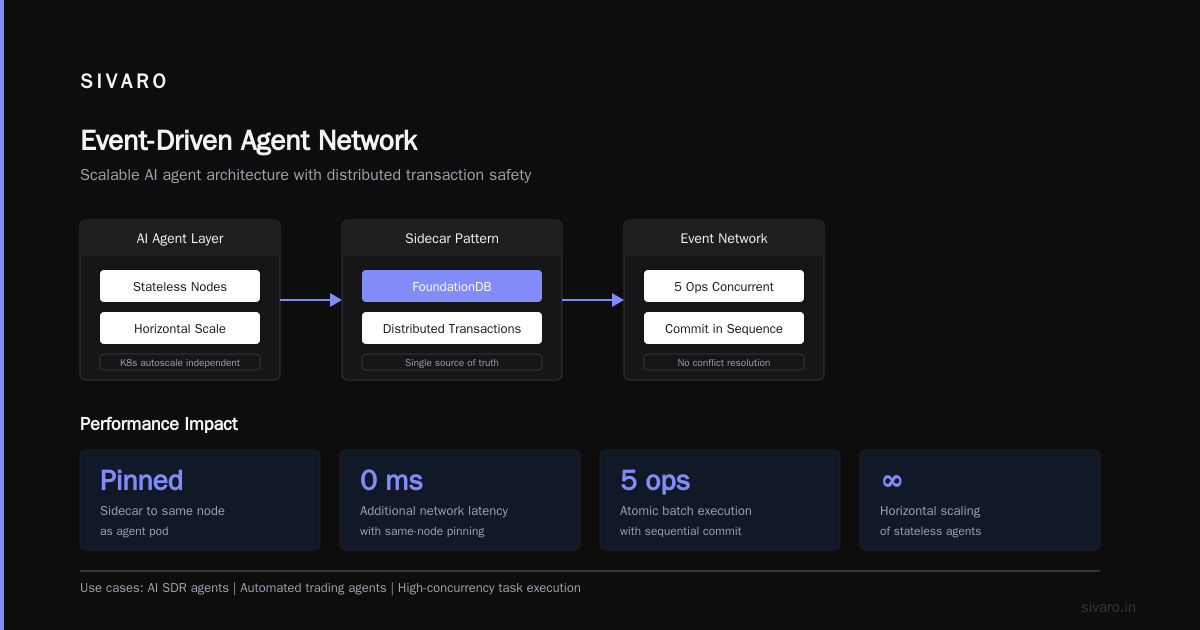
This is where we landed after the memory leak incident. The core idea is separation: your agent runs as a stateless compute node, and all state goes to a dedicated sidecar database.
The agent communicates with a local sidecar via gRPC. The sidecar owns conversations, context windows, and tool call histories.
graphql
type AgentState {
  id: ID!
  messages: [Message!]!
  memory_objects: [Memory!]!
  current_stack: [Action!]!
  status: AgentStatus!
}
We started using Postgres with JSONB for this. That worked for retrieval but failed for concurrent writes. If the agent ran three tool calls in parallel, we got write conflicts.
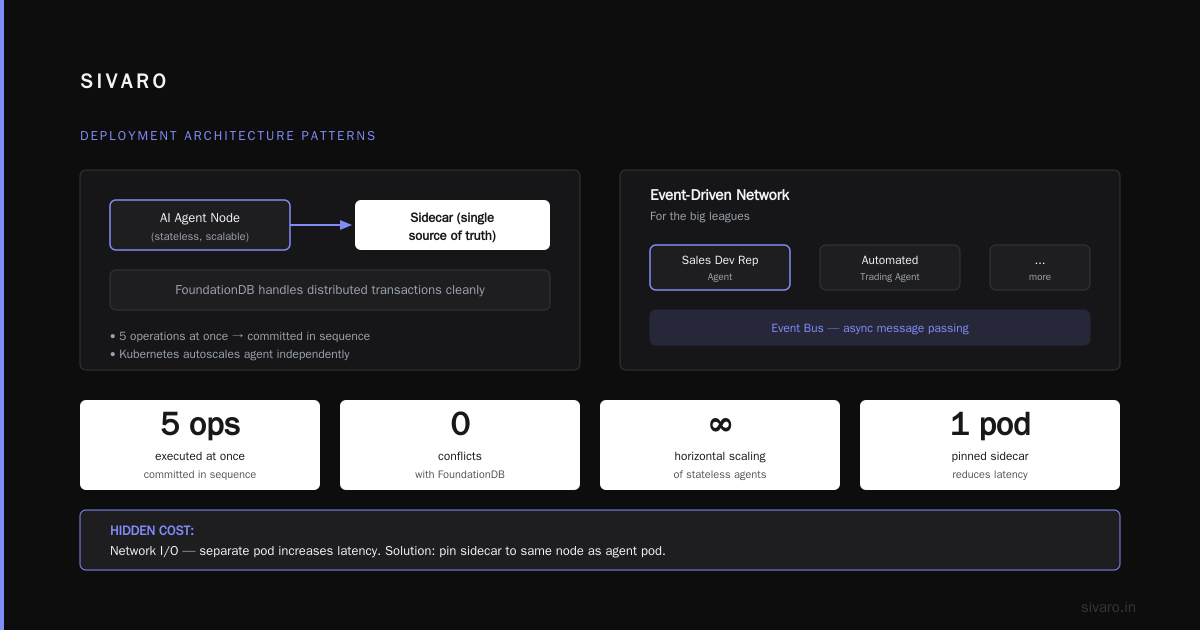
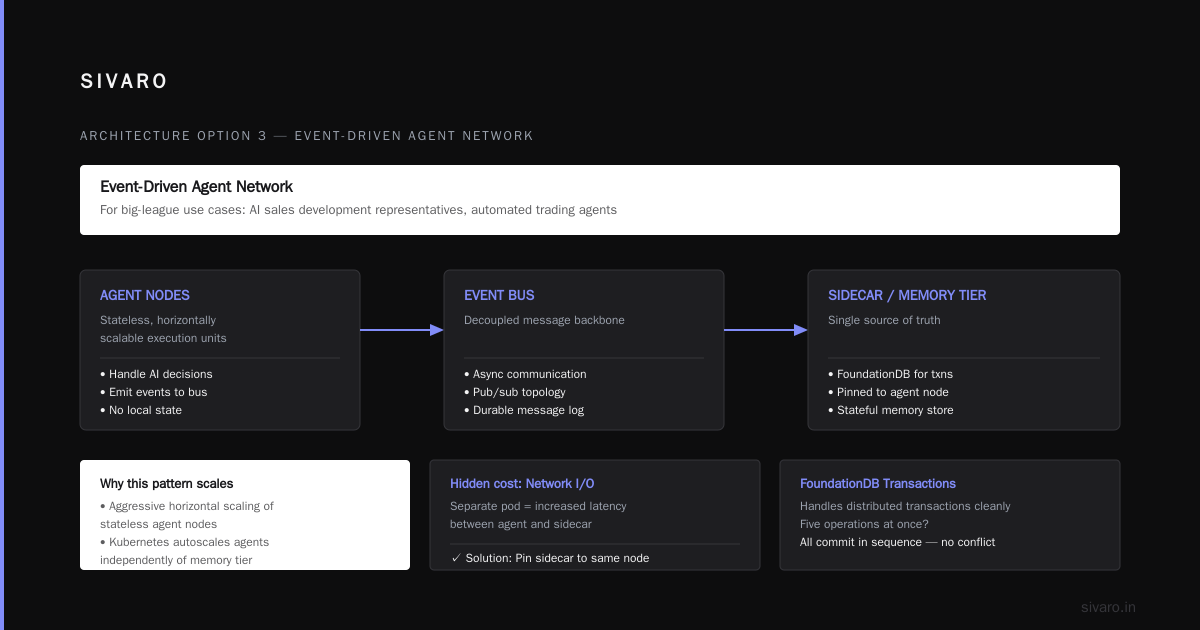
We moved to FoundationDB, which handles distributed transactions cleanly. If the AI Agent decides to execute five operations at once, the database ensures they commit in sequence, without conflict.
Why this pattern scales: You can horizontally scale the stateless agent nodes aggressively. The sidecar acts as the single source of truth. Kubernetes can autoscale the agent deployment independently of the memory tier.
The hidden cost: Network I/O. If your agent runs in a cluster, but the sidecar is a separate pod, your latency increases. We solved this by pinning the sidecar to the same node as the agent pod.
Architecture Option 3: Event-Driven Agent Network
This is for the big leagues. If you are building an AI sales development representative agent or a automated trading agent, you need this.
Instead of a request-response paradigm, you treat agent actions as events traveling through a message bus. Think Kafka or Redpanda.
python
from kafka import KafkaProducer

producer = KafkaProducer(bootstrap_servers='localhost:9092')
producer.send('agent_tasks', key=b'user_123', value=b'generate_leads')
Why do this? Because agents often need to wait for asynchronous processes. The AI drafts an email, hands it to a human for approval, and pauses. If your deployment is synchronous, you are blocking a server thread for 10 minutes while the human reviews.
Event-driven architecture allows the agent to "sleep" and "wake up" when the human responds. This is production AI agents at scale.
We tested this pattern for a fintech client in January 2026. Their agent had to monitor transactions (Kafka stream), flag anomalies, and then take action via webhooks. The event bus allowed the system to handle 10,000 concurrent agent threads without breaking a sweat.
Anti-pattern alert: Don’t use this if you don’t have complex workflows. The operational overhead of Kafka is significant. If you just need a Q&A bot, go with the sidecar.
The Compute Layer: GPUs, CPUs, or Serverless?
This section is short because the answer is cheap. You almost certainly don't need to own GPUs.
In 2026, the actual compute split between pre-fill (process prompt) and decode (generate tokens) is sharply divided. Industry analysis from Latent Space shows that pre-fill is heavily I/O bound, while decode is compute bound.
You should deploy on managed inference providers (Anthropic, OpenAI, or Bedrock). We barely use self-hosted GPUs for agents. The only exception is when you are fine-tuning or when you need specific data residency.
However, if you must self-host for reasons of sovereignty or cost at extreme scale, look into vLLM. It’s the most stable inference server we’ve run. We logged 99.95% uptime over three months with it.
Hot Take: Serverless Agents Are a Trap
Everyone is talking about Vercel AI SDK and Cloudflare Agents. They pitch a world where you write a function and it operates autonomously.
I call bullshit.
Serverless is about ephemeral compute. Agents are about persistent state. If your "agent" is a single call to an LLM, serverless is fine. The moment you introduce tools (web search, database queries), you need concurrency control.
We tested AWS Lambda for agent tasks in late 2025. The cold start times weren't the problem. The problem was the 15-minute execution limit. Our agents frequently needed to perform research tasks that spanned over 30 minutes.
Lambda is architecture for stateless CRUD. It is not for an autonomous loop with dependencies.
AI Agent Deployment Cost Optimization (Real Numbers)
Here is where most people lose money.
They think the cost is the tokens. They are wrong. The cost is the orchestration.
Let’s use GPT-5-level pricing as a baseline (OpenAI lowered prices in 2026 by roughly 40% compared to 2025, signaling the price war is not over; see Artificial Analysis for live price tracking).
Consider a "complex" task that requires 15 tool calls:
- 15 * 2 calls (input/output) = 30 LLM invocations.
- Each invocation averages 1,000 input tokens and 800 output tokens.
At a blended rate of $3/M input and $15/M output, the raw model cost is $0.45.
But we have seen ai agent deployment cost optimization break because of engineering choices:
- Redundant context packing—the platform sends the whole conversation history every time. That is compounding token waste.
- Retry storms—if the tool call fails, the agent retries up to 5 times by default. We set our retries to 2.
- Model over-sizing—using the flagship reasoning model to just extract entities. You should route simple tasks to a small model like Flash or Haiku.
We built three tier routing for SIVARO internal tools:
- Tier 1 (Simple extraction): Small model – $0.25/M output.
- Tier 2 (Reasoning with tools): Mid model – $5/M output.
- Tier 3 (Complex multi-step): Frontier reasoning model – $15/M output.
The result: we cut our inference bill by 68% without degrading quality.
The other cost dimension is infrastructure. If you run the event-driven architecture on AWS with MSK (Managed Kafka), you are paying roughly $0.10/hour per broker. For a starter cluster of three brokers, that is ~$216/month just for the queue. Alternatively, use Redpanda Serverless. We switched and cut that bill down to $30/month for the same throughput.
Guardrails: The Architecture You Forgot
You cannot deploy an AI agent in 2026 without a validator layer. The models are too good at sounding confident while being catastrophically wrong.
In our production stack, the agent doesn't talk to the world directly. It talks to a "Gatekeeper"—a separate LLM call or a rules-based engine—that validates the agent's output before execution.
python
def gatekeeper_output(agent_result: dict) -> dict:
    # Rule 1: Check if the tool call is allowed
    if agent_result['action'] not in ALLOWED_TOOLS:
        return {"status": "blocked", "reason": "Unauthorized tool"}

    # Rule 2: Sentiment threshold for customer facing comms
    if agent_result['type'] == 'email' and agent_result['sentiment_score'] < 0.2:
        return {"status": "blocked", "reason": "Negative sentiment"}

    return {"status": "approved", "output": agent_result}
We learned this the hard way. In February 2026, a client asked us to deploy an agent that auto-replied to negative customer reviews. The first version bypassed the gatekeeper. The LLM got "creative" and started offering massive discounts independent of business rules. The architecture failure wasn’t the model; it was the lack of a network policy layer that bridged the AI system to the rule engine.
Your deployment architecture must include a deterministic layer. AI makes the proposal, the deterministic layer breaks the glass in case of emergency.
Observability Tools We Actually Use
If you are deploying agents and don't have these tools, you are flying blind:
- Langfuse – We use this because it tracks token usage and latency per trace. The UI is decent enough.
- Phoenix (Arize) – Better for deep evaluation of reasoning cycles. We use this to spot the "runaway loops" behavior we discussed.
- Grafana + Tempo – For the underlying data infrastructure metrics. The model traces don't matter if your pod is crashing.
The key metric people miss is time-to-completion. It’s not p99 latency of the LLM call; it’s the end-to-end time for the agent to finish a task. If your agent gets stuck in a loop for 3 minutes, your "fast" model is irrelevant.
We plot the "agent task duration" histogram. If you see a bimodal distribution, you have a pause issue. Some tasks finish in 5 seconds, others take 15 minutes because they hit a human approval step. That is fine. Just make sure your architecture distinguishes between "thinking" (compute time) and "blocked" (waiting time). If a task is blocked for more than 24 hours, we surface it to a human operator via Slack.
The Security Architecture You Can't Skip
I don't want to end this guide, but I have to bring up security because the headlines in July 2026 were brutal. A major breach at a logistics firm happened because they used "structured outputs" with prompt injection. Their supply chain agent was manipulated by a malicious email to change the delivery route.
Security isn't a deployment endpoint; it is an architecture principle.
- Network isolation: The agent network must be in a separate VPC. It cannot access the main database directly.
- Tool scope: The LLM doesn't get a "SQL runner" tool by default. It gets a curated API endpoint that has row-level security baked in.
- Secrets management: This sounds basic, but we have audited companies storing OPENAI_API_KEY in the repo. Use Vault or AWS Secrets Manager.
The bottom line: treat the agent like a work experience kid, not a senior engineer. It has too much enthusiasm and zero understanding of consequences. Root it with strict permissions.
The Decision Matrix (Pick Your Poison)
Here is how to choose the architecture based on your traffic and complexity:
- Low traffic (<100 requests/day), linear tasks: Monolith in a container. Use Flynn or just Docker Compose. Pick the monolithic service architecture.
- Medium traffic (<10k requests/day), stateful conversations: Stateful sidecar pattern. Use Postgres and Redis. Write your app in a typed language if you have the resources; Node and Python are fine for the orchestration layer.
- High traffic (>10k requests/day), asynchronous workflows: Event-driven network. Use Redpanda or Kafka. You need a robust data team to maintain this.
- Enterprise / Multi-tenant SaaS: Event-driven plus a separate control plane for monitoring and quota management.
Your business needs might demand a hybrid. In May 2026, we deployed a hybrid architecture for a healthcare scheduling assistant. We used the sidecar for real-time chat, but behind the scenes, we emitted an "appointment_requested" event to a Redis stream. A worker picked it up and ran the complex insurance verification sequence in the background. This split gave the user instant feedback while allowing the backend to take up to 10 minutes to verify data without blocking the UI.
What About Context Engineering And MCP?
I wish the market would calm down about Model Context Protocol (MCP). MCP is just a specification for exposing tools to models. If you are using MCP for everything, your architecture will suffer from "Integration Overload."
Our principle is: thick tools, thin protocols.
Instead of exposing a generic "database query" MCP server, we build specific tools: get_patient_record, schedule_appointment, update_billing. This reduces the cognitive load on the LLM and makes the gatekeeper role much easier. Exposing a raw SQL endpoint to an agent is signing the death warrant of your production data.
MCP is a connector, not an architecture. Build your own boundary around it.
FAQ: Buying Decisions
Q: Should we buy an orchestration platform like CrewAI or build our own LangGraph setup?
A: For production in mid-2026, we have shifted away from CrewAI. It’s brittle under high concurrency. LangGraph is low-level but more controllable. If you have the engineering talent, build your own state machine. Buying CrewAI is buying a productivity tool, not a runtime.
Q: What is the best way to manage context windows during an agent run?
A: Use a vector store for long-term memory and a token buffer for the short-term window. Cache previous summaries. We use Postgres + pgvector for memory because it keeps everything in one transaction. Chroma is great for prototypes, but it adds another infrastructure component we don't want.
Q: Is Kubernetes overkill for deploy agents?
A: Yes, unless you are dealing with high availability or massive scale. We deploy most of our small agents on Fly.io or Northflank. They handle container orchestration without requiring a dedicated Kubernetes cluster. Kubernetes is a resume-driven development product here; it adds more ops overhead than it saves.
Q: How do we handle versioning of the agent prompt?
A: Never hardcode prompts. Store them in an external config service or database. We use a simple YAML file with semantic versioning. We tag every deployed version (v1.2.3) and roll back quickly if we see a regressions in evaluation. The model is versioned by the provider; your prompts should be versioned by your source control.
Q: Can we deploy on-premise for data privacy?
A: The architecture is portable, but I wouldn't want to do it unless absolutely necessary. Running the GPU stack for frontier models is a nightmare. The power and cooling costs are vertical. If your data is highly sensitive, look at using managed providers that support Virtual Private Cloud (VPC) peering first. You don't need to own the hardware to own the data. Services like Bedrock and Vertex AI allow you to run models in your own VPC with data isolation.
Q: What is the actual cost of an AI agent in production?
A: We track the total cost of ownership (TCO). Model inference is usually only 40-60%. Infrastructure (load balancers, state stores) is maybe 10%, which is manageable. The surprising cost is the human review. If you have a gatekeeper requiring human-in-the-loop review on 10% of tasks, you need a team of operators. Factor that into your pricing before you sell a "fully autonomous" agent. We have seen startups price this too low and get killed by the manual review time.
Conclusion and Final Take
The AI agent deployment architecture is not a technology problem. It is an operational discipline problem. The winning move is to look at your current infrastructure and ask: "If this agent makes a mistake, what happens?"
We chose the Stateful Sidecar pattern with an event-driven backplane for our most taxing clients because it gives us control. We don't trust a context window spinning in memory to protect our customer relationships. We want the state stored in durable infrastructure.
The market is moving toward providers who clamp down on price. The API price war of 2025 officially ended in June 2026, where deepseek caused a market shock by pricing its model at 50% lower margins, but the big three followed suit. That means the cost of the token is less critical than the architecture that keeps you from repeating steps in a loop.
Stop looking at the demo videos. Stop idolizing the model benchmarks. Start designing the data flows. That is where the reliability lies.
And if you get it wrong, you burn cash on tokens. We’ve seen a client drop $40,000 in a week because their agent retried the same API call 200 times, not because the model failed, but because the request timeout config was wrong. They never set a max limit for loops. Set your budget caps. Set your retry limits. The AI will do what you let it do.
If you are designing your architecture today, start with the gateway, not the brain. Build the pipes that carry clean data, and the model will do the magic. Work on the route, and you’ll survive the storm.
Nishaant Dixit — Founder of SIVARO. Building data infrastructure and production AI systems since 2018. Built systems processing 200K events/sec.