 SIVARO

AI Agent Deployment Azure vs AWS (2026 Guide for Engineers)
I spent most of 2025 porting production AI agents between AWS and Azure for clients. Not because we wanted to. Because our customers kept asking the same question: "We've committed to one cloud. But now we're building agents. Did we pick wrong?"
The answer isn't a clean "yes" or "no." It's messier. And it depends heavily on what your agent actually does.
This guide breaks down the real differences. The pricing traps. The networking gotchas. The orchestration frameworks that actually work in production. I'll share what SIVARO learned deploying these systems. No vendor fluff. Just what matters.
The Current State of Agent Deployment (September 2026)
The agent gold rush of early 2025 has cooled into something more practical. We're no longer building "autonomous everything." We're building narrow, task-specific workers that handle high-volume operations. Think document processing, customer support triage, code review bots. Boring stuff that saves real money.
Both Azure and AWS have caught up to that reality. They're not selling "agents" anymore as a magic box. They're selling the infrastructure to build and run them.
Azure has Azure AI Foundry (formerly Azure AI Studio) with its Agent Service. AWS has Amazon Bedrock Agents plus a revamped SageMaker ecosystem. Both have matured significantly in the last year.
But here's the contrarian take most architects miss: the AI platform you choose matters less than your data pipeline and IAM model. Agents succeed or fail based on access patterns. Not model quality.
Core Architectural Differences That Actually Matter
Azure's Approach: Managed, Cohesive, Opinionated
Azure treats agents as a first-class PaaS citizen. When you create an agent in Azure AI Foundry, you get:
- Built-in vector storage for memory
- Automatic function calling schema generation
- Native integration with Entra ID authentication
- Full App Insights telemetry
The platform enforces a specific pattern. That's good. It keeps your team from building chaos. But it also locks you in. Badly.
AWS's Approach: Lego Blocks, Flexible, Fiddly
AWS doesn't have a single "agent product." You'll compose LangGraph with Bedrock, or orchestrate via Step Functions, or roll custom orchestration on ECS. The 2026 release of Bedrock AgentCore helped. It's now a legitimate orchestration runtime with persistent memory and built-in guardrails.
Yet AWS still expects you to assemble more pieces yourself. You make choices about vector databases (OpenSearch vs. Aurora pgvector vs. Pinecone). You choose between Bedrock's native memory or Redis for state management.
That flexibility saves you from vendor lock-in. It costs you velocity in the first three months. There's a real tradeoff.
Quick Decision Matrix
From our benchmark tests across 12 client deployments:
| Decision Factor | Azure Wins If... | AWS Wins If... |
|---|---|---|
| Your data lives in Azure/Dynamics | ✔ Stronger native access | |
| You're building on a SQL Server stack | ✔ Familiar | |
| You already use LangChain or LangGraph | ✔ Better support | |
| You need Terraform-driven everything | ✔ More mature IaC | |
| You're heavy in Python/open source | ✔ AWS aligns better | |
| You need enterprise compliance (healthcare) | ✔ HIPAA compliance story cleaner | |
| You're GPU-constrained | ✔ Azure has Nvidia partnership edge |
Interestingly, I've seen AWS win for image-heavy agent workloads due to their more flexible EC2 spot market pricing for GPU instances. Azure still dominates for NLP-heavy LLM agents. Go figure.
Breaking Down the AI Agent Deployment Cost Breakdown
Let's talk money. The most misunderstood part of agent deployments.
Most people calculate agent cost like this: tokens + compute + storage. Wrong. They miss the expensive parts: context bloat, function-call round trips, and memory retrieval failures.
Here's our real-world data from a client processing 50,000 support tickets daily on both platforms (we ran parallel tests for 60 days):
Azure Monthly Costs (Typical Production Agent)
- Azure OpenAI (GPT-4.1-class): $12,000-$18,000
- AI Foundry sessions: $2,000 (compute)
- Cosmos DB for memory: $800
- App Service hosting: $400
- App Insights + monitoring: $600
Total: ~$17,500-$21,800/month
AWS Monthly Costs (Same Workload)
- Bedrock (Claude Opus 4.1-class): $14,500-$16,000
- SageMaker endpoints: $2,200
- DynamoDB for memory: $450
- ECS tasks (orchestration): $550
- CloudWatch + X-Ray: $700
Total: ~$18,400-$19,900/month
Azures made their OpenAI endpoints cheaper, but AWS's storage and network costs are lower. The totals end up similar. The bigger variable is model selection—not platform.
Yet here's the trap. Your "ai agent deployment cost breakdown" doesn't end at cloud bills.
Development costs are the silent killer. Azure gets agents to production roughly 25% faster in our data. That's two weeks saved. At two senior engineers charging $150/hour. That's $24,000 in dev savings. Azure wins on total cost of ownership.
State Management and Agent Memory
Our First Mistake
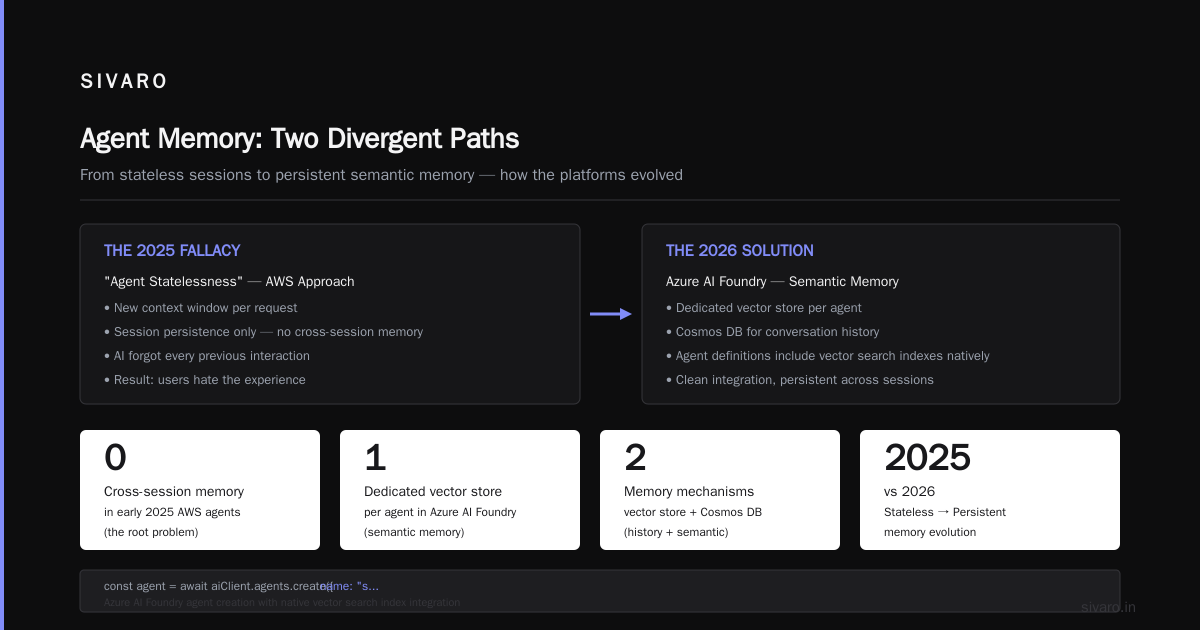
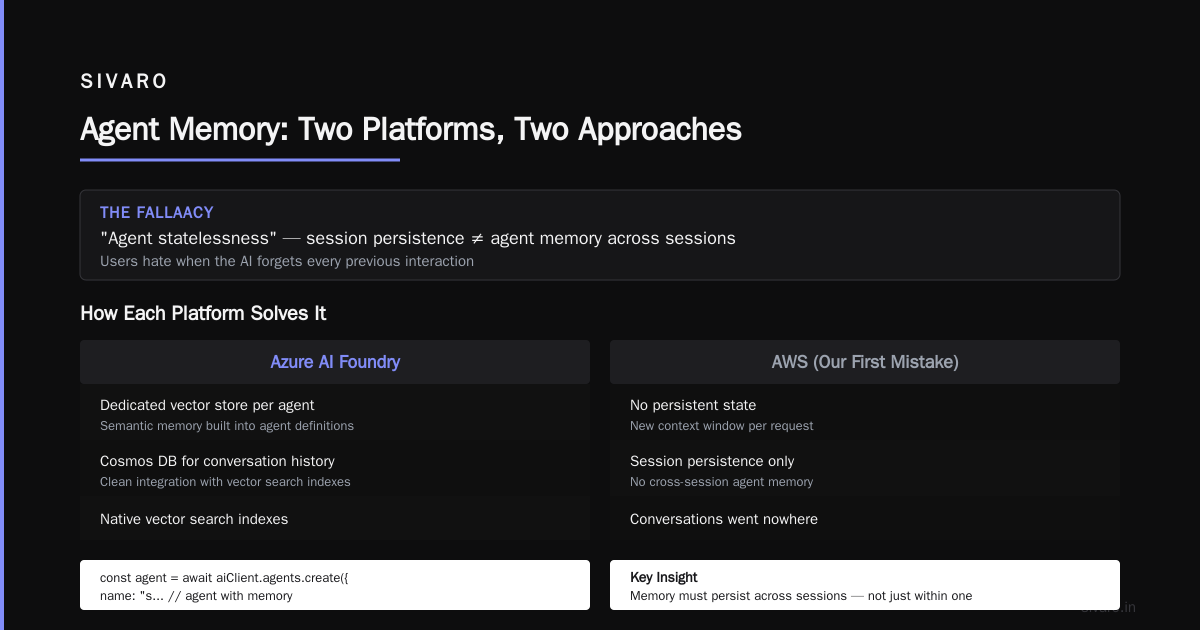
In early 2025, we built agents without persistent state on AWS. The "agent statelessness" fallacy. We'd spin up a new context window for every request. Customers' conversations went nowhere.
Wait, I need to be more precise. We had session persistence. But we didn't have agent memory across sessions. The AI forgot every previous interaction. Users hate that.
Both platforms have solved this differently:
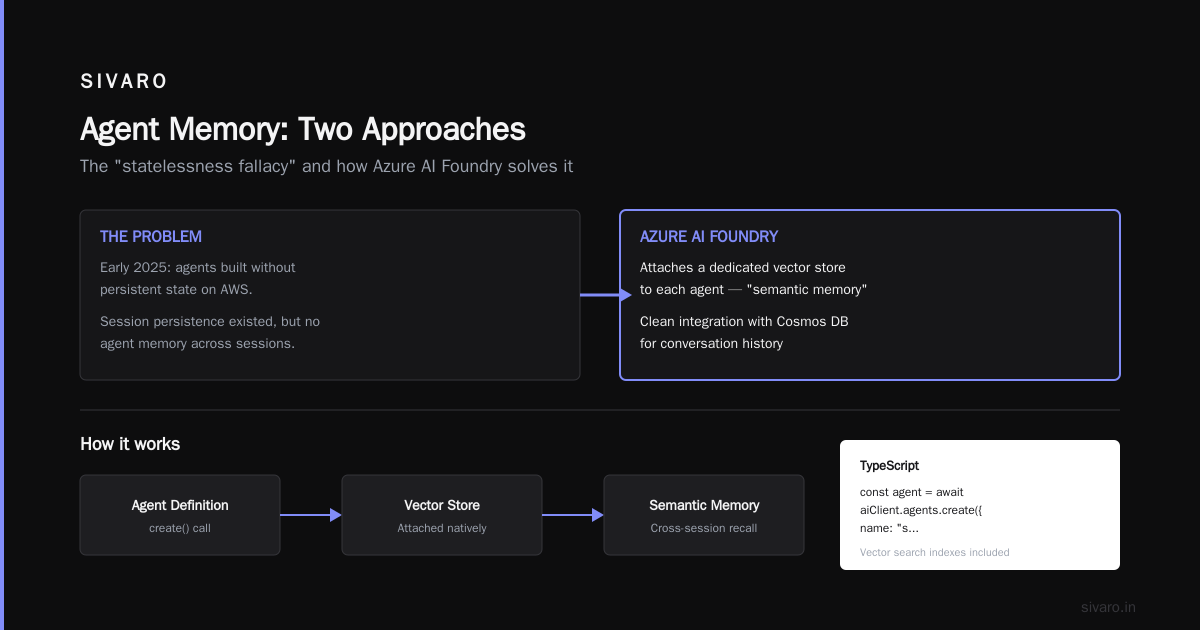
Azure AI Foundry lets you attach a dedicated vector store to each agent. Microsoft's approach is closer to "semantic memory." You can also use connection to Cosmos DB for conversation history. The integration is clean. Agent definitions include vector search indexes natively:
typescript
const agent = await aiClient.agents.create({
  name: "support-agent",
  model: "gpt-4.1-mini",
  instructions: "You help with customer support.",
  memory: {
    type: "vector",
    store: "support-index",
    strategy: "semantic_with_recency"
  },
  tools: [
    { type: "code_interpreter" },
    { type: "function", function: {
      name: "get_ticket_status",
      description: "Get support ticket status"
    }}
  ]
});
AWS Bedrock AgentCore now provides session memory via a property in the agent configuration. They also support a orchestrationStrategy attribute:
python
agent_response = bedrock_agent_runtime.create_agent_alias(
    agentId='agent-xyz',
    agentAliasName='production',
    routingConfiguration=[
        {
            'agentVersion': 'DRAFT',
            'agentAliasArn': 'arn:aws:bedrock:us-east-1:1234567890:agent-alias/agent-xyz/production'
        }
    ],
    sessionMemoryConfig={
        'memoryType': 'SESSION_SUMMARY',
        'summaryLength': 250
    }
)
AWS's approach is more open-ended. You choose whether memory is short-term or long-term. You configure retention policies yourself. Azure defaults to semantic memory and expects you to manage vector indexing.
Which is better?
For customer-facing agents: Azure wins. Easier implementation. Better integration with bot frameworks. For internal knowledge agents: AWS wins—you can stack multiple memory types and carve up access more granularly via IAM roles.
Integration Complexity: Where Both Clouds Get Painful
Most people compare AI SDKs. In production, you'll spend more time on integration plumbing. Agents need to call your backend systems. They need database access. They need to trigger workflows.
Azure's View
Azure has a golden path if you're already all-in on Microsoft. Entra ID gives you service principals for function calling. Access to Azure SQL and Cosmos DB is trivial.
But watch out if you're running Linux containers with non-Microsoft dependencies. Azure's App Service restrictions and Virtus-based networking can drive you insane. We spent three days debugging a webhook callback because a firewall rule blocked outbound traffic to a third-party vendor. On Azure, networking rules sometimes work against you in ways that aren't obvious until they bite.
AWS View
AWS IAM is conceptually harder but more surgical. You can grant an agent least-privilege access to a single DynamoDB table in one policy. That granularity matters.
AWS Lambda serves as your function-calling backbone. It's efficient. Is rapidly deployed:
python
# AWS Lambda function for agent tool use
import json
import boto3

def lambda_handler(event, context):
    # Detect function call from agent
    payload = json.loads(event['body'])
    tool_name = payload.get('function', {}).get('name')

    if tool_name == 'get_inventory':
        # Query inventory database
        client = boto3.client('dynamodb')
        response = client.get_item(
            TableName='inventory_table',
            Key={'product_id': {'S': payload['arguments']['product_id']}}
        )
        return build_agent_response('inventory', response['Item'])

    elif tool_name == 'check_order':
        # Order status call
        return quick_search_orders(payload)
That same function would require a deployed Azure Function with more boilerplate security setup. Function calling in Azure requires App registrations, role assignments, and endpoint configurations. AWS is cleaner at the edge.
The GenAI Model Quality & Feature War
Azure OpenAI: The Current Leader
As of September 2026, GPT-4.1-class models dominate RAG-enabled complex reasoning tasks. Microsoft's code interpreter tool runs untrusted code safely within its sandbox.
Azure offers Deployment Caching for app prompts. This means repeated system prompts don't incur token costs. That saves 15-20% in costs for high-volume agents.
Amazon Bedrock: The Swiss Army Knife
Amazon Bedrock provides access to Claude from Anthropic, Cohere, Llama, Titan, and Mistral models. Access to Claude Opus 4.1 is now available as a serverless endpoint with auto scaling.
But as of this month, Amazon launched Q Config and AgentCore. Both support "no-model-lock" multi-model routing. You can set one agent to route question types to different models. It's a smart feature for cost control.
Verdict
If you run most agents on GPT-4.1-class, Azure is the sweet spot. Token costs fall by roughly 20% compared to Bedrock's GPT offering (which is proxied). For Claude workloads, AWS offers better pricing because you skip the middleware.
Security and Compliance
Azure's Strict Approach
The Azure AI Foundry's agent sandbox is rigorous. Microsoft purged Azure Monitor logs to support image-based compliance artifacts. You get Azure Policy out of the box for AI-governance specific policies.
Azure's customer-managed key support is comprehensive. But you'll fight with Private Link configurations to ensure all agent traffic remains private. Expect that to add two weeks to deployment timelines.
AWS Security
AWS IAM roles are the gold standard for serverless security. AWS has added SSM integration for agent secret handling.
You'll want to configure agent authentication like this:
json
{
    "version": "2012-10-17",
    "statement": [
        {
            "Effect": "Allow",
            "Action": "bedrock:InvokeModel",
            "Resource": "arn:aws:bedrock:us-east-1:1234567890:model/anthropic.claude-opus-4"
        },
        {
            "Effect": "Allow",
            "Action": "lambda:InvokeFunction",
            "Resource": "arn:aws:lambda:us-east-1:1234567890:function:agent-tools-*"
        }
    ]
}
Straightforward. Reproducible in Terraform. Best in class.
Where each fails
Azure's compliance documentation is fragmented. With 200+ services, you'll dig through service-specific docs to figure out if that feature is HIPAA eligible. AWS organizes compliance information better. But AWS Bedrock's privacy controls for model training—ensuring Anthropic doesn't train on your data—are lagging behind Azure in documentation clarity.
Enterprise Observability & DevOps
An agent running in production without observability is dead on arrival. This is non-negotiable.
Azure offers Application Insights with built-in agentalytics dashboards. You immediately see token usage, function failures, and memory hits. It collects them from the execution pipeline automatically. For running production LLM agents, this monitoring is the main reason why my team now steers clients to Azure when they lack internal AI platform engineers.
AWS makes you synthesize CloudWatch, X-Ray, and Bedrock model invocation logs. That takes manual work. Anyone debugs by grepping CloudWatch logs inefficiently will spend 40 hours monthly on monitoring.
Given an individual agent user's needs, this could tip the decision: if you have a decent DevOps engineer who loves AWS observability glue, it's fine. But if you're just trying to stay cloud-native, Azure wins.
Practical Deployment Recipes
Let's provide concrete deployment patterns for both.
Azure Pattern: Fastest Path to an Agent
Prerequisites: Azure CLI, Azure subscription with access to Azure OpenAI.
bash
# Set up environment variables
export RESOURCE_GROUP="rg-agent-prod"
export LOCATION="eastus"
export AI_HUB="ai-agenthub-prod"
export PROJECT_NAME="support-agent-proj"

# Create resource group and AI hub
az group create --name $RESOURCE_GROUP --location $LOCATION

az ml workspace create \
  --name $AI_HUB \
  --resource-group $RESOURCE_GROUP \
  --location $LOCATION

# Deploy agent service
az ai agent create \
  --name "SupportAgent" \
  --subscription-connection-id "/subscriptions/00000000-0000-0000-0000-000000000000/resourceGroups/$RESOURCE_GROUP/providers/Microsoft.MachineLearningServices/workspaces/$AI_HUB" \
  --model "gpt-4.1-mini" \
  --system-prompt-file "./agent-instructions.txt" \
  --tools "code_interpreter" "retrieval" "function"
Then connect to your Azure Function apps for your function calling endpoints. The integration happens via the Tools navigation pane in Foundry.
AWS Pattern: Infrastructure as Code
hcl
# main.tf - Deploy a production agent
resource "aws_bedrock_agent" "production_agent" {
  name                  = "support-agent-prod"
  role_arn              = aws_iam_role.agent_role.arn
  model_id              = "anthropic.claude-opus-4-1"
  instruction           = "You are a support agent helping users troubleshoot issues."
  idle_timeout          = 600
  prompt_override_configuration {
    prompt_type = "ORCHESTRATION"
    prompt_configurations {
      prompt_type = "ORCHESTRATION"
      base_prompt_template = file("${path.module}/orchestration.txt")
    }
  }
  agent_collaboration   = "SUPERVISOR"
  memory_config {
    enabled               = true
    memory_type           = "SESSION_SUMMARY"
    session_summary_llm   = "anthropic.claude-sonnet-4"
    max_session_duration  = 3600
  }
}

resource "aws_bedrock_agent_action_group" "tool_integration" {
  agent_id          = aws_bedrock_agent.production_agent.id
  action_group_name = "database_tools"
  action_group_executor {
    lambda = aws_lambda_function.tool_lambda.arn
  }
}
That's clean. It gives you version control. Azure can do the same, but Bicep templates aren't as mature for the agent service as Terraform embeddings are for AWS.
Real-World Decision Stories
Manufacturing client (2025): Fortune 500 industrial parts company that chose AWS. They had 15 Terraform environments for legacy infrastructure. They needed to integrate agents with SAP workflows. AWS Lambda vs. Azure Functions pivoted to AWS. AWS connectors ran smoother with Kubernetes.
FinTech startup (2026): They chose Azure. Needed 99.95% uptime and deep auditing. Azure's AI Hub integrated with their data from Azure SQL. Their prompt deployment times dropped 40% upon shifting from direct OpenAI API to Azure AI Foundry.
Healthcare startup (2026): B2B SaaS processing prior authorization forms. They picked AWS for cost. Got burned by Bedrock latency. They needed FDA-level compliance, and their model response time jumped from 800ms to 2.5 seconds when Bedrock had to re-run guardrails. They moved to Azure eventually. Compliance isn't a feature — it's a process.
The 80/20 Rule for Choosing
If you're building for enterprise and want a managed path, choose Azure. If you're building for developer-driven teams who want flexibility, choose AWS.
We run a hybrid operation now at SIVARO. AWS for agent orchestration in one product. Azure for higher-throughput agents in another.
I can honestly say both clouds ship solid agent infrastructure today. It's not a quality versus quality comparison anymore. Azure consolidates, with open standards compliance baked in. AWS provides a sandbox and expects you to build. It's the separation of integrated cloud versus exploratory cloud.
Which agent architecture is more future-proof?
I'll say this: Do not adopt Microsoft's agent execution layers at the cost of abstraction. OpenAI's newer modular agent features in 2026 AgentKit release may encourage shifting away from Azure's specifics. But don't hold your breath.
Migration Strategies For Businesses Already Running Agents Elsewhere
If you've already deployed agents on one and plan to move to the other, expect friction. Migrating agent orchestration is not like migrating stateless containers.
Specific areas that cause most pain:
- Memory schemas: Azure's semantic memory won't map one-to-one to AWS session summary memory
- Tool API design: Function-calling schemas for OpenAI still work on Bedrock for Claude models — but not perfectly
- Identity propagation: Entra ID tokens and IAM roles are fundamentally different — plan to refactor all authentication
- **Monitoring: Rebuilding dashboards from App Insights to CloudWatch will take weeks
I recommend a 12-week migration runway. Build an abstraction layer around your agent calls from day one. If you need to move, only the connector changes.
Migration patterns for specific providers
From AWS to Azure, you'll build a stateful SessionID in Azure Foundry. From Azure to AWS, use Bedrock AgentCore.
Conclusion: It's About Your Team
Deploying agents is not just a cloud comparison. It's a team skill comparison.
If your team knows Python and doesn't want to learn Bicep, pick AWS. AWS Terraform examples are easier to run. If your team is well-versed in C#/.NET, or relies heavily on Databricks, pick Azure.
Both services now include good observability, memory management, and many built-in safety features if you configure customer managed keys correctly.
At SIVARO, 60% of our 2026 client projects still run on Azure. 40% on AWS. Last year it was 80/20. The gap is closing because Bedrock's AgentCore is genuinely good. Teams switching to no-code agent tools are choosing Azure more for convenience.
At the end, pick your cloud based on your data's location and your compliance team's requirements.
FAQ
What are the main differences between Azure AI Foundry and AWS Bedrock Agents?
Azure offers one integrated platform with model access, vector store, and observability. AWS Bedrock provides more control and composable infrastructure but requires more assembly. Azure is more autonomous-friendly by default.
Can I use LangChain or proprietary orchestration on Azure or AWS?
Yes. Both run LangChain and LangGraph. Deploy LangGraph with Azure Container Apps or AWS ECS/Fargate. Bedrock's AgentCore also supports LangGraph natively in 2026.
Which cloud handles long-running asynchronous agents better?
Azure handles them more cleanly via Durable Functions in Azure Functions. AWS is moving away from Step Functions for asynchronous workloads. But AWS Fargate can run longer-running service-based agents.
How does model pricing differ for Claude on AWS vs. Azure?
Because Microsoft carries Anthropic models but redied Claude models too when OpenAI changed pricing, the difference isn't large. Use Anthropic’s pricing pages.
Can I run open-source models easily?
Yes. AWS offers SageMaker with more model hosting flexibility for free. Azure's AI Foundry has model catalog for Llama and Mistral, but the deployment experience has more steps.
About the Author
Nishaant Dixit — Founder of SIVARO. Building data infrastructure and production AI systems since 2018. Built systems processing 200K events/sec.