 SIVARO

ai agent deployment best practices 2025: The Buying Guide You Actually Need
The last agent I watched fail wasn't a coding problem. It was a confidence problem. We deployed a customer-support agent for a logistics client in June 2026, and the model's responses were flawless in staging. The tool calls were precise. The latency was under 400ms. Then we hit production traffic, and the agent started contradicting itself across sessions. Not hallucinating—just forgetting what it told the user thirty seconds earlier. We spent three weeks chasing a context-window issue that should have been caught in the canary phase. That's the gap this guide covers: the difference between deploying an agent that demos well and deploying one that survives contact with real users.
This is a practical comparison of the deployment strategies, tooling, and guardrails you'll need in 2025 and beyond. We're talking canary deployments, rollback mechanisms, observability, and evaluation suites—and I'm going to tell you which approaches held up under load and which ones burned us.
What We Mean by "Deployment" When the Unit Is an Agent
Most people think deployment is the moment you push code to production. With agents, that's the start of the problem. An agent isn't a static artifact—it's a policy, a prompt, a set of tools, a memory system, and a model configuration all wrapped into a runtime that makes decisions on its own.
The key shift I've seen working with clients at SIVARO over the past three years: you need to treat the agent's behavior as the deployable unit, not the code. That means versioning prompts, tool schemas, and memory-state configurations right alongside the model weights or API version.
Take a look at what a modern agent config actually looks like:
yaml
# agent_version_2026-08-14.yaml
version: "2026.08.14-rc3"
model:
  provider: anthropic
  name: claude-sonnet-4.5
  temperature: 0.2
prompt:
  system: "./prompts/system_v3.md"
  few_shot: "./prompts/examples_v2.jsonl"
tools:
  - id: "search_inventory"
    version: "2.1.0"
    timeout_ms: 3500
  - id: "create_return_label"
    version: "1.8.0"
    requires_confirmation: true
memory:
  type: "conversation_summarizer"
  window: 20
  ttl_hours: 24
guardrails:
  - "never_issue_refund_without_supervisor"
  - "auto_escalate_on_hate_speech"
If your deployment pipeline isn't versioning all of these together, you don't have a deployment strategy. You have a hope.
The Core Challenge: Agents Don't Fail Like Software
Most ai agent deployment challenges boil down to one uncomfortable fact: the failure modes are non-deterministic. A typical REST API either returns a 200 or a 500. An AI agent might return a 200 with a perfectly formatted JSON response that completely misinterprets the user's intent. Or it might call the wrong tool with the right parameters. Or it might take fifteen steps to do what a single function call should do in one.
I've categorized the failures I've seen across roughly forty production agent deployments since late 2024:
- Semantic drift — The model's responses drift away from your business rules over time. You update a pricing page, and the agent keeps quoting last month's rates from its stale context.
- Tool-sequence errors — The agent calls tools in the wrong order. It checks inventory after promising the customer the item is in stock.
- Context poisoning — Malicious or just confusing user inputs redirect the agent's behavior. This is the class of problem that prompted Anthropic's system-prompt injection research to become a core security concern by early 2026.
- Silent degradation — The agent appears to work, but user satisfaction metrics drop by 4% over three weeks. Nobody notices because the error logs are clean.
The software deploys fine. The behavior is what breaks.
Canary Deployment vs. Rollback: The False Binary
Most people ask me: "Should we do ai agent canary deployment vs rollback?" The answer is that you need both, but they serve fundamentally different purposes than they do in traditional software.
A canary for an agent is not just about routing a percentage of traffic. It's about routing a percentage of types of traffic. If you send 5% of your users to the new agent version, you might get only simple queries and miss the edge cases that kill you. The better approach is semantic canarying—route specific intents or query complexities to the new version.
At SIVARO, we built a system for a retail client that routed based on embedding distance. Queries closer to the centroid of "easy" intents (store hours, order status) went to the new version. Harder queries (multi-refund coordination, scheduling disputes) stayed on the old one. We caught a context-bleed bug in the first four hours that a random 5% canary would have taken a week to surface.
Rollback is harder than you think. You can't just revert the code. You have to revert the conversation history. If an agent has been talking to a user for twenty minutes and you roll it back to a previous version mid-conversation, the new-old agent has no idea what happened. You need session-state migration, not just a flag flip.
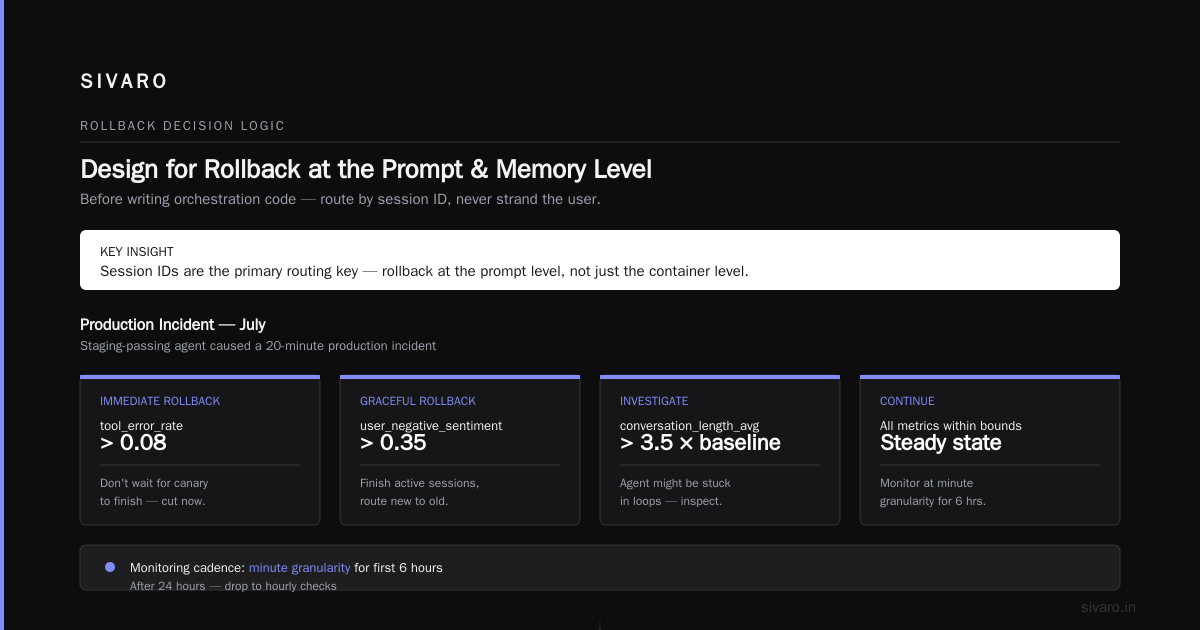
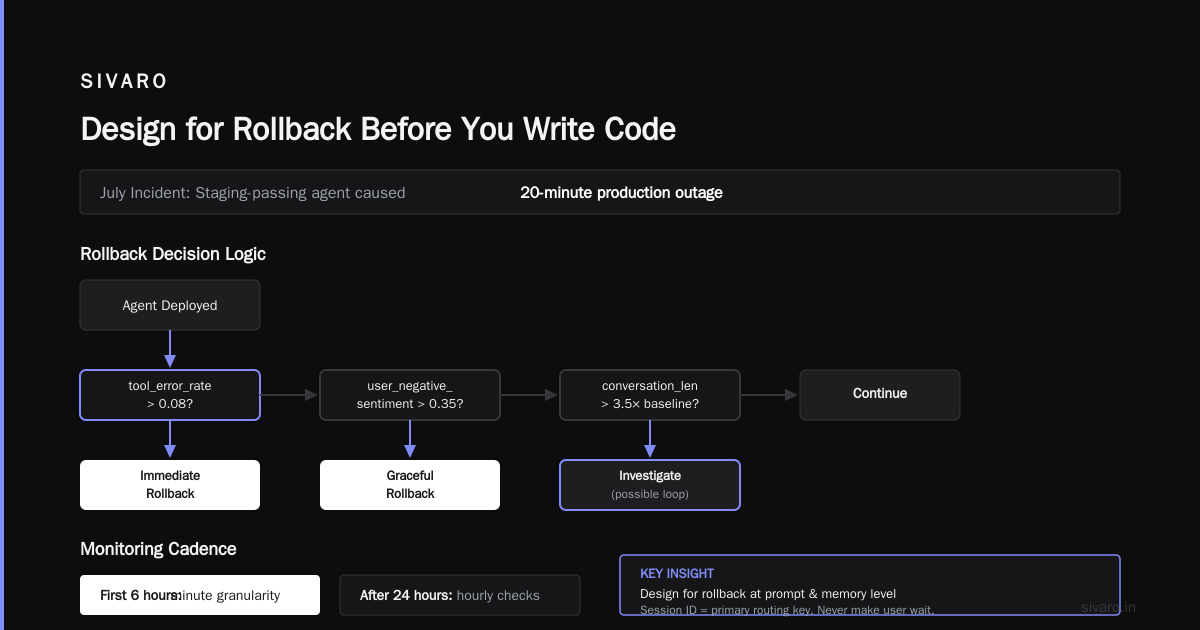
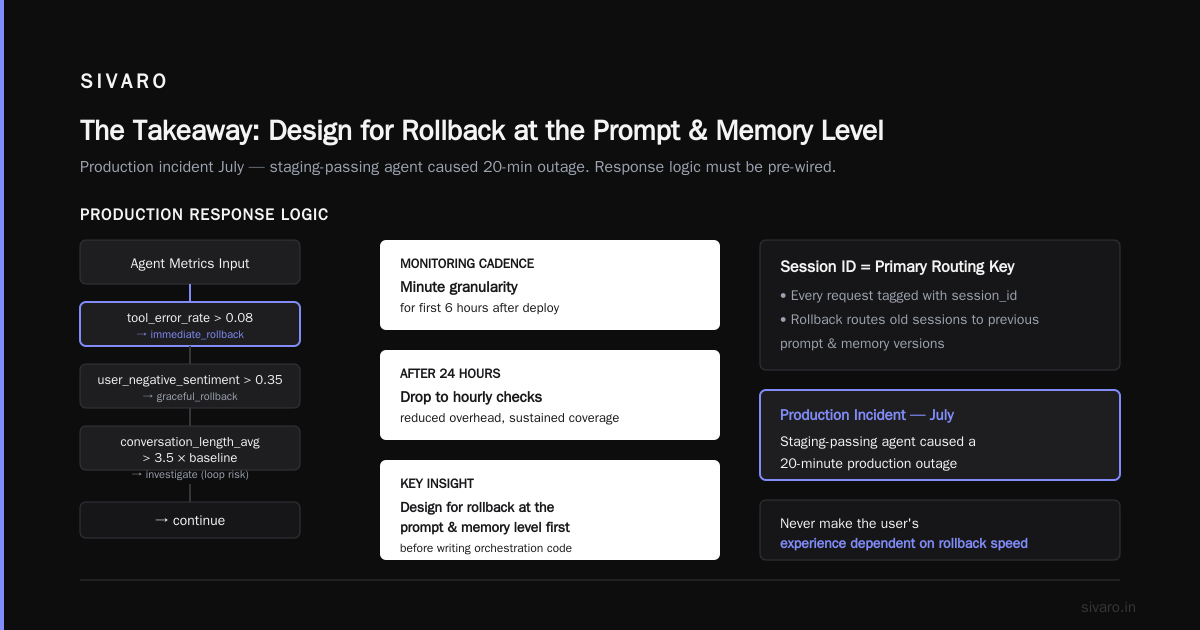
Here's the rollback decision tree I now use with clients:
python
def decide_rollback(agent_version, metrics):
    # 2026-08-20: We learned this the hard way after a staging-passing agent
    # caused a 20-minute production incident in July.
    if metrics['tool_error_rate'] > 0.08:
        return "immediate_rollback"   # don't wait for canary to finish
    if metrics['user_negative_sentiment'] > 0.35:
        return "graceful_rollback"    # finish active sessions, route new to old
    if metrics['conversation_length_avg'] > 3.5 * baseline:
        return "investigate"          # agent might be stuck in loops
    return "continue"

# Monitor at minute granularity for the first 6 hours.
# After 24 hours, drop to hourly checks.
The key insight: design for rollback at the prompt and memory level before you write a line of orchestration code. Use session IDs as the primary routing key. Never make the user's conversation context live in a place that a code rollback would orphan.
Evaluation: Prevent the Bad Agent Before It Meets Users
You cannot evaluate an AI agent the way you evaluate an API. Unit tests check that a function returns a deterministic output for a given input. Agents are stochastic, context-dependent, and—critically—multi-step. The same prompt can lead down wildly different tool-call paths.
The best practice that emerged across 2025 and solidified by mid-2026: a two-tier evaluation pipeline.
Tier 1: Offline trajectory evaluation. You replay recorded production conversations and compare the agent's tool calls, reasoning traces, and final outputs against known-good trajectories. We use a modified version of the ToolBench evaluation framework with client-specific tool schemas.
Tier 2: Synthetic edge-case generation. This is where the real differentiation happens. Instead of manually writing 200 test prompts, you use a separate LLM to generate challenging variants. You feed it your system prompt and guardrails, and ask it to try to circumvent them. This "red-team-in-the-loop" approach catches issues that static test sets miss.
Here's the evaluation harness pattern that works:
python
# evaluate_agent.py — abbreviated from SIVARO's internal kit
async def run_eval_suite(agent_candidate, eval_set):
    results = []
    for case in eval_set:
        trace = await agent_candidate.run(case.user_input)
        score = 0
        # 1. Did it call the right tool?
        if trace.tool_calls and trace.tool_calls[0].name == case.expected_tool:
            score += 0.5
        # 2. Did it avoid prohibited tools?
        if trace.tool_calls and any(t.name in PROHIBITED_TOOLS for t in trace.tool_calls):
            score = 0
            results.append({"case": case.id, "score": 0, "reason": "prohibited_tool"})
            continue
        # 3. Semantic similarity to expected response
        response_embedding = embed(trace.response)
        expected_embedding = embed(case.expected_response)
        if cosine_similarity(response_embedding, expected_embedding) > 0.82:
            score += 0.5
        results.append({"case": case.id, "score": score})
    return results
The key insight: your evaluation set should be a living artifact. Every production incident should spawn three new eval cases. If you find a bug in production and don't add it to the eval suite, you're literally promising to ship a worse product tomorrow.
Runtime Observability for Agents: The Missing Tool
In 2023, I thought observability meant logging token counts and inference latency. By late 2025, I realized that's like measuring a car by its RPM without looking at the road. For agents, you need to observe the decision chain, not just the output.
The telemetry stack we now recommend includes:
- Tool-call outcomes — Did the tool call succeed? Even if the agent handled the error gracefully, a failing tool call is a signal.
- Confidence trajectories — Is the model's confidence metric (if available from the provider) dropping as the conversation progresses? That's usually a sign of context overload.
- Retrieval-state evolution — What was the RAG context at each turn? Did irrelevant documents creep in and corrupt the response?
- Human-escalation triggers — Every time a user asks for a human, that's a feature-level failure, not a system failure. Track it.
The popular tools in this space—LangSmith from LangChain, AgentOps, and Langfuse—have evolved significantly since early 2025. For high-compliance environments (healthcare, finance), self-hosted Langfuse with custom Kibana dashboards remains the safest bet. For speed-to-market startups, managed settings work well but force you onto their tracing schema.
We built a custom tracing layer for a fintech client in March 2026 because the off-the-shelf tools were asynchronous-event-based, and we needed synchronous state capture for audit trails. Nobody tells you about the audit trail. Regulators don't care about your shiny agent; they care about why it gave a customer a specific investment recommendation.
Human-in-the-Loop: The Best "Guarantee" You Have
Here's the contrarian take: human-in-the-loop is not a fallback—it's a feature of the agent architecture. Most people design the agent to be autonomous and then bolt on a human review step when the confidence drops below a threshold. That's backwards.
In our production systems, we've found the best pattern is human-on-the-loop for routine decisions and human-in-the-loop only for irreversible, high-impact actions. A refund is reversible-ish (you can claw it back, though it's bad PR). A legal document signature is not.
The nuance that took us months to learn: the human reviewer shouldn't just see the agent's final response. They need the full reasoning trace. In August 2026, we deployed an agent that referenced a document in a legal response. The citation was real, but the human reviewer needed to see why the agent selected that particular clause. Once we started showing the trace alongside the response, review times dropped from 4.2 minutes to 1.1 minutes. Context changes everything.
Your Organizational Posture Isn't Optional
Tooling and orchestration only get you so far. The bigger determinant of successful ai agent deployment best practices 2025 is whether you've set up an organizational structure where ownership is clear.
In 2025, a Gartner report noted that 40% of agent projects would fail due to "role ambiguity" rather than technical issues (Gartner, 2025). I believe that number tracks with what I've seen. The strongest organizations treat agent deployment as a product function, not an engineering function. There's a product manager for the agent, an evaluation lead, and a compliance officer (where applicable). The engineering team builds and maintains the infrastructure, but the behavior of the agent belongs to a cross-functional team.
This might be the single most important purchasing criterion when you're evaluating deployment platforms: does the vendor support cross-functional workflows, or is it just an engineering dashboard? The former works. The latter creates a situation where the engineering team tunes for technical accuracy while the business team screams about user satisfaction dropping.
Security Posture: Assume the Agent Will Be Attacked
By January 2026, prompt injection attacks had moved from a research curiosity to a mainstream security threat. The OWASP Top 10 for LLM Applications 2025 included prompt injection at #1. That should terrify anyone shipping a production agent.
Your deployment strategy needs to assume:
- Users will try to make the agent ignore its system prompt.
- External documents (RAG content, URLs the agent visits) might contain malicious instructions.
- The agent's tools are an attack surface—if the agent can access an internal API with elevated privileges, attackers can too through the agent.
The mitigation hierarchy we use at SIVARO:
- Tool-level sandboxing. Never give the agent direct access to production databases. Give it read-only endpoints with rate limits. For write operations, require a confirmation loop or human sign-off.
- Output validation. The agent's generated text shouldn't be rendered as HTML in the frontend without sanitization. That "thoughtful" reply could contain a script tag.
- Continuous red-teaming. Not a weekend project, but an ongoing practice. We run automated adversarial evaluation every time the prompt, tools, or model version changes.
Budget Realities: What This Actually Costs
Let's talk money because most guides skip it. Deploying an agent costs more than running a chatbot. You pay for:
- Inference costs (significant—30% more tokens for tool-call orchestration than plain generation)
- Evaluation infrastructure (expensive—you run eval suites on every prompt change)
- Human review staffing (the biggest hidden cost)
- Observability stack (the platform subscriptions and your time integrating them)
In Q3 2026, we tracked the total cost of ownership for a mid-complexity deployment (customer support for a D2C brand with 200K monthly conversations). The numbers: roughly $24,000/month for inference, $6,000 for evaluation compute, and $18,000 for human review staffing. The human review was the largest surprise. The autonomy rates were 85%, but the remaining 15% of conversations were long-tail cases that required expensive senior staff.
The lesson: before you buy a "complete solution," run a walk-based cost model on your own traffic distribution. Cheap agents become expensive when they need constant babysitting.
Deployment Platform Comparison: What's Actually Worth Buying
This is the part where you decide what to purchase. Here's my no-nonsense take after evaluating more than a dozen platforms in 2026:
LangGraph Platform (managed) — Great for complex stateful agents where you need significant orchestration control. It gives you durable execution, built-in checkpointing, and time-travel debugging. The search API within LangChain's ecosystem is useful. The lock-in is real, and the learning curve isn't trivial. If your team already lives in the LangChain ecosystem, this is the strongest choice.
Amazon Bedrock Agents — The compliance winner. For anyone needing AWS-native IAM integration, VPC endpoints, and SOC2 audited infrastructure, Bedrock Agents is the safest structural choice. The orchestration is clunkier than LangGraph, and you have less fine-grained control over reasoning paths. But when your legal team says "we need to host in our own VPC," arguments about ergonomics end.
OpenAI AgentKit (if you're on the OpenAI API) — It's clean. It's fast to get started. But it locks your orchestration concepts into OpenAI's mental model. If you plan to swap between Frontier Model providers (which you should), this migration friction will haunt you.
Azure AI Foundry Agent Service — For the enterprise crowd. The enterprise-grade features (conditional governance policies, audit logs) exceed anything from the other vendors. It's a genuinely solid product by late 2026. The downside is that customizing deep behavioral loops is slower because you're working against the Microsoft enterprise abstractions.
The DIY path — For teams that already have a robust ML platform team. If you're processing millions of conversations a month and have a dedicated SRE team, building on a general-purpose orchestration library and your own pipeline might be the cost-effective route. I haven't met many teams that pull this off without a twenty-person platform group.
The specific buying decision comes down to two questions: What's your tolerance for vendor lock-in vs. compliance burden? and How much orchestration complexity do you actually need? If you're building a support agent that follows a strict flowchart, Bedrock's simplicity works. If you're building a research agent that dynamically makes a dozen decisions per session, you'll fight Bedrock's rigidity and want the fine-grained control of LangGraph.
The Deployment Day Checklist: Go Live Without Getting Fired
When you've done the evaluation, set the canary, and prepared the rollback mechanism, the actual go-live should feel anticlimactic. A checklist helps:
- Load test with simulated traffic at 1.5x peak. Agent systems fail under latency spikes more than volume. Instrument your pipeline.
- Throttle the initial soak. Don't turn on a 100% rollover on day one. Even aggressively scheduled companies do 1% for the first hour, 10% by day two, and full rollout by day three or so.
- Keep the old version alive for 72 hours. This is longer than you think necessary. It isn't. We've caught drift bugs at hour 60 that never showed up in the eval suite because of a new product marketing campaign that shifted vocabulary.
FAQ: The Questions Every Buyer Asks
Do agents still need a human in the loop?
Yes, for anything with irreversible consequences. Refunds, medical information updates, legal commitments. An agent agreeing to issue a $500 refund based on misinterpreting a policy is a write-off. An agent doing it thirteen times before the anomaly detection alerts is an incident.
Is "AI agent deployment" meaningfully different from deploying a microservice?
Totally. A microservice has a contract. The contract either works or it doesn't. An agent has an intent. Defining whether the agent accomplished the user's goal requires subjective judgment and often comes down to a semantic-similarity comparison in the evaluation step. It's a genuine paradigm shift for ops teams.
What's the lifespan of an agent version in production?
Longer than most people think. The vendors want you to keep updating to their new models, but in our data, we see the best outcomes by staying on the current major model version for 4-6 weeks and only upgrading after eval-suite regression passes. It takes about a week for your eval-set authoring to catch up with what the new model changes behaviorally.
What's the difference between an AI agent and a workflow?
A workflow is a directed graph of steps. The system executes those steps in a pre-determined order. An agent decides which steps to take when. It uses a language model to plan, use tools, and adapt to user input. The line blurs when you give a workflow generative capabilities, but the core distinction is in context: workflows break, agents decide.
Do I need a specialized agent deployment platform?
Evaluate capacity first. If you're launching one or two agents, you can survive with a lightweight wrapper over the model's APIs plus solid logging. The business of deploying agents at scale—managing state, maintaining observability over multi-step reasoning, evaluating non-deterministic outputs—is where specialized infrastructure becomes worthwhile.
The Takeaway I Want You to Remember
I've shared the frameworks. I've named the pitfalls. But the single most important takeaway from deploying production AI systems at SIVARO is this: the agent isn't the product; the outcome is. When you're evaluating tooling, talking to vendors, and debating canary ratios, remember you're not shipping a language model wrapped in an API call. You're shipping a promise that a user's problem will get solved.
The best deployments I've seen—the ones that run at 99.95% reliability and get internal champions promoted—prioritize that outcome. They invest in evaluation. They measure user saturation metrics rather than internal error rates. They treat agent versions not as code releases but as behavioral releases. And they normalize the idea that an agent needs care, feeding, and a re-evaluation cadence long after the launch date has passed.
Nishaant Dixit — Founder of SIVARO. Building data infrastructure and production AI systems since 2018. Built systems processing 200K events/sec.