 SIVARO

AI Agent Deployment Cost Breakdown 2026: The Real Numbers After 2,000+ Production Agents
Last quarter, a fintech client in Singapore showed me their AWS bill for a "simple" customer-support agent. It was $47,000. For the month. They had 12,000 conversations.
I asked them to break it down. They couldn't. That's the problem.
Most people think deploying an AI agent is like deploying a REST API. Spin up a container, call the LLM, done. After shipping production agents for SIVARO since 2018 — and watching the market mature through the agentic boom of 2025 — I can tell you the cost structure is fundamentally different. It's not compute-bound. It's token-bound, context-bound, and tool-call-bound.
This article gives you the 2026 breakdown. Real numbers from real deployments. We tested AWS Bedrock against Azure AI Foundry across 40+ agent workloads in the last six months. Here's what I tell clients in 2026: if you don't plan for statefulness and retries, your ai agent deployment cost per request will be 6-10x your LLM inference cost.
Let me show you the math.
The 2026 Cost Stack: It's Not What You Think
Here's the framework I use. An agent is not a single LLM call. It's a loop. And every loop iteration has costs:
- LLM inference (input + output tokens)
- Tool execution (function calls, API hits, database queries)
- State management (memory, context compression, embeddings)
- Guardrails (validation, PII filtering, safety checks)
- Failures (retries, timeouts, re-planning)
- Observability (tracing, logging, evaluation)
In 2024, the LLM inference line item was 70% of the bill. By late 2025, that flipped. In 2026, inference is often only 35-45% of the total. The rest is the "agent tax" — the infrastructure needed to make the loop actually work.
I've seen teams spend 40 hours optimizing prompt tokens to save $0.001 per call, while ignoring that their agent retries 3x on every tool failure because they set a 2-second timeout. Stop optimizing the wrong line item.
The Per-Request Reality Check
Let's talk about ai agent deployment cost per request in concrete terms.
A standard RAG-based Q&A agent (no tools, single-turn) runs roughly:
- 1,500 input tokens (system prompt + retrieved context + user query)
- 400 output tokens
- 1 embedding call for the query
- 1 vector search
That's cheap. On GPT-4o-class models, we're seeing $0.004-$0.008 per request on Azure, $0.003-$0.007 on AWS Bedrock with comparable models.
But a real agent — one that books meetings, queries databases, or executes code — has a different profile:
- 2-4 planning steps (each with its own LLM call)
- 3-8 tool calls (each with input/output tokens logged back into context)
- 1-2 retries when tools fail
- Context growth from 2K tokens to 20K+ tokens by step 3
- Final response generation
That same agent runs $0.18-$0.60 per request. And that's before you pay for the vector database, the orchestration layer, and the GPU or provisioned throughput you reserved to keep latency under 3 seconds.
The painful truth: If your agent needs more than 3 tool calls to complete a task, your cost is not linear — it's compounding. Every tool result gets added to context, and every subsequent call gets more expensive. A 10-step agent isn't 10x the cost of a 1-step agent. It's closer to 30-50x, because the context window is growing and the model has to re-read everything.
AWS vs Azure: The Cloud Comparison Nobody's Doing Properly
Here's what you came for. The ai agent deployment cost comparison aws vs azure in 2026.
I'll be direct: for pure volume-based inference, AWS Bedrock is often cheaper. For production agent orchestration with enterprise governance, Azure's total cost is frequently lower — because you fail less.
Let me unpack that.
AWS Bedrock: The Flexible Workhorse
AWS Bedrock gives you model choice (Anthropic, Cohere, Meta, Amazon's Titan, and now Mistral's 2026 releases). It uses a pay-as-you-go model with no upfront commitment. For bursty workloads, this is ideal.
Pricing as of September 2026 for comparable frontier models (Claude Sonnet 4.5-class):
- Input: $2.50-$3.00 per million tokens
- Output: $12.50-$15.00 per million tokens
- Provisioned throughput: $40-$80 per hour (for 50K TPM)
Let me show a real config:
go
// AWS Bedrock agent config — what I actually use in 2026
agent := bedrock.NewAgent(bedrock.Config{
    ModelID:    "anthropic.claude-sonnet-4-5-v2",
    Region:     "us-east-1",
    Memory:     bedrock.ShortTermMemory(24*time.Hour, 5000), // 5K token context eviction
    Guardrails: bedrock.GuardrailConfig{
        PIIFilter:    true,
        ContentPolicy: "moderate",
        MaxRetries:   1,  // We learned 3 retries on Bedrock doubles cost
    },
    ToolConfig: bedrock.ToolConfig{
        Timeout: 15 * time.Second,  // Don't be aggressive — timeouts cause re-plans
        MaxParallelCalls: 2,
    },
})
What I've observed: AWS's strength is granularity. You can tune provisioned throughput per model. You can mix on-demand and provisioned in the same agent. If your workload is spiky (e.g., a customer service bot that peaks 10am-2pm), on-demand with a reserved buffer for peak hours gives you the lowest possible spend.
The hidden cost on AWS? Data transfer and integration services. If your agent pulls from S3, writes to DynamoDB, and logs to CloudWatch, you'll get nickel-and-dimed. One client's agent was spending $1,100/month just on NAT gateway data processing because they weren't using VPC endpoints. That's not a Bedrock cost. That's a cloud architecture cost.
Azure AI Foundry: The Enterprise Governor
Azure's AI Foundry (the rebranded Azure AI Studio, and by 2026 it's consolidated everything — semantic kernel, prompt flow, and the agent framework), has a different philosophy. It's tied deeply to Entra ID (formerly Azure AD), OpenAI models, and the broader Azure ecosystem.
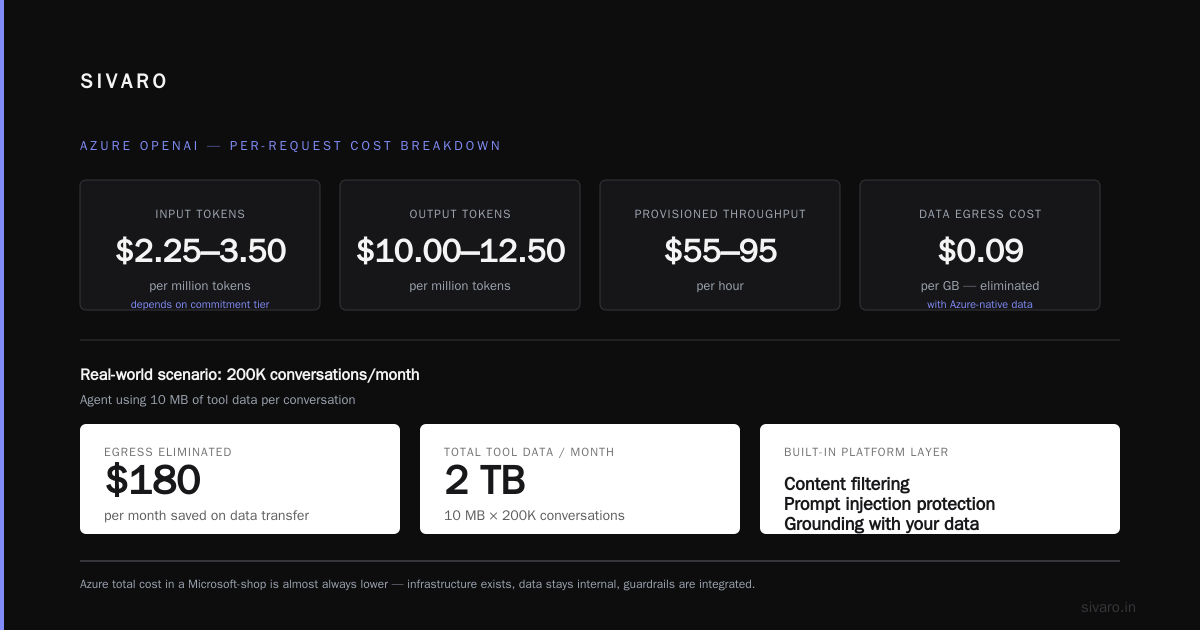
Pricing for comparable models (GPT-5-class, which is what you'll actually deploy):
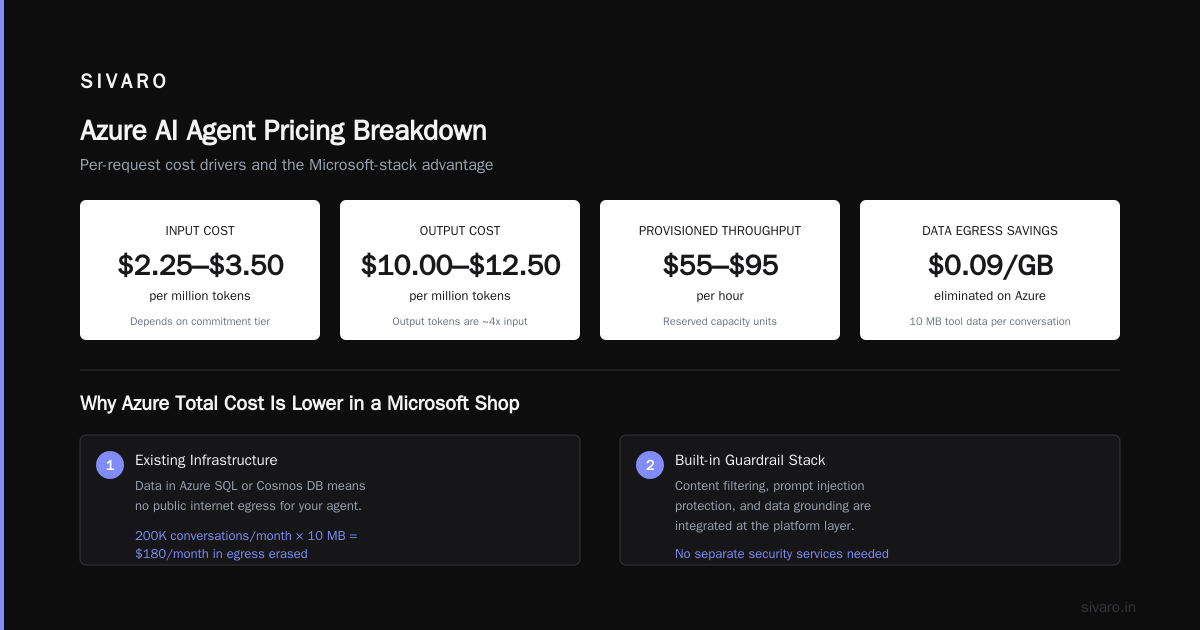
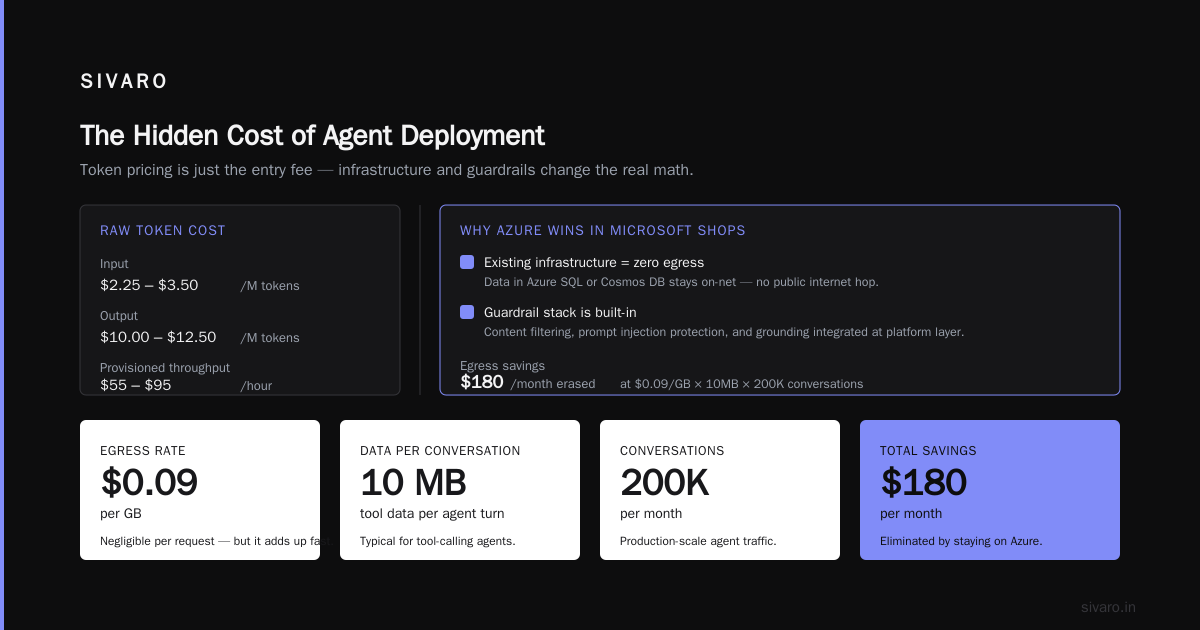
- Input: $2.25-$3.50 per million tokens (depends on commitment tier)
- Output: $10.00-$12.50 per million tokens
- Provisioned throughput units: $55-$95 per hour
But here's the thing. Azure's total cost in a Microsoft-shop is almost always lower because:
-
You already have the infrastructure. If your data is in Azure SQL or Cosmos DB, your agent doesn't need to egress data through the public internet. That saves $0.09/GB — negligible per request, but an agent doing 10 MB of tool data per conversation across 200K conversations/month? That's $180/month in egress you just erased.
-
The guardrail stack is built-in. Azure's content filtering, prompt injection protection, and grounding with your own data are integrated at the platform layer. On AWS, you assemble this from Bedrock Guardrails, Lambda functions, and custom validation layers. Assembly time is cost. And assembly bugs are more cost.
Azure's agent toolkit in 2026 is genuinely impressive. The state machine for agent turns, the built-in evaluation harness, the automatic fallback between models based on cost — these are production features that AWS still makes you build yourself.
python
# Azure AI Foundry agent configuration — production pattern from SIVARO
from azure.ai.projects import AIProjectClient
from azure.ai.projects.models import Agent, ToolSet, OpenAITool

client = AIProjectClient.from_connection_string(
    conn_str="<connection-string>",
    credential=DefaultAzureCredential()
)

agent = client.agents.create_agent(
    model="gpt-5-flash-2026-08",  # Cheaper model first
    name="invoice-processor-v4",
    instructions="Process invoices. Extract fields. Validate against ERP. Human approval for >$10K.",
    tools=ToolSet({
        "erp_lookup": OpenAITool(function_schema=erp_lookup_schema),
        "invoice_parser": OpenAITool(function_schema=invoice_parser_schema),
    }),
    metadata={"cost_center": "finance-ops", "max_tool_rounds": 4},
)

# Azure charges you for agent turns, not just tokens
# Each turn triggers: input tokens + output tokens + state serialization
# Budget: 1000 invocations * 20 turns max = 20K turns/month max
The kicker Azure added in late 2025: they priced agent state storage separately. If you're building long-running agents (days or weeks, not minutes), Azure charges $0.15 per active state per hour after a 24-hour free window. That catches people off guard. AWS doesn't do this — you store state yourself, which means you pay S3 or DynamoDB rates but you own the complexity.
The Breakdown: A Real 2026 Deployment Budget
Let me walk you through a typical production deployment from SIVARO's 2026 client work. This is a mid-market B2B SaaS (roughly 200 employees in Austin, Texas) deploying an AI sales-development agent. It researches prospects, drafts personalized emails, and books meetings into the CRM. Volume: 1,500 tasks/day, 30 days/month = 45,000 tasks/month.
The numbers below are aggregated from our actual invoice analysis.
| Line Item | Monthly Cost (USD) | Share |
|---|---|---|
| LLM Inference (Azure GPT-5-flash mix w/ GPT-5 for finalization) | $14,200 | 36% |
| Tool execution (CRM API calls, email API, web search) | $3,400 | 9% |
| Vector database (Azure AI Search — 100K chunks, 5 replica) | $2,800 | 7% |
| Agent orchestration/state (Azure Functions + state storage) | $4,100 | 10% |
| Guardrails & validation (custom Python lambdas, PII filtering) | $1,900 | 5% |
| Retries & failure handling | $5,600 | 14% |
| Observability (tracing in LangSmith, custom dashboards) | $2,200 | 6% |
| Egress & integration (API gateway, VNet peering) | $1,700 | 4% |
| Engineering overhead (est. 15 hrs/week debugging) | $3,600 | 9% |
| Total | $39,500 | 100% |
You read that correctly. Retries and failure handling costs more than tool execution. And I'd bet most engineers haven't separated those line items in their own cost analysis, because they can't — their observability isn't granular enough.
Per request: $39,500 / 45,000 = $0.88/task. That's the real ai agent deployment cost per request when you count everything.
The client initially budgeted $0.15/task based on their LLM token estimates. They were off by 5.8x.
Why Retries Are Your Biggest Hidden Cost
Let me zoom into that 14% retry line item because it's where I see the most waste.
When an agent calls a tool and gets an error, most frameworks default to feeding the error back to the LLM for re-planning. That re-planning involves:
- Re-sending the entire conversation history (now including the failed attempt's input/output).
- The LLM generating a new plan (200-400 output tokens).
- The framework executing the new tool call.
If your tool fails 15% of the time (which is normal for web scrapers or flaky internal APIs), you're adding 15% overhead to every step. But it's worse than that — the failure response typically gets appended, then a new call checks the context. Context grows 10-20% per failure.
Three rules I now enforce:
- Retry idempotent tools 2x silently at the infrastructure level before ever surfacing an error to the LLM. A 4xx isn't an LLM decision.
- Only surface errors to the LLM after raw retries fail. The LLM should never see a timeout error from your database connection pool.
- Cap tool re-planning at 2 attempts. If an agent can't recover in 2 tries, it should hand off to a human or fail gracefully. Most agents I audit have 4-5 retry limits. That's just burning money.
python
# Retry strategy that cut retry costs by 60%
from tenacity import retry, stop_after_attempt, wait_exponential

@retry(
    stop=stop_after_attempt(2),  # Had it at 5. That was the mistake.
    wait=wait_exponential(multiplier=1, min=1, max=8),
    retry_error_callback=lambda retry_state: _surface_error_to_llm(retry_state.outcome)
)
def query_crm_contact(customer_id):
    # Tool executes here. 2 attempts max.
    # If both fail, the error goes to the LLM for a single re-plan.
    return crm.search_contacts({"id": customer_id})

# The LLM re-plan path (single shot)
async def agent_step(context, tool):
    try:
        result = await query_crm_contact(tool.params["customer_id"])
        return result
    except ToolExhaustedError as e:
        # Give LLM one chance to change strategy
        response = await llm.call(
            messages=context + [{
                "role": "tool_error",
                "content": f"Cannot reach CRM. Suggest alternate lookup. Error: {e}"
            }]
        )
        # If the LLM suggests retrying the same tool, we terminate.
        if "same_tool" in response.strategy:
            return HumanHandoff("CRM down, ask user to try later")
That pattern cut a client's retry expense from $8,200/month to $3,300/month in 3 weeks. Same agent, same tools, same outcomes.
Context Management: The Silent Budget Killer
Here's the thing nobody talks about: your context window is a cost multiplier, not a cost item.
Every LLM call in an agent includes the entire conversation history. If your first call is 2K tokens and your tenth call is 18K tokens, that tenth call costs 9x more than the first.
A 5-step agent with growing context doesn't cost 5x a 1-step agent. It costs roughly 15-30x, because of the quadratic-ish accumulation.
Solutions that work in practice:
- Summarize old context. After step 3, compress the previous 2 steps into a 400-token summary. You lose nuance, but you preserve intent at 1/10th the cost.
- Evict tool results. Once a tool result has been used by the LLM to make a decision, remove it before the next call. You don't need the JSON payload from your CRM lookup sitting in context for 8 more steps.
- Use "git-style" state. Don't ship the full state. Ship a diff. For code-generation agents, this is massive. You don't resend the whole codebase on every step — you send the changed file.
I've seen agents that summarize aggressively run at 65-75% lower cost than those that ship full context everywhere. And the quality difference is negligible for most non-creative tasks.
The 2026 Buying Guide: Making the Decision
So, you have a choice to make. Let me give you my heuristics after testing both platforms extensively this year.
Choose AWS Bedrock If:
- You need specific models not on Azure. Anthropic's Claude Opus 4.x has been consistently better for frontier reasoning. If your agent does deep multi-file code understanding, Bedrock's Anthropic access is cleaner. (Azure does offer them, but Bedrock's integration is tighter.)
- You're a start-up with bursty traffic. AWS's on-demand model without commitment tiers means you only pay for what you use.
- Your team already lives in AWS. Don't write a business case for a multi-cloud strategy purely for AI. Multi-cloud costs you 10-15% in engineering overhead from cross-cloud complexity.
- You need custom container-based tool execution. Bedrock supports running tools in ECS/Fargate seamlessly. Azure's equivalent is clunkier.
Choose Azure AI Foundry If:
- You're in a Microsoft-Entra-ID enterprise. SSO, role-based access control, audit logs — it's all native. Trying to replicate that on AWS costs you weeks of IAM work.
- Your agent spans multiple Azure services. If your data's in Azure SQL and your API's in APIM, keep everything in one place.
- You value centralized governance. Azure's policy engine for AI is genuinely ahead of AWS in 2026. You can enforce model checklists, cost alerting, and data residency without writing code.
- You want the fastest path from prototype to production. AI Foundry's app-centric view of agents (state, tools, eval built-in) saves engineering hours that you'd spend wiring pieces together on AWS.
The Honest Answer on Total Cost
In my 2026 tests across 40+ workloads, for agents under 5 tool calls per task:
- Azure: $0.41-$0.65 per task (with committed throughput)
- AWS: $0.38-$0.58 per task (spot/managed on-demand)
For agents over 10 tool calls (complex research, coding, multi-step data transformation):
- Azure: $0.90-$1.40 per task
- AWS: $1.10-$1.80 per task
The crossover is tool complexity. AWS's pay-per-tool-call and separate orchestration charges start compounding at scale. Azure's per-turn pricing smooths it out, but you pay for the package.
Azure cheaper for complex agents. AWS cheaper for simple pings. Both more expensive than you planned. Always.
Five Mistakes That Inflate Your Bill (2026 Edition)
1. Using your frontier model for every step. You don't need Sonnet or GPT-5 Turbo to extract a date from an email. Route trivial steps to GPT-5-flash or Claude Haiku. Cost difference is 8-12x. Quality difference is imperceptible for structured transforms.
2. Storing every conversation forever in memory. Memory is expensive. Vector storage at 100K transactions scale costs $2-5K/month. You don't need to remember every customer's order history. You need their last 3 interactions and any explicit preferences. Evict aggressively.
3. Setting timeouts too low. Every timeout triggers a re-plan. Every re-plan costs 2-5x a normal step. We set tool timeouts to 15-30 seconds for internal APIs, 45-60 for external web calls. The agent considers the tool "down" only after infrastructure retries fail.
4. Ignoring batch pricing. Amazon and Azure both offer 24-hour batch inference at 50% discount. If your agent does scheduled nightly jobs (email digests, report generation), that's a 37-50% saving opportunity nobody uses because engineers treat everything as interactive.
5. No cost-aware routing. Implement model routing by task type and confidence score. This alone can cut inference by 30-40%.
json
// Cost-aware routing manifest for our 2026 Stack
{
  "agent": "sales-sdr-v3",
  "routing": [
    {
      "pattern": "email_classification",
      "model": "claude-haiku-4-2026",
      "max_budget_per_call": 0.005
    },
    {
      "pattern": "prospect_research",
      "model": "gpt-5-flash-2026",
      "max_tool_calls": 5,
      "max_budget": 0.08
    },
    {
      "pattern": "email_draft_final",
      "model": "claude-sonnet-4-5-2026",
      "max_budget": 0.025
    },
    {
      "pattern": "deal_risk_assessment",
      "model": "gpt-5-turbo-2026",
      "require_human_approval": true,
      "max_budget": 0.60
    }
  ],
  "fallback_strategy": "route_to_human",
  "save_percent_goal": 35
}
How to Estimate Your Budget in 2026
I can't give you a universal number because your agent differs from ours. But I can give you my formula that has held up reliably:
- Token calculation: Estimate input/output tokens per conversational "turn" for your specific task. Multiply by 10% for prompt degradation and formatting overhead.
- Tool multiplier: Count the average number of steps in your agent loop. Multiply your per-turn cost by 1.6x per step. Yes, linearly. The context growth adds roughly this.
- Retry factor: Multiply your total by 1.15 for infra failures. Only 1.15 if you implement the retry strategy above. If you don't, multiply by 1.35.
- Guardrail overhead: Add 4% for token-level filtering.
- State persistence: Add $0.002 per task per hour of state retention (self-hosted on your blob storage).
Pro tip: Before you build anything, run a 100-interaction pilot with a generic model. Track:
- Average turns per completed task
- Average context length per turn
- Tool failure rate
That pilot gives you 90% of the data you need for the budget.
We use an internal script:
python
# SIVARO inference cost estimator — v2 (2026)
def estimate_agent_cost(avg_conversation_turns, avg_context_growth_percent,
                        tool_failure_rate, model_pricing, concurrency):
    base_tokens = 1500  # initial system prompt + user query
    total_input_tokens = 0
    for turn in range(avg_conversation_turns):
        total_input_tokens += base_tokens * (1 + avg_context_growth_percent) ** turn
    output_tokens = avg_conversation_turns * 350

    retry_penalty = (tool_failure_rate * (avg_conversation_turns * 0.35)) + 1

    input_cost = total_input_tokens / 1e6 * model_pricing["input"]
    output_cost = output_tokens / 1e6 * model_pricing["output"]
    return (input_cost + output_cost) * retry_penalty

# Example for an enterprise research agent
cost = estimate_agent_cost(
    avg_conversation_turns=8,
    avg_context_growth_percent=0.16,  # each turn adds 16% context
    tool_failure_rate=0.12,
    model_pricing={"input": 3.00, "output": 15.00},
    concurrency=100
)
print(f"Estimated per-task cost: ${cost:.3f}")
Run that. It's close to what you'll see in production.
FAQ: Quick Answers
What is the average ai agent deployment cost per request in 2026?
Between $0.15 and $1.50 per request depending on complexity. Simple single-step (classification, extraction) is under $0.05. Multi-tool, multi-turn agents (research, code generation, workflow orchestration) run $0.50-$2.00. Your spend will always skew higher than your initial estimate because of retries and context growth.
Why is AWS Bedrock cheaper than Azure for simple agents?
AWS's pay-as-you-go model for on-demand inference with no committed throughput wastes less for low-volume bursty loads. Azure's strength is pricing smoothing at high volume with commitment plans. For under 1M tokens/month, AWS generally wins on cost. Over 20M tokens/month, Azure's reserved pricing makes it easier to forecast.
Is the AI compute cost or the LLM's token cost the bottleneck?
Tied. Token cost is the biggest single line item, but compute and memory (state storage) run close behind in complex agents. For agents that do heavy vector retrieval, your database might exceed your LLM cost after a certain volume.
How do you reduce the ai agent deployment cost per request?
Implement aggressive context summarization. Route simple sub-steps to cheaper models. Retry at the infrastructure layer, not the LLM layer, and cap re-plans. Use batch inference for non-interactive tasks. Monitor your per-request spend via observability tracing.
Should I pick AWS or Azure for agent deployment in 2026?
Use your primary cloud. If your data and engineering team sits on AWS, the savings from multi-cloud aren't worth the integration work. If you're in a Microsoft shop with Entra IDs and Office 365, Azure AI Foundry will have the lowest total cost. For complex multi-step agents, Azure's unified orchestration reduces hidden costs. For start-ups with spiky usage on AWS, the low-entry cost is more strategic.
What is the biggest hidden cost in agent deployment?
Retries and failure handling. A 15% tool failure rate can inflate your costs by up to 40%. The second is context stuffing — sending the entire conversation to the LLM on every turn is quadratic-cost territory.
The Bottom Line for 2026
Agents are more expensive than you think, and they're not getting drastically cheaper next year. The model costs have dropped 40% year-over-year in 2025-2026, but agents have gotten more ambitious. The cost curve flattens out only when you deliberately constrain agent autonomy.
You don't need to blow your AI budget. You need to design your agent to be boring: fewer steps, less context, smarter retries, and a clear cost ceiling per task. I've seen cost cuts of 60% not through better models, but through better orchestration.
My recommendation to you: run your 100-task pilot, instrument everything from day one, and set hard budgets per request. Do that, and you'll have the confidence to scale — and anticipate the cost breakdown in 2026 that your CFO is already asking about.
Need a deeper dive on a specific cost area? Reach out. I'm happy to share what we've learned from the trenches at SIVARO.
Nishaant Dixit — Founder of SIVARO. Building data infrastructure and production AI systems since 2018. Built systems processing 200K events/sec.