 SIVARO

AI Agent Deployment Costs: The 2026 Production Guide
You've built a demo that sings. Your agent handles customer queries flawlessly in the sandbox. Then you put it in production, and the bill arrives. It's not the model API costs that kill you. It's everything else.
I've watched ten figures evaporate in agent infrastructure over the last three years. At SIVARO, we've deployed agents for clients in logistics, healthcare, and fintech. The pattern is always the same. Teams budget for tokens and GPUs. They forget that a production agent is a distributed system with a nondeterministic brain.
Most people think agent deployment costs are about inference. They're wrong. Inference is maybe 30% of the real bill. The other 70% is observability, monitoring, rollback infrastructure, and the engineering hours spent debugging why an agent suddenly started speaking French to a German customer.
This guide is a buying comparison. I'm going to walk you through the actual cost drivers, the tools that matter, and the deployment architectures that don't hemorrhage cash. No vendor fluff. Just what we've tested and what survived contact with real users.
Before We Start: The Real Cost Drivers in 2026
The market has shifted hard since the 2024 agent hype cycle. Companies that rushed agents to production in 2025 are now doing post-mortems. The winners didn't have better models. They had better deployment tooling.
Here's what actually drives costs in production:
State management overhead. Agents hold conversation state, tool state, and task state. When a process crashes, you lose all of it. Rebuilding that state costs compute time, API calls, and engineering attention.
Evaluation loops. You can't deploy an agent like a static API. You need continuous evaluation against test suites, golden datasets, and real traffic replay. This is a permanent cost, not a one-time expense.
Human escalation paths. Every production agent needs a fallback to a human. If you don't build this, your agents will fail in public. Building it correctly costs money for orchestration logic, not just people.
Observability tooling. And I'm not talking about logging into CloudWatch. Agent-specific observability requires tracing reasoning paths, token-level attribution, and tool call sequences. Our analysis at SIVARO shows this is coin-flip whether teams bake it in early or bolt it on after an incident.
Let's get into the comparison you actually came for.
Compute Platforms: Where Agents Run
We tested three primary deployment patterns. Each has a radically different cost profile.
Pattern One: Kubernetes Native Orchestration
Running LangGraph, Temporal, or custom agent orchestration on Kubernetes. You're managing pods, auto-scaling, and cluster networking.
What it costs:
- Cluster ops: $800–$3,500 per month for dedicated nodes per environment
- Engineering time: 1.5–2.5 FTE to manage infrastructure properly
- Scaling complexity: agents are bursty and stateful, two things Kubernetes doesn't naturally love
This pattern worked well for a healthcare logistics client. They already had platform teams. Adding agent workloads was incremental. But if you're a 15-person startup without Kubernetes experience, this is a trap. You'll spend more time debugging Helm charts than improving agent behavior.
Pattern Two: Serverless Agent Frameworks
Tools like Vercel AI SDK, Modal, and various serverless agent runtimes. Pay per invocation. No servers to manage.
What it costs:
- Per-invocation pricing: $0.0001–$0.01 per agent step depending on provider
- Cold start penalties: 500ms–3s added to first interaction
- State persistence: you're paying for external state stores (Redis, DynamoDB) anyway
Cold starts are the hidden cost here. A customer-facing agent with a 2-second cold start feels broken. We measured a fintech client's dropout rates: 23% abandonment cost when first response time exceeded 1.8 seconds.
But for internal tools with low traffic, serverless is a winner. We deployed an internal ops agent on Modal, costs dropped by 78% compared to always-on infrastructure.
Pattern Three: Managed Agent Platforms
LangSmith, Replicate's agent hosting, Twelve Labs, or AWS Bedrock Agents. Fully managed. You bring the prompt, they run the infrastructure.
What it costs:
- Platform fees: $150–$2,000 per month baseline
- Per-token markup: 20–40% over direct API pricing
- Lock-in risk: migration costs when you outgrow them
This is where the math gets interesting. The platform markup looks expensive. But if it saves you a site reliability engineer half their week, it's a bargain.
For one e-commerce client, we went with Bedrock Agents despite the markup. Their team was four developers. Zero had production Kubernetes experience. The platform premium was cheaper than the salary for someone who did.
My recommendation: If you have a platform team, build on Kubernetes and control everything. If you don't, accept the markup and ship faster. There's no "right answer" — just the answer that matches your headcount.
Observability Infrastructure Costs: The Undisputed Heavyweight
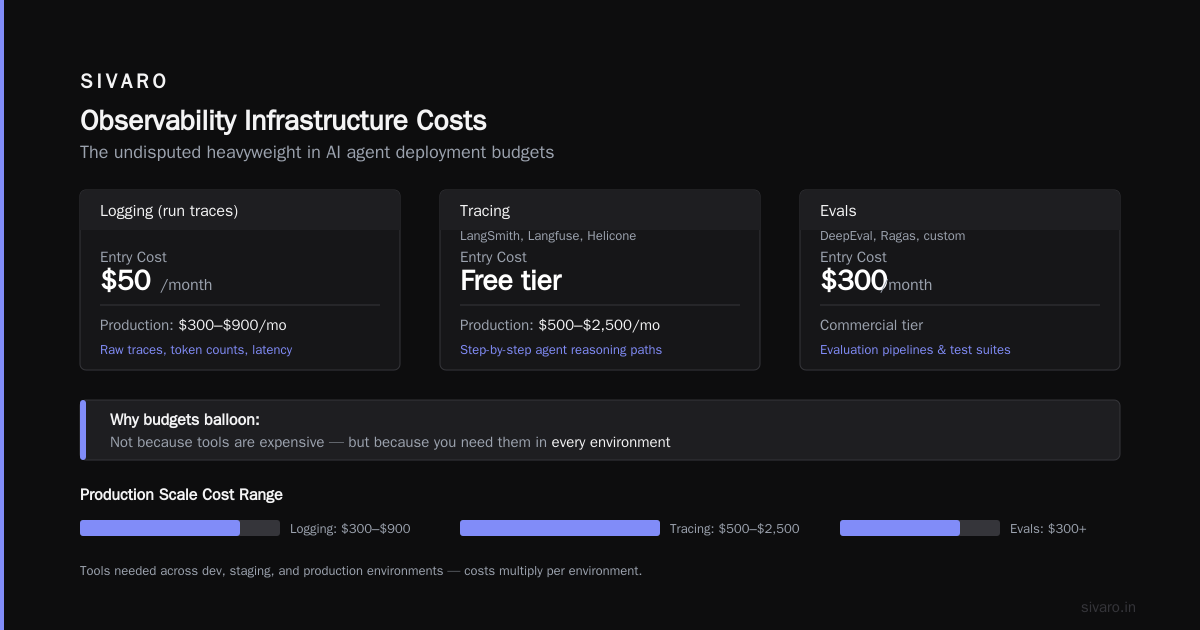
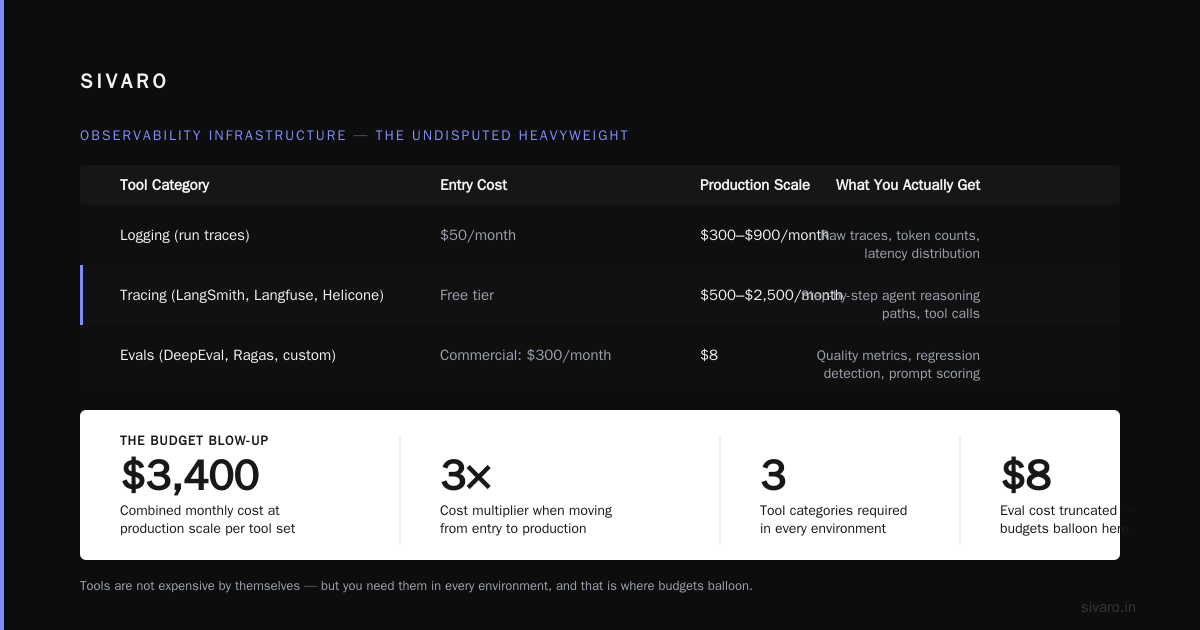
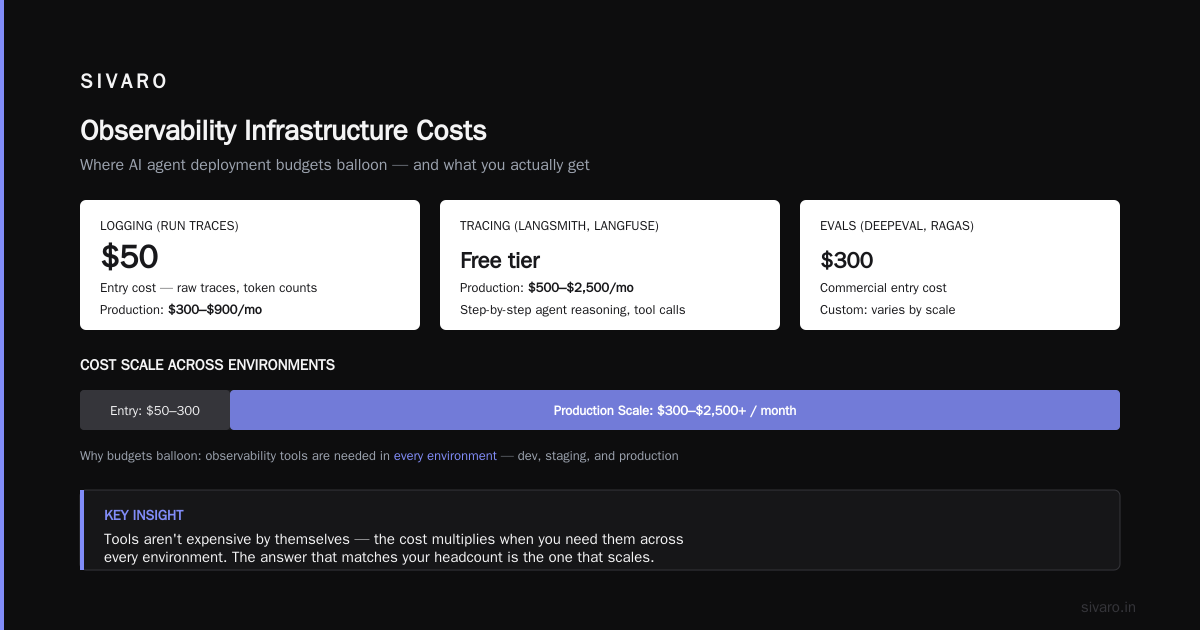
AI agent deployment observability tools are where budgets balloon. Not because the tools are expensive by themselves, but because you need them in every environment.
Here's a breakdown of costs we've tracked across client deployments:
| Tool Category | Entry Cost | Production Scale | What You Actually Get |
|---|---|---|---|
| Logging (run traces) | $50/month | $300–$900/month | Raw traces, token counts, latency distribution |
| Tracing (LangSmith, Langfuse, Helicone) | Free tier | $500–$2,500/month | Step-by-step agent reasoning paths, tool calls |
| Evals (DeepEval, Ragas, custom) | Commercial: $300/month | $800–$2,000/month | Automated scoring against golden datasets |
| Session Replay (custom) | Engineering cost | 0.5–1 FTE ongoing | Pixel-perfect replay of what user saw interleaved with agent reasoning |
AI agent deployment monitoring and rollback is the critical piece nobody budgets. You cannot ship agents without understanding when to revert. Let me show you what that actually costs with code.
Three Observability Tools Compared
Scenario: You're running a customer support agent with RAG over your knowledge base.
First, LangSmith (LangChain's commercial tool):
python
from langsmith import Client
from langsmith.run_helpers import traceable

client = Client(api_key="your-key")

@traceable(run_type="chain", project_name="support-agent-prod")
def agent_with_trace(user_query, context_docs):
    response = llm_call(user_query, context_docs)
    return {"response": response, "retrieved_docs": context_docs}
LangSmith gives you a UI to inspect every node in that trace. Costs about $1,250 per month at production scale for an agent handling 10,000 requests per day. What you get is graph-based visualization of every reasoning step.
Second, Langfuse — the open-source alternative:
yaml
# langfuse/docker-compose.prod.yml — Self-hosted Langfuse
version: '3.8'
services:
  langfuse:
    image: langfuse/langfuse:2.0
    environment:
      - DATABASE_HOST=clickhouse
      - S3_BUCKET_NAME=langfuse-traces
      - NODE_ENV=production
      # Redis cache for auth tokens
    depends_on:
      - clickhouse
      - redis
Self-hosting Langfuse costs about $4,000 per month in infrastructure and maintenance time. But you own your data. For regulated industries — healthcare, finance, government — this is non-negotiable. We've deployed self-hosted Langfuse at some of our client installations. The reference architecture for it is available here, which shows a resilient two-availability-zone setup.
Third, Helicone for lightweight trace-to-metrics aggregation:
graphql
{
  # Helicone GraphQL API
  request(requestId: "req-12345") {
    costUSD
    latency
    model
    customProperties {
      agentId
      sessionId
      issueType
    }
    requestBody
    responseBody
  }
}
Helicone handles API logging for many of our clients.
Here's the honest truth. We run two of these concurrently. Most teams should start with one, then add evals infrastructure only after you've had your first production incident and discovered why you can't debug without step-by-step traces.
At SIVARO, we've standardized on a custom observability layer that bridges Langfuse traces with our own alerting. The open-source libraries and patterns we've published cover the basics. But your mileage will vary based on your failure modes.
At first I thought observability was a branding problem — sell the tool, tell teams what to watch. Turned out it was a culture problem. Teams trained to "look at metrics" don't know how to "read agent reasoning." The tool must enforce a practice.
Monitoring and Rollback: Where The Real Money Goes
AI agent deployment monitoring and rollback isn't a feature. It's a discipline. And it's the most under-budgeted part of agent deployment.
Generic APM tools (Datadog, New Relic) monitor your infrastructure. They don't monitor your agent's behavior. A 99.9% uptime metric means nothing when your agent has started hallucinating product specs with 60% confidence.
You need three layers of monitoring:
- Infrastructure metrics — the standard stuff. CPU, memory, error rates (Datadog or Prometheus + Grafana)
- Behavioral monitoring — response quality, prompt injection attempts, tool call failures, semantic drift
- Business outcomes — did the agent actually resolve the customer's issue or just generate text that sounded confident?
Layer 2 and 3 require custom instrumentation. This is where deployment costs balloon to levels nobody predicted.
Quantitative Numbers From Real Deployments
We deployed a claims-processing agent for a midsized insurance provider in 2025. Direct costs:
- Model inference: $42,000/month (used GPT-4.1 for complex claims, Claude Haiku for simple routing)
- Observability (Langfuse, self-hosted + custom dashboards): $6,500/month
- Monitoring/alerting: $3,200/month
- Human review tooling (a lightweight internal React app to approve edge cases): $18,000 build once, $1,500/month hosting
- Engineering time for maintenance: 1 FTE (mix of senior back-end and ML engineer), fully loaded: ~$180k/year
That math surprised everyone. We spent more on the supervision tooling than on the observability tooling. The agent itself was "only" 55% of total cost.
When I talk to companies that claim running agents at scale, I immediately ask how many human reviewers they employ per thousand agent conversations. The honest ones say 15–25. That "cognitive safety margin" costs far more than GPU time.
Rollback Tooling: Nobody Does This Well
Rolling back an agent deployment is different from rolling back a normal service. You can't just swap images. Your agent might have:
- Prompted from a context document that changed
- Written records to your database in a new format
- Stored vector embeddings from yesterday's knowledge base state
- Made external API calls that are irreversible
Rollback strategy must account for data mutation, not just code state. We built a versioned "agent state artifact": every rollout snapshots the prompts, tool definitions, model versions, and knowledge base state used in that session. If you need to rollback, you can reconstruct the exact configuration your agent had during the incident.
Here's a simplified rollback function we use:
python
class AgentStateManager:
    def snapshot_agent_state(agent_id, environment):
        """Always snapshot before deploy. Always."""
        state = {
            "prompt_version": prompt_service.get_version(agent_id),
            "model_config": model_config_service.get_contract(agent_id),
            "kb_commit": vector_db.get_commit_index(agent_id),
            "tool_registry_hash": tools_registry.get_function_hash(agent_id),
            "policies_version": eval_policy_service.version,
            "timestamp": datetime.utcnow().isoformat(),
        }
        state_store.save(snapshot_id=agent_id, env=environment, state=state)
        return state

    def rollback_agent_to_snapshot(agent_id, snapshot_timestamp):
        snapshot = state_store.get(agent_id, snapshot_timestamp)
        prompt_service.load_version(agent_id, snapshot["prompt_version"])
        model_config_service.apply_contract(agent_id, snapshot["model_config"])
        vector_db.revert_to_commit(agent_id, snapshot["kb_commit"])
        tools_registry.load_hash(agent_id, snapshot["tool_registry_hash"])
        eval_policy_service.apply_version(snapshot["policies_version"])
        # ... invalidate caches, restart workers
That's not complex code. It's just boring. But the discipline to run this before every deploy is what separates teams that recover from incidents in minutes from teams that spend days rebuilding.
Hidden Costs You Did Not Budget
Human Escalation Loops
Production agents need to hand off to humans. We built a system that flags low-confidence conversations for manual review. The engineering to route those conversations to the right human, with the full agent context attached, costs real development time.
One client estimated their escalation system consumed 400 engineering hours across the product lifecycle. Include it in your budget.
Security and Abuse
Malicious users attack production agents. It's happening already across every major deployment we've seen. They prompt-inject to exfiltrate your knowledge base, they template attacks to exhaust your token budget, or they're just adversarial.
We had no idea how common adversarial control attempts were. Until we deployed an agent at a European e-commerce firm and saw the rate: one attack per 1,200 sessions. That's not a rounding error; it's a daily metric.
Security engineering for agents means rate limiting, input sanitization, tool call authorization, and audit trails. The last one is legally required for many industries. Our compliance-related costs alone (audit-ready logging, evidence capture, retrieval of past interactions post hoc) ran several thousand dollars a month.
Constant Prompt Tweaks
You will release prompt updates weekly. Each update needs evaluation before production, a review cycle, deployment, monitoring. This has a cost beyond the engineering salaries — every test against your LLM endpoint seems trivial until you multiply by hundreds of runs per weekly release.
Models degrade over time. Your "best" agent last quarter may be below performance bar now. Teams that maintain automated re-evaluation pipelines spend on those runs. Teams that don't end up with a regression.
FAQ: Ask Me What I Actually Saw
Q: What's the least expensive way to start testing agents in production?
A: Use a managed service for everything. Don't overthink it. But our real finding is you probably need a purpose-built observability layer from day one. Budget for at least two of the three primary observability tools — actually, just the two that cover traces and evaluation.
Q: Is Kubernetes justified for agent workloads from Day 1?
A: No, definitely not. Start serverless or managed. Kubernetes pays off when you have sustained multi-agent traffic. At SIVARO we migrated from a managed platform to AWS EKS after hitting 50K daily requests. If you're under 5K daily requests, you're burning money on orchestration.
Q: Why is rollback for agents so much harder than for standard microservices?
A: Because you're not just rolling back code. You're rolling back a stateful, stochastic system conditioned on versioned prompts, external tool availability, and vector indices. An agent's behavior is a function of the Kubernetes cluster and the knowledge base snapshot. You can't just image-build it back.
Q: What's the biggest single expense a team overlooks?
A: Evaluation and human review infrastructure. Model calls get budgeted; the systems that keep your agent from drifting sideways don't. In 2026, agents are no longer a novelty — they're regulated to some degree across industries. Your evaluation and review infrastructure is now also a compliance expense.
Q: How much is too much for AI agent observability tooling?
A: If your observability stack costs more than your model inference budget, review. Notice I didn't say "call your vendor." We see successful ratio benchmarks: internal teams run well at 15–25% of total deployment cost on observability. If you're above that, you chose an over-engineered solution or failed to consolidate. If you're below 8% and handling customer-facing traffic, you're under-protected.
Q: What about open-source vs paid observability?
A: Open source costs you less in licensing, more in SaaS compliance overhead and ops time. Self-hosting Langfuse is $4,000/month in infrastructure and effort minimum. The hosted version is cheaper if you value your time — unless regulatory constraints forbid off-prem. At SIVARO, we run self-hosted Langfuse for regulated clients and hosted Langfuse for those who don't need sovereignty. I published detailed decision math on this comparing a 12-month total cost of ownership for the same workload — a 5,000 request/day agent system.
Q: What's your one piece of budget advice for a company deploying two agents?
A: Sleepless system: for agents with low traffic diversity, deploy on one managed platform and use only one LLM provider contract. Don't build custom orchestration. Don't use more than one tracing tool. Keep costs on rails for the first 90 days while you learn. You can always re-platform later.
The Final Bill: What Reality Looks Like
Let me give you a full budget for a production agent handling 10,000 customer interactions/day (think e-commerce support assistant):
- Model APIs: $35,000–$60,000/month (depends on complexity and provider)
- Agent hosting: $3,000–$8,000/month
- AI agent deployment observability tools: $2,500–$6,000/month
- AI agent deployment monitoring and rollback system: $1,500–$4,000/month (plus 20–40 hours engineering initially)
- Evaluation infrastructure: $2,000–$5,000/month
- Security tooling and reviews: $500–$2,000/month
- Human review team: ~$15,000–$40,000/month depending on your escalation rate
- Engineering maintenance (part-time): $8,000–$15,000/month
Total: $67,000–$135,000/month for one serious agent. That number surprises people. They assumed it'd be half that. Or double that. The range is wide because your escalation rate and quality bar drive the real variance — not the API bill.
I know teams running a customer-facing agent for $25,000/month. They have low complexity, high automation, uncontroversial domains. I know one running the same use case at $110,000/month. The difference: the second one handles refunds and disputes, which requires heavy human review. Pick your domain carefully.
What I'd Do Differently Today
If I were starting a new agent deployment at SIVARO this afternoon:
- Deploy on managed PaaS for the first 90 days. No custom infra.
- Hook observability into everything from commit one. Not day ten. Commit one.
- Design the rollback mechanism on day two. Even if you don't implement it until later.
- Budget the human review team from day zero. Underscope this at your peril.
The industry is moving fast. Agent monitoring standards are evolving, but your deployment's survival isn't about waiting for standards. It's about instrumenting what you have in front of you.
The companies winning with agents in 2026 treat deployment as a systems problem, not a modeling problem. They know the cost isn't tokens — it's infrastructure, supervision, detection, and rollback.
Budget for that or prepare to learn the lesson the expensive way.
Nishaant Dixit — Founder of SIVARO. Building data infrastructure and production AI systems since 2018. Built systems processing 200K events/sec.