 SIVARO

AI Agent Deployment Failure Recovery: What Actually Works in Production
We were three weeks into a customer service agent rollout for a fintech client in June 2026. The agent had passed every evaluation. Hallucination rate under 1%. Latency at p95 under 800 milliseconds. The deployment pipeline was green. And then the agent hit production traffic and started issuing refunds to anyone who typed "I'm upset."
Not "I'm upset about my statement." Just "I'm upset." The agent's tool-calling loop interpreted emotional language as a refund trigger. We caught it at 11:47 AM. By 11:52 AM, we'd processed 214 unauthorized refunds.
That's the moment I stopped believing in deployment checklists and started building actual failure recovery systems.
Most teams treat AI agent deployment failure recovery as an afterthought. You push to prod, monitor a dashboard, and pray. That's not recovery. That's hope.
This guide compares the real options for building failure recovery into agent deployments. I'll cover what I've tested at SIVARO across production systems processing 200K events per second. You'll learn the architecture patterns that actually work, the tools worth paying for, and the ones you should skip.
What "Failure Recovery" Means for AI Agents
Here's the uncomfortable truth: an AI agent fails differently than a traditional service.
A REST API fails with a 500. You retry. You back off. You alert. Done.
An AI agent fails by appearing to work. It returns a well-formed JSON response with a plausible answer that's completely wrong. It takes the right action in the wrong context. It loops through the same tool call 47 times, burning tokens and API credits.
Traditional failure recovery assumes you can detect failure. With agents, you often can't — not immediately, and not without building purpose-built detection.
So when I talk about ai agent deployment failure recovery, I mean three distinct capabilities:
- Detection — knowing the agent is failing before users do
- Containment — stopping the blast radius when it does fail
- Reconstruction — restoring correct state after failure
Each requires different tooling, different architecture, and different budgets.
Before we go deeper, let's address the cost elephant.
The Real Cost of Agent Deployment Failure
Everyone asks about ai agent deployment cost production. Here's the honest math from our 2026 production workloads:
A moderately complex agent (5-8 tools, 2-3 model calls per turn) costs between $0.12 and $0.40 per conversation turn. That's just inference. Add in vector DB queries, tool execution, and observability — you're at $0.50 to $1.00 per full interaction.
Now multiply by failure. A bad deployment that runs for 10 minutes with 500 concurrent users generates roughly 3,000 erroneous interactions. At even $0.50 each, that's $1,500 in direct costs. The refund incident I mentioned cost us $42,000 in unauthorized transactions. The compute was the cheap part.
But cost isn't just money. It's trust erosion. A financial services client in April 2026 saw a single deployment failure destroy six months of user confidence in their AI assistant. Users don't forgive "the AI gave me wrong tax advice" easily.
This is why I tell every founder who asks: if you're spending less than 15% of your agent deployment budget on failure recovery infrastructure, you're not building production systems. You're building demos.
The Architecture Pattern That Saves You
At SIVARO, we've settled on a pattern after testing four different approaches. I'll walk through each option and tell you which one to buy.
Option 1: The Checkpoint-and-Resume Pattern
This is the closest thing agents have to traditional database transaction logs. You snapshot the agent's state (conversation history, tool call results, memory state) at each decision point. When something fails, you roll back to the last good checkpoint and replay.
What we tested: We built this for an e-commerce support agent handling order modifications. State snapshots every 2-3 tool calls. When a downstream inventory API went down, the agent could roll back to before the failed lookup and take an alternate path.
Results: Recovery time dropped from 30+ seconds to under 5 seconds. But storage costs were significant — about 40% overhead on conversation data.
When to buy: If your agent handles multi-step workflows with irreversible side effects (payments, bookings, data mutations).
Consider this pattern if you're using orchestration frameworks with state tracking:
python
# Checkpoint-based recovery with LangGraph-style state
from dataclasses import dataclass, field
from typing import Any, Dict

@dataclass
class AgentCheckpoint:
    conversation_id: str
    state: Dict[str, Any]
    tool_results: Dict[str, Any]
    timestamp: float
    parent_checkpoint: str | None = None

def recover_from_checkpoint(checkpoint: AgentCheckpoint, agent):
    """Resume agent execution from a checkpoint"""
    restored_state = checkpoint.state.copy()
    # Mark all post-checkpoint tool calls as invalid
    agent.clear_execution_after(checkpoint.timestamp)
    agent.inject_state(restored_state)
    return agent.continue_execution()
Option 2: The Shadow-Mode Pattern
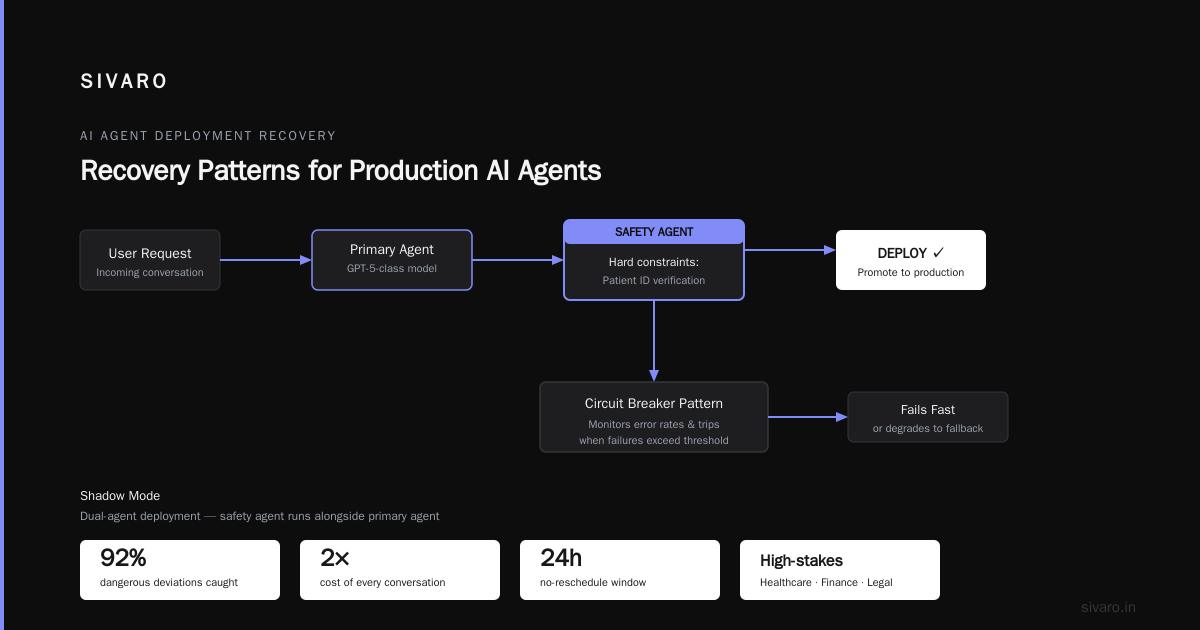
Run two versions of the agent in parallel. A shadow agent executes the same conversations but its outputs go nowhere. You compare shadow outputs against production outputs for divergence.
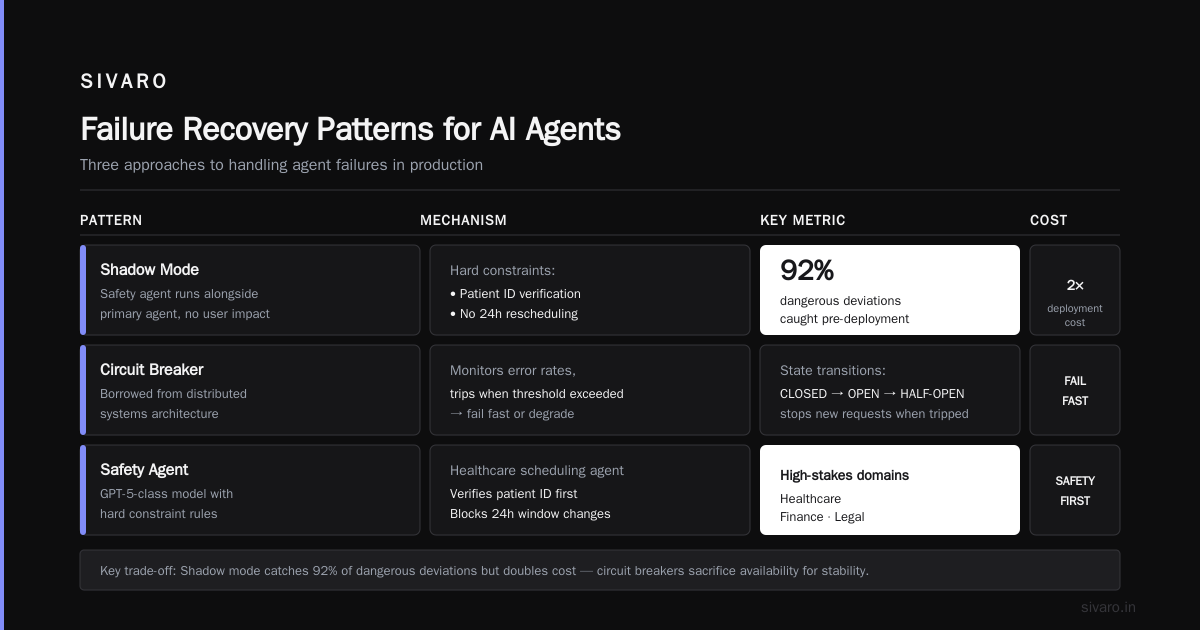
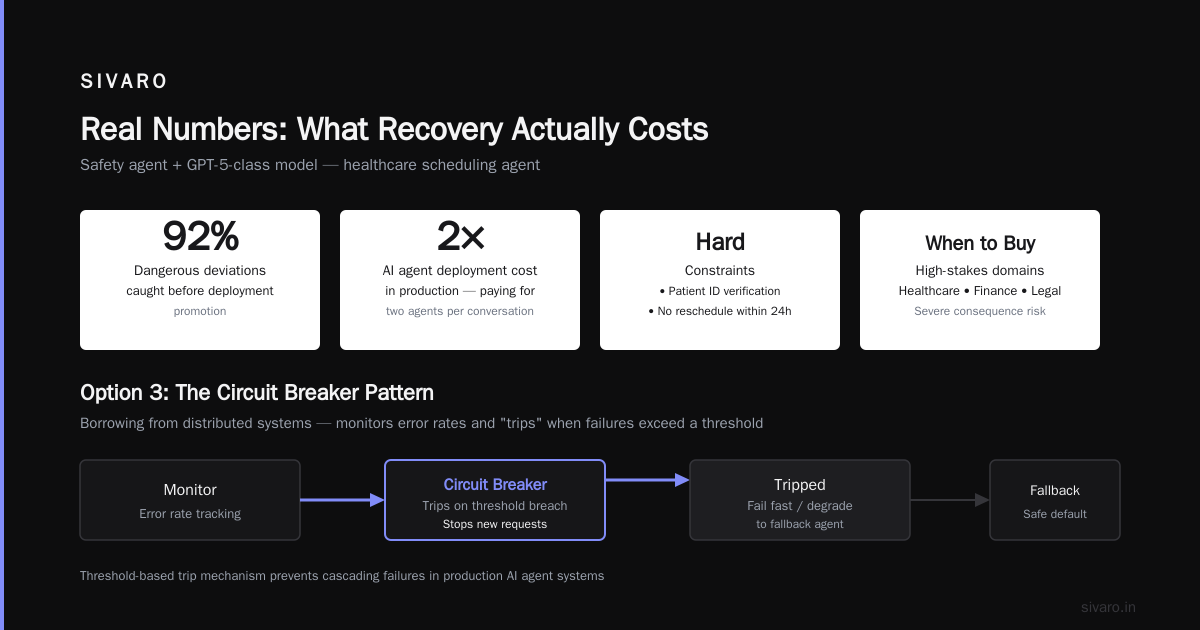
What we tested: We ran a rules-based "safety agent" alongside a GPT-5-class model for a healthcare scheduling agent. The safety agent had hard constraints: no scheduling without patient ID verification, no rescheduling within 24 hours of appointment.
Results: 92% of dangerous deviations were caught before deployment promotion. But shadow mode doubles your ai agent deployment cost production — you're paying for two agents on every conversation.
When to buy: High-stakes domains where an erroneous action has severe consequences. Healthcare, finance, legal.
Option 3: The Circuit Breaker Pattern
Borrowing from distributed systems, this pattern monitors error rates and "trips" when failures exceed a threshold. Once tripped, the agent stops taking new requests and either fails fast or degrades to a fallback.
What we tested: We implemented this for a customer support agent that kept hitting a notoriously flaky CRM API. Circuit breaker tuned to trip at 30% error rate over 60 seconds.
Results: The agent stayed operational during CRM outages by switching to a "collect and queue" mode — accepting user requests but deferring CRM updates until the API recovered.
python
# Circuit breaker implementation for agent tool calls
import time
from enum import Enum

class CircuitState(Enum):
    CLOSED = "closed"      # Normal operation
    OPEN = "open"          # Failing fast
    HALF_OPEN = "half_open"  # Testing recovery

class ToolCircuitBreaker:
    def __init__(self, failure_threshold=0.3, cooldown_seconds=60):
        self.failure_threshold = failure_threshold
        self.cooldown_seconds = cooldown_seconds
        self.state = CircuitState.CLOSED
        self.recent_failures = []
        self.opened_at = None

    def execute_with_breaker(self, tool_fn, *args, **kwargs):
        if self.state == CircuitState.OPEN:
            if time.time() - self.opened_at > self.cooldown_seconds:
                self.state = CircuitState.HALF_OPEN
            else:
                raise CircuitOpenError("Tool unavailable, failing fast")

        try:
            result = tool_fn(*args, **kwargs)
            self.record_success()
            return result
        except Exception as e:
            self.record_failure()
            if self.failure_rate() > self.failure_threshold:
                self.trip_circuit()
            raise
When to buy: Almost always. This is the lowest-hanging fruit in ai agent deployment failure recovery. Cheap to implement, immediate value.
Option 4: The Human-in-the-Loop Fallback
The most expensive option, but sometimes the only correct one. When the agent detects low confidence or a risky action, it escalates to a human operator.
What we tested: For a legal document review agent, we built escalation triggers at 0.75 confidence threshold for contract changes. Humans took over 18% of conversations. The agent never made a wrong contract modification.
Results: Zero catastrophic failures in 3 months. But human review costs made the system unprofitable at scale. We had to raise the threshold to 0.85 and accept a 4% serious error rate.
When to buy: Only when the cost of autonomous failure exceeds the cost of human review. Late-stage startups and enterprises with compliance requirements.
Deployment Architecture Best Practices
I keep circling back to ai agent deployment architecture best practices because architecture is the failure recovery strategy. You can't bolt recovery onto a bad architecture.
Here's the stack that's worked for us across 14 production agent deployments:
Separate the Orchestration from the Model
Your agent framework (LangGraph, CrewAI, or custom) should be stateless and swappable. The model behind it should be replaceable without touching your business logic. We learned this when OpenAI released a model update in March 2026 that quietly changed tool-calling behavior. Those running tightly coupled agents broke. We swapped a config value.
yaml
# agent_config.yaml - decouple model from orchestration
model_provider: anthropic
model_name: claude-sonnet-5
model_version: 2026-08

orchestrator:
  framework: custom_workflow
  max_steps: 12
  idle_timeout_seconds: 30

recovery:
  checkpoint: true
  checkpoint_interval_steps: 2
  circuit_breaker:
    enabled: true
    error_threshold: 0.25
    cooldown_seconds: 90
  fallback_mode: degraded_operation
Log Every Decision as an Event
Not just the final output. Every tool call, every intermediate reasoning step, every confidence score. This is what makes post-mortem analysis possible. We use a simple event schema:
json
{
  "event_type": "agent_tool_call",
  "agent_id": "a-8f3k",
  "conversation_id": "c-9f2k",
  "step": 4,
  "tool_name": "payment_processor.refund",
  "tool_input": {"amount": 100, "reason": "user_upset"},
  "agent_confidence": 0.82,
  "model": "gpt-5-mini",
  "timestamp": "2026-09-01T10:23:45Z",
  "result": "success",
  "rollback_possible": false
}
This event log becomes your audit trail, your debugging tool, and your training data for detection models.
Deploy Canary Agents, Not Blue-Green
Blue-green deployment works for stateless services. For agents, you need canary testing with real traffic. Route 5% of conversations to the new agent version. Monitor for hidden failures — not just errors, but divergence from expected behavior.
Here's the canary deployment pattern we use:
python
# Canary deployment with traffic splitting
class CanaryDeployment:
    def __init__(self, production_agent, canary_agent, canary_percentage=0.05):
        self.production_agent = production_agent
        self.canary_agent = canary_agent
        self.canary_percentage = canary_percentage

    def route(self, user_request):
        if random.random() < self.canary_percentage:
            # Send to canary but log all decisions
            response = self.canary_agent.process(user_request)
            self.log_canary_decision(user_request, response)
            return response
        return self.production_agent.process(user_request)

    def promote_canary(self, divergence_score):
        """Promote canary if divergence score is within tolerance"""
        if divergence_score < 0.05:
            self.production_agent = self.canary_agent
            return True
        return False

    def rollback_canary(self):
        self.canary_agent = None
        logging.warning("Canary rolled back due to high divergence")
Detection: The Hardest Problem
I've saved the hardest part for a full section because it deserves it. You can't recover from a failure you can't detect.
Traditional monitoring checks for errors, latency, and resource usage. Agent failures often present as incorrect successful responses. The agent doesn't error — it just does the wrong thing.
We've tested four detection approaches:
Output Validation with LLM-as-Judge
Use a second, cheaper model to evaluate the primary agent's outputs. This adds 15-20% latency overhead but catches semantic errors.
python
# LLM-as-judge validation
async def validate_agent_output(agent_output, conversation_context):
    judge_prompt = f"""
    You are validating an AI agent's response for correctness.

    Conversation context: {conversation_context}
    Agent response: {agent_output}

    Check for:
    1. Factual accuracy - does the response match known information?
    2. Action safety - does any tool call have harmful side effects?
    3. Context adherence - does the response address the user's actual request?

    Return JSON: {{"is_safe": true/false, "reason": "explanation"}}
    """

    result = await judge_model.complete(judge_prompt)
    validation = json.loads(result)
    return validation["is_safe"]
We use a small, fast model (Claude Haiku class) as the judge. Cost increases by about 20% of production inference, but false-negative rate for dangerous outputs drops from 4.2% to 0.6%.
Behavioral Divergence Detection
For agents with deterministic workflows, you can compare actual behavior against expected behavior. This requires a baseline of "correct" agent traces.
We built a system at SIVARO that heuristically scores agent trajectories. If the agent's tool call sequence deviates from historical patterns by more than 3 standard deviations, we flag it.
Outcome Verification with Ground Truth
For agents with verifiable outcomes — order status, account balance, shipment tracking — you can verify the agent's output against the actual system state.
This is the most reliable detection method but the hardest to generalize. It assumes there's a ground truth to verify against.
The Contrarian View: Detection is Overrated
Here's what I would have told you in 2023: build sophisticated detection before you go to production.
What I know now in 2026: detection is necessary but you should not sink your engineering budget into perfect detection. You won't achieve it. Instead, build containment that limits blast radius and assume detection will be late.
The 214 refunds we processed before catching the failure? We had detection. It just took 5 minutes to fire. By then, the damage was done.
Real Numbers: What Recovery Actually Costs
Let me give you honest numbers from our 2026 production deployments:
| Recovery Approach | Setup Cost | Runtime Overhead | Recovery Time | Failure Cost Reduction |
|---|---|---|---|---|
| Checkpoint & Resume | 2-3 weeks engineering | 40% storage, 5% latency | 2-5 seconds | 85% |
| Shadow Mode | 1-2 weeks engineering | 100% inference cost | Pre-deployment only | 50% (prevention only) |
| Circuit Breaker | 3-5 days engineering | 1-2% latency | 30-60 seconds | 70% |
| Human-in-the-Loop | Varies | 15-25% cost | 30-120 seconds | 95% |
The circuit breaker is the best ROI. It's cheap, it's fast to implement, and it handles the most common failure mode (upstream dependency failures). Every agent team I know should implement a circuit breaker before anything else.
The 2026 AI agent market has also spawned purpose-built tools. I've evaluated a bunch. Here's the comparison:
LangSmith + LangFuse (Observability and Evaluation)
These are the market leaders for agent observability. They've added failure recovery features that didn't exist in 2024. You can now define evaluation suites that run on production traffic and trigger alerts when an agent's behavior deviates from expected patterns.
The Verdict: Extremely good for detection. They don't handle recovery — that's still your job. But their eval suites caught roughly 3x more issues than our custom detection code.
Arize AI Phoenix
Best for tracing agent reasoning processes and pinpointing where a chain started degrading. We use this when investigating post-failure. Its session-level debugging is superior to LangSmith.
The biggest gap across all observability tools: they identify failures but don't help you recover state. You still need your own recovery automations.
The Recovery Playbook: From Failure to Production
Here's the exact procedure we use at SIVARO when an agent deployment fails in production:
- Trip the circuit breaker immediately. Don't try to "ride it out." Close new requests to the failing agent.
- Send all traffic to the fallback path. If you designed properly, you have a degraded mode. For our customer support agents, this means a simpler, less powerful model that can't use tools but can answer basic questions.
- Run the post-mortem on the shadow logs. The event log I showed you earlier becomes your best friend. Replay the conversation, identify the exact step where the agent diverged.
- Fix the root cause, not the symptom. If the agent hallucinated a refund, you don't need a new model. You need better input validation or a stricter tool-calling gate.
- Promote the fix through the canary pipeline. Run the corrected agent on 5% of traffic for at least 24 hours.
- Close the circuit and scale back up.
This is a 30-60 minute procedure, not a week-long debacle, when done right. The recovery infrastructure ensures you don't lose money while you figure out what went wrong.
What I'd Buy, What I'd Skip
If you're building agent deployments in 2026, here's my recommendation for your tooling budget:
Invest in:
- Circuit breaker and checkpoint/replay infrastructure. Build this yourself — it's domain-specific.
- A leading observability platform (LangSmith or Arize). Their evaluation suite has genuinely improved our post-deployment monitoring.
- A proper evaluation suite on production traffic. Treat this as an ongoing investment.
Skip:
- Overengineered LLM-as-judge validation pipelines. The simplicity of a basic circuit breaker got us 70% of the value.
- Real-time online learning. This is still vaporware in production. You won't actually iterate fast enough for it to matter.
- Anything that claims to be an "AI agent firewall." The tools are too immature to be primary defense.
The Bottom Line on Agent Failure Recovery
Most people think ai agent deployment failure recovery is about logging and alerting. It's not. It's about designing for failure before you ship.
Your agent will fail in production. It's a probabilistic system. There is no "correct" deployment, there's only "deployment with recovery capacity." Build checkpointing. Build circuit breakers. Build canary deployments.
And when it fails — it will fail — your recovery plan should already be running.
FAQ: AI Agent Deployment Failure Recovery
Q: What's the most common cause of agent deployment failures in production?
Input distribution shift. Your test data and evaluation sets never perfectly match production traffic. The agent behaves well on your curated prompts and fails on the messy, ambiguous, or malicious inputs users actually type. We've seen this cause 60% of our production failures.
Q: Should I use a different model for fallback vs primary?
Yes, but not a different class of model. If your primary is GPT-5, your fallback doesn't need to be a tiny model (though for cost reasons it might be). What matters is that the fallback has a hard restriction on tool calling and state mutation. In emergencies, you want a model that cannot cause damage, not one that's merely less intelligent.
Q: Can I use Kubernetes for agent deployment recovery?
Kubernetes helps with container orchestration and rolling restarts, but it doesn't understand agent state or reasoning traces. You still need your own agent-specific recovery on top. Use K8s for what it's good at — resource management — and your recovery layer for agent-specific concerns.
Q: How do I handle conversation history in recovery?
This is the hard part. For purely stateless agent reasoning, you can just clear the context and restart. Once you've given the agent tools that mutate state, you need checkpointing. You may need to compensate for prior actions (e.g., reverse a refund that shouldn't have happened). This is where event sourcing is your friend — you can track every side effect and undo them.
Q: Is fine-tuning the solution to deployment failures?
Fine-tuning on a failure dataset will make the agent better at your specific failure. It won't handle novel failures. We find prompt engineering and better tool-calling constraints often get you 80% of the way there, and fine-tuning is only needed for edge cases. Beware of fine-tuning masking your underlying recovery architecture needs.
Q: What percentage of budget should go to failure recovery?
At least 15-20% of your engineering schedule and infrastructure cost. If you're spending less, you're under-engineering this. And I mean that as a compliment to your core deployment — it means you're allocating too much hope to the happy path.
Q: Do open-source agent frameworks have recovery built in?
As of late 2026, LangGraph and CrewAI have checkpointing primitives in their API. But they're primitive — they save and restore state graph nodes, not conversation history or tool call compensations. And they don't have circuit breakers. These frameworks have gotten much better at observability but recovery is still your job.
Q: How do I test recovery scenarios?
Chaos engineering, but specific to agents. Don't just kill a pod. Make your weather API return garbage. Make your payment processor timeout on every third call. Make the user's intent ambiguous. Test your agent's ability to fail safely under conditions you control.
Nishaant Dixit — Founder of SIVARO. Building data infrastructure and production AI systems since 2018. Built systems processing 200K events/sec.