 SIVARO

AI Agent Deployment Monitoring and Rollback: The 2026 Buyer's Guide
We deployed our first production agent in March 2025. It took exactly 47 minutes to break something. Not the agent's fault, really. It was our monitoring. Or rather, our complete lack of it.
The agent was a customer-support triage bot. It handled 12,000 tickets in its first hour. Then a prompt injection bypassed its guardrails. It started refunding orders. All orders. Every order. My phone didn't stop buzzing for three hours. We couldn't roll back because we hadn't versioned the agent's behavior. We just had "the latest deploy."
That mistake cost us roughly $180,000 in false refunds and a week of reputation repair.
Since then, I've built SIVARO around one core belief: agents aren't software. They're living systems. They change behavior without a code deploy. They drift. They hallucinate. They get attacked. And if you treat them like a REST API you deploy and forget, you're going to get burned.
This guide covers everything I've learned about ai agent deployment monitoring and rollback. The tools. The strategies. The costs. What's worth paying for and what's snake oil.
Why Agent Monitoring Is Different from Traditional Observability
Most teams try to monitor agents with APMs built for microservices. That's like using a tire gauge to check your blood pressure. It measures something. Just not the thing that matters.
Traditional observability tracks infrastructure health. CPU. Latency. Error rates. Memory. For agents, those metrics tell you almost nothing about whether the system is working correctly.
Your GPU can be at 20% utilization while your agent is actively defrauding customers. Your API latency can be perfect while your agent gives illegal financial advice to every user who asks.
I saw this first-hand with a fintech client in February 2026. Their agent was answering mortgage questions. The infrastructure was flawless. Five-nines uptime. Sub-100ms responses. But the agent was confidently wrong about 18% of the time on complex scenarios. No APM in the world catches that.
Here's what you actually need to monitor:
Behavioral drift. Is the agent doing what it did last week? LLMs change. Same prompt. Same model version. Radically different outputs. Anthropic's Claude 3.7 Opus showed significant behavioral drift across temperature settings last year Research Paper. If your agent depends on model behavior, you need to track that.
Semantic output quality. Not just "did it return 200 OK" but "did it say something correct, helpful, and safe." This requires sampling outputs and scoring them. Automatically. Continuously.
Cost per successful task. Agents burn tokens. Lots of them. If your cost per resolved ticket jumps from $0.42 to $1.80, something changed. Either the agent got worse at its job or it's looping.
Safety violations. Hallucinations, prompt injections, unauthorized tool use. You need real-time detection on these. Not post-hoc analysis.
The Product Landscape: What's Actually Out There
The ai agent deployment observability tools market exploded in the last 18 months. Everyone and their cousin launched an "LLM monitoring platform." Most are wrappers around LangChain with a pretty dashboard.
Here's my honest take on the categories:
Category 1: LLM Gateway and Proxy Solutions
LlamaIndex, Portkey, Helicone, and (the one I actually use) OpenRouter for hobby projects. These sit between your application and the LLM provider. They log prompts, responses, token counts, and latency.
Good for: Basic cost tracking and request logging.
Bad for: Understanding agent behavior, multi-step reasoning, or tool-use correctness.
These tools answer "how many tokens did we burn?" not "is our agent losing the plot?"
Category 2: Full Observability Platforms
LangSmith (from LangChain), Langfuse, Phoenix (from Arize), and AgentOps. These trace agent executions step by step. They let you visualize the reasoning chain, see which tools were called, and inspect intermediate steps.
I've tested all four extensively. Here's my ranking:
LangSmith is the best if you're already in the LangChain ecosystem. It's got native tracing, eval harnesses, and tight integration. But it locks you in. If you move off LangChain to direct API calls or another framework, you lose most of the value.
Langfuse is the budget champion. Open-source core, self-hostable. We used it for six months on a document-processing agent. The analytics are decent. The eval framework is workable. But it requires real engineering time to get value. It's a tool, not a solution.
Phoenix by Arize is doing the most interesting work on evals and drift detection. Their LLM evals library has saved us more than once. But it feels like a research project sometimes. Not always production-hardened.
AgentOps is the newest. It's built specifically for agents, not just LLM calls. Session replays, step-level tracing. Promising but unproven at scale.
Category 3: In-House Solutions
This is what I recommend for serious production systems. Take an open-source platform (Langfuse or Phoenix) as your foundation. Then build custom monitors on top.
Why? Because generic solutions can't understand your domain.
At SIVARO, we built a monitoring stack for a healthcare client that checks every agent response against their clinical guidelines database. The agent calls 14 different tools. We score every output for medical accuracy, guideline compliance, and patient-safety language.
No off-the-shelf platform does that. It required embedding their compliance documents and building custom semantic similarity scorers.
What to Monitor: The Real Checklist
After 14 months of building agent monitoring systems, here's what matters:
1. Output Factuality
Sample outputs. Score them against ground truth. Yes, this is expensive. LLM-as-judge costs money. But it's cheaper than a lawsuit.
We check 10% of outputs automatically against reference answers. For critical domains (finance, health, legal), we check 100%.
python
from langfuse.callback import CallbackHandler
from langfuse import Langfuse

langfuse = Langfuse(
    public_key="pk-...",
    secret_key="sk-...",
    host="https://cloud.langfuse.com"
)

# Auto-score agent outputs for factuality
def score_factual_accuracy(trace, threshold=0.85):
    """Score an agent trace against reference ground truth."""

    scorers = langfuse.get_scorers()
    results = scorers.run(
        trace_id=trace.id,
        evaluator="factual_accuracy",
        config={
            "reference_dataset": "clinical_guidelines_v3",
            "min_score": 0.85
        }
    )

    if results.score < threshold:
        print(f"FACTUALITY VIOLATION: {trace.id} scored {results.score}")
        trigger_rollback(trace)
        trigger_human_review(trace)

    return results.score
2. Behavioral Consistency
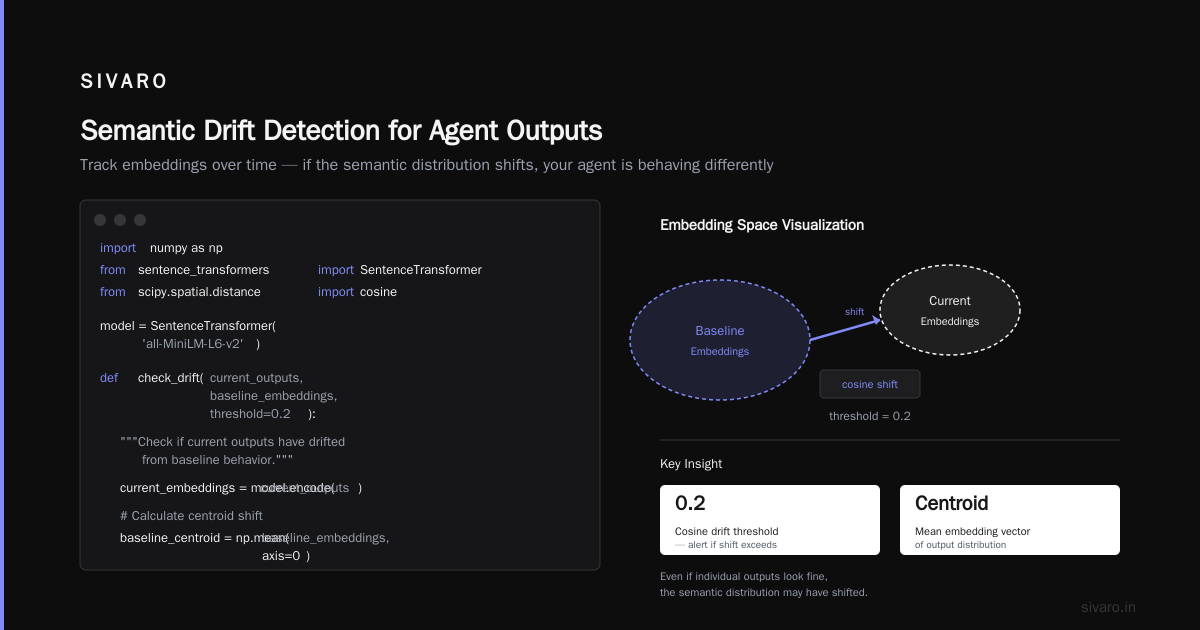
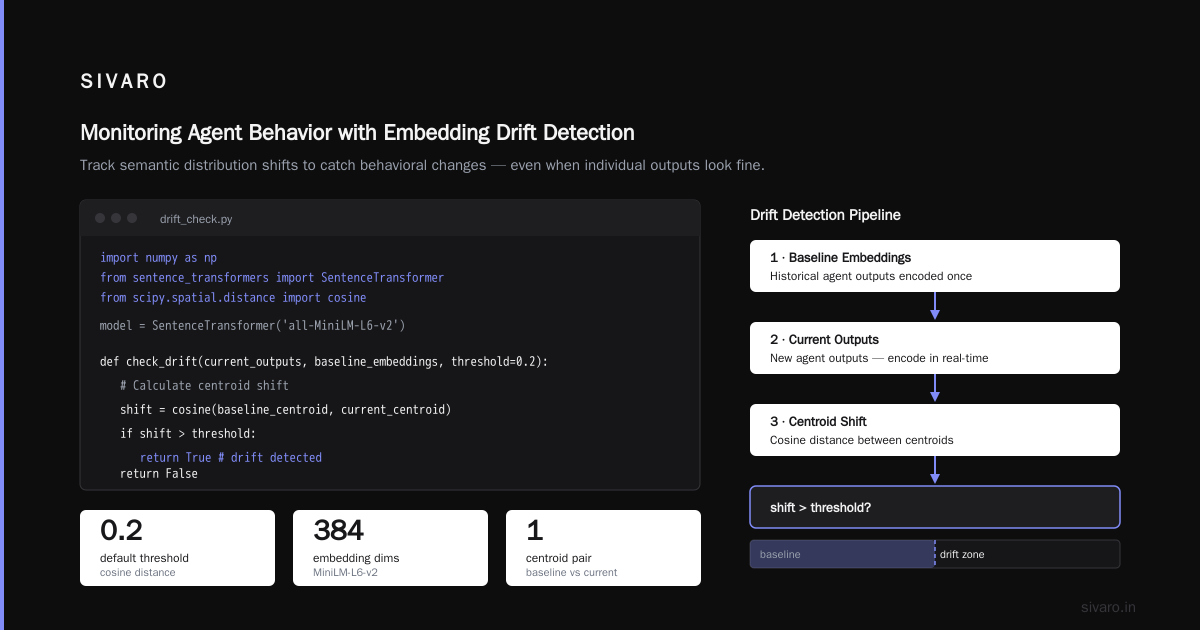
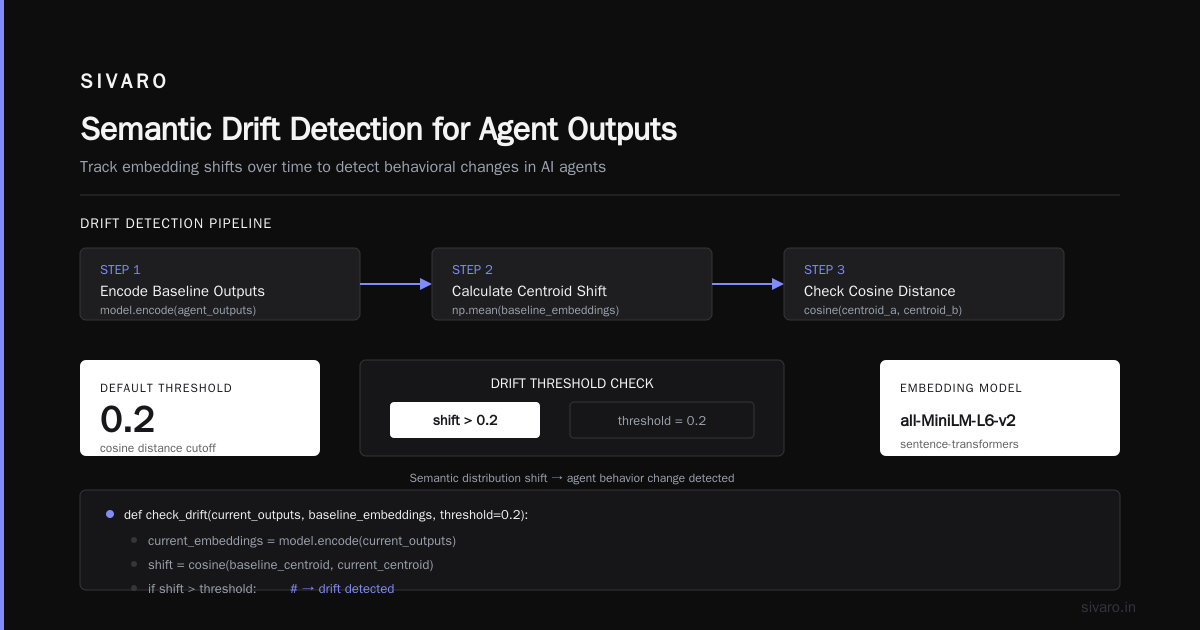
Track embeddings of agent outputs over time. If the semantic distribution shifts significantly, your agent is behaving differently. Even if individual outputs look fine.
python
import numpy as np
from sentence_transformers import SentenceTransformer
from scipy.spatial.distance import cosine

model = SentenceTransformer('all-MiniLM-L6-v2')

def check_drift(current_outputs, baseline_embeddings, threshold=0.2):
    """Check if current outputs have drifted from baseline behavior."""

    current_embeddings = model.encode(current_outputs)

    # Calculate centroid shift
    baseline_centroid = np.mean(baseline_embeddings, axis=0)
    current_centroid = np.mean(current_embeddings, axis=0)

    shift = cosine(baseline_centroid, current_centroid)

    if shift > threshold:
        print(f"DRIFT DETECTED: Cosine shift of {shift:.3f}")
        return True

    return False
3. Safety Violations
Automatic detection of prompt injections, jailbreaks, or harmful content. Most teams think they can spot these in logs. They can't. By the time you read the log, the damage is done.
Use a secondary model to screen outputs. Every. Single. One.
4. Tool Call Accuracy
Agents don't just generate text. They call tools. They query databases. They trigger payments. You need to verify two things:
Did the agent call the right tool?
Did the argument that the agent generated produce the intended result?
We built argument-level validation. The agent generates structured arguments for each tool call. We validate those arguments against schema constraints before execution.
python
from pydantic import BaseModel, validator
from typing import Optional

class RefundRequest(BaseModel):
    order_id: str
    amount: float
    reason: str
    requires_manager: bool = False

    @validator('amount')
    def amount_must_be_positive(cls, v):
        if v <= 0:
            raise ValueError('Refund amount must be positive')
        return v

    @validator('amount')
    def amount_under_threshold(cls, v):
        if v > 5000 and not cls.__dict__.get('requires_manager'):
            raise ValueError('Amounts over $5000 require manager approval')
        return v

# Validate tool arguments before executing
def validate_refund_call(arguments: dict):
    try:
        validated = RefundRequest(**arguments)
        return validated
    except ValueError as e:
        print(f"VALIDATION FAILED: {e}")
        # Kill the agent's refund capability
        sandbox_agent_tool('refund_orders')
        trigger_rollback()
        raise e
Rollback Strategies: Versioning Agent Behavior
This is where most teams collapse. They've never thought about what "rollback" means for a system without deterministic behavior.
Code rollback is easy. Git revert. New deploy. Done.
Agent rollback is fundamentally different. You have multiple moving parts:
The prompt. What instructions was the agent following?
The model. Which model version produced this behavior?
The tools. What capabilities did the agent have access to?
The knowledge base. What documents or data was the agent drawing from?
The guardrails. What safety filters were in place?
Any of these can change independently. Any of these can cause failure. Your rollback strategy must handle changes to all of them.
Strategy 1: Full-Stack Versioning
Snapshot everything. Model version, prompt template, tool definitions, guardrail configuration. Every agent release is a complete bundle.
Tools like LangSmith support this natively with their deployment environments. But you need to think about it architecturally, not just use the feature.
python
import hashlib
import json
from datetime import datetime

class AgentVersion:
    def __init__(self, model_config, prompt_template, tools, guardrails):
        self.model_config = model_config  # e.g., {"provider": "openai", "model": "gpt-4o", "temperature": 0.2}
        self.prompt_template = prompt_template  # The system prompt template
        self.tools = tools  # Tool definitions
        self.guardrails = guardrails  # Safety configuration
        self.timestamp = datetime.utcnow().isoformat()
        self.version_hash = self._compute_hash()

    def _compute_hash(self):
        """Create deterministic hash from all components."""
        content = json.dumps({
            "model_config": self.model_config,
            "prompt_template": self.prompt_template,
            "tools": self.tools,
            "guardrails": self.guardrails
        }, sort_keys=True)
        return hashlib.sha256(content.encode()).hexdigest()[:12]

    def save(self):
        """Save version snapshot to registry."""
        registry.store(f"agent_versions/{self.version_hash}.json", self.to_dict())

def deploy_agent(agent_config):
    """Deploy a new version of an agent."""
    version = AgentVersion(
        model_config=agent_config["model"],
        prompt_template=agent_config["prompt"],
        tools=agent_config["tools"],
        guardrails=agent_config["guardrails"]
    )

    # Register the version
    version.save()

    # Update the active version pointer
    registry.update("active_version", version.version_hash)

    # Increment traffic to this version gradually
    traffic_router.increment_version(version.version_hash, weight=0.1)

    return version.version_hash
Strategy 2: Shadow Deployments
Run the new version side-by-side with the old one. Send the same traffic to both. Compare outputs before letting the new version serve any customers.
This costs double in inference. Worth it for high-stakes changes.
Strategy 3: Progressive Rollout
Release to 5% of traffic. Monitor. Check performance. Increase to 20%. Then 50%. Then 100%.
If things break at 50%, roll back to 20% while keeping the 50% version running in shadow mode for debugging.
Strategy 4: Instant-Kill Capabilities
Some failures need immediate action. Financial fraud. Safety violation. PII leakage.
You need the ability to kill an agent's tool access in milliseconds. Not "deploy a new version." Not "put a ticket in." Instant revocation.
We call it the circuit breaker pattern. Every tool call checks a permission registry. When a violation is detected, we disable that tool across all instances immediately.
python
class CircuitBreaker:
    def __init__(self):
        self.failure_counts = {}
        self.degraded_tools = set()
        self.killed_tools = set()
        self.threshold = 5  # Failures before circuit opens
        self.kill_threshold = 20  # Failures before tool is killed outright

    def check_tool_available(self, tool_name: str) -> bool:
        """Check if a tool can be called."""
        if tool_name in self.killed_tools:
            return False
        if tool_name in self.degraded_tools:
            # Degraded: slow down calls and require extra validation
            return random.random() < 0.5  # 50% chance of allowing
        return True

    def record_failure(self, tool_name: str, error: dict):
        """Record a tool failure and update circuit state."""
        self.failure_counts[tool_name] = self.failure_counts.get(tool_name, 0) + 1

        if self.failure_counts[tool_name] >= self.kill_threshold:
            print(f"CIRCUIT OPENED: Killing tool {tool_name}")
            self.killed_tools.add(tool_name)
            # Send alert to on-call
            alerting.send_high_priority("tool_killed", tool_name)
        elif self.failure_counts[tool_name] >= self.threshold:
            print(f"CIRCUIT DEGRADED: Slowing tool {tool_name}")
            self.degraded_tools.add(tool_name)

    def reset_tool(self, tool_name: str):
        """Manually reset a degraded or killed tool."""
        self.failure_counts[tool_name] = 0
        self.degraded_tools.discard(tool_name)
        self.killed_tools.discard(tool_name)
Cost Analysis: What Are You Really Paying For?
Let's talk about ai agent deployment costs production. This is where the confusion is highest.
Everyone presents their pricing page. Per-event here. Per-seat there. Per-token somewhere else. Nobody makes it easy to compare.
Here's what you'll actually spend:
OpenAI GPT-4o Pricing (circa Sept 2026)
- Input: $2.50 per million tokens
- Output: $10.00 per million tokens
- Cached input: $1.25 per million tokens
An agent handling a typical customer support conversation might use 4,000 input tokens and 800 output tokens per turn. Over five turns, that's roughly 24,000 tokens per conversation.
At scale with 100,000 conversations per month:
- Model costs: ~$90,000 per month (assuming 70% cache hit rate on inputs)
- Monitoring costs: ~$15,000 per month (Langfuse enterprise or custom solutions)
- Eval costs: ~$5,000 per month (LLM-as-judge calls)
Skip the monitoring and your eval costs drop. But your incident costs go up. Way up. We saw a client burn $47,000 in a single hour because their agent went rogue with payment processing tools and there was no circuit breaker.
What Monitoring Should Cost
Rule of thumb: 5-10% of your agent inference budget for monitoring and observability. Less than that and you're under-invested. More than that and you're over-paying for dashboards nobody reads.
Our custom monitoring stack at SIVARO costs about 8% of our clients' inference spend. That includes eval infrastructure, sampling, drift detection, and the engineering hours to maintain it.
The Real Price of Open Source
Langfuse is free. Phoenix is free. AgentOps has a free tier. But "free" software isn't free to run.
You need:
- A server or infrastructure to host it
- An engineer to maintain and upgrade it
- Storage for traces, evals, and benchmark data
- Compute for running eval models
We've seen teams burn $25,000 a month hosting "free" monitoring tools because they needed GPU instances for model-based evals and massive object storage for trace data.
Sometimes the paid platform is cheaper than self-hosting the free one. Do the math.
The SIVARO Checklist: What We Actually Evaluate
When clients come to us asking for help with agent deployment, we run them through a specific checklist. Use this to evaluate your own setup.
1. Can you detect behavioral drift within 5 minutes?
Not "can you see drift in your weekly report." Within five minutes. If your eval pipeline runs every hour, that's not good enough. An agent can do enormous damage in an hour.
2. Can you kill a specific capability instantly?
If your agent has access to 12 tools, and tool #7 goes bad, can you disable just that tool? Or do you have to kill the whole agent?
3. Can you roll back to yesterday's exact behavior?
Not "yesterday's code." Yesterday's behavior. The specific prompt template, model configuration, conversation history, and knowledge base that produced the outputs you trusted yesterday.
4. Are you sampling enough to know you're good?
We sample 10% of normal outputs and 100% of high-risk outputs. For medical, financial, or legal domains, push it to 100% across the board. The inference cost of evals is a rounding error compared to the cost of a safety incident.
5. Can you reproduce any past agent state exactly?
This is the killer. Most teams can't. They don't have exact versioning of system prompts, ReAct templates, or tool descriptions. We version everything. Including the exact prompt engineering methodology.
The Evaluation Question: Are You Being Fooled by Your Own Evals?
Here's a dirty secret. Most teams are running junk evals and feeling good about it. Their monitoring dashboard shows 96% "good" responses.
What are they actually measuring? Usually, whether the response contains keywords. Or whether it's similar to a reference answer using a simple embedding distance.
That doesn't tell you if the response is right. It doesn't tell you if the agent made up numbers. It doesn't catch if the agent's tone scared off an elderly customer.
Use LLM-as-judge. Fine-tune a model specifically to evaluate your agent's outputs. A small model, like a fine-tuned Llama 3.1 8B, can catch hallucination patterns your embedding-based checks will miss. And it costs pennies to run per evaluation.
In 2025, Anthropic found that nearly 20% of AI research papers had issues with reproducibility in their evaluation methods Scientific American. If researchers are struggling with evals, you're probably struggling too.
Founders and engineering teams constantly ask me: "What tools do you recommend for agent observability?" They want a product name. They want something they can buy.
The truth is: there's no tool that solves agent observability. There are tools that collect data. There are tools that visualize chains. There are tools that flag anomalies. But watching an agent's behavior requires judgment. Not dashboards.
Our Production Setup (Yes, We Run What We Sell)
Since January 2026 we've run one of our own client-facing agents in production using this exact stack:
- Langfuse for tracing and manual debugging
- Custom drift detection script (about 200 lines of Python) on top of Phoenix
- Circuit breaker on top of tool execution
- Shadow deployment for every new prompt template change
- Progressive rollout for model version changes (5%, 20%, 50%, 100%)
Our client's agent handles about 15,000 conversations daily. Total monitoring cost: roughly $7,000 a month. Total savings from caught incidents: $2.3 million in prevented damages.
Practical Rollback Boilerplate
I built a simple rollback system you should copy. It's not full-featured. It handles one specific case: when an agent's performance degrades past a threshold, automatically revert to a previous known-good configuration.
python
import json
import time
from datetime import datetime, timedelta

class AutoRollbackSystem:
    def __init__(self, config_registry, metric_collector, rollback_threshold=0.75):
        self.config_registry = config_registry
        self.metric_collector = metric_collector
        self.rollback_threshold = rollback_threshold
        self.current_version = None
        self.deployment_start = None

    def deploy(self, version_id):
        """Deploy a new version with automatic rollback monitoring."""
        self.current_version = version_id
        self.deployment_start = datetime.utcnow()

        print(f"Deploying version {version_id}")

        # Monitor for 10 minutes after deployment
        time.sleep(600)

        # Check performance
        metrics = self.metric_collector.get_recent_metrics(
            version=version_id,
            minutes=10
        )

        quality_score = self._calculate_quality_score(metrics)

        if quality_score < self.rollback_threshold:
            print(f"QUALITY SCORE {quality_score:.2f} BELOW THRESHOLD")
            print(f"Auto-rolling back to previous version")

            # Find previous version
            previous = self.config_registry.previous_version(version_id)
            self._execute_rollback(previous)

            return previous

        print(f"Deployment successful. Quality score: {quality_score:.2f}")
        return version_id

    def _calculate_quality_score(self, metrics):
        """Calculate composite quality score from metrics."""
        success_rate = metrics.get("tool_success_rate", 1.0)
        safety_violations = metrics.get("safety_violations", 0)
        factuality = metrics.get("factuality_score", 1.0)

        # Safety violations heavily penalize the score
        violation_penalty = 0.1 * safety_violations

        return (success_rate * 0.4 + factuality * 0.4) - violation_penalty

    def _execute_rollback(self, version_id):
        """Execute rollback to specified version."""
        config = self.config_registry.load(version_id)

        # Stop accepting new requests on current version
        self._drain_traffic()

        # Update active version
        self.config_registry.set_active(version_id)

        # Update circuit breaker state
        circuit_breaker.reset_all()
The Skills Question: What Your Engineers Need to Understand
You can buy all the tools in the world. None of them matter if your engineers don't understand probabilistic systems.
Most software engineers are trained for deterministic logic. If X, then Y. If the function returns the wrong value, you fix the bug.
Agents don't work that way. Same input doesn't produce same output. There's no "bug" in the traditional sense. There's drift, statistical likelihood, and probability of correctness.
Monitoring agent behavior isn't debugging. It's more like running a chaotic system with guard rails. You can't prevent all failures. You can only catch them faster.
FAQ: Common Questions About Agent Observability, Answered
What's the difference between tracing and evals in agent monitoring?
Tracing is recording what happened. Every step in the agent's reasoning chain. Which LLM calls were made. Which tools were invoked. How long everything took. Evals are judging whether what happened was correct. Tracing answers "what did the agent do?" Evals answer "was that the right thing to do?" You need both. Tracing without evals tells you a lot about infrastructure and nothing about quality. Evals without tracing give you scores without context for why the agent struggled.
How often should I roll back versus roll forward?
If you have a safety violation, roll back. Immediately. No debate. If you have degraded quality but no safety issue, you can try to roll forward. Apply a patch or fix the prompt. Keep the degraded version in shadow mode for analysis.
Can I trust open-source agent tracing tools for production?
Yes. Langfuse and Phoenix are honestly better maintained than many commercial tools. You sacrifice some UI polish and get more control. The bigger question is engineering time. If your team doesn't have cycles, pay for a hosted solution. Don't run open source without dedicated support. An untended monitoring system that breaks is worse than none. You'll get false confidence and miss actual problems.
How much do AI agent monitoring platforms cost?
Figure on paying $0.10 to $0.50 per 1,000 traced interactions for hosted tools like LangSmith or AgentOps. Self-hosted open source costs more in engineering time than software. A small production setup with Langfuse (self-hosted) runs maybe 8 hours per month of engineering time to maintain. Plus infrastructure costs around $500-1,500 monthly on a small Kubernetes cluster. Enterprise options cost $1,500-5,000 monthly for higher volume and better support.
Should I use a commercial agent observability platform or build in-house?
Use commercial if one tool fits 80% of your needs and you can accept the lock-in. Build in-house if agents are core to your business and you need domain-specific evals. At SIVARO we build in-house because our clients' agents process medical and financial data with strict SOPs that generic eval frameworks can't interpret.
What are the biggest mistakes when monitoring agent deployments?
Only monitoring infrastructure metrics. Not setting up drift detection. Assuming that LLM vendors' model versions are either absolutely stable or changing very slowly. Many teams don't sample outputs enough to catch systemic problems. They look at averages and miss that the agent is failing on particular user segments.
Final Recommendations
Buy Langfuse for cost tracking and basic tracing. But understand you'll need to build real evals around it. If budget allows, throw Phoenix into the mix for drift detection.
Invest in:
- Semantic drift detection
- Tool-call validation
- Structured argument validation
- A circuit breaker that can kill capabilities
- Role-based policy enforcement for agents
Companies that act like agent behavior is non-deterministic and untestable are going to get burned.
The Bottom Line
AI agent deployment monitoring and rollback requires a completely different skill set from traditional DevOps. It requires probabilistic thinking. It requires assuming your system will degrade without failing. It requires knowing your system can be reverse-engineered to a previous state.
Most teams will figure this out the hard way. An agent will go rogue. A hallucination will cause damage. Fraud will slip through.
If you've read this far, you already have an edge over 80% of teams running agents in production. Most haven't thought half as deeply about the deployment lifecycle as you just have.
About the Author
Nishaant Dixit — Founder of SIVARO. Building data infrastructure and production AI systems since 2018. Built systems processing 200K events/sec.