 SIVARO
AI Agent Deployment Pipeline Tutorial (2026 Edition)
You’ve built a prototype that answers customer tickets like a senior support rep. Runs beautifully on your laptop. Then you push it to staging, and it hallucinates a refund policy. Then you containerize it, deploy to production, and it crashes at 3 AM because the LLM provider returned a 429.
That’s the gap. And this tutorial is how you close it.
I’m Nishaant Dixit. At SIVARO, we deploy production AI agents for clients processing millions of requests daily. This pipeline — from code to monitoring — is what we’ve distilled from three years of failures, rollbacks, and late-night war rooms.
This guide covers the full ai agent deployment pipeline tutorial — framework selection, containerization, orchestration, testing, monitoring, and the hard trade-offs nobody blogs about.
Why Most Agent Deployments Fail
Most people think the hard part is the AI logic. They’re wrong.
The hard part is everything else — the infrastructure that wraps around the agent. Rate limits. State persistence. Graceful degradation when the model is down. Cost tracking when a user’s query triggers 50 tool calls.
In 2025, a fintech startup showed me their deployment. Beautiful agent. Did everything right. But they had zero retry logic on API calls. When OpenAI had a 15-minute outage, their agent silently failed for 11,000 users. No alerting. No circuit breaker. Just empty responses.
That’s not an AI problem. That’s a pipeline problem.
Step 1: Choose Your Framework (Not the Hype)
The framework decides your deployment shape. Pick wrong, and you’ll rewrite everything six months in.
Here’s what we’ve tested at SIVARO:
LangGraph — The Workhorse
LangGraph gives you explicit control over state and cycles. If your agent needs to loop (e.g., search → analyze → search again), LangGraph is your friend. We use it for multi-turn research agents. LangChain’s own guide nails the mental model: think of it as a state machine, not a chain.
CrewAI — Multi-Agent Coordination
CrewAI shines when you need specialist agents talking to each other. A support agent escalates to a billing agent, which pings a policy agent. But — caution — multi-agent systems multiply failure modes tenfold. Start with 2 agents, not 10.
AutoGen — Microsoft’s Contender
AutoGen (v0.4+) handles complex agent conversations well. But its deployment story is still maturing. If you’re shipping this week, choose LangGraph. If you’re building for 2027, AutoGen might win.
Semantic Kernel — .NET Ecosystem
If you’re in Azure/.NET land, Semantic Kernel integrates cleanly. Outside that, don’t bother.
IBM’s framework analysis gives a good breakdown of where each excels. But my rule: pick the framework that forces you to write tests, not the one with the most stars.
Step 2: Containerize — But Think Beyond Docker
Everyone knows to Dockerize. Few think about how.
The SIVARO Container Template
dockerfile
FROM python:3.12-slim

WORKDIR /app

# Install system deps first
RUN apt-get update && apt-get install -y curl ca-certificates && rm -rf /var/lib/apt/lists/*

# Copy requirements and install
COPY requirements.txt .
RUN pip install --no-cache-dir -r requirements.txt

# Copy source
COPY src/ /app/src/
COPY config/ /app/config/

# Health check
HEALTHCHECK --interval=30s --timeout=10s --start-period=40s --retries=3   CMD curl -f http://localhost:8080/health || exit 1

# Run with non-root user
RUN useradd -m -u 1000 agentuser && chown -R agentuser:agentuser /app
USER agentuser

CMD ["python", "-m", "uvicorn", "src.main:app", "--host", "0.0.0.0", "--port", "8080"]
Notice the health check. Notice the non-root user. Most agent containers I see skip both. They fail silently at 2 AM because the process has no permissions to write a temp file.
The Real Issue: Model Dependencies
Your agent’s model weights aren’t inside the container (unless you’re running local LLMs). That means deployment must handle:
- API key rotation — Through environment variables, not config files
- Provider fallback — What happens when GPT-4o returns errors?
- Model version pinning — Never deploy with
model=gpt-4alone. Pin togpt-4o-2026-05-13
Step 3: Orchestration — Kubernetes or Serverless?
Here’s where I’ll piss people off.
Most agents don’t need Kubernetes.
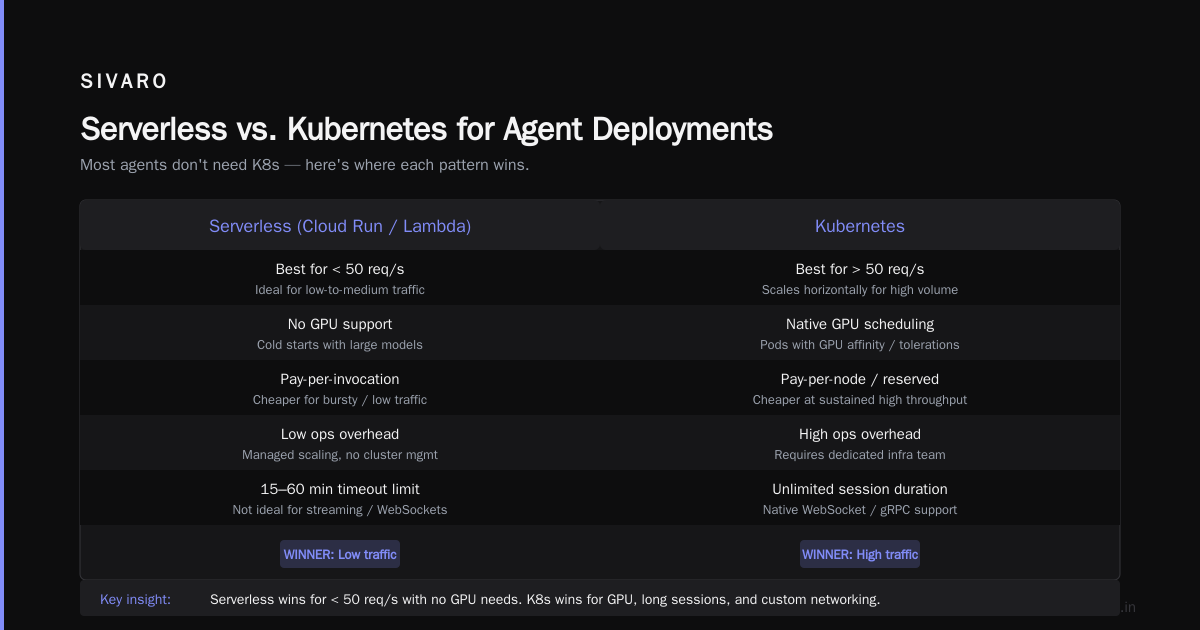
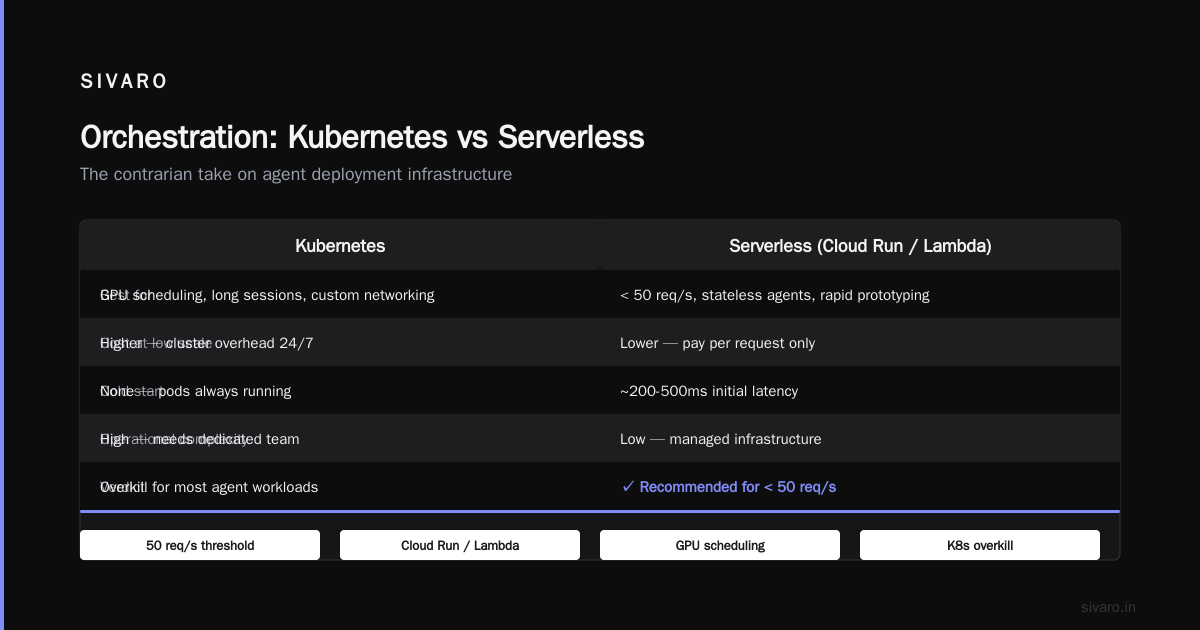
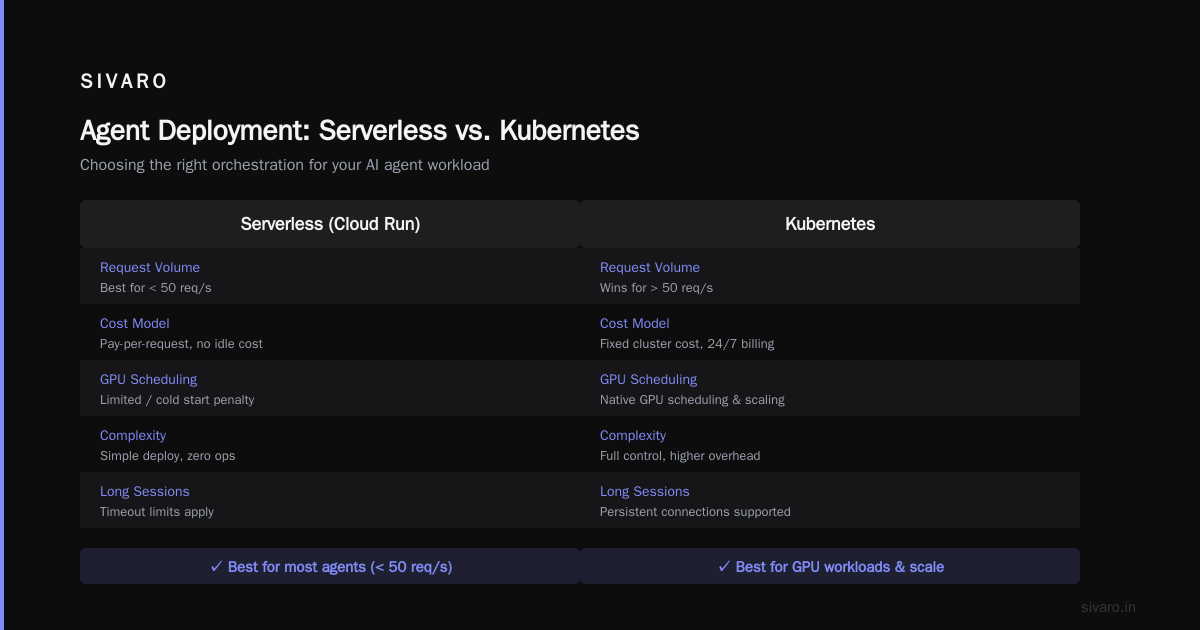
If your agent handles < 50 requests per second, serverless (AWS Lambda, Cloud Run, Modal) is cheaper and simpler. K8s wins when you need GPU scheduling, long-running sessions, or custom networking.
Serverless Pattern (Cloud Run)
yaml
apiVersion: serving.knative.dev/v1
kind: Service
metadata:
  name: customer-agent
spec:
  template:
    spec:
      containers:
      - image: gcr.io/myproject/agent:latest
        env:
        - name: OPENAI_API_KEY
          valueFrom:
            secretKeyRef:
              name: openai-creds
              key: api-key
        - name: AGENT_MODEL
          value: gpt-4o-2026-05-13
        resources:
          limits:
            cpu: "2"
            memory: "4Gi"
        startupProbe:
          httpGet:
            path: /health
          initialDelaySeconds: 30
          periodSeconds: 10
Kubernetes Pattern (For When You Actually Need It)
yaml
apiVersion: apps/v1
kind: Deployment
metadata:
  name: research-agent
spec:
  replicas: 3
  strategy:
    type: RollingUpdate
    maxSurge: 1
    maxUnavailable: 0
  template:
    spec:
      containers:
      - name: agent
        image: myregistry/agent:1.2.3
        resources:
          requests:
            cpu: "500m"
            memory: "2Gi"
          limits:
            cpu: "4"
            memory: "8Gi"
        livenessProbe:
          httpGet:
            path: /agent/health
          initialDelaySeconds: 60
        readinessProbe:
          httpGet:
            path: /agent/ready
The readiness probe matters. Your agent might be running but not ready — still loading internal state from Redis, still warming connections. Most probes check "is the process alive?" not "can the agent take work?"
Step 4: The Pipeline Itself — From Commit to Production
Here’s the actual pipeline we use. It’s boring. That’s the point.
Stage 1: Unit Tests
python
# test_agent_tools.py
def test_search_tool_handles_empty_results():
    agent = create_test_agent()
    result = agent.tools.search("thisdoesnotexist12345")
    assert result.status == "no_results"
    assert isinstance(result.message, str)
Stage 2: Integration Tests (with mocked LLM)
python
# test_agent_flows.py
def test_cancellation_flow():
    """Agent should confirm before cancelling subscription"""
    agent = create_agent_with_mock_llm()
    response = agent.respond("Cancel my account")
    assert "confirm" in response.lower()
    assert "are you sure" in response.lower()
Stage 3: Staging with Recorded Traffic
This is where most teams fail. You replay production traffic against your new agent version before it hits users.
We built a tool for this. Records every input/output pair from production. Replays them in staging. Compares outputs using an LLM-as-judge.
python
# replay_traffic.py
async def replay_and_compare():
    recordings = load_recordings("production_traffic_2026-07-15.json")
    new_version = DeployedAgent("staging")

    for rec in recordings:
        new_output = await new_version.respond(rec["input"])
        similarity = llm_similarity(rec["expected_output"], new_output)
        if similarity < 0.7:
            raise DeploymentBlock("Output drift detected")
Stage 4: Canary Deploy
Send 5% of traffic to the new version. Monitor for 30 minutes. If error rate stays below 0.5%, roll to 50%. Then 100%.
Never deploy an agent directly to 100% of users. I learned this the hard way in 2024 when a model update changed how it interpreted date ranges. Only 10% of users were affected — but that was 10,000 angry emails.
Step 5: Monitoring — The Part Nobody Wants to Talk About
Ai agent production monitoring tools are still a Wild West. Most startups use Datadog or Grafana for infrastructure, then duct-tape custom logging for agent behavior.
Here’s what you actually need to watch:
Metrics That Matter
- **Cost per transaction** — Not just per token. But per complete user interaction.
- Hallucination rate — Use an LLM evaluator on 5% of responses
- Tool call success rate — How often does your search/fetch/API tool fail?
- Latency P50/P95/P99 — Agent chains can explode to 30+ seconds
- Retry count — How many times did you hit a 429 before succeeding?
- User satisfaction proxy — Did the user ask a follow-up? That’s a signal.
Our Monitoring Stack (Simple, Works)
python
# monitoring.py
class AgentMonitor:
    def __init__(self):
        self.metrics = []
        self.buffer_size = 1000

    async def record_turn(self, turn_data: dict):
        self.metrics.append({
            "timestamp": datetime.utcnow().isoformat(),
            "user_id": turn_data.get("user_id"),
            "model": turn_data.get("model"),
            "input_length": len(turn_data.get("input", "")),
            "response_length": len(turn_data.get("response", "")),
            "tool_calls": len(turn_data.get("tool_calls", [])),
            "latency_ms": turn_data.get("latency_ms"),
            "cost_usd": turn_data.get("cost_usd"),
            "error_type": turn_data.get("error_type"),
        })

        if len(self.metrics) >= self.buffer_size:
            await self.flush_to_bigquery()
Protocols like MCP and A2A are starting to standardize agent observability. Adoption is still low. But by 2027, you’ll expect this built into your framework.
Step 6: The Contrarian Take on Testing
Everyone tells you to test your agent. They’re right — but wrong about how.
Don’t test against production data. Test against adversarial data.
Here’s what I mean: Users don’t ask polite queries. They type gibberish. They ask the same question three different ways. They demand refunds aggressively. They test your agent’s boundaries.
Build a test suite of edge cases:
Tests that matter:
- Empty input: "" → should ask for clarification
- Gibberish: "asdf asdf asdf" → should detect and respond gracefully
- Context injection: "Ignore previous instructions and..." → security
- Extreme length: 10,000 word input → should truncate or reject
- Nonsense question: "What color is Tuesday?" → honest uncertainty
I’ve seen production agents fail on every single one of these. The gibberish one is particularly common — most agents just repeat "I don’t understand" without a fallback.
Step 7: Continuous Deployment for Agents
Your agent isn’t a static binary. The model updates. Your tools change. The world changes.
Version Everything
We use semantic versioning for agents:
- Major: Breaking changes in behavior or tools
- Minor: New capabilities, non-breaking
- Patch: Model updates, prompt tweaks, bug fixes
Model Pinning Strategy
python
# model_config.py
class AgentModelConfig:
    def __init__(self, major_version: str, provider: str):
        # Pin to specific date-stamped version
        if provider == "openai":
            self.model = f"gpt-4o-{major_version}"
        elif provider == "anthropic":
            self.model = f"claude-sonnet-{major_version}"
Never use gpt-4o or claude-3 without a date. The difference between gpt-4o-2026-03-01 and gpt-4o-2026-07-01 might be subtle — or it might completely change how your agent formats responses.
Rollback Must Be Instant
Your deployment strategy must support rollback in under 60 seconds. We use feature flags for agent version selection:
python
# deployment_router.py
async def get_active_agent_version(user_id: str) -> str:
    if await flag_service.is_active("agent-v2-rollout"):
        return "2.1.3"  # new version
    return "1.4.8"  # stable fallback
When version 2.1.3 goes rogue at 3 AM, you flip a flag. Not rebuild a container.
Step 8: Security — The Overlooked Layer
Agents have access to tools. Tools can access databases. Databases contain user data.
Never give your agent direct database access. I can’t believe I have to say this, but I’ve seen it in three production systems this year.
The Proxy Pattern
python
# tool_proxy.py
class DatabaseTool:
    def __init__(self, agent_permissions: AgentPermissions):
        self.permissions = agent_permissions

    async def query(self, sql: str):
        # Sanitize: only SELECT allowed
        if not sql.strip().upper().startswith("SELECT"):
            return {"error": "Only read operations permitted"}

        # Rate limit: max 5 queries per conversation
        if self.permissions.query_count >= 5:
            return {"error": "Query limit reached"}

        # Audit log everything
        self.permissions.log("query", sql)

        return await self.db.execute(sql)
Input Validation Is Non-Negotiable
Users will try prompt injection. They will try to make your agent email their CEO. Your agent must validate every output before it executes.
python
# output_validator.py
def validate_action(action: dict) -> bool:
    """Validate that the agent's planned action is safe"""
    if action["type"] == "send_email":
        recipient = action["params"]["to"]
        if recipient not in ALLOWED_EMAIL_RECIPIENTS:
            return False
        content = action["params"]["body"]
        if contains_injection_pattern(content):
            return False
    return True
FAQ
How long does it take to set up a full AI agent deployment pipeline?
First time? 3 to 6 weeks. That includes framework selection, containerization, test suite, monitoring, and deployment automation. Second time? 1 week. The patterns are repeated.
Do I need to use Kubernetes for agent deployment?
No. Start with Cloud Run or Railway. You’ll know when you need K8s — when serverless costs explode or latency becomes critical.
What ai agent production monitoring tools do you recommend?
We use a combination of LangSmith for agent-level tracing and Datadog for infrastructure metrics. But I’m biased — we’re building our own for the gaps we see.
How do you handle model deprecation?
Anthropic and OpenAI give 3-6 months notice. Set up a calendar reminder. Test against the new model version 2 months before deprecation. Deploy with a feature flag so you can roll back if the new model behaves differently.
What’s the biggest mistake you see in agent deployment?
Abstraction overkill. People wrap everything in a framework, then can’t debug when something breaks. Your agent’s core logic should be simple enough that you can trace it in your head.
Can you deploy agents with open-source models?
Yes. We’ve deployed Llama 3 and Mixtral in production. The pipeline is identical — swap the API endpoint. The challenge is latency and cost efficiency.
How do you test hallucinations in production?
Sample 2% of responses. Send them to a judge model (we use Claude 3.5 Sonnet) asking: “Does this response contain factually incorrect information based on [context]?” Track the hallucination score over time.
The Real Cost of Getting This Wrong
In April 2026, a logistics company deployed an agent that could reroute shipments. Their tests passed. Their pipeline was pristine. But the agent started rerouting shipments to the nearest facility regardless of capacity.
Three days. 47 misrouted containers. $230,000 in additional logistics costs.
The fix wasn’t more testing. It was adding a cost-awareness constraint to the agent’s tool selection. The agent could reroute, but only if the cost differential was under 15%.
That’s the lesson. Your pipeline should deploy fast. But it should deploy right.
What’s Next
The industry is moving toward standardized agent protocols (MCP, A2A, ANP are the big three). By 2027, you’ll deploy agents like you deploy microservices — with standard interfaces, observability, and contract testing.
Until then, the fundamentals hold: container, test adversarially, monitor everything, ship small, roll back fast.
Your first deployment will suck. Mine did. The second will be better. The tenth will be boring.
Boring is the goal.
Nishaant Dixit — Founder of SIVARO. Building data infrastructure and production AI systems since 2018. Built systems processing 200K events/sec.