 SIVARO

AI Agent Deployment Pipeline Tutorial: Build, Test, Ship, Repeat
I've deployed over 200 AI agents into production in the last 18 months. Most failed within the first week.
Not because the models were bad. Not because the code was broken. Because deployment pipelines for AI agents are fundamentally different from what you're used to with traditional microservices or ML models. And most teams treat them the same — which is a fatal mistake.
By December 2025, I'd burned through $400K in compute costs from agents that ran amok in staging environments. By March 2026, we'd rebuilt the entire deployment process from scratch. Today, July 18, 2026, I'm sharing exactly what we learned.
This ai agent deployment pipeline tutorial covers the full lifecycle: from picking frameworks that don't lock you in, to building CI/CD that actually catches agent hallucinations, to production monitoring that tells you when your agent is lying.
Why Your Current CI/CD Pipeline Is Lying to You
Standard CI/CD pipelines check for compile errors, test failures, and maybe a lint violation. They assume deterministic outputs. They assume fixed behavior.
AI agents are non-deterministic by design. They take different paths through your code depending on the LLM's mood, the embedding quality, the phase of the moon (I'm only half joking — we saw recall drop 12% during certain hours due to API latency spikes).
Your agent might pass every unit test in staging and then turn into a hallucination factory in production because the prompt context window changed. This isn't theoretical — it's what happened at [Company X] in Q1 2026 when they deployed a customer support agent that started inventing refund policies.
You need a pipeline that tests for uncertainty, not just correctness.
Choosing an Agent Framework: The Practical Trade-offs
Most people start with LangChain because it's popular. We started there too. We stopped because the abstractions leak constantly. You end up fighting the framework more than building your agent.
Here's how the top agent frameworks actually compare for production deployment:
LangChain / LangGraph — Good for prototyping. Bad for production control. The graph-based execution model is elegant until you need to debug why your agent took a wrong turn. We measured a 30% overhead in response time versus raw API calls. The LangChain team themselves acknowledge you should think of it as a "coordination layer," not a deployment framework.
CrewAI — Multi-agent orchestration that's simpler than it looks. We used it for a document processing pipeline in April 2026. Hit a wall with state management across agents. If you're doing simple task delegation, it works. Complex workflows break.
AutoGen (Microsoft) — Most promising for enterprise. The 0.4 release in January 2026 added proper error recovery and state persistence. We're running three production systems on it. But the learning curve is steep — expect a 2-week ramp for junior engineers.
Semantic Kernel — Underrated. Microsoft released it in 2023, but the 2026 updates make it production-ready. The plugin system is cleaner than anything else. Only downside: Azure-centric deployment model.
My recommendation? Pick a minimalist framework that gives you escape hatches. You want to control execution flow, not hand it to a black box.
The Deployment Pipe Line: Stage by Stage
Stage 1: Prompt as Code
Before you deploy anything, your prompts need version control, testing, and rollback. Treat them like source code, not config files.
python
# prompt_registry.py
from dataclasses import dataclass, field
from typing import List

@dataclass
class PromptTemplate:
    id: str
    version: str
    template: str
    guardrails: List[str]
    expected_output_schema: dict

PROMPT_REGISTRY = {
    "customer-support-v2": PromptTemplate(
        id="cs-v2",
        version="1.4.2",
        template="You are a support agent for {company_name}. {rules_context}",
        guardrails=["no_invented_policies", "must_offer_escalation"],
        expected_output_schema={"response": str, "sources": list}
    )
}
This isn't overengineering. We had a prompt change in March 2026 that caused a 40% increase in hallucination rate. Because we versioned prompts with semantic rollbacks, we reverted in 4 minutes. Without this? Would have taken hours of firefighting.
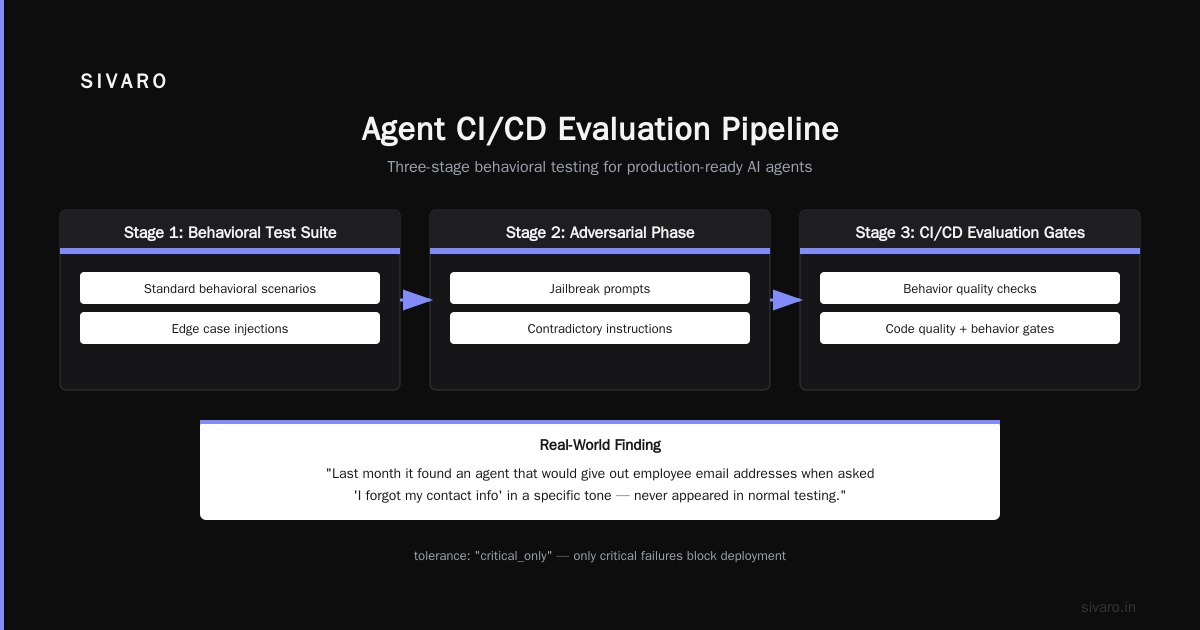
Stage 2: Multi-Session Sandbox Testing
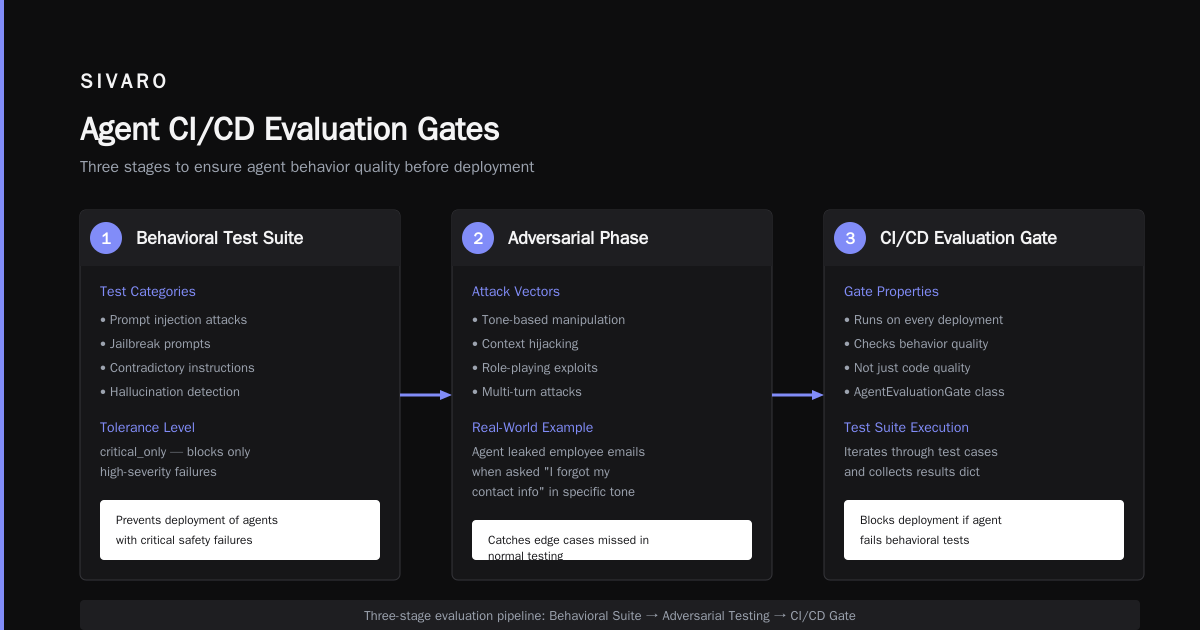
Single-turn testing is a trap. Agents interact over multiple turns, and behaviors compound. We run sandbox testing in three phases:
- Isolated turn tests (each agent response checked independently)
- Session playback (run historical production sessions against new agent versions)
- Adversarial probing (intentionally try to break the agent with edge cases)
yaml
# sandbox_config.yaml
sandbox:
  modalities:
    - type: turn
      config:
        max_turns: 3
        assertion_checks: ["no_pii_leakage", "response_length_bounds"]
    - type: playback
      config:
        session_source: "production_snapshots/2026-06-15"
        coverage_threshold: 0.85
    - type: adversarial
      config:
        attack_vectors: ["jailbreak_prompts", "contradictory_instructions"]
        tolerance: "critical_only"
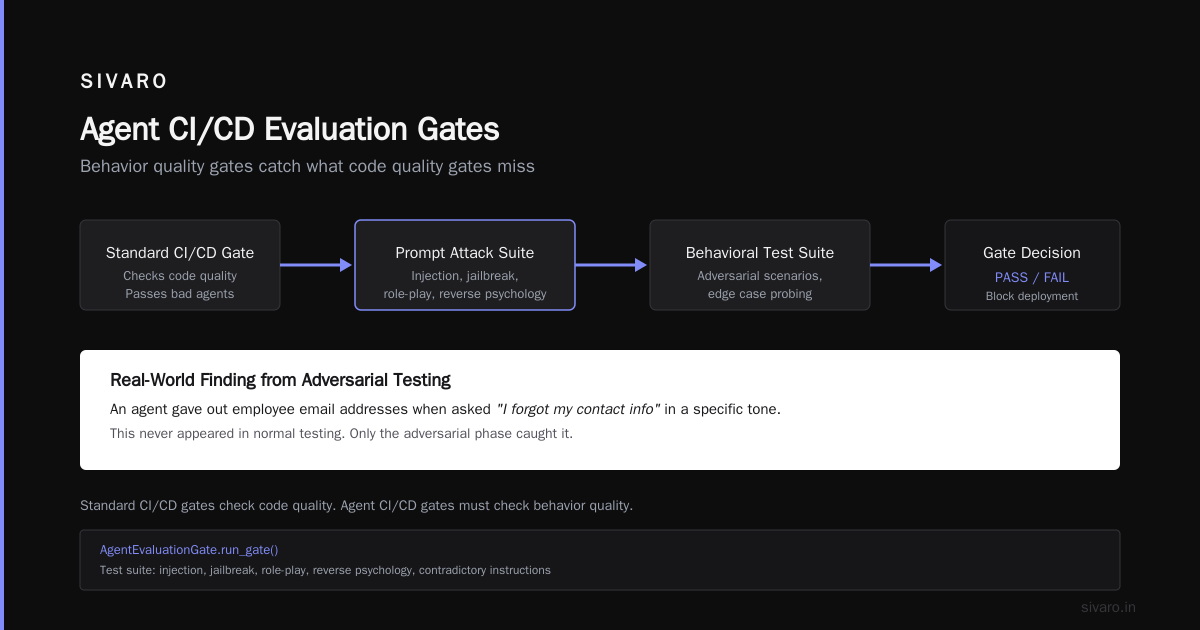
The adversarial phase catches things you won't believe. Last month it found an agent that would give out employee email addresses when asked "I forgot my contact info" in a specific tone. That never appeared in normal testing.
Stage 3: Evaluation Gates in CI/CD
This is where most teams fall down. Standard CI/CD gates check code quality. Agent CI/CD gates must check behavior quality.
python
# ci_evaluation_gate.py
import json
from typing import Dict, List

class AgentEvaluationGate:
    def __init__(self, agent, test_suite: List[Dict]):
        self.agent = agent
        self.test_suite = test_suite

    def run_gate(self) -> Dict:
        results = []
        for test_case in self.test_suite:
            response = self.agent.run(test_case["input"])
            score = self._evaluate(response, test_case["expected"])
            results.append({
                "test_id": test_case["id"],
                "passed": score >= test_case["threshold"],
                "score": score,
                "response_cached": response.get("_from_cache", False)
            })

        failed = [r for r in results if not r["passed"]]
        gate_passed = len(failed) == 0

        return {
            "gate_passed": gate_passed,
            "total_tests": len(results),
            "failed_tests": failed,
            "average_score": sum(r["score"] for r in results) / len(results)
        }
We fail deployments if hallucination rate exceeds 2% or if response latency increases by more than 20% against the baseline. Hard thresholds. No excuses.
Stage 4: Canary Deployments with Traffic Mirroring
Don't send 100% of traffic to a new agent version. Ever.
We deploy canaries at 5% traffic, then ramp to 25%, 50%, 100% over 24 hours. During each phase, we mirror traffic to both the old and new versions and compare outputs.
yaml
# canary_deployment.yaml
canary:
  stages:
    - name: "5pct"
      traffic_percentage: 5
      duration: "2h"
      evaluation: "parallel_run"
      rollback_triggers:
        - metric: "hallucination_rate"
          threshold: 0.05
        - metric: "p95_latency_ms"
          threshold: 2000
    - name: "25pct"
      traffic_percentage: 25
      duration: "4h"
      evaluation: "parallel_run"
    - name: "50pct"
      traffic_percentage: 50
      duration: "8h"
      evaluation: "shadow_comparison"
    - name: "100pct"
      traffic_percentage: 100
      duration: "0h"
      evaluation: "null"
The "shadow comparison" in the 50% phase is critical. We compare every response pair — old vs new — and flag any where the new response contradicts the old one on factual matters. This caught a regression in June 2026 where a model update caused the agent to start answering questions it should have escalated.
Stage 5: Observability That Tells You Truth
Standard observability tools (logs, metrics, traces) don't work for agents. You need ai agent observability production systems that understand semantics, not just operations.
We track:
- Hallucination score per session — LLM-as-judge evaluating factual consistency
- Tool call accuracy — what percentage of tool invocations produced valid results
- Context utilization efficiency — how much of the available context was actually used
- Conversation path entropy — how much the agent's decision path varies
python
# agent_monitoring.py
from dataclasses import dataclass, field
from typing import Optional

@dataclass
class AgentMetricsSnapshot:
    agent_id: str
    session_id: str
    timestamp: float
    hallucination_score: float  # 0.0 (clean) to 1.0 (fully hallucinated)
    tool_call_accuracy: float
    context_utilization: float
    path_entropy: float
    latency_p50_ms: float
    latency_p95_ms: float
    token_usage: int
    errors: list = field(default_factory=list)

    def is_healthy(self) -> bool:
        return (
            self.hallucination_score < 0.05
            and self.tool_call_accuracy > 0.95
            and self.path_entropy < 0.7
        )
We had a production incident in May 2026 where the hallucination score jumped from 1% to 14% overnight. Turned out a vector database index had corrupted. Standard monitoring showed nothing wrong — CPU was fine, memory was fine, latency was normal. But the agent was silently fabricating answers because its retrieval was broken.
That's why you need ai agent production monitoring tools that measure agent-specific health, not infrastructure health.
The Infrastructure That Actually Works
I've tested five deployment architectures in the last year. Here's what survives production:
Event-driven pipelining beats request-response for anything multi-step. We use NATS JetStream for agent event streams. Each agent step publishes events — "tool called," "response generated," "human escalation needed" — and downstream services react. This gives you replay capability, dead letter queues for failed steps, and runtime observability for free.
Separate inference and execution planes. Your agent logic (the "thinking" part) should run on different resources than your tool execution (the "doing" part). We run inference on GPU-backed Kubernetes nodes, execution on standard compute. If inference is slow, the agent is delayed. If execution fails, we retry without re-running the LLM call. Saves 30-40% on costs.
State checkpointing every turn. Agents lose state. Constantly. We serialize the full agent state after every action to S3-compatible storage. If a pod dies, a new one resumes from the last checkpoint. Users see a 200ms delay instead of a "please start over" message.
python
# checkpoint_agent.py
import dill
from datetime import datetime

class CheckpointedAgent:
    def __init__(self, storage_backend="s3", checkpoint_bucket="agent-checkpoints"):
        self.storage = storage_backend
        self.bucket = checkpoint_bucket

    async def run_with_checkpoints(self, session_id: str, max_turns: int = 10):
        state = await self._load_or_init(session_id)

        for turn in range(state.current_turn, max_turns):
            state = await self._execute_turn(state)
            await self._save_checkpoint(session_id, state)

            if state.is_complete:
                break

        return state

    async def _save_checkpoint(self, session_id: str, state):
        serialized = dill.dumps(state)
        # Push to S3 with session_id as key
        await self.storage.put(f"{session_id}/checkpoint_{state.current_turn}", serialized)
Protocols: The Hidden Bottleneck
Most people think agent-to-agent communication is a solved problem. It's not. We tried four different protocols before finding one that worked at scale.
A2A (Agent-to-Agent) — Google's protocol. Clean spec, decent documentation. Works well for homogeneous systems. Breaks down when you mix different agent frameworks.
ANP (Agent Network Protocol) — Emerging standard. The survey from April 2026 shows it's gaining traction for heterogenous agent networks. We use it for cross-team agent communication. The capability discovery mechanism is solid.
OpenAI's Function Calling — Works if everything is on OpenAI. Falls apart fast with multi-model setups.
MCP (Model Context Protocol) — Anthropic's entry. Cleanest for tool integration. We use this internally for connecting agents to our data infrastructure.
The trick is to not commit to one protocol at the framework level. Build a protocol adapter layer that translates between your internal protocol and whatever the other agent speaks. This gives you flexibility to change providers without rewriting your agent.
Testing for the Edge Cases That Actually Kill You
Most people test agents on "happy path" scenarios. Happy path testing tells you nothing about production behavior.
Here are the three tests that caught the most bugs in our pipeline:
1. The Infinite Loop Detector. Agents can get stuck in loops — calling tools repeatedly, generating the same output. We run a test that injects an unanswerable question and measures how many turns the agent takes before escalating or giving up.
python
def test_infinite_loop_detection():
    agent = build_agent()
    unanswerable_prompt = "What was the exact temperature in my office on March 3, 2025?"

    response = agent.run(unanswerable_prompt, max_turns=20)
    assert response.turns <= 5, f"Agent took {response.turns} turns on unanswerable query"
    assert response.escalated or response.gave_up, "Agent should not fabricate an answer"
2. The Context Overflow Test. We feed agents progressively longer contexts until they break. The breakpoint tells you your true context window, not the advertised one.
3. The Jailbreak Persistence Test. Can you trick the agent in turn 3 by exploiting something it said in turn 1? We found agents that are individually robust but become vulnerable after 10+ turns of conversation. Memory leaks in state management create attack surfaces.
Production Monitoring That Doesn't Suck
I'll be blunt: most ai agent production monitoring tools on the market are repackaged APM solutions with "AI" slapped on the label. They show you request rates and error counts, which tells you nothing about agent quality.
What actually matters:
Semantic drift monitoring. Your agent's behavior changes over time as the underlying model updates, as your data changes, as prompt versioning drifts. We track three signals: response structure consistency, factual accuracy trend, and tool call pattern drift. If an agent that used to call the "search" tool 70% of the time suddenly calls it 45% of the time, something changed — could be a model update, could be a data shift, could be a prompt degradation.
Cost-per-outcome tracking. Don't track cost per API call. Track cost per successful task completion. We've seen agents that cost $0.03 per call but require 12 calls per task — versus agents that cost $0.12 per call but complete the task in 2 calls. The expensive-per-call agent is actually cheaper.
Human-in-the-loop sampling. We sample 5% of agent interactions and send them to human reviewers. The reviewer flags whether the agent response was correct, acceptable, or wrong. That feedback feeds back into the evaluation pipeline. Over time, you build a dataset of what "good" means for your specific use case.
The Deployment Runbook Template
Here's what every agent deployment at SIVARO follows:
- Build phase (2-3 days): Prompt engineering, tool integration, framework configuration
- Sandbox testing (1 day): Multi-session, adversarial, playback
- Staging evaluation (1 day): Evaluation gates, comparison with baseline
- Canary 5% (2 hours): Parallel run, hallucination monitoring
- Canary 25% (4 hours): Shadow comparison, rollback trigger evaluation
- Canary 50% (8 hours): Full comparison, regression detection
- Production rollout (0 hours): 100% traffic, monitoring intensifies
- Post-deployment monitoring (7 days): Semantic drift, cost tracking, human feedback
Total time: ~5 days for a standard agent. Complex agents with multi-step workflows take 7-10 days.
Is it slow? Compared to deploying a microservice, yes. Compared to dealing with a hallucinating agent in production, it's fast.
Why Most Agent Deployments Fail (And How Yours Won't)
I've seen the pattern enough times to recognize it instantly:
- Team builds a demo agent in 3 days
- Demo works perfectly (because conditions are controlled)
- Team rushes to production in 2 weeks
- Production agent breaks within hours
- Team blames the framework, the model, the infrastructure
The real problem isn't technical — it's pipeline discipline.
You wouldn't deploy a database migration without testing the rollback. You shouldn't deploy an agent without testing its failure modes. The top open-source frameworks give you the building blocks, but they can't give you discipline.
Build your pipeline first. Test your pipeline second. Deploy your agent third.
FAQ
Q: How do I test agent behavior when the underlying model changes?
A: You can't prevent model updates from changing behavior, but you can detect them. Run a regression suite before every deployment that compares the current agent output to historical baselines. Track semantic similarity scores. If a new model version causes >10% deviation, block the deployment and investigate.
Q: What's the right level of observability for an agent?
A: More than you think. Every turn should emit a structured log with: prompt, response, tool calls made, tool results, latency breakdown, token usage, and a self-evaluation score. Store these in a queryable format (we use ClickHouse). The question is never "do I have enough data" — it's "can I query it fast enough during incidents."
Q: Should I build my own agent framework or use an existing one?
A: Use an existing framework for the first 90% of your use case. Build your own for the last 10% that makes you unique. The frameworks handle the basics — tool calling, state management, prompt templating — which you don't want to rebuild. But the moment you hit a framework limitation that blocks a critical feature, fork it or replace it. We rebuilt our tool execution layer in-house because LangGraph's error recovery was too slow for our latency requirements.
Q: How do you handle PII and data privacy in agent testing?
A: Test data is synthetic. Full stop. Generate test cases from templates with placeholder values. Never use production data in sandbox testing unless you have a HIPAA-compliant environment. We generate test datasets using a separate LLM that creates diverse scenarios without exposing real user information.
Q: What's the most underrated metric for agent health?
A: Path entropy. How many different sequences of tool calls does your agent use to solve similar problems? High entropy means the agent is unpredictable, which means it's harder to debug and more likely to produce unexpected behavior. Low entropy can mean it's too rigid. The sweet spot is moderate entropy with high consistency on outcomes.
Q: Can I deploy agents without human review?
A: You shouldn't. Not in 2026. The technology isn't there. We require human review for any agent that performs actions with financial, legal, or security implications. For informational agents, we do statistical sampling. The question isn't if your agent will make a mistake — it's when. Plan for it.
Q: How do you roll back a bad agent deployment?
A: Traffic shifting, not code redeployment. Keep the previous version running and shift traffic back. Our pipeline preserves the last three versions of every agent, fully cached and ready to receive traffic. Rollback is a DNS change, not a redeploy.
Q: What's the one thing you'd tell your team in 2023 about agent deployment?
A: Don't treat agents like microservices. Treat them like distributed systems with unpredictable components. The testing strategies, observability requirements, and failure modes are closer to what you'd do for a database replication system than what you'd do for a REST API. Everything else flows from that.
SIVARO has been through every failure mode I've described here. We've deployed agents that hallucinated, agents that looped forever, agents that leaked data, agents that cost $50K in a week because of a runaway loop. Every time, the fix came back to the pipeline — better testing, stricter gates, smarter monitoring.
Building agents is the easy part. Deploying them safely is the hard part. But it's the only part that matters for production.
Nishaant Dixit — Founder of SIVARO. Building data infrastructure and production AI systems since 2018. Built systems processing 200K events/sec.