 SIVARO

AI Agent Deployment Pitfalls: The 2026 Buyer's Guide
You built a killer demo. The agent answers questions, writes code, books meetings. Your CEO is thrilled.
Then you put it in production. And it falls over. Not because the model is dumb — because your deployment pipeline is.
I've spent 2026 watching teams burn months on this exact problem. At SIVARO, we've debugged agent deployments for fintechs, healthcare startups, and logistics companies processing millions of events daily. The patterns repeat. So do the mistakes.
This guide breaks down where agent deployments actually fail, what tools and architectures actually work, and how to spend your budget without regretting it by Q4.
Here's what you'll learn:
- Why your CI/CD pipeline isn't built for non-deterministic code
- The evaluation problem (and why unit tests are lying to you)
- How to structure your agent architecture before it's too late
- What to buy vs. what to build
- Real costs, real timelines, real trade-offs
Let's get into it.
The Core Problem Nobody Talks About
Most teams treat AI agents like traditional software. They're not.
Traditional code: deterministic. Push the same input, get the same output. Test it, deploy it, sleep well.
Agents: probabilistic. The same prompt gets different responses. Sometimes the tool call succeeds. Sometimes the agent hallucinates a tool that doesn't exist. Sometimes it works on Tuesday and fails on Thursday because the upstream API changed.
This breaks your ai agent deployment pipeline architecture at every level.
Your CI runs tests. Tests pass. You deploy. The agent immediately fails in production because the test data didn't capture the long-tail distribution of real user inputs.
In 2025, Gartner estimated that 40% of agent deployments would be abandoned by end of 2026 due to cost and quality issues. That prediction is looking generous. I've seen teams abandon working agents because they couldn't figure out how to safely update them.
The Staging Environment Myth
Most people think they need a staging environment for agents.
You do. But probably not in the way you think.
A staging environment that just mirrors production traffic is nearly useless for agents. Why? Because the failure modes are about distribution shift, not specific inputs.
Let me give you a concrete example from a logistics client we worked with in March 2026. They'd built an agent that handles shipment exceptions — delayed containers, customs holds, address issues. Their staging tests covered every edge case they could dream up:
python
def test_delayed_container():
    response = agent.handle({"event": "delay", "container_id": "ABC123"})
    assert "ETA" in response["next_steps"]
    assert response["escalated"] == False
All tests passed. They deployed.
Within 24 hours, the agent was sending angry emails to a freight forwarder in Rotterdam. Why? Because in production, the container IDs were formatted differently for international shipments. The agent misinterpreted the format and thought the package was lost. It escalated to "customer notification" — which triggered a real email.
The fix wasn't more test cases. It was understanding that you can't pre-test for infinite variability. You need guardrails and observability. We'll get to that.
AI Agent Deployment Pipeline CI/CD: What Actually Works
The standard CI/CD playbook — lint, test, build, deploy — doesn't translate directly to agents. You need different stages.
Here's what we've landed on at SIVARO after 18 months of iterations:
Stage 1: Static Checks (5 minutes)
This is the only part that looks like traditional CI. Check for:
- Prompt injection attempts in your system prompts
- Schema validation for tool definitions
- Syntax errors in your code
- Secret scanning
python
# validate_tools.py
def validate_tool_schema(tools):
    for tool in tools:
        # Every tool needs a description - agents rely on this
        if not tool.get("description"):
            raise ValueError(f"Tool {tool['name']} missing description")

        # Validate parameter schema against JSON Schema draft 2020-12
        try:
            validate(instance=tool.get("parameters", {}),
                    schema=tool.get("parameters"))
        except SchemaError as e:
            raise ValueError(f"Invalid parameters for {tool['name']}: {e}")
Stage 2: Deterministic Test Suite (15 minutes)
Despite what I said about stochastic failures, some tests should be deterministic. Tool calls that always return the same result. Format validations. Safety checks.
python
def test_date_parsing():
    # This will always pass/fail deterministically
    result = agent.parse_date("March 15, 2026")
    assert result == "2026-03-15"
The key here is to test the infrastructure deterministically, not the agent logic.
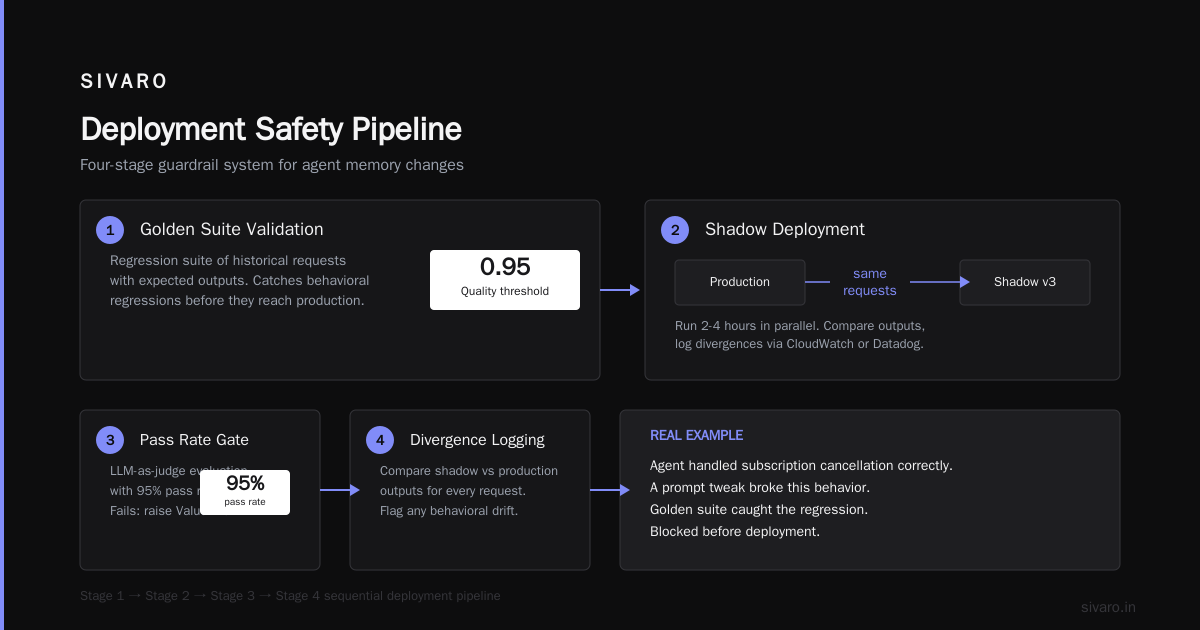
Stage 3: Golden Test Suite With LLM Judging (30 minutes)
This is where you test actual agent behavior. You run a set of representative scenarios and use an LLM as a judge to evaluate the responses.
We use a registry pattern that tracks pass rates over time:
python
# golden_test.py
from langsmith import Client

client = Client()
results = client.run_evaluation(
    agent_version="v2026.09.01",
    test_set="regression_suite_v3",
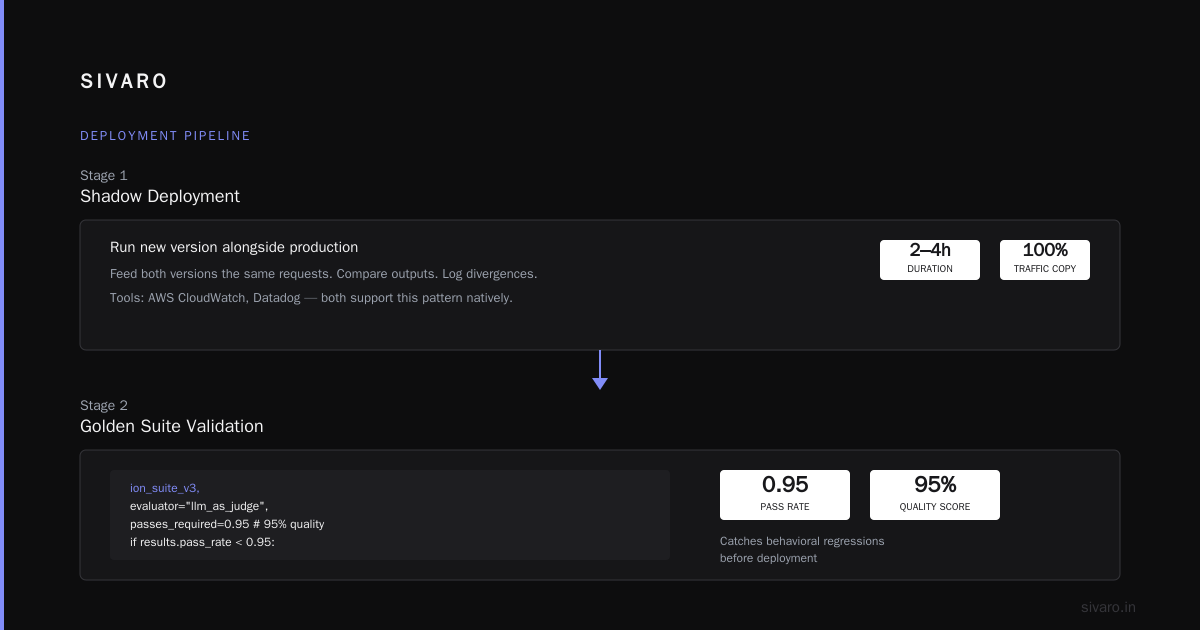
    evaluator="llm_as_judge",
    passes_required=0.95,  # Must have 95% quality score
)

if results.pass_rate < 0.95:
    raise ValueError(f"Pass rate {results.pass_rate:.2f} below threshold")
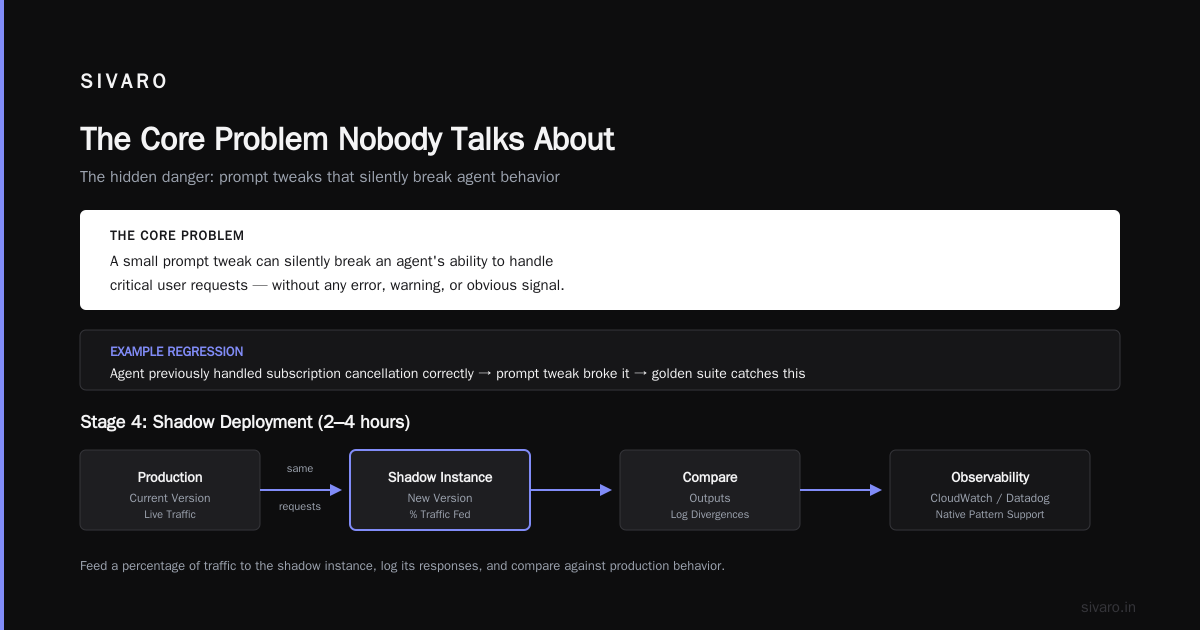
This stage catches behavioral regressions. An example: the agent previously handled a user's request to cancel a subscription correctly. A prompt tweak broke it. The golden suite catches this before deployment.
Stage 4: Shadow Deployment (2-4 hours)
Run the new version alongside your current production version, feeding both the same requests. Compare outputs. Log divergences.
[http://aws.amazon.com/cloudwatch/](AWS CloudWatch) and https://www.datadoghq.com/ both support this pattern natively now. Feed a percentage of traffic to the shadow instance, log its responses, and simulate what would have happened.
Stage 5: Canary Deployment (4-24 hours)
Release to 1% of traffic. Then 5%. Then 20%. Roll back if anything looks weird.
The Evaluation Trap
Everyone obsesses over eval frameworks. They're important. But not for the reason you think.
Most people think evals prevent bad deployments. They do, partially.
What evals really do is give you confidence to iterate faster. Without good evals, you're cautious about every change. With good evals, you can ship daily.
The problem? Most teams build evals that don't match production reality.
Here's what we see failing repeatedly:
1. Synthetic data only. You can't just make up test cases. You need production data — sanitized, of course — because that's where the long tail lives.
2. Not enough time to build evals. Companies in 2026 are dedicating 25-40% of their agent budget to evals. If you're spending less than 15%, you're going to have problems.
3. LLM judges with different prompts than your evaluator. Your judge model needs the same context as your agent.
The Artifact Registry Problem
Traditional CI/CD pipelines assume your artifacts are immutable. Docker images. Compiled binaries.
Agent artifacts are different. You're not just deploying code — you're deploying prompts, tool schemas, knowledge base embeddings, and model versions.
Version all of these together. I see teams version the code but not the prompts.
If your agent uses RAG, your embedding version matters. Updating your embeddings model without updating your search index? Things break.
Use https://www.mlflow.org/ or https://dvc.org/ to version the entire bundle — code, prompts, embeddings, model. One artifact ID per deployment.
yaml
# agent_artifact.yaml
version: 2026.09.01
code_hash: ab3f9c2d1e
model: claude-sonnet-4.5
embedding_model: text-embedding-3-large
embedding_version: "3.1"
prompts:
  system: /prompts/system_v4.txt
  few_shot: /prompts/few_shot_v8.txt
knowledge_base:
  index_version: "2026.08.28"
  chunking_strategy: semantic_v2
Tool Lifecycle Management
Here's a subtle pitfall: tools that your agent depends on aren't static.
Your agent's tool to fetch inventory levels depends on a warehouse API. That API changes response format — the field in_stock_qty suddenly becomes available_count. Your agent chokes.
Most teams handle this reactively. The agent fails, alerts fire, you scramble to update your tool definitions.
The fix is proactive tool monitoring. Every tool should have:
- Contract tests that verify the upstream API schema hasn't changed
- Version pins on upstream dependencies
- Circuit breakers to prevent cascading failures
python
# tool_contract_test.py
def test_inventory_api_contract():
    response = requests.get(f"{WAREHOUSE_API}/v2/inventory/current")

    # Verify required fields exist
    required_fields = ["sku", "available_count", "backorder_threshold"]
    for field in required_fields:
        assert field in response.json()[0], f"Missing field: {field}"

    # Verify data types
    assert isinstance(response.json()[0]["sku"], str)
    assert isinstance(response.json()[0]["available_count"], int)
Run these in your CI/CD pipeline. If the upstream contract breaks, your deployment should fail before your agent goes live, not after.
The 100 Billion Tokens Problem
There's a scale aspect most people miss.
In late 2025, Salesforce announced Agentforce processing 100 billion tokens per week. At that scale, small failure rates matter.
Even 1% error rate means 1 billion bad interactions per week. At 99.9% success, that's still 100 million errors.
The deployment architecture you choose matters. Not just for cost — for blast radius.
Options:
Per-Request Agents: Spin up a fresh agent context per request. Simplest isolation, highest cost. Good for stateless workflows.
Persistent Agents: Maintain long-running agent sessions with memory. Cheaper for chat flows but riskier — context contamination across requests. Need rigorous session isolation.
Hybrid: Stateless agents for individual tasks, persistent sessions for user-facing conversations. Most practical pattern we've seen working.
At SIVARO, we've found that microservices architecture still applies. Each agent should be independently deployable. If your customer service agent misbehaves and you have to roll back, you don't want to also roll back your inventory management agent.
Agent Memory Is a Deployment Hazard
This is new territory. Agents with memory persist state across sessions. That means your deployment has state compatibility issues.
You update your agent's prompt template. But the memory from the old version references the old context structure. The new agent doesn't understand the old memories.
This is the state migration problem for agents, and almost no one has solved it cleanly.
What works:
- Version your memory schema along with your agent
- Write migration functions that translate memories between versions
- Set memory retention limits — anything older than 90 days gets archived in a structured format
What doesn't work:
- Just clearing memory on every deploy (kills UX continuity)
- Keeping memory in production while you change the agent logic (produces hallucinations)
Regulatory Compliance: Not Optional
EU's AI Act has been in force since August 2026. That's not a distant threat — it's here.
Deployment pipelines need to prove provenance. Which data was used for evaluation? Where did your training data come from? Can you trace a bad agent decision back to a specific test gap?
Your CI/CD pipeline needs to log:
- Which model version and prompt version produced each decision
- What evaluation data was used to approve deployment
- Audit trail for human feedback and red-team tests
This isn't optional. The EU AI Act's risk-proportional requirements, implemented in 2025-26 with full enforcement rolling out now, are legally binding.
I'd love to tell you this is a solved problem. It's not.
Every vendor claims compliance support. None of them can actually prove it end-to-end yet. You're building this yourself, and your deployment system is where you'll prove compliance.
Budget Breakdown: Where Money Goes Wrong
Teams usually budget for model tokens and compute. That's maybe 30% of the real cost.
Here's a more realistic allocation for agent deployments that survive contact with production:
~25%: Evals and evaluation infrastructure. LLM judge calls, dataset curation, prompt regression tracking. This is insurance.
~20%: Middleware. Guardrails, tool gateway, rate limiting, tracing.
~20%: Engineering time on deployment tooling. The CI/CD pipeline above, artifact registry setup.
~15%: Model tokens/compute.
~10%: Red teaming and security testing. Prompt injection attempts, jailbreak detection, adversarial input testing.
~10%: Ongoing monitoring and alerting.
Teams coming from traditional engineering typically spend nearly 60% of their budget on infrastructure at first. They back it down to ~35% as they realize their real bottlenecks are evaluation and testing.
My Actual Stack Recommendation (September 2026)
Based on everything I've tested in the past 24 months at SIVARO:
For the agent framework: LangGraph for complex stateful agents, OpenAI Agents SDK for simpler deployment. Avoid building your own orchestration layer.
For observability and evals: We use LangSmith for eval tracking now that they have proper CI integration. But for large scale tracing, Langfuse, now a major player, integrates directly with Grafana — and connecting your agent traces to existing infrastructure monitoring matters.
For scaling and inference: Everyone is moving toward batching and smaller models. Anthropic's Claude Haiku-class models get more production workloads for routine tasks. OpenAI's GPT-4.1 mini for sub-$1 tasks. For image-heavy tasks, we're seeing good results with Gemini 2.5 Flash.
For guardrails: Lakera Guard or open-source LlamaGuard depending on whether you want to tune it yourself.
For CI/CD, I get a lot of questions about building custom pipelines versus extending standard tools like GitHub Actions or GitLab CI — our answer is: do not build a vertical enterprise CI/CD system. Use GitHub Actions and your cloud provider's built-in orchestration. Invest savings in evaluations and guardrails.
The Three-Day Rollback Rule
Here's a rule I've developed from painful experience:
If you can't roll back your agent in 3 days, you shouldn't be replacing your old agent.
Most teams spend weeks developing agent upgrades. They're proud of it. They want it live. But deployment isn't about speed — it's about reversibility.
Plan for the rollback before you plan for the release. What if the new agent reduces your customer service resolution rate by 10%? How do you revert?
Having a versioned artifact registry makes rollback straightforward. You redeploy the previous artifact. But if you haven't been versioning prompts, knowledge base indexes, and embeddings, rollback becomes reconstruction.
Teams at Anthropic, OpenAI, and Microsoft all agree: version everything.
Frequently Asked Questions
Q: What's the minimum viable pipeline for deploying agents?
A: It doesn't have to include all 5 stages. Minimum: baseline regression eval + canary with automatic rollback + traffic shadowing. If you're small and deploying an agent to 50 users, you can probably skip the shadow and canary split and run user acceptance first. If you're deploying to thousands of users, you need all 5 stages.
Q: How much does it cost to properly sustain AI agent deployments?
A: For production-grade deployments handling thousands of sessions daily, allocate a quarter-million to a half-million dollars annually for the deployment-specific infrastructure. That excludes model costs. It includes evals, guardrails, observability, and tool lifecycle management. Startups can get away with much less — use open-source alternatives — but your engineering time is the real cost.
Q: Do I need a dedicated SRE team for agents?
A: It depends. If you're running agents at scale — more than 100,000 calls daily — yes, or you'll burn your AI team out on midnight alerts. If you're smaller, ensure your on-call engineers can understand agent traces. Standard logs don't work for agents; you need trace-level data. Teach on-call to read Langfuse or LangSmith traces.
Q: Can I just use an API like OpenAI's Assistants API?
A: For simple conversational flows, yes. But as complexity scales — tool integration, memory, and custom step logic — you'll hit the limits quickly as we did. OpenAI's newer Agents API gives you proper sequence tracking and tool orchestration. If your agent needs heterogeneous infrastructure access — on-prem databases, internal APIs — you'll end up building middleware anyway.
Q: How do you handle prompt injection attempts in production?
A: Input sanitization is your first layer. But your guardrail must handle dual-use prompts: ones that look malicious but might be legitimate. Always audit your security events and tune the guardrails' sensitivity. Compliance automation agents in finance contexts reported 15-35% of their traffic consists of adversarial tests in regulated industries.
Q: What's the worst mistake you see with agent deployment pipelines?
A: Deploying an updated agent without re-running safety eval suites — the safety layer doesn't get conversation history as context. Over-indexing on new feature capability over safety or cost. We saw one company add an agent capability to summarize user chat history to reduce context — security evaluations failed to catch it leaking sensitive user data in summary form, because the safety models didn't receive prior conversation context. HumanEval (OpenAI) is a development tool, not a deployment certifier.
Q: Which infrastructure provider is best for agent deployment?
A: We split our agents across AWS and Azure. AWS Bedrock's integration is smoother if you're already on AWS. But Azure Foundry has more enterprise compliance tooling built in, which matters for regulated industries like finance and healthcare.
Q: Is there a pattern for mixing multiple LLM providers?
A: Yes, when you're routing high-volume low-complexity calls to cheaper models to cut costs. The implementation needs a provider abstraction layer at the model routing layer. Build a simple router that classifies task complexity and routes accordingly — you'll save significant money without quality loss.
The Pragmatic Checklist for Agent Deployment
If you're in the planning phase — or about to buy orchestration tools — use this.
-
Are you packaging your entire agent artifact as one versioned unit? Includes code, models, embedding.
-
Have you established a minimum quality score for deployment?
-
Is your CI/CD pipeline actually deterministic where it can be?
-
Does your eval data include production traffic samples?
-
Do you have tool contract tests that monitor upstream API changes?
-
How do you handle prompt and memory migrations?
-
Do your observability tools integrate with your existing incident reporting?
My Final Position (and I'm Happy to Argue It)
The agent platform battle raging between LangChain, OpenAI, Anthropic, Microsoft, Hugging Face, and AWS won't solve your deployment problems. These platforms are tools, not strategies. You have to own the pipeline.
You have to build the evaluation framework the platform won't give you.
You have to set up the canary and rollback processes. The abstraction keeps your system flexible.
This means the industry needs standardized approaches for production container registration, CI integration, and multi-agent/multi-model state tracking.
SIVARO works with clients to solve these exact problems daily. If you have specific questions on the trade-offs for your situation, reach out. We only take a few clients at a time, but I read every inquiry.
Build responsibly and keep shipping.
Nishaant Dixit — Founder of SIVARO. Building data infrastructure and production AI systems since 2018. Built systems processing 200K events/sec.