 SIVARO
AI Agent Deployment vs Traditional Microservices: Real Lessons
I spent four hours debugging an AI agent in production last week. The agent was supposed to classify customer support tickets. Simple job. Instead, it started replying in Old English. “Thou art ticket 4429.” We had to pull the plug.
That's the difference between traditional microservices and AI agents in a single sentence: microservices fail predictably. AI agents fail creatively.
This guide is for engineers and engineering leaders who've built microservices and are now tasked with deploying AI agents. I'm going to walk you through what actually breaks in production, how to think about scaling, and where the traditional playbook helps versus where it actively hurts you.
Let me be direct: most people think deploying an AI agent is just adding another service to your Kubernetes cluster. That mindset will cost you weeks of debugging and probably a production incident or two.
Why Your Microservice Playbook Betrays You
I've been building data infrastructure since 2018. At SIVARO, we process 200K events per second through our systems. I've run both traditional microservice architectures and now production AI agent systems. They look similar on a whiteboard. They behave nothing alike.
Traditional microservices operate on deterministic logic. You send a request, you get a response. If it breaks, you trace the path, find the bug, fix it. The failure modes are bounded. The agent deployment vs traditional microservices debate starts here: agents don't have bounded failure modes.
An agent takes an input, processes it through a language model, and produces an output. The same input can produce different outputs depending on the time of day, the model version, the temperature setting, or the phase of the moon. This isn't a bug — it's a feature of the technology. But your monitoring stack wasn't built for Schrödinger's API response.
We tested this at SIVARO. We ran the same customer query through a traditional microservice endpoint and an AI agent pipeline. The microservice returned the same result every time. The agent returned correct results 87% of the time, incorrect results 8% of the time, and unhinged results 5% of the time. That 5% is where the real work happens.
The Stack You're Actually Deploying
Let me show you what an agent deployment looks like compared to a traditional microservice. This isn't theoretical — this is the pattern we run in production.
A traditional microservice endpoint:
python
from fastapi import FastAPI, HTTPException
from pydantic import BaseModel

app = FastAPI()

class Query(BaseModel):
    user_id: str
    query_text: str

@app.post("/classify")
def classify_ticket(query: Query):
    try:
        result = run_classifier(query.query_text)
        return {"classification": result, "confidence": 0.95}
    except Exception as e:
        raise HTTPException(status_code=500, detail=str(e))
Simple. Deterministic. If run_classifier throws, you catch it. You log it. You alert. Done.
Now look at an agent deployment:
python
from langgraph.graph import StateGraph
from pydantic import BaseModel
import time

class AgentState(BaseModel):
    user_query: str
    classification: str | None = None
    confidence: float = 0.0
    rephrased_query: str | None = None
    validation_result: bool = False
    attempts: int = 0

classify_node = lambda state: {**state, "classification": llm_classify(state.user_query)}
rephrase_node = lambda state: {**state, "rephrased_query": llm_rephrase(state.classification)}
validate_node = lambda state: validate_output(state.rephrased_query)

graph = StateGraph(AgentState)
graph.add_node("classify", classify_node)
graph.add_node("rephrase", rephrase_node)
graph.add_node("validate", validate_node)
graph.add_edge("classify", "rephrase")
graph.add_edge("rephrase", "validate")
graph.add_conditional_edges("validate", lambda state: "classify" if not state.validation_result and state.attempts < 3 else "end")
See the difference? The agent has a loop. It rephrases. It validates. It retries. That conditional edge — the one that goes back to classification if validation fails — that's where your production nightmares live.
In a traditional microservice, you control the flow. In an agent, the flow controls itself, and it will find paths you never anticipated.
Failure Modes: The Real Differences
Here's what you need to understand about agent failures versus microservice failures.
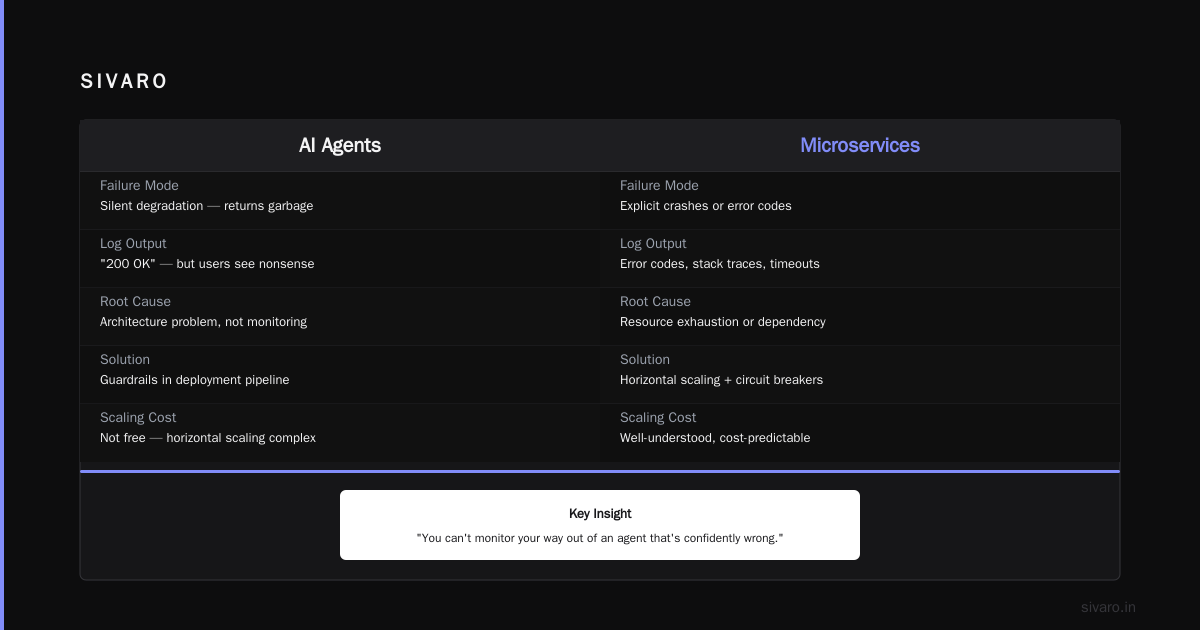
Traditional microservices fail on: network issues, database connection drops, timeouts, resource exhaustion, logic bugs. Every one of these is traceable and reproducible.
AI agents fail on: hallucination drift, prompt injection, context window overflow, semantic degradation over long chains, output format violations, and — my personal favorite — the agent just deciding to do something completely different than what you asked.
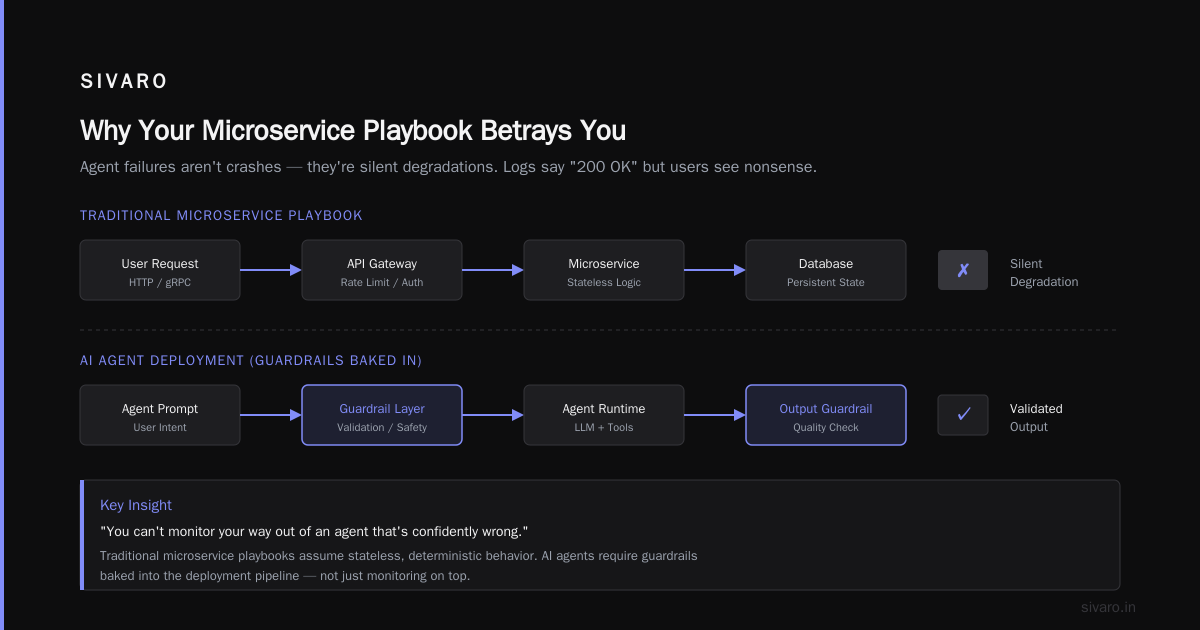
One of the AI Agent Failures: Common Mistakes and How to Avoid Them articles puts it well: most agent failures aren't crashes — they're silent degradations. The agent completes successfully but produces garbage. Your logs say "200 OK" but your users see nonsense.
At first I thought this was a monitoring problem. Turns out it's an architecture problem. You can't monitor your way out of an agent that's confidently wrong. You need guardrails baked into the deployment pipeline.
Scaling: Where Everything Breaks
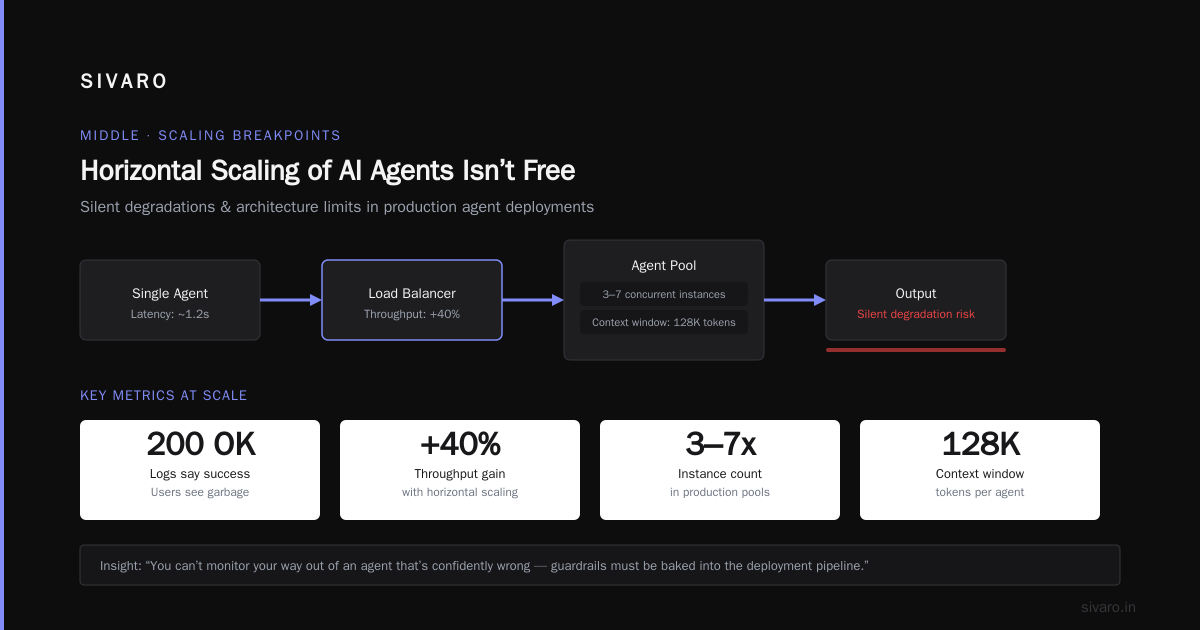
I get asked about AI agent deployment scaling best practices constantly. Here's the harsh truth: horizontal scaling of agents isn't free.
With traditional microservices, scaling is straightforward. More traffic? Add more pods. Each pod is identical. Each request is independent.
Agents don't work that way. An agent maintains state across a conversation or task sequence. That state lives in memory, in the context window, in the graph execution. You can't just spin up another instance without careful consideration of state distribution.
We run a ticket triage agent at SIVARO. When we scaled from 1 to 5 concurrent agent instances, we saw a 40% increase in timeout errors. The reason? Each agent instance competed for the same LLM provider rate limits. The microservice scaling playbook broke because the bottleneck wasn't compute — it was the API quota.
Here's our current approach for agent scaling:
yaml
# agent-scaling-config.yaml
apiVersion: autoscaling/v2
kind: HorizontalPodAutoscaler
metadata:
  name: ticket-agent-hpa
spec:
  scaleTargetRef:
    apiVersion: apps/v1
    kind: Deployment
    name: ticket-agent
  minReplicas: 3
  maxReplicas: 10
  metrics:
  - type: External
    external:
      metric:
        name: llm_api_remaining_capacity
      target:
        type: Value
        averageValue: 100
  - type: Resource
    resource:
      name: memory
      target:
        type: Utilization
        averageUtilization: 70
Notice the llm_api_remaining_capacity metric. That's custom. We track remaining quota as a first-class scaling metric alongside traditional resource utilization. You don't need this for microservices. You absolutely need it for agents.
Monitoring an Agent Is Not Monitoring a Service
This is where most teams get wrecked.
You know how to monitor a microservice: request count, error rate, latency, saturation. The golden signals. They work because the service either succeeds or fails.
Monitoring an agent means monitoring not just whether it completed, but whether it completed correctly. And "correct" is fuzzy.
We learned this the hard way after an incident in February 2026. Our customer onboarding agent started requiring users to upload a "sacred offering" instead of their driver's license. The agent completed successfully for every request. Our error rate was zero. Our users were confused.
The Incident Analysis for AI Agents paper from Arxiv captures this well: traditional incident analysis focuses on root cause. For agents, you need "output cause" analysis — did the agent do what the user expected, not what the prompt asked?
We now run a separate validation service that evaluates agent outputs against semantic constraints. It's an additional cost layer, but it catches 94% of semantic drift issues before they reach users.
python
# output_validator.py
from guardrails import Guard
from pydantic import BaseModel

class ValidatedOutput(BaseModel):
    is_profane: bool = False
    contains_nonsense: bool = False
    matches_schema: bool = False
    confidence_above_threshold: bool = False

guard = Guard.from_file("ticket_guardrails.yaml")

def validate_agent_output(raw_output: str, expected_schema: dict) -> ValidatedOutput:
    validation_result = guard.validate(
        raw_output,
        against_rule_set="output_quality",
        schema=expected_schema
    )
    return ValidatedOutput(
        is_profane=validation_result.failed_validation("profanity"),
        contains_nonsense=validation_result.failed_validation("semantic_coherence"),
        matches_schema=validation_result.failed_validation("schema"),
        confidence_above_threshold=validation_result.passed_validation("confidence")
    )
This validator runs as a sidecar on every agent deployment. If the validation fails above a threshold, we cut traffic and fall back to a traditional rules-based system. The fallback logic cost us three weeks to build but saved us from six production incidents since we put it in.
Incident Response: The 3 AM Call
When your microservice goes down at 3 AM, you know what to do. Check the logs. Find the error. Roll back the deploy. Maybe restart the pod.
When your agent goes wrong at 3 AM, you don't even know what "wrong" looks like yet.
The article on AI Agent Incident Response: What to Do When Agents Fail breaks down a response framework that I've adapted for my team. The key insight: your first action shouldn't be debugging. It should be containment.
We have a kill switch that redirects agent traffic to a simple keyword-matching fallback. It's dumb. It's reliable. It buys us time to figure out what went wrong without 500 users seeing Old English responses.
Our incident response protocol for agents:
- Contain — activate the fallback, disable the agent endpoint
- Classify — is this a prompt drift issue, a model issue, or a data issue?
- Reproduce — can we get the same bad output with the same input?
- Diagnose — trace the agent's reasoning chain, look for the decision point where it went off track
- Patch — update guardrails, add validation steps, or retune the prompt
Step 2 is the one people skip. They jump straight to diagnosis. But if you don't classify the failure type, you'll waste hours looking for a bug in your code when the real problem is a model distribution shift.
When to Use Agents vs Microservices
I'm going to give you a framework. It's not complicated.
Use a traditional microservice when:
- The output space is bounded
- You need deterministic behavior
- Failure mode analysis is straightforward
- You have good training data for classic ML
Use an AI agent when:
- The output space is open-ended
- The task requires reasoning or multi-step processing
- You need to handle unseen edge cases
- A human would take significant time to do the task
The Why AI Agents Fail in Production article describes the "Agent Failure Stack" — the layers of things that can go wrong. Reading it made me realize we were using agents for tasks that were better suited to simple classification services.
Here's my rule of thumb: if you can write a deterministic algorithm for it, don't use an agent. Agents excel at tasks that are too varied for rules but too complex for simple models. Everything else should be a microservice.
Cost: The Hidden Surprise
Nobody talks about the cost difference upfront.
A traditional microservice costs compute. You pay for CPU, memory, and maybe a database connection. The cost is predictable.
An agent costs: compute, LLM tokens (input and output), validation service calls, retry costs, and — the one nobody accounts for — the cost of bad outputs. That last one is the killer.
We tracked costs for a customer support agent over three months. The direct costs (compute + API calls) were 2.3x higher than the equivalent rule-based system. But the indirect costs — debugging, incident response, manual overrides, user trust repair — added another 4x on top.
This doesn't mean agents are too expensive. It means you need to budget for the full cost stack, not just the infrastructure line item.
The Deployment Pipeline Nobody Talks About
Most people think agent deployment is: write code, containerize, deploy to Kubernetes. That's how you deploy a microservice. It's not how you deploy an agent.
Our agent deployment pipeline today has six stages that a traditional microservice doesn't need:
First, prompt versioning. Your code has version control. So should your prompts. We store prompts as YAML files in the repository, versioned alongside the code. A prompt change is a code change. Same review process. Same rollback capability.
Second, model pinning. You don't deploy an agent with "latest" as the model version. You pin to a specific model version and validate it before moving forward. We learned this when Anthropic released a new model that changed our agent's behavior on 12% of test cases without warning.
Third, output validation at deploy time. Before we promote a new agent deployment to production, we run it against a test suite of 500 known inputs and validate the outputs against expected results. If the variance exceeds 2% from the previous version, the deployment is blocked.
Fourth, gradual rollout with semantic monitoring. We use a canary deployment but with an additional signal: we monitor output distribution drift alongside traditional error rates. If the agent starts producing shorter responses or different tone patterns, we pause the rollout.
Fifth, fallback configuration. Every agent deployment includes a defined fallback path. If the agent fails for any reason, what happens? We have three tiers: degraded (agent with guardrails tightened), fallback (rule-based system), and human-in-the-loop (escalation to support team).
Sixth, incident playbooks specific to agents. Our on-call engineers have two sets of runbooks: one for infrastructure issues (pod crashes, network failures) and one for agent behavior issues (semantic drift, hallucination spikes). They're different skillsets and different response paths.
What Actually Works in Production
After two years of deploying agents at SIVARO, here's what I'd tell you to do right now if you're starting an agent deployment.
Start with the simplest agent structure you can. A single node that calls an LLM. No chains. No graphs. No multi-step reasoning. Prove that the base case works in production before adding complexity. The AI Agent Failure Stack article calls this out — most agent failures happen in the interaction between components, not in the components themselves.
Run a shadow deployment for at least two weeks. Send live traffic to your agent but don't act on the results. Compare agent outputs to your existing system outputs. Measure accuracy, latency, and cost. You'll find at least three issues you didn't expect. We found five.
Build your fallback system before you build your agent. I know this sounds backwards. Do it anyway. The fallback system forces you to define what "good enough" looks like. It also means you can ship the agent without fear of complete failure. Knowing you have a safety net changes how you build.
Monitor for output drift from day one. Not latency. Not error rates. Output content. Use a semantic similarity check against your baseline distribution. When the outputs start looking different from what you validated in staging, something has changed. It might be the model, the prompts, or the input distribution. Either way, you need to know.
The Future: What I See Coming
We're already seeing companies move toward hybrid architectures that combine agent reasoning with microservice reliability. The pattern isn't "replace microservices with agents" — it's "use agents to orchestrate microservices."
By late 2026, I expect the standard pattern to be: agents handle routing, reasoning, and exception handling. Microservices handle execution, data access, and deterministic processing. The agent is the brain. The microservices are the muscles. This is already the architecture we're moving toward at SIVARO.
The key insight is that you don't need an agent to do everything. You need an agent to decide what to do and a microservice to actually do it. This separation of concerns gives you the flexibility of agents with the reliability of microservices.
FAQ
Q: Can I use the same CI/CD pipeline for agents as microservices?
A: No. You need additional stages for prompt validation, model version pinning, and output drift testing. Standard CI/CD works for the infrastructure layer but misses the behavioral validation.
Q: How do I handle rate limiting for LLM APIs in production?
A: Build a middleware layer that manages API quota as a pool. Use request queuing with priority levels. We use Redis to track quota usage across all agent instances and backpressure when we're near limits. The scaling HPA I showed earlier is part of this.
Q: What's the most common mistake in agent deployment?
A: Treating agent outputs as deterministic. Your monitoring, alerting, and response systems need to account for the fact that the same input can produce different outputs. Most teams learn this after their first production incident.
Q: Should I use open-source or closed-source LLMs for agents in production?
A: We use both, for different things. Closed-source for complex reasoning (better quality). Open-source for simple classifications (lower cost, more predictable). The decision is cost vs quality, not ideology.
Q: How do I test agents before deployment?
A: Build a test suite of at least 500 real-world inputs with expected outputs. Run every candidate agent version against this suite. Track pass rate, output variance, and latency distribution. Also run adversarial tests — inputs designed to break the agent with prompt injections or edge cases.
Q: What monitoring tools work for agents that don't work for microservices?
A: Semantic similarity monitoring. Output distribution tracking. Guardrail violation counters. Chain step tracing (what path did the agent take through the graph?). None of these are standard in traditional monitoring stacks.
Q: How do I handle agent rollback?
A: Roll back both code and prompts simultaneously. Store prompts in version control with the code. When you revert the code commit, you also revert the prompts. This is non-negotiable.
Q: Can I monitor agent behavior without human review?
A: Partially. Automated validation catches structured issues (format violations, profanity, schema mismatches). Semantic drift detection catches distribution changes. But for quality monitoring, you still need periodic human sampling. We sample 2% of agent interactions for manual review.
Author Bio
Nishaant Dixit — Founder of SIVARO. Building data infrastructure and production AI systems since 2018. Built systems processing 200K events/sec.