 SIVARO
AI Agent Deployment Without Regret
You built an agent that nails your internal benchmark. Demos are smooth. Then you put it in production, and within a week, you're paging someone at 2 AM because the agent emailed a customer the wrong refund amount using a confidently fabricated policy.
This is normal. And it's avoidable.
I'm Nishaant Dixit, founder of SIVARO. My team has deployed production AI systems since 2018. We've watched the agent hype cycle of 2025 turn into the agent reckoning of 2026. A friend at a Series C fintech told me last month: "We spent a quarter building agents. We spent another quarter just figuring out why they broke." That's the gap this guide covers.
ai agent deployment without regret isn't about being perfect. It's about building the feedback loops, guardrails, and observability so that when your agent is wrong — and it will be — you find out fast, fix it fast, and lose the least trust possible.
Here's what you'll learn: why production agents fail, what should be in your deployment checklist before the first rollout, and how to treat agents as infrastructure instead of magic.
The 95% Reality Check
Let's start with the ugly number. Why 95% of AI Agents in Production Are Breaking reports that an overwhelming majority of agent deployments are failing. You can argue with the exact figure — but you can't argue with the pattern I see daily.
Most people think the failure is the model. Wrong. The model isn't the problem. It's the scaffolding around it.
The top causes we've observed in production client work:
- No defined success metric. The agent does something, but nobody decided what "good" looks like.
- Context rot. Agents carry too much context, forget what matters, or let old state poison new decisions.
- Silent tool failures. The agent calls an API that returns an error, then it hallucinates a recoverable fallback instead of escalating.
- No human-in-the-loop for high-stakes actions. The agent is autonomous by default when it should be consultative first.
At SIVARO, we learned this the hard way. In late 2024, we built a support agent for a logistics client. It worked great in staging. In production, it started interpreting ambiguous tracking updates as "package lost" and auto-refunding orders. The refund tool didn't have a kill switch. We had to revoke API keys during business hours. That's the kind of mistake you only make once.
The Complete Guide to AI Agent Observability and Monitoring makes the point clearly: agents behave differently in production than in evaluation because the environment is non-deterministic. "Non-deterministic" is a polite way of saying "your agent will occasionally do something you truly cannot explain."
Deployment Is Not a Checklist-First Problem
Read the Best Practices for Deploying AI Agents in Production and you'll get a list: evaluate, monitor, guardrail, version, rollback. Fine. But if you start there, you'll optimize for the wrong thing.
Start with: What is the worst thing this agent can do — and how do we make it impossible?
Not "what can go wrong" and "we'll add a guardrail later." Make it impossible to do the catastrophic thing alert.
For a code assistant, the worst thing is auto-merging a bad PR. So the agent shouldn't have merge permissions. It produces a PR, a human merges.
For a billing agent, the worst thing is issuing a refund without approval. So the refund tool requires a second signature, alwaysas. No exceptions.
For a customer-facing chatbot, the worst thing is making up a policy. So the agent must ground every claim in a retrieved document, and if it can't, it says "I don't know" and hands off.
This sounds obvious. I keep saying it, and I keep seeing production systems where the agent has write access to the same database as the humans. You don't earn trust with autonomy. You earn it with boundaries.
Observability: MELT Is Not Optional
In 2025, observability for LLM apps was about tracing individual requests. In 2026, that's table stakes. Agents need observability across state, memory, and trajectory.
The AI Agent Observability: The MELT Framework (2026) breaks it into four categories. MELT stands for:
- Metrics — counts, latencies, error rates, tool call success rates
- Events — logs of significant actions with structured context
- Logs — detailed records of each step in an agent's reasoning chain
- Traces — end-to-end visibility of a single agent session across tool calls and context changes
We run all four. But I'd argue that for agents, traces are the most important and the most often ignored.
Here's an actual trace pattern we see constantly:
User: "Why was I charged twice?"
Agent (thinking): "User issue may relate to subscription and one-time fee. Need to check billing data."
Agent (tool call): stripe.charges.list(userId=123)
Tool result: 200 OK, 2 charges, both for $49
Agent (action): Refunded one charge automatically
Fine. Now the second trace:
User: "I want a refund for my last subscription charge."
Agent (thinking): "User mentioned subscription. Locating most recent subscription charge."
Agent (tool call): stripe.charges.list(userId=456)
Tool result: 200 OK, 1 charge, for $499
Agent (action): Refunded the charge automatically, no approval
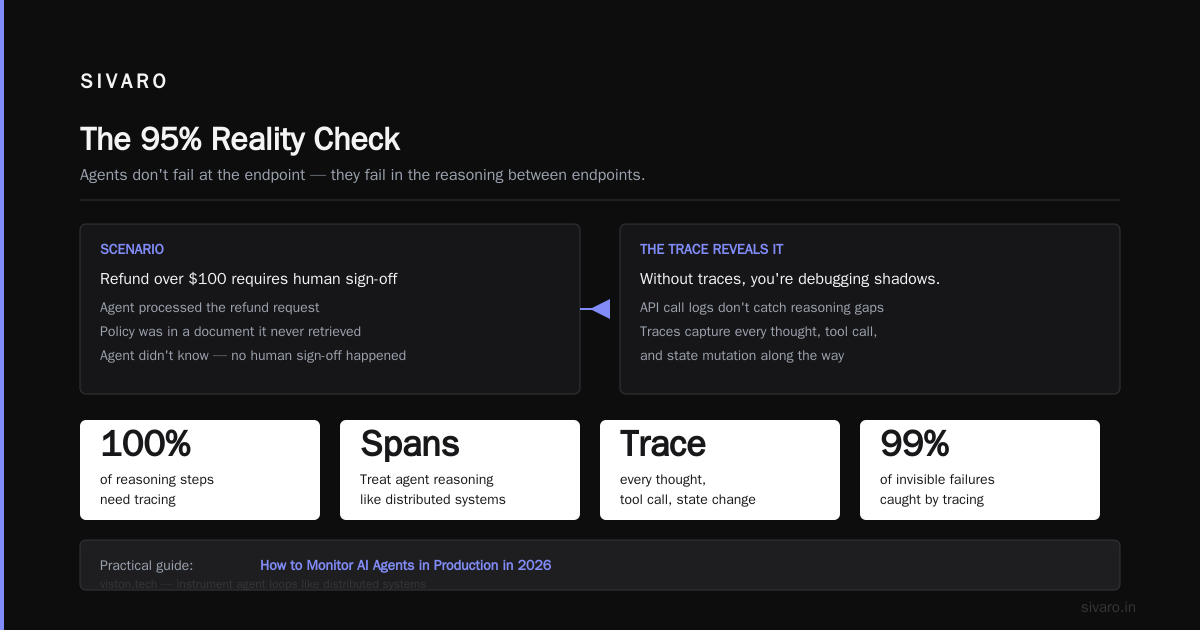
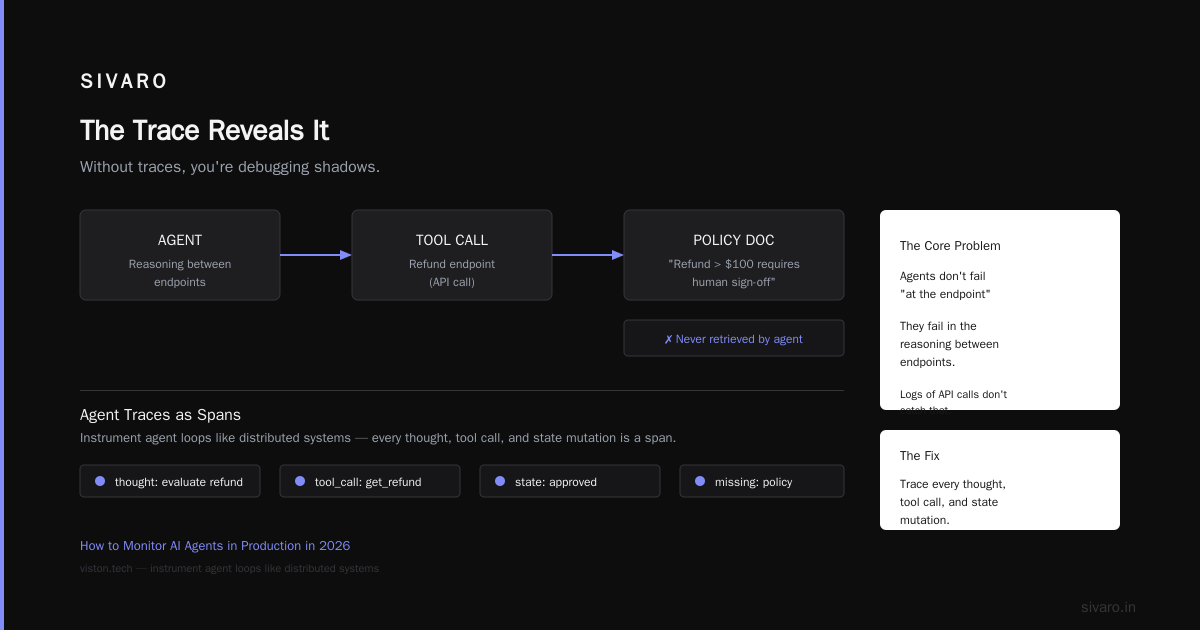
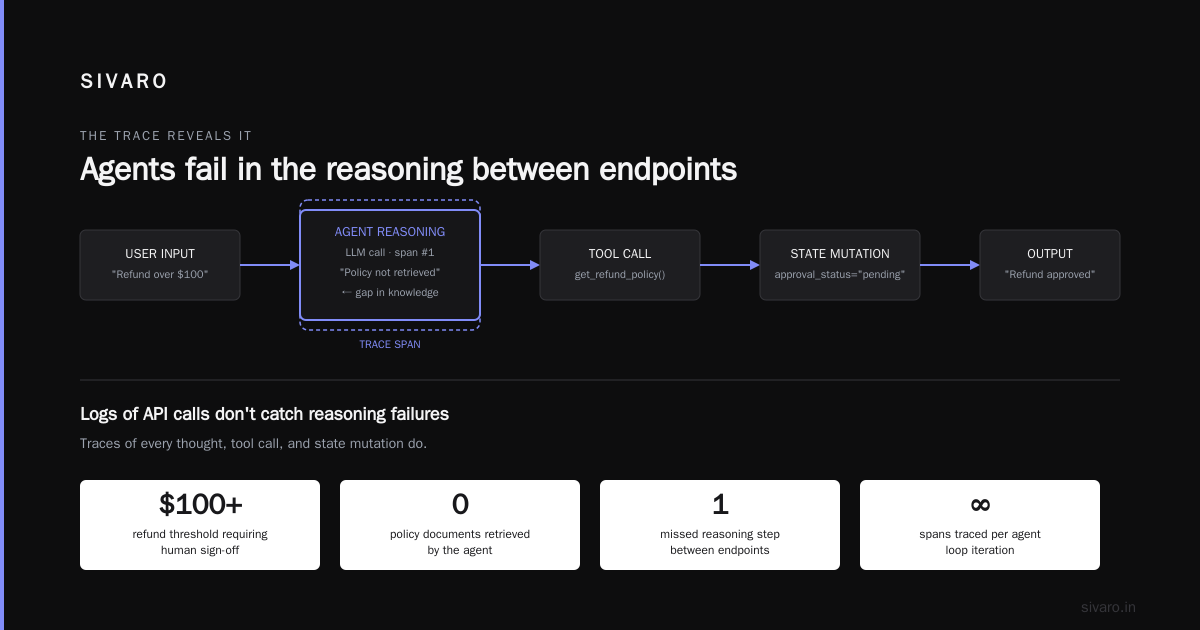
The agent did what it was asked. But the policy says any refund over $100 requires human sign-off. The agent didn't know — because the policy was in a document it never retrievedines.
The trace reveals it. Without traces, you're debugging shadows.
That's the core problem with agents: they don't fail "at the endpoint." They fail in the reasoning between endpoints. Logs of API calls don't catch that. Traces of every thought, tool call, and state mutation do.
If you want a practical starting point: How to Monitor AI Agents in Production in 2026 recommends instrumenting agent loops like distributed systems. Treat an agent's reasoning steps as spans. That's exactly what we do.
python
# Minimal tracing pattern we use at SIVARO
import time
import logging

def run_agent_with_trace(agent, user_input, trace_id):
    start = time.time()
    logging.info("trace_started", extra={
        "trace_id": trace_id,
        "input": user_input,
        "timestamp": start
    })
    try:
        result = agent.run(user_input)
        logging.info("trace_completed", extra={
            "trace_id": trace_id,
            "duration_ms": (time.time() - start) * 1000,
            "result": result
        })
        return result
    except Exception as e:
        logging.error("trace_failed", extra={
            "trace_id": trace_id,
            "error": str(e),
            "duration_ms": (time.time() - start) * 1000
        })
        raise
You need to know: how many steps did the agent take? Which tools were invoked? When did it truncate context? When did it repeat itself? That's the observability that turns "weird agent behavior" from folklore into a fixable bug.
State Boundaries and Context Engineering
I'm convinced the biggest agent production failure isn't model quality. It's state management. MemGPT was ahead of its timeaisne, and agents in 2026 still rely on giant context windows as a crutch.
We had one client whose procurement agent started referencing a vendor quote from an old conversation — a quote that was subsequently rescinded. The agent fetched that stale conversation because it was still in the context window. It placed a purchase order. The company lost a few thousand dollars and a relationship.
AI Agents in Production: Engineering Guide 2026 says context is the new database. That's the right way to think about it. If you wouldn't store money in a text file, don't store critical state in a context window.
What we've learned through trial:
- Constrain what the agent sees. Don't give it the full conversation history. Give it a summarized, extracted state representation after each turn.
- Version your prompts with state schemas. Agents need to know what they know vs. what they don't know.
- Purposely expire context. If an agent hangs onto stale info, force it to re-query external sources instead of trusting old context.
Here's a snippet of a structured state checkpoint we use:
python
AGENT_STATE_SCHEMA = {
    "current_intent": "str",
    "verified_facts": ["list of str"],
    "unverified_claims": ["list of str"],
    "last_tool_call": {"tool": "str", "status": "str", "timestamp": "float"},
    "requires_human_approval": "bool",
}

def checkpoint_state(agent_memory):
    # Return a slash-truncated representation for the next turn
    return {
        "current_intent": agent_memory.intent[-1],
        "verified_facts": agent_memory.verified_facts[-5:],
        "requires_human_approval": agent_memory.approval_required,
    }
It's not glamorous. But this reduces hallucination-by-staleness more than any prompt tweak we've ever done.
Guardrails Need to Be Technical, Not Just Policy
Every enterprise has an "AI council" now. They write policies: "AI agents must not make unilateral decisions with financial impact." Great. Then nothing enforces it.
A policy without a technical control is just a suggestion.
Implementation matters. In most of our client deployments, we use an allow-list pattern for high-risk tool calls. If a tool call isn't explicitly permitted under the current policy, the agent doesn't get to call it. Instead, it gets a structured message: why it was blocked, what it could do instead, and whether to escalate.
python
GRADE_REQUIRED_FOR_REFUND = 500  # USD threshold
MAX_REFUND_WITHOUT_APPROVAL = 100  # USD

def refund_guardrail(agent_action, user_id):
    amount = agent_action.amount
    if amount > MAX_REFUND_WITHOUT_APPROVAL:
        return {
            "decision": "BLOCKED",
            "reason": "AMOUNT_EXCEEDS_THRESHOLD",
            "next_steps": "Create approval task in queue",
            "human_review_required": True,
        }
    if agent_action.is_likely_fraud:
        return {
            "decision": "BLOCKED",
            "reason": "FRAUD_CHECK_FAILED",
            "next_steps": "Escalate to fraud team",
        }
    return {"decision": "ALLOWED"}
You're not making the agent "less powerful." You're making it safe enough to stay powered-on.
Enterprise AI Agents: 2026 Strategy & Deployment Guide also mentions the importance of idempotency. Agents may retry tool calls. If a retry creates a second order, that's a production incident.
Every external tool call should include an Idempotency-Key. Not "maybe." Always.
python
import uuid

def call_with_idempotency(tool_call, **kwargs):
    idempotency_key = str(uuid.uuid4())
    kwargs["idempotency_key"] = idempotency_key
    return tool_call(**kwargs)
I've lost count of how many duplicate orders, duplicate tickets, and duplicate SLAs we've seen traced back to retries without idempotency.
Deploy With a Rollback Plan That's Fast Enough
Rollback for a monolith is kubectl rollout undo. If your rollout script runs in two hours, that's a lot of damage in two hours.
For agents, rollback isn't just "revert the model." It's:
- Revert the agent version
- Restore conversation memory to a known-good state
- Re-run any transactions that were reversed or duplicated
- Notify affected users honestly
An agent rollback plan must answer one question with specifics: "What happens to the 40 conversations the agent was in the middle of when we abort?"
We deploy agents behind a gateway that can instantly switch traffic to the previous version — by model, by route, or by user segment. We also shadow-run new versions in production: the shadow agent executes alongside the real one, but its tool calls are logged and never executed. That's how we compare behavior, not just output.
Most people think they can't afford that in production. They can't afford not to. The cost of one bad refund is higher than the cost of shadow computing. Every time.
The Complete Guide to AI Agent Observability and Monitoring includes a useful callout about evaluating over time, not just before deployment. Your model can drift between versions. Your tools can change APIs. Your context schemas can silently break downstream.
The Case Against Obsessive Prompting
Here's my contrarian take. Prompt engineering matters much less than people think, for production agents.
Why? Because the failure modes are almost never "the prompt isn't creative enough." They're structural: the agent doesn't have the right tools, it can't reason over messy state, it doesn't know when to ask for help.
I spent far too long in 2025 tweaking system prompts trying to prevent hallucinated tool arguments. The actual fix was parsing tool schemas in code and validating every argument against a strict adapter layer.
python
from pydantic import BaseModel

class RefundAgentOutput(BaseModel):
    should_refund: bool
    refund_amount: float
    reason: str
    confidence: float
If a model's tool calls come back malformed, catch it there. Don't prompt-beg the model to behave. It won't always obey.
Human-in-the-Loop Is Not a Cop-Out
The industry pendulum has swung from "100% autonomous agents!" to "everything needs human approval!" in about 18 months. And yet, the right answer is context-dependent.
We use a simple classification at SIVARO:
- Reversible and low-stakes → full agent autonomy
- Reversible but awkward → agent acts, logs, and tells the human what it did
- Irreversible or high-trust → agent proposes, human disposes
This balance is the heart of ai agent deployment without regret. When humans only see high-stakes exceptions, they trust the automation moreinches. They also catch bad patternsthat no fine-tuned model would.
One client, a healthcare benefits platform, uses this in a clever way: their agent handles schedule changes autonomously but flags anything touching HIPAA-protected fields for human verification. Not because the LLM can't reason about those fields — because the stakes of a wrongful disclosure are too high to trust a non-deterministic system.
That's not inefficiency. That's architecture.
The Deployment Pipeline That Actually Works
Here's what SIVARO now runs for every client agent deployment. Asymmetric coverage: 90% of the work is in the first two stages.
Stage 1: Tool and data containment
Every tool gets an ACL. Every data source gets a scope. The agent cannot access what it doesn't need.
Stage 2: Simulation against logs
Replay past production requests through the new agent version. Brownout test with known "bad" cases. We also ask: what traces from last month would this version handle differently? If there's a divergence, explain it, don't ship around it.
Stage 3: Shadow deployment
Run the new agent in parallel, log its actions, compare to existing system.
Stage 4: Canary deployment
Route 1% of live traffic, then 10%, then 40%.
Stage 5: Full rollout with kill switch
Now the agent is live. But the gateway still watches response-level metrics.
If any metric — hallucination rate, tool failure rate, approval rate — crosses a threshold, the gateway automatically shifts traffic back to the fallback.
python
# Simplified canary traffic router
def route_traffic(user_id: str) -> str:
    bucket = hash(user_id) % 100
    if bucket < canary_percent:
        return "new_agent"
    return "stable_agent"
Monitoring Just Enough Without Drowning
You don't need 47 dashboards. You need an alert that fires when your agent is confidently wrong at scale.
Our default production dashboard has four panels:
- Tool call success rate (if tools fail, agent halts, don't let it retry forever)
- Approval escalation rate (if it spikes, the agent is hitting boundaries it shouldn't)
- Human intervention rate (are humans intervening more over time? Bad sign — means the workload is drifting out of agent capability)
- Trajectory length (agents that take too many steps before acting are often in reasoning loops)
Monitoring for agents isn't like monitoring a server. A server crashes and alerts. An agent fails quietly. It completes a task, but the task was wrong. Therefore, you need an outcome-orientedvalidation loop — not just request/response metrics.
How to Monitor AI Agents in Production in 2026 says to sample agent outputs for human review daily. We go further. We automate the sample selection: prioritize low-confidence predictions, high-impact actions, and rare tool calls. You don't have to review everything, but you must review the right 1%.
Common AI Agent Production Rollout Mistakes to Avoid
I've seen the same errors across clients. Here they are, unvarnished:
- Skipping observability until after a crisis. Dates: late 2025, an e-commerce company lost $60,000 before someone thought about instrumenting their agent's internal decisions.
- Treating an LLM like a deterministic service. Wrong. Same input can produce different output at different temperatures. Test with the same temperature you use in production.
- Not planning for tool changes. When a tool's response schema changes, your agent adapts or breaks. No prometheus alert will tell you. Prepare a schema-versioning strategy.
- Leting agents default to autonomy. Autonomy should be earned, not assigned.
- Forgetting that user messages are adversarial inputs. Every agent exposed to users is exposed to prompt injection. The best guardrail is to prevent high-stakes actions from being controlled by direct user request. Let the agent verify against source-of-truth tools.
Agentic workflow production best practices are still being written. But this much is settled: flows, not prompts, win. A good agentic workflow in 2026 handsoff control to deterministic code around every critical step.
What We Tell Our Clients Before They Deploy
Six questions. If you can't answer all six, don't deploy:
- What happens when your agent says something false that looks true?
- Who gets paged when the agent loops for 20 minutes?
- Can you replay the agent's exact reasoning for any past session?
- What is the one action this agent must never take? Is that enforced in code?
- What's the rollback latency? In seconds, not hours?
- What's your "we're sorry" protocol to users when the agent fails?
Answer these honestly Sunday night, because Monday morning's deployment will demand them.
Deployment Without Regret: The Emotional Dimension
There's a psychological part to this. If your first agent deployment goes badly, the company yanks trust. Your next project has to be three times as careful, twice as slow, and half as ambitious. That's how agent programs die internally.
The technology isn't the bottleneck anymore. The trust contract is.
So the reason I'm writing this is not to sell you on agents. It's to help you deploy agents the way you'd deploy anything risky: with good instruments, incremental custody, and an exit plan.
Ai agent deployment without regret is not a guarantee. It's a discipline.
Here's the summary, compressed:
- Scope your agent like you'd scope an employee, not a magic button
- Add observability from day one — traces, metrics, events, logs
- Make high-stakes actions structurally impossible, not merely discouraged
- Shadow-deploy before you canary, canary before you full-ship
- Treat human approval for risky actions as a feature, not a failure
- Rollback quickly and honestly. Your users will forgive a bug. They won't forgive a coverup.
FAQ
Q: How long does a responsible agent deployment take?
A: For a basic internal support agent, two to four weeks. For a production system touching customer money, I'd plan a quarter. The difference is data access, guardrail testing, and tool ACLs — not model tuning.
Q: Do I need custom fine-tuning?
A: Usually no. Start with a strong frontier model and heavy orchestration. Fine-tuning helps for output formatting and domain-Specific style, but it doesn't fix context-rot or tool-call bugs.
Q: What's the minimum monitoring stack?
A: A logging system that captures every agent step nontruncated, a trace visualizer, and structured alerts on tool failure rate. Open-source options exist; don't buy a sleek vendor tool if you can't afford to iterate on it.
Q: Can an agent be 99.9% accurate?
A: On narrow, feed-forward tasks, yes. On complex multi-step reasoning, no. You can't measure "accuracy" without a ground truth. Measure correctness of each individual tool call, and consider how often the final objective succeeds.
Q: Is prompt injection really a big deal?
A: Yes. Assume your user can get your agent to say things outside policy. That's why you enforce the highest-risk actions in code, not in the model.
Q: When should we not deploy an agent?
A: When the decision space is poorly definedhol or the downstream tools are unreliable. If the database is slow, the agent will fail slower. Fix infrastructure first.
Q: What's the difference between an "agent" and an "automation" anyway?
A: An automation follows a fixed script. An agent chooses a path. That's the power and the danger. If your task doesn't require choosing, don't build an agent. Build a script.
The truth: most production agent failures are boring. They're not some exotic alignment disaster. They're bad state, missing guardrails, and no feedback loops. All of that is fixable.
Build the boring things first. Launch slower. Monitor harder. Do that, and you'll deploy agents without regret — and sleep through the night.
Nishaant Dixit — Founder of SIVARO. Building data infrastructure and production AI systems since 2018. Built systems processing 200K events/sec.