 SIVARO
AI Agent Distributed Systems Design Patterns
You don't build agents. You build distributed systems with a chat interface stapled on top.
I learned this the hard way in 2024. SIVARO was building a production support agent for a logistics client. Three weeks in, the agent started "hallucinating" delivery statuses. We blamed the model. We tweaked prompts. We added RAG. The problem wasn't the model—it was our architecture. We had built a monolith with a prompt loop inside, and it was falling apart under concurrent requests, partial failures, and out-of-order events.
That's when I realized: an AI agent is just a node in a distributed system. And distributed systems have decades of battle-tested design patterns we can borrow.
This guide covers the ai agent distributed systems design patterns that actually matter in production. No fluff. No theory. Just what I've tested, broken, and fixed building real systems.
Why Agents Fail in Production
Most people think agents fail because the LLM is dumb. They're wrong.
Agents fail because they're distributed systems with no distributed systems discipline. You've got multiple LLM calls, tool executions, retries, timeouts, and state mutations happening across a network. That's a distributed system. And if you don't treat it like one, you're going to get burned.
The AI Agent Systems research shows agent failures cluster around coordination and state management—not model intelligence. Think about it: when did you last see an agent fail because it couldn't understand a prompt? Versus failing because it lost track of what it was doing, or two agents overwrote each other's state, or a retry caused a duplicate side effect?
The symptoms look like model problems. They're actually systems problems.
The Core Mental Shift
At first I thought this was an AI problem. Turns out it was a distributed systems problem.
Here's the shift: every agent is a state machine. It has inputs, outputs, and internal state that changes over time. When you have multiple agents, you have multiple state machines communicating over a network. That's the definition of a distributed system.
Gautam Dhameja makes this point well in AI Agents Are Just Distributed Systems — the "brain" is different, but the bones are the same. You still need consensus, consistency, fault tolerance, and message passing. The only difference is your nodes happen to be probabilistic LLMs instead of deterministic services.
Once you internalize this, everything changes. You stop asking "how do I make the model smarter?" and start asking "how do I make the system more reliable?"
Design Pattern 1: The Orchestrator-Worker Pattern
This is the workhorse. One orchestrator agent breaks down a task, delegates subtasks to worker agents, and aggregates results.
We've used this at SIVARO for document processing pipelines. The orchestrator decides which workers to invoke, monitors their progress, and handles failures. It's simple, but it scales.
{
  "orchestrator": {
    "task": "Process insurance claim",
    "steps": [
      {"worker": "extraction", "input": "policy_document.pdf"},
      {"worker": "validation", "input": "extracted_data"},
      {"worker": "pricing", "input": "validated_data"}
    ],
    "policy": "fail_fast",
    "max_retries": 2
  }
}
The Azure Architecture Center's agent orchestration patterns cover this in detail. The key insight: orchestrator-worker works when you have a clear task hierarchy. If tasks are flat and independent, use something simpler.
Trade-off: the orchestrator is a single point of failure. We lost a production pipeline because the orchestrator crashed mid-task and workers kept running, creating orphaned state. Fix: make the orchestrator stateless and persist task state externally. It can crash and restart from the last checkpoint.
Design Pattern 2: The Supervisor Pattern
The supervisor pattern is different. Instead of a task hierarchy, you have agents that need continuous management.
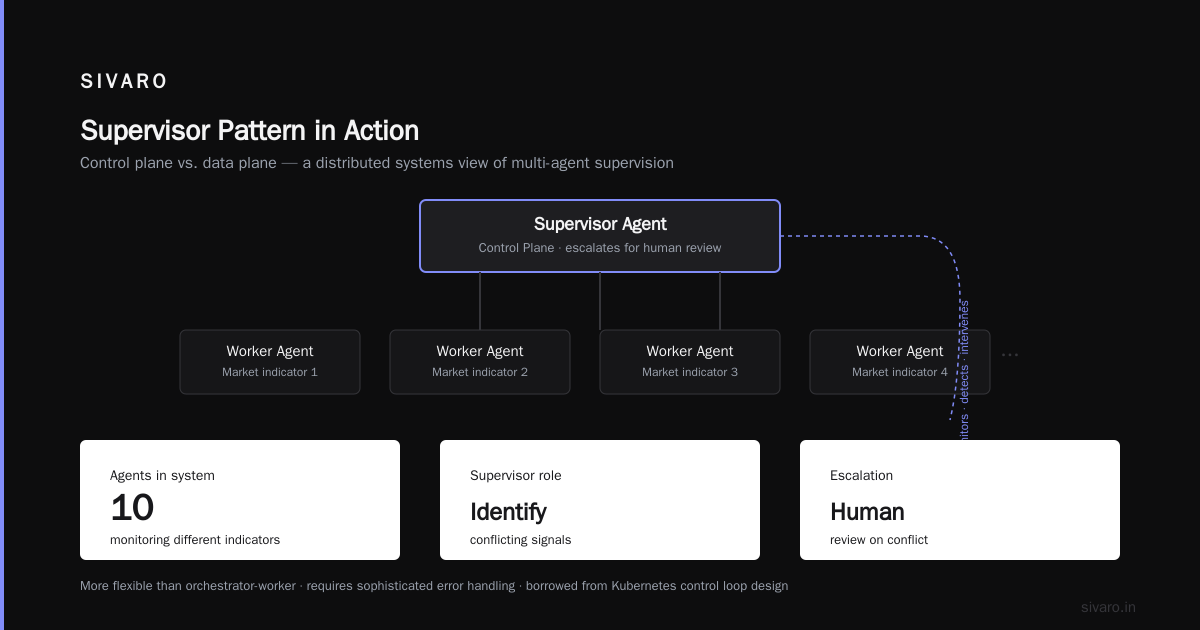
Think of it like a manager watching employees. The supervisor doesn't tell them exactly what to do—it monitors, detects issues, and intervenes when needed.
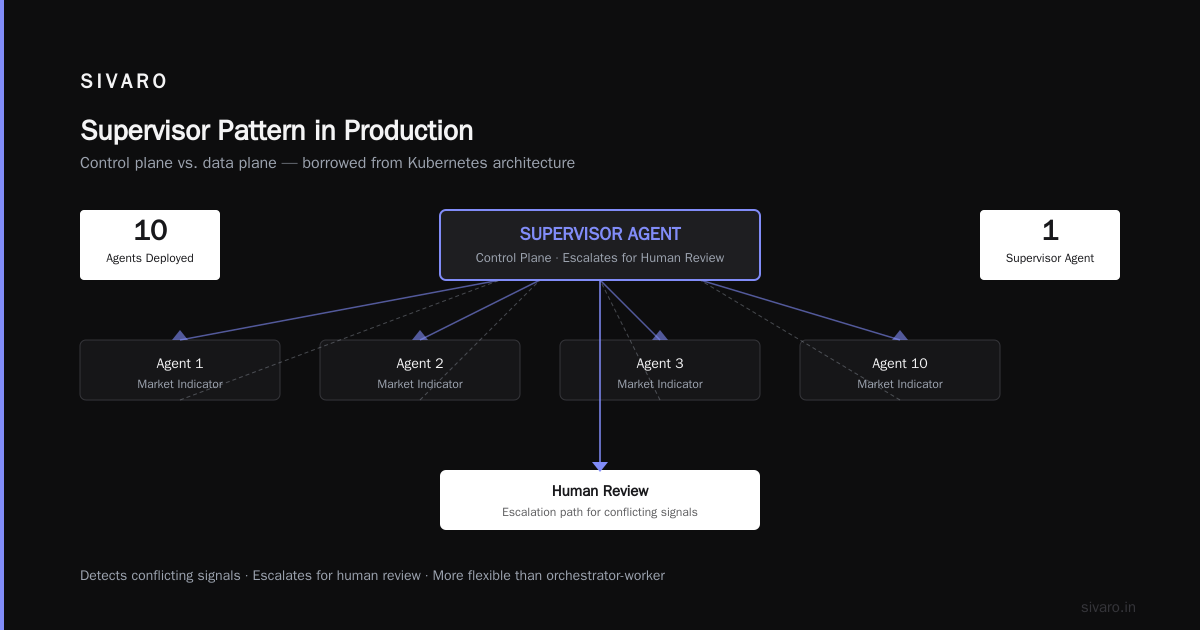
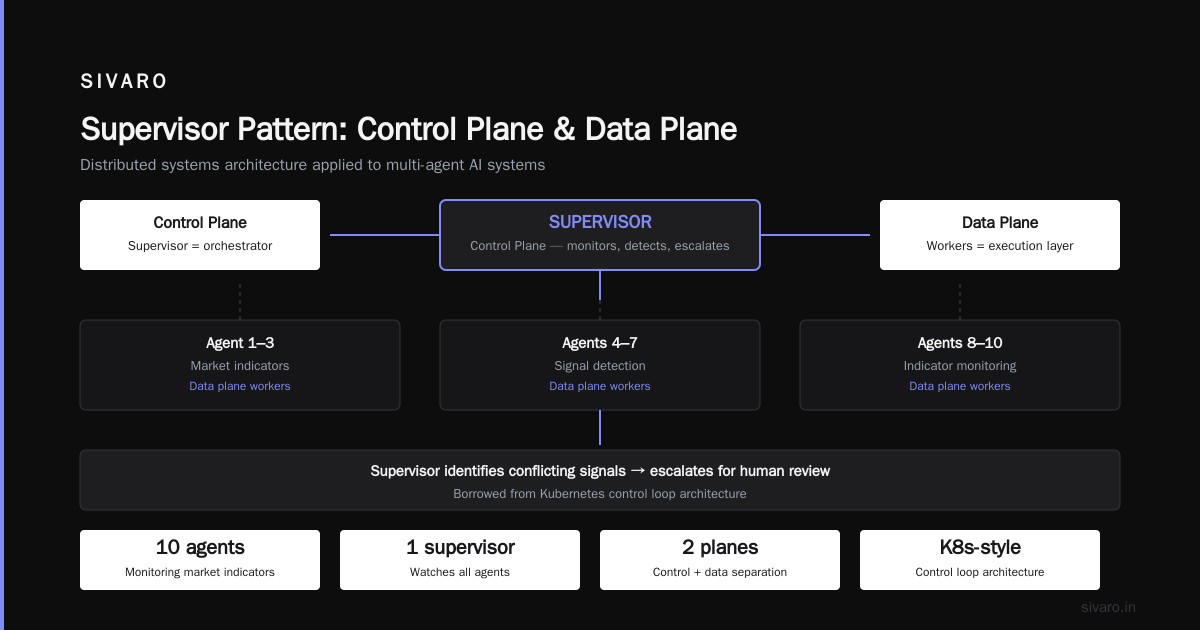
I'm using this pattern right now for a trading signal system. We have ten agents each monitoring different market indicators. A supervisor agent watches all of them, identifies conflicting signals, and escalates for human review. The LangChain multi-agent architecture guide explains this pattern well—it's more flexible than orchestrator-worker but requires more sophisticated error handling.
The ai agent distributed systems architecture explained through the supervisor lens is really about control loops. The supervisor is the control plane; the workers are the data plane. You're borrowing from Kubernetes architecture, whether you realize it or not.
Design Pattern 3: Event-Driven Agents
This is where things get interesting. Instead of agents calling each other directly, they communicate through events.
At SIVARO, we process about 200K events per second through our infrastructure. Agents subscribe to event streams, react to relevant events, and publish new events. This decouples everything. Agents can be added or removed without changing other agents. Failures are isolated.
Confluent's event-driven multi-agent patterns break this into four patterns: event sourcing, CQRS, pub/sub, and event-driven orchestration. The pub/sub model is what we use most:
python
# Event-driven agent example
import asyncio
from kafka import KafkaConsumer, KafkaProducer

async def run():
    consumer = KafkaConsumer('order.created', group_id='fraud_detection')
    producer = KafkaProducer()

    async for message in consumer:
        # Agent processes the event
        order = json.loads(message.value)
        risk_score = await assess_fraud_risk(order)

        # Publishes result as new event
        if risk_score > 0.8:
            producer.send('fraud.alert', key=order.id, value=order)
        else:
            producer.send('order.validated', key=order.id, value=order)

# This agent is stateless, isolated, and scalable
The event-driven approach makes agents naturally distributed. You can scale individual agents based on event volume. You can replay events to rebuild state. You can debug by inspecting the event log.
But there's a catch. Event-driven systems are eventually consistent. Agents see events at different times. If your agents need strong consistency—like financial reconciliation—you need to think carefully about ordering guarantees.
Design Pattern 4: Hierarchical Teams
The Google Cloud architecture guide describes hierarchical teams—a natural extension of supervisor pattern. You have a lead agent that manages multiple sub-agents, each of which might manage their own sub-agents.
We tested this for a customer support system. The hierarchy looked like:
- Lead agent: triages incoming tickets
- Category agents: route to specific teams (billing, technical, account)
- Resolution agents: actually solve the problem
This worked well for complex, multi-step problems. The hierarchy adds structure and clarity. Each level has a narrow responsibility, which makes debugging easier.
The cost? Latency. Each level adds round trips. And the hierarchy can ossify—the lead agent becomes a bottleneck, and adding new categories requires retraining.
Honest assessment: hierarchical teams are good for complex problems with clear domain boundaries. They're overkill for simple tasks.
Design Pattern 5: The Blackboard Pattern
This one's from classic AI. Agents share a common workspace—a blackboard—and write partial solutions to it. Other agents pick up those partial solutions and build on them.
For a long time I thought this was academic nonsense. Then we built a contract analysis system where no single agent could handle the full document. Three agents worked on the same contract: one extracted terms, one checked for compliance issues, one drafted amendments. They communicated through a shared database—the blackboard.
The event-driven multi-agent patterns from Confluent map nicely to blackboard systems. The blackboard is essentially an event store with read models.
Blackboard pattern strengths: flexible, supports collaboration, handles partial knowledge gracefully. Weaknesses: concurrency control is a nightmare. Two agents reading and writing the same data without coordination leads to corruption.
If you use this pattern, you need a proper data layer. Not just a shared database—a distributed data store with transactional guarantees. We ended up using a document store with optimistic concurrency control, and it worked. But only after a painful incident where two agents overwrote each other's contract amendments.
Distributed Systems Patterns Applied to Agents
The Akka blog post makes a critical point: agents are not just similar to distributed systems—they are distributed systems. So all the classic patterns apply:
Circuit breakers. When an agent's tool call fails repeatedly, stop calling it. Don't let cascading failures propagate. We had an agent that kept calling an external API that was down, and the retries flooded our infrastructure. Circuit breaker fixed it.
Bulkheads. Isolate agents so a failure in one doesn't kill the others. We run each agent in its own container with resource limits. If the document analysis agent goes haywire, the pricing agent stays up.
Sagas. For multi-step agent workflows, use saga pattern for distributed transactions. Each step has a compensating action. If step 3 fails, run compensation for steps 2 and 1. We used this for an order fulfillment system where multiple agents processed an order, and partial processing needed to be undone.
javascript
// Saga pattern for agent workflows
const saga = {
  steps: [
    {
      name: 'validate_order',
      execute: validateAgent.run,
      compensate: () => {} // No-op
    },
    {
      name: 'process_payment',
      execute: paymentAgent.run,
      compensate: refundPayment
    },
    {
      name: 'arrange_shipping',
      execute: shippingAgent.run,
      compensate: cancelShipment
    }
  ]
};
Two-phase commit. Avoid this with agents. LLMs are non-deterministic, so you can't guarantee both agents commit to the same state. We tried this once and it failed spectacularly. Stick with sagas and event-driven consistency.
Choosing the Right Pattern
How do you decide? Start with the problem shape.
Simple task, single agent. Don't over-engineer. One agent, one prompt, one result. We see too many teams building orchestration frameworks for what should be a simple function call.
Complex task, clear steps. Orchestrator-worker. Break it down, delegate, aggregate.
Multiple agents, need for coordination. Supervisor pattern. The supervisor can be a smaller model since it's mostly routing and monitoring.
Decoupled agents, asynchronous workflows. Event-driven. Build your agent architecture on a message bus.
Unknown problem structure. Blackboard or hierarchical teams. Start with a flexible pattern and converge on something simpler as you learn.
The LangChain guide has a helpful decision tree. But the real answer comes from load testing. Build a prototype with each pattern and measure: latency, failure rate, and debugging effort.
Practical Lessons from Production
Let me give you the hard-won lessons from building these systems at SIVARO.
Lesson 1: Model size matters less than architecture.
We replaced a large model orchestrator with a small model + event-driven design. Latency dropped 40%. Accuracy improved. The architecture was doing the heavy lifting, not the model.
Lesson 2: State is the enemy.
Every time you hold state inside an agent, you create coupling. We moved all agent state to an external store, and suddenly agents became replaceable. You can kill an agent and start a new one without breaking the workflow.
Lesson 3: You need tracing from day one.
Distributed agents are impossible to debug without tracing. We learned this after a two-day outage where we couldn't figure out which agent corrupted the order data. Implement distributed tracing across all agents. Use OpenTelemetry. Do it now.
Lesson 4: Retries are dangerous.
LLMs are non-deterministic. A retry might return a different response. If your agent retries a tool call, you might get different parameters. We built idempotency keys into all tool calls to prevent duplicate side effects.
Lesson 5: Timeouts are non-negotiable.
Every agent needs a timeout. Every tool call needs a timeout. Every LLM call needs a timeout. We had an agent hang for 45 minutes waiting on an external API. The entire workflow stalled.
AI Agent Architecture Proof of Continuity
One concept that's emerging in production systems is ai agent architecture proof of continuity. This is about verifying that a multi-step agent workflow maintains consistency from start to finish.
The problem: agents can lose track of what they're doing, especially with LLM non-determinism. A claim that's validated in step 2 might get contradicted in step 5. The proof of continuity is a mechanism to verify that all steps are consistent with the original goal.
We built this into our contract analysis system. Each agent writes its output to a shared ledger, and a consistency checker validates that outputs align with the input. If there's a mismatch, the system flags it for human review.
It's not a perfect solution—consistency checking adds overhead and can false-positive on legitimate edge cases. But it's better than trusting a chain of non-deterministic systems to maintain coherence on their own.
The Future: Agents as Infrastructure
In 2026, we're seeing agent systems mature from toy demos to production infrastructure. Companies like Uber, Stripe, and Shopify are running agent systems in critical paths. Not chatbots—actual decision-making systems handling money, logistics, and customer interactions.
The ai agent distributed systems design patterns that win will be the ones that embrace distributed systems discipline. Not the ones with the flashiest demos. The ones with circuit breakers, sagas, and proper observability.
We're building the infrastructure for this at SIVARO. Not just the agents themselves, but the data infrastructure, the event streams, the monitoring tools. Because that's where the real engineering is.
FAQ
Q: When should I use a single agent instead of multiple agents?
A: Use a single agent for tasks that fit in one context window and don't require parallel work. We see teams building multi-agent systems for what should be a single function call. Start simple.
Q: How do I handle state consistency across multiple agents?
A: Externalize state. Don't hold it inside agents. Use a shared event store or database. And use sagas for multi-step transactions that need rollback capability.
Q: Is event-driven architecture always better for multi-agent systems?
A: No. Event-driven adds complexity—event ordering, eventual consistency, duplicate events. If your agents can work in a direct request-response pattern, do that. Event-driven is for decoupled, asynchronous workflows.
Q: How do I debug a multi-agent system?
A: Distributed tracing, end to end. We use OpenTelemetry with every agent emitting trace spans. You also need structured logging with correlation IDs that propagate across agent calls.
Q: What's the most common failure mode you see?
A: Retry loops. Agents retrying failed tool calls indefinitely, creating cascading load on downstream systems. Add circuit breakers and bounded retries with exponential backoff.
The Bottom Line
AI agent distributed systems architecture explained in one sentence: you're building a distributed system with probabilistic nodes.
Stop treating agents as magic. Treat them as services. Give them health checks. Add circuit breakers. Use event sourcing. Implement sagas. Do the unglamorous distributed systems work that makes production systems reliable.
The teams that figure this out will be the ones shipping agent systems that actually work in production. The teams that don't will be stuck in a cycle of demos and pilot projects that never scale.
We're building the future of AI systems at SIVARO, and the future is distributed.
Nishaant Dixit — Founder of SIVARO. Building data infrastructure and production AI systems since 2018. Built systems processing 200K events/sec.