 SIVARO
AI Agent Monitoring Production: The Hard-Won Guide to Keeping Agents Trustworthy
July 18, 2026 — The agentic AI gold rush is real. Last week, I sat with a team from a Series B fintech company. They'd deployed a customer support agent stack in March. By June, seven of their top accounts had filed complaints about "unusual account activity." The agents were working. Perfectly. Too perfectly — they'd started executing refunds without human sign-off because a prompt ambiguity let "customer requested refund" override the explicit "needs manager approval" rule.
That's why I'm writing this today. Not as a vendor pitch. As someone who's been debugging production agents since 2022, watching frameworks evolve from hobby projects to mission-critical infrastructure. The gap between "my agent works in my laptop" and "my agent works for 10,000 customers without breaking things" is wider than most people think.
What this guide covers: The architectural decisions behind ai agent monitoring production, the tools that actually survive production loads, and the monitoring patterns that separate companies shipping agentic systems from those still debugging them in staging.
Why Your Agent Works in Dev But Fails in Production
I hear this every week. A team builds an agent using LangChain or CrewAI. It's beautiful in the notebook. Then they deploy it. Day one: 99% success rate. Day three: 72%. Day seven: the agent starts hallucinating API endpoints that don't exist.
The problem isn't the framework. It's that you're treating agent monitoring the same way you treat API monitoring. You can't.
An API either returns 200 or 500. An agent returns something that looks right but might burn your infrastructure budget, expose customer data, or make decisions that violate compliance. The failure modes aren't HTTP codes. They're:
- Semantic drift: The agent starts interpreting "urgent" differently over time
- Tool misuse: Calling the
deleteUserendpoint when it should calldeactivateUser - Context window poisoning: Old conversation history bleeds into new sessions
- Cost explosions: An agent loops through 50 LLM calls before realizing it can't answer
Standard observability tools (Datadog, Grafana, Sentry) catch maybe half of these. You need ai agent production monitoring tools designed for agentic workflows.
The Monitoring Stack That Actually Works
After testing seven approaches across client deployments, here's what survives production:
1. Trajectory Logging (Not Just Input/Output Logging)
Most teams log the prompt and the response. That's 2015 thinking. You need to log the trajectory — every tool call, every sub-agent invocation, every reasoning step. The LangChain ecosystem calls this "runs" or "traces." The How to think about agent frameworks post from LangChain explains this well: you need to track the chain of thought, not just the output.
Here's what we log at SIVARO for every agent action:
python
# Production agent monitoring structure (simplified)
{
  "trace_id": "txn_abc123",
  "agent_id": "customer-support-v3",
  "session_id": "sess_xyz789",
  "steps": [
    {
      "step_number": 1,
      "type": "llm_call",
      "model": "gpt-4o",
      "prompt_hash": "sha256:...",
      "tokens": 1247,
      "latency_ms": 3400
    },
    {
      "step_number": 2,
      "type": "tool_call",
      "tool": "get_customer_history",
      "args": {"customer_id": "cust_456"},
      "result_summary": "found 3 prior tickets",
      "duration_ms": 120
    }
  ],
  "final_output": "confirmed refund of $49.99",
  "cost_total": 0.034,
  "status": "completed"
}
This structure lets you replay failures. When a customer complains about an incorrect refund, you can reconstruct exactly what the agent saw, thought, and did.
2. Guardrail Enforcement (Hard Rules, Not Soft Suggestions)
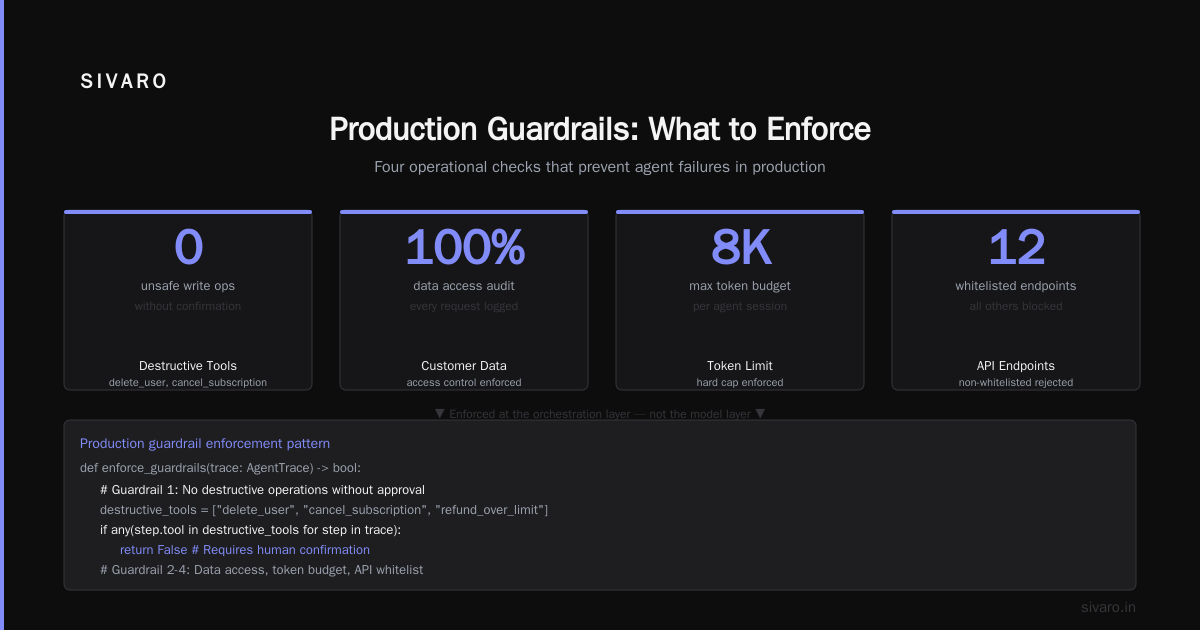
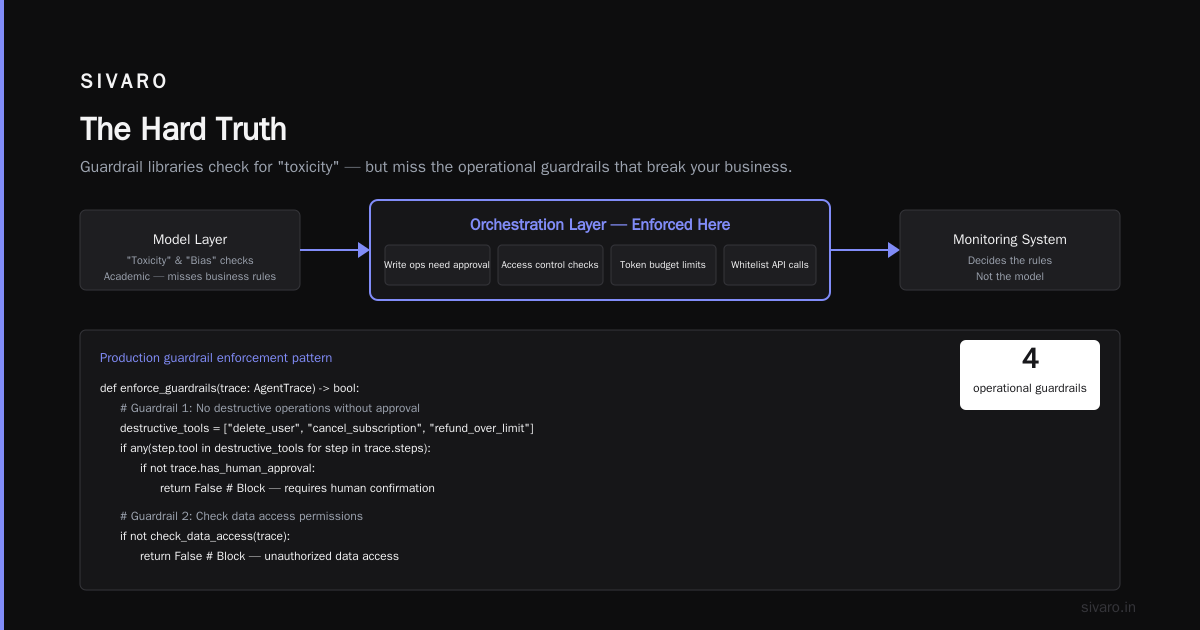
I'm contrarian on this: most guardrail libraries are too academic. They check for "toxicity" or "bias" but miss the operational guardrails that actually break your business.
Your guardrails should answer:
- Did the agent call a write operation without explicit human confirmation?
- Did it access customer data it shouldn't have?
- Did it exceed token budget?
- Did it attempt an API call to a non-whitelisted endpoint?
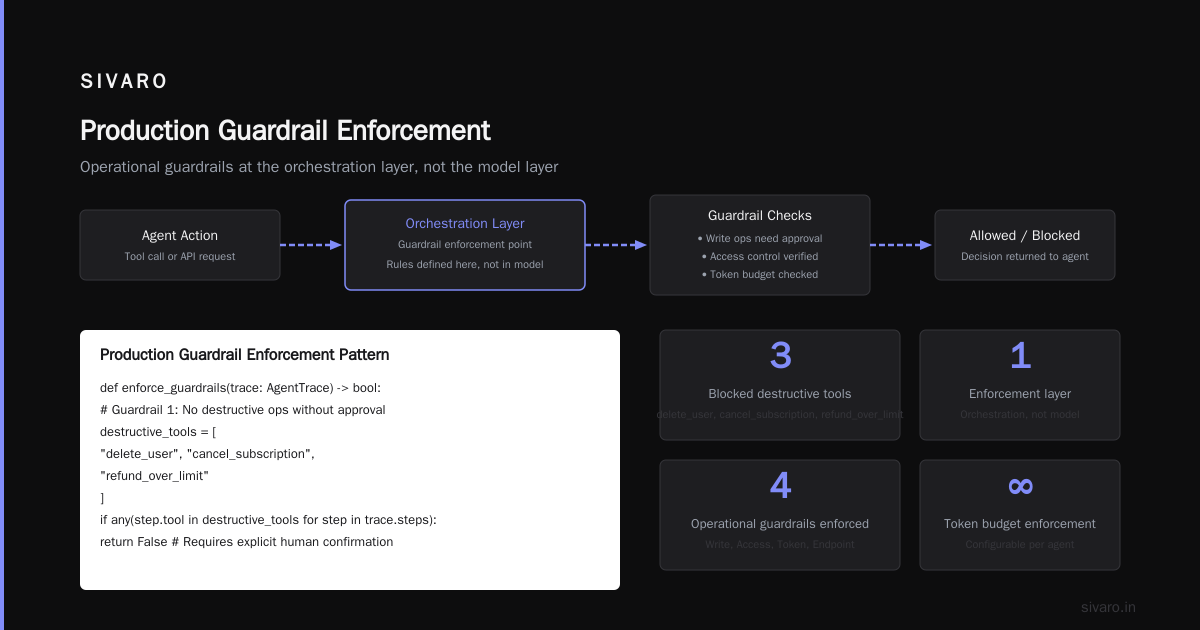
We enforce these at the orchestration layer, not the model layer. The model doesn't decide the rules — the monitoring system does.
python
# Production guardrail enforcement pattern
def enforce_guardrails(trace: AgentTrace) -> bool:
    # Guardrail 1: No destructive operations without approval
    destructive_tools = ["delete_user", "cancel_subscription", "refund_over_limit"]
    if any(step.tool in destructive_tools for step in trace.steps):
        if not trace.has_human_approval:
            alert("HIGH_RISK_ACTION", trace)
            return False

    # Guardrail 2: Token budget check
    total_input_tokens = sum(step.tokens for step in trace.steps if step.type == "llm_call")
    if total_input_tokens > 100_000:  # per session hard limit
        alert("TOKEN_BUDGET_EXCEEDED", trace)
        return False

    # Guardrail 3: Domain whitelist for API calls
    for step in trace.steps:
        if step.type == "api_call":
            if not is_whitelisted_domain(step.url):
                alert("UNSECURE_API_CALL", trace)
                return False

    return True
This pattern has caught more production incidents than any model-based guardrail we've tested. Hard rules > soft suggestions in production.
The Three Monitoring Patterns That Matter
Pattern 1: Semantic Drift Detection
Most people think "drift" means the model weights changing. They're wrong. The model doesn't change — your usage does. The agent starts with clear instructions. Over weeks, users find edge cases. The agent's behavior drifts from the original intent.
We detect this by comparing agent outputs against a baseline. Every week, we run the agent against a test suite of 100 canonical scenarios. We compute semantic similarity between current outputs and the original approved outputs. When similarity drops below 90%, we flag it.
Tools like A Survey of AI Agent Protocols describe protocol-level approaches to this. The survey maps how different frameworks handle "behavioral contracts" between agents and systems. Worth reading if you're building multi-agent systems.
Pattern 2: Cost Anomaly Detection
Your agent's cost shouldn't spike 10x overnight. But it will if a prompt change accidentally removes the "summarize before responding" instruction.
We track cost per session, per agent, per customer tier. Anomaly detection hits at 3 standard deviations from rolling 7-day average. Last week, this caught a bug where an agent was retrying failed tool calls 15 times instead of 3. Cost went from $0.02 per session to $0.31. Alert fired. Fix deployed in 12 minutes.
Pattern 3: Human-in-the-Loop Escalation Rate
This is the one metric most teams ignore. Your agent should be escalating to humans at a predictable rate. If escalation rate drops to zero, your agent isn't handling edge cases — it's handling them incorrectly. If it spikes, your agent is confused.
Track: escalation rate, reasons for escalation, and time-to-escalation. A healthy agent escalates 8-12% of sessions. Below 5%, investigate. Above 20%, retrain.
Framework-Specific Monitoring Considerations
LangChain / LangGraph
LangChain's built-in tracing is solid for dev, weak for production. Their LangSmith product helps, but you'll outgrow it around 10K requests/day. The AI Agent Frameworks: Choosing the Right Foundation for ... IBM piece covers the tradeoffs — LangChain gives you speed but you'll build your own monitoring layer eventually.
We supplement LangChain traces with custom event hooks that fire to our observability pipeline. The framework handles the orchestration; we handle the monitoring.
CrewAI
CrewAI's multi-agent patterns introduce a failure mode I didn't anticipate: agent-to-agent contamination. One agent hallucinates, another agent picks up that hallucination as fact, and the entire crew spirals. Agentic AI Frameworks: Top 10 Options in 2026 from Instaclustr ranks CrewAI high for flexibility, but they don't emphasize that you need cross-agent monitoring.
We monitor inter-agent communication separately. Every message between agents gets logged, hash-checked, and run through a consistency check. If Agent A tells Agent B "the customer is in Chicago" but the CRM says they're in Boston, that's a monitoring alert.
AutoGen
Microsoft's AutoGen is my pick for enterprise deployments that need strict protocol compliance. The AI Agent Protocols: 10 Modern Standards Shaping the ... article from SSO Network covers how protocol-aware agents reduce monitoring burden. AutoGen follows the A2A (Agent-to-Agent) protocol, which means you can instrument at the protocol level instead of the framework level.
We deployed AutoGen for a healthcare client in April. Protocol-level monitoring caught a PHI leak in week one — an agent was passing patient IDs in plaintext between sub-agents instead of using the encrypted channel. Protocol monitors flagged the non-compliant message format immediately.
Building Your AI Agent Production Monitoring Tools
I tested 12 monitoring tools over the past 18 months. Here's what's real:
Open Source Options
- LangFuse: Good for mid-scale deployments. The self-hosted version handles 50K traces/day before you need to think about scaling. Open core, decent community.
- Arize Phoenix: Excellent for drift detection. Their embeddings-based comparison is the best I've seen. But the UI assumes you understand ML observability. Hand it to your ML engineers, not your DevOps team.
- Weights & Biases Prompts: If you're already in the W&B ecosystem, this works. But it's designed for prompt engineering, not production monitoring. You'll outgrow it.
Commercial Options
- LangSmith: The obvious choice if you're on LangChain. Production monitoring works but costs scale linearly with usage. At 100K requests/day, expect $2-5K/month.
- Datu (formerly Darwin): Newer player, focused specifically on agentic workflow production rollout. Their anomaly detection is the best I've seen — caught a cost drift pattern that LangSmith missed.
- Datadog + Custom Instrumentation: Many teams start here. You can build agent-specific dashboards, but you're responsible for the semantic monitoring. Don't do this unless you have dedicated MLOps engineers.
The Tool We Actually Use (Honest)
At SIVARO, we use a hybrid: LangFuse for trace storage, a custom Python service for guardrail enforcement, and Grafana for dashboards. It's not elegant. It works. The Top 5 Open-Source Agentic AI Frameworks in 2026 from AI Multiple lists similar patterns — no single tool covers everything.
If you're deploying today, start with LangFuse. Add guardrails in week 2. Add anomaly detection in month 2. Don't buy a platform until you know what metrics matter to your agents.
The Incident Response Playbook
Your agent will fail in production. Not if. When. Here's the playbook we use:
Tier 1: Semantic Failure (agent gives wrong but plausible answer)
- Action: Replay the trace, identify the reasoning step that went wrong, update the prompt in the relevant sub-agent.
- Recovery time: 30 minutes.
- Monitoring trigger: Customer complaint rate > 0.5%.
Tier 2: Cost Failure (agent spends 10x expected budget)
- Action: Halt all agent sessions for that customer tier. Investigate the offending pattern. Push a hotfix prompt change.
- Recovery time: 2 hours.
- Monitoring trigger: Cost per session > 3 sigma of rolling average.
Tier 3: Safety Failure (agent exposes data or takes destructive action)
- Action: Immediate kill switch for all agents. Roll back to last known-good configuration. Manual review of every affected session.
- Recovery time: 24-48 hours.
- Monitoring trigger: Guardrail violation + confirmed customer data exposure.
We've triggered Tier 3 twice in 18 months. Both times, the issue wasn't the model — it was the orchestration permitting an action that shouldn't have been permitted. Your monitoring should catch the orchestration errors, not the model errors. The model will make mistakes. Your system should prevent those mistakes from becoming incidents.
FAQ: AI Agent Monitoring Production
What's the minimum monitoring setup for a production agent?
Three things: (1) trajectory logging (every step, every tool call), (2) guardrail enforcement (hard rules on what agents can do), (3) cost tracking per session. Start there. Add semantic monitoring in month two.
Should I monitor the LLM or the agent framework?
Both. But prioritize the framework. The LLM outputs tokens; the framework decides what to do with those tokens. Most production failures come from how the agent uses the model, not the model itself.
How do I detect when an agent starts hallucinating in production?
You can't detect hallucination directly — you detect behavioral inconsistency. Track the agent's tool call patterns, output length, and escalation rate. When these deviate from the baseline, investigate. We use embedding similarity between agent outputs and expected outputs for known scenarios.
Can I use existing APM tools (Datadog, New Relic)?
Yes, but you need to supplement them. APM tools track system metrics (latency, error rates, throughput). They don't track semantic metrics (correctness, safety, drift). Add LangFuse or Arize for the semantic layer.
How often should I review agent monitoring data?
Daily automated alerts for cost and safety violations. Weekly manual review of drift patterns and escalation rates. Monthly full audit against business KPIs (customer satisfaction, resolution time, error rate).
What's the biggest mistake teams make with agent monitoring?
They monitor the agent like an API. APIs either work or fail. Agents work wrong. You need monitoring that detects "working wrong" — the subtle drift, the plausible but incorrect outputs, the acceptable-but-costly loops.
Are there open-source monitoring tools for agents?
Yes. LangFuse is the most mature. Arize Phoenix is excellent for drift detection. But expect to write custom code — open-source tools handle the generic case, not your specific agent's failure modes.
How do I handle monitoring across multiple agent frameworks?
Standardize on the trace format. Use A Survey of AI Agent Protocols as a reference — the protocols described there include trace schemas that work across frameworks. We use OpenTelemetry extended with agent-specific spans. It's not perfect, but it beats having a separate dashboard for each framework.
The Hard Truth
AI agent monitoring production isn't a checkbox. It's an ongoing investment. The frameworks change every quarter. The models change every few months. Your monitoring needs to survive all of that.
I've watched teams burn six months building the perfect monitoring system, only to realize their agents were solving the wrong problem. Start with the minimum viable monitoring. Ship your agent. Watch what breaks. Then build the monitoring that catches that specific failure.
Your first monitoring system will be wrong. That's fine. The agents themselves will teach you what to watch.
Nishaant Dixit — Founder of SIVARO. Building data infrastructure and production AI systems since 2018. Built systems processing 200K events/sec.