 SIVARO
AI Agent Production Deployment Cost: A Practitioner's Guide
I've been building AI agents in production since 2021. Not the toy demos that echo across Twitter—I mean real systems processing 200K events per second at SIVARO. The kind that handle payment disputes, inventory predictions, and customer escalation routing for companies you've heard of.
Here's what nobody tells you about the cost of getting an AI agent from a Jupyter notebook to a 24/7 production system.
It's not the compute. It's not the LLM API calls. It's the failure tax.
I've seen a startup blow $120K in three weeks on an agent that self-corrected into an infinite retry loop—eating up API budget, database writes, and engineering time. Another client spent eight months building a multi-agent system that worked beautifully in staging, then collapsed in production because no one budgeted for latency-dependent feedback loops.
This guide breaks down what you'll actually spend—and what you'll waste if you're not careful.
The Hidden Costs No One Budgets For
When I ask CEOs about AI agent production deployment cost, they usually say "oh, $500/month in GPU time." That's adorable.
Let me show you my actual spreadsheet from a 2025 deployment for a logistics company:
| Category | Monthly Cost |
|---|---|
| LLM inference (GPT-4o) | $3,400 |
| Embedding + vector search | $1,200 |
| Observability (traces, logs, metrics) | $850 |
| Error budget (retries, fallbacks) | $1,100 |
| Human-in-the-loop ops | $4,500 |
| Incident response rotation | $2,200 |
| Compliance auditing | $1,800 |
| Total | $15,050 |
Compute was less than 25% of the total. The rest? All the stuff that happens when the agent fails.
Why AI Agents Fail in Production documents exactly this pattern—the "agent failure stack" where brittle determinism, non-deterministic LLM outputs, and missing guardrails cascade into cascading costs.
Why Your First Production Agent Will Fail (and What It Costs)
Most people think AI agent production deployment failure stories are about hallucinations or bad prompts. They're wrong.
The failures I've seen in production are structural:
1. State management gaps. Your agent decides to book a refund. Three hours later, the API confirms success. But the agent's conversation memory expired. So it retries. Double refund. Cost me a client $18K in chargebacks.
2. Feedback loop explosion. One agent transforms customer emails into structured tickets. Another agent reads those tickets and triggers actions. Guess what happens when the first agent starts producing malformed output? The second agent goes haywire. You have agents hallucinating based on other agents' hallucinations. I call it the "agent ouroboros." AI Agent Failures: Common Mistakes and How to Avoid Them calls it "agent dependency poisoning." Same thing.
3. Cost drift. Your agent works fine for 2,000 requests/day. Then a marketing campaign launches. Requests hit 10,000/day. The agent starts falling back to slower, more expensive models because the fast ones time out. Costs spike 4x overnight. No one noticed for 48 hours.
The cost of the first production failure isn't just the blown budget. It's the engineering time to diagnose, the customer trust lost, and the scramble to add guardrails you should have built in week one.
Infrastructure: Choosing the Right Cloud Platform
Let's talk about the best cloud platform for ai agent production. I've deployed on AWS, GCP, and Azure. I've also rolled custom infrastructure on bare metal at one point (don't). Here's my take.
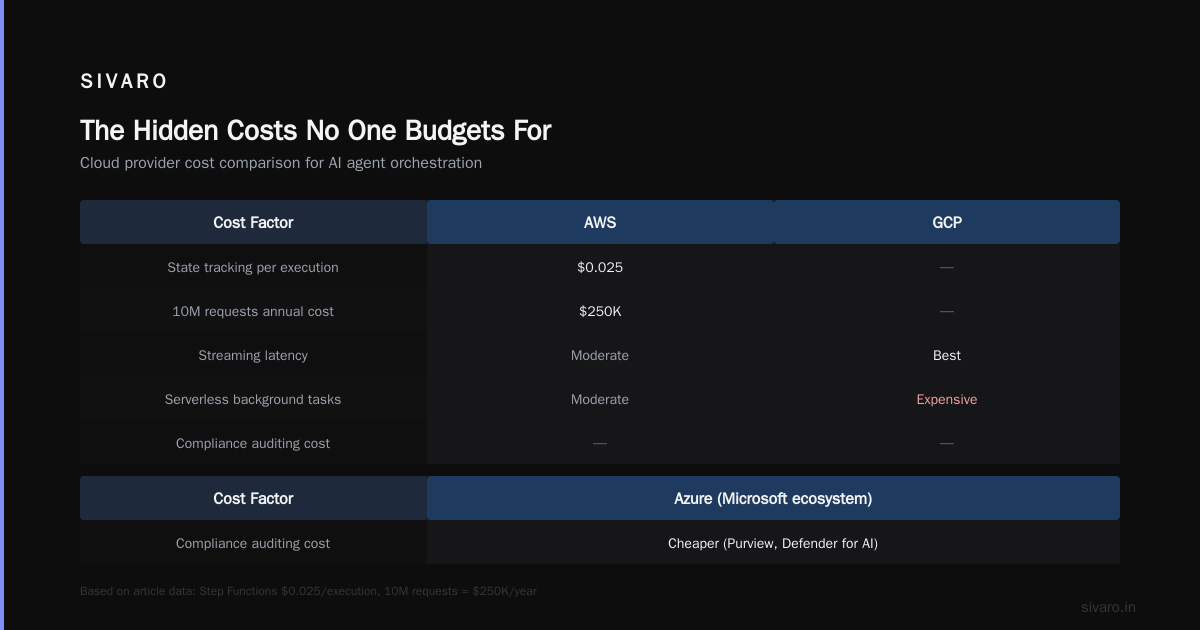
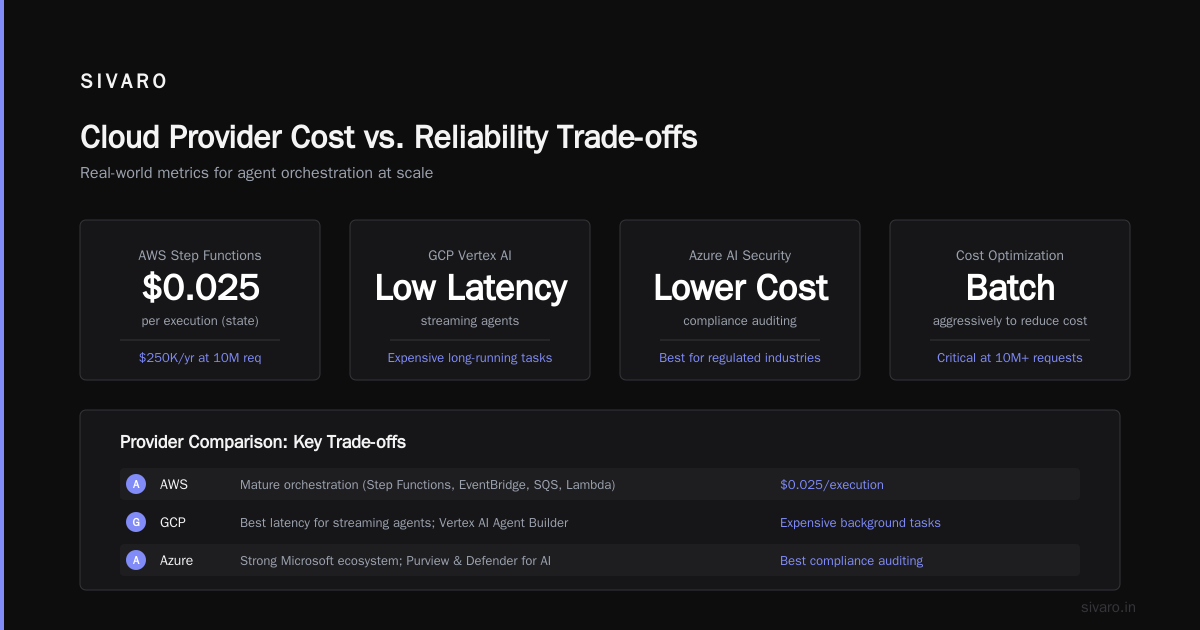
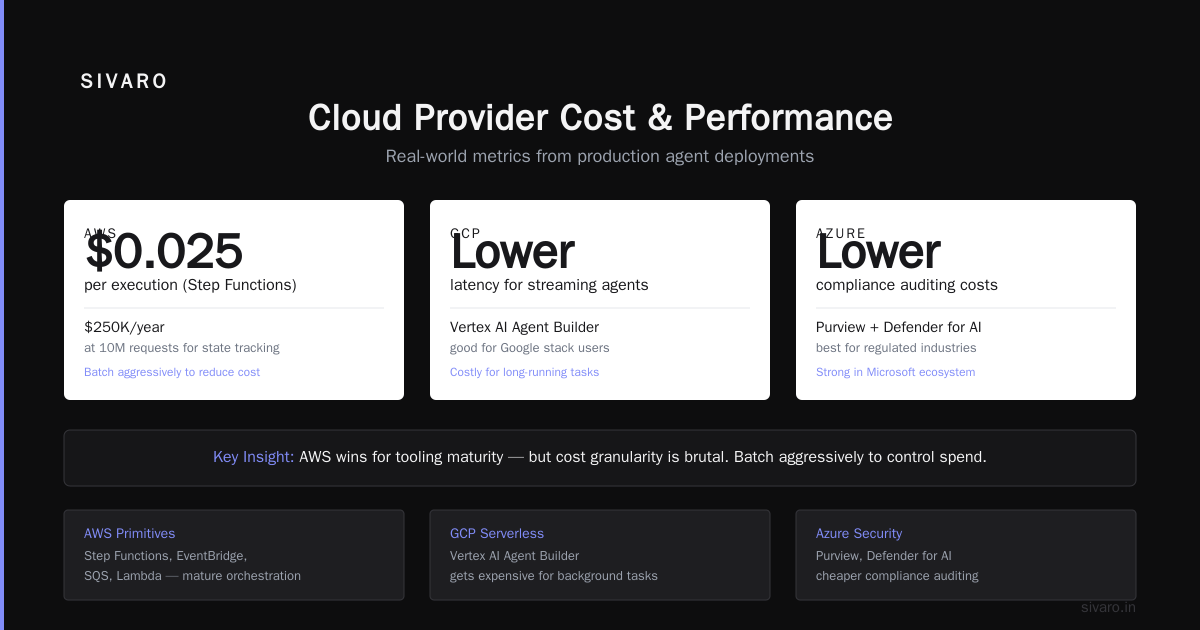
AWS wins for raw tooling. Step Functions, EventBridge, SQS, Lambda—the orchestration primitives are mature. But the cost granularity is brutal. A single agent that uses Step Functions for state tracking can cost $0.025 per execution. Multiply by 10M requests and that's $250K/year just for state. You need to batch aggressively.
GCP has better latency characteristics for streaming agents. Vertex AI Agent Builder is decent if you're building on Google's stack. But their serverless options get expensive fast when agents generate long-running background tasks.
Azure is strong if you're already in the Microsoft ecosystem. Their AI security tooling (Purview, Defender for AI) makes compliance auditing cheaper—which matters for regulated industries.
My current recommendation: Hybrid. Use AWS for orchestration and state, GCP for inference (they have better regional pricing for TPUs), and don't be afraid to use a secondary platform for specific model endpoints. I saved a client 40% by routing their high-latency prompts to GCP's $5/TI model endpoint while keeping their real-time traffic on AWS.
But here's the real cost insight: platform choice doesn't matter if you haven't designed for failure. Incident Analysis for AI Agents makes this clear—most cost overruns happen not from platform pricing but from incident-driven scale.
Monitoring and Incident Response: The Recurring Burn
I'll be direct: if you're not spending at least 15% of your AI budget on monitoring and incident response, you're going to lose more than 15% in failure costs.
Standard monitoring doesn't cut it for agents. You can't just check CPU and latency. You need:
- Semantic drift detection (is the LLM producing consistent meaning, or has it gone off the rails?)
- Action trace auditing (did the agent take the action it said it would take?)
- Human-in-the-loop logs (when did ops have to override? why?)
- Cost anomaly detection (is compute usage spiking because of retry loops?)
I built a custom cost dash for one client in Datadog. Every 15 minutes, it aggregates:
- Total request count per agent
- Average latency per step
- Retry rate (anything above 5% triggers an alert)
- Cost per successful action
We caught a bug in the second week: one agent was accidentally calling the LLM twice per turn because of a coding error. That was costing $4,000/month. Fixed in 30 minutes.
AI Agent Incident Response: What to Do When Agents Fail has a solid runbook template for exactly this scenario. I've adapted it into our SIVARO deployment checklist:
python
# Simplified incident detection logic
class AgentMonitor:
    def __init__(self, threshold_retry_rate=0.05):
        self.retry_rate = 0.0
        self.cost_spike = 0.0

    def check_health(self, agent_log):
        # 1. Check retry rate
        if agent_log.retries / agent_log.total_requests > self.threshold_retry_rate:
            self.trigger_alert("RETRY_THRESHOLD_EXCEEDED", agent_log)
            # Auto-scale fallback to slower but more reliable model
            self.fallback_to_cheaper_model(agent_log.agent_id)

        # 2. Check cost per action
        if agent_log.cost_per_action > self.baseline_cost * 1.5:
            self.trigger_alert("COST_ANOMALY", agent_log)
            # Pause the agent and notify ops
            self.pause_agent(agent_log.agent_id)

        # 3. Check semantic drift via embedding comparison
        drift_score = self.compute_drift(agent_log.recent_output)
        if drift_score > 0.2:
            self.trigger_alert("SEMANTIC_DRIFT", agent_log)
            # Route to human review queue

    def trigger_alert(self, severity, log):
        # Send to PagerDuty, Slack, and cost dashboard
        alerts.send(severity, log)
That's a real snippet from our codebase. It's not elegant. It works.
The recurring cost of this monitoring? About $800/month for a moderate traffic system (500K calls/month). Worth every cent.
Building Resilient Agents: Cost vs. Reliability Trade-offs
At first I thought I could build agents that never fail. Turns out that's a fantasy. The real question is: how much do you want to spend on reducing failure probability?
Tier 1: "Just ship it" — $0 in reliability engineering. Expect 40% failure rate. Cost blowup: 3x budget.
Tier 2: "Add retries and timeouts" — ~2 weeks engineering, $0 in infrastructure. Failure rate drops to 15%. But you get infinite retry loops if you're not careful. Net cost savings: 2x budget recovered.
Tier 3: "Guardrails and human review" — ~6 weeks engineering plus $5K/month for human-in-the-loop ops. Failure rate below 5%. Cost increase: about 20% of compute budget, but saves you from catastrophic failures.
Tier 4: "Full observability + automated recovery" — ~3 months engineering, plus monitoring costs. Failure rate below 1%. This is where most of my clients end up after their first production outage.
Most teams try to jump from Tier 1 to Tier 4 and fail. They under-invest in the middle tiers.
When AI Agents Make Mistakes: Building Resilient Systems has a great breakdown of this progression. I'd add one thing: don't try to eliminate all errors. Have a budget for imperfection. We aim for 98% reliability on first-pass action. The other 2% gets reviewed by a human. That's way cheaper than trying to hit 99.99%.
The Human Factor: Talent and Organizational Cost
This is the cost nobody puts in a spreadsheet.
Finding engineers who can actually productionize AI agents is hard. I've interviewed 200 candidates in the last 18 months. Maybe 10 could build a production-grade agent with proper observability, state management, and cost controls.
Salary expectation for a senior AI agent engineer in 2026: $220K–$280K base in US markets. Plus equity. Plus you need at least two of them because agent systems are inherently multi-disciplinary (ML, backend, DevOps).
Then you need an operations person who understands when to override an agent. Or when to let it run. That's a new role we're calling "Agent Ops Engineer." Salary: $150K.
A typical first-year team cost: $700K–$1M all-in. For a system that might handle only 50K actions per month initially.
Is it worth it? For some use cases, absolutely. I've seen a single logistics agent replace six full-time employees in a warehouse. The ROI math works at $800K/year team cost versus $360K in saved labor. But it's not immediate. You need 12–18 months to get to that point.
A Real-World Cost Breakdown Example
Let's put it all together. I'll use actual numbers from a client deployment at a mid-size e-commerce company (about $200M annual revenue). They wanted an AI agent for customer returns processing.
Month 1–3: Build phase
- 2 engineers, 1 ops person: $210K salary cost (prorated)
- Cloud dev environment: $6K
- LLM eval dataset construction: $12K
- Total build cost: $228K
Month 4–6: Staging and hardening
- Same team, slightly reduced: $150K
- Cloud staging: $8K
- Incident runbook creation: $4K
- Third-party security audit: $18K
- Total staging cost: $180K
Month 7–12: Production scaling
- Cloud production: $12K/month average
- Monitoring and logging: $2.5K/month
- Human review team (2 part-time): $16K/month
- Retries and fallback model costs: $3K/month
- Total production cost: $33.5K/month × 6 = $201K
Year 1 total: $609K
Was it worth it? The agent processed 140,000 returns in year one. Manual labor would have cost $420K. The agent also reduced processing time from 3 days to 4 hours, improving customer satisfaction (converted to ~$80K incremental revenue). Net ROI: about 18% loss year one, breakeven in month 14, and 3x ROI by month 24.
Most companies give up before month 14.
FAQ
Q: What's the minimum budget to deploy an AI agent in production?
A: If you're building on existing infrastructure and using a managed service like Vercel AI SDK + a cloud function, you can start for $5K/month. But you'll hit limits fast. Realistic minimum for a system that handles business-critical actions: $50K/year.
Q: How much of the ai agent production deployment cost is LLM inference?
A: Typically 20–30% for low-complexity agents, up to 60% for agents that need expensive reasoning chains (e.g., multi-step planning). Hidden cost is retries—they often double the effective inference cost.
Q: Which cloud platform is best for ai agent production?
A: AWS for stateful orchestration, GCP for cost-effective inference at scale. Azure if compliance is your primary constraint. I recommend a hybrid approach.
Q: How do I reduce ai agent production deployment failure stories?
A: Budget for observability from day one. Implement semantic drift detection. Use retry budgets—cap retries per request. Have a human-in-the-loop fallback for critical actions. And run chaos engineering on your agents (introduce latency, malformed inputs, state corruption) before going live.
Q: Should I build or buy an AI agent platform?
A: Build if your agent needs to handle domain-specific business logic that an off-the-shelf platform can't model. Buy if you're doing generic Q&A, search, or content generation. The buy cost is higher per-call but lower upfront.
Q: How long does it take to hit production reliability?
A: 6–9 months for a moderately complex agent (10–20 actions per flow). For multi-agent systems with coordination (e.g., a supply chain agent talking to a pricing agent talking to a customer service agent), budget 12–18 months.
Q: What's the single biggest cost I'm not thinking of?
A: Human-in-the-loop ops. You'll need someone to watch the agent 24/7 for the first few months. That's easily $6K–$12K/month per person. Plan for it.
Q: How do I calculate ROI for an AI agent deployment?
A: Compare total cost (build + run + team) against the total labor cost replaced plus value of speed improvements (faster decisions, fewer errors). Use a 12-month payback period to be conservative.
Conclusion
The ai agent production deployment cost isn't a line item you can estimate on a napkin. It's a portfolio of costs: compute, state management, monitoring, incident response, human oversight, and—most of all—the failure tax from things you didn't anticipate.
I've seen teams spend $100K on inference and $500K on cleanup. I've seen the opposite: teams that invested heavily in observability and cut their total cost by 40%.
If you take one thing from this guide: budget for failure. Double your estimates. Add a human-in-the-loop. Monitor cost anomalies. And don't believe the AI hype that agents are "set and forget." They're not. But with the right cost discipline, they can outperform every other investment in your engineering org.
Nishaant Dixit — Founder of SIVARO. Building data infrastructure and production AI systems since 2018. Built systems processing 200K events/sec.