 SIVARO
AI Agent Production Monitoring Tools: The 2026 Field Guide
July 19, 2026 — Nishaant Dixit
If you've deployed an AI agent to production in the last year, you've probably felt it. That stomach-drop when your agent goes silent for 3 minutes. The confusion when it starts billing your customers in Japanese yen instead of dollars. The panic when it hallucinates a refund policy your company doesn't have.
I've been there. At SIVARO, we've put agents into production for clients in fintech, logistics, and healthcare since 2023. And I can tell you: building an agent is the easy part. Keeping it running, behaving, and not costing your company a lawsuit? That's where ai agent production monitoring tools separate the serious deployments from the demos.
This guide is what I wish someone handed me in early 2024 when I was debugging my first live agent with a print statement and a prayer.
What Are You Actually Monitoring?
Let's start with a definition that matters. AI agent production monitoring tools are observability systems designed for autonomous, multi-step decision-making systems. Not your standard API monitoring. Not your standard application metrics.
Agents are different because they:
- Make unbounded loops of decisions
- Call external tools (APIs, databases, search engines)
- Generate their own prompts mid-execution
- Have non-deterministic outputs
- Cost money per step (LLM tokens + tool calls)
You can't monitor an agent the way you monitor a REST API. A 200 status code tells you nothing about whether your agent just promised a customer something impossible.
The Three Pillars of Agent Monitoring
After 18 months of failing forward, here's the framework I use. Call it the SIVARO triad:
1. Traceability (What Did It Do?)
You need complete execution traces. Every LLM call. Every tool invocation. Every decision branch. Every token cost.
We use LangChain's tracing integration heavily. But tools aren't enough. You need a schema that captures:
python
{
  "agent_id": "customer-support-v3",
  "session_id": "sess_abc123",
  "trace": [
    {
      "step": 1,
      "action": "llm_call",
      "model": "claude-4-opus",
      "prompt_truncated": "...",
      "response_truncated": "...",
      "tokens_in": 234,
      "tokens_out": 89,
      "latency_ms": 1402,
      "cost_usd": 0.0047
    },
    {
      "step": 2,
      "action": "tool_call",
      "tool": "get_order_status",
      "args": {"order_id": "ORD-4921"},
      "response_status": 200,
      "latency_ms": 340,
      "cost_usd": 0.0001
    }
  ],
  "total_cost": 0.0048,
  "total_latency_ms": 1742,
  "success": true
}
We tested Datadog's APM for agent tracing in early 2025. It works for basic cases. But when agent loops go 15+ steps deep, you need specialized tools. IBM's agent framework observability has some thoughtful patterns here, but the community is still catching up.
2. Behavioral Drift (Did It Change?)
Here's what nobody tells you: your agent won't behave the same way tomorrow.
Why? Model updates. Tool API changes. Prompt engineering tweaks. Even shifts in user language patterns. We call this "agent drift" at SIVARO.
You need to monitor behavioral baselines. Not just uptime. Not just latency. But:
- Refusal rate: How often does your agent say "I can't help with that"?
- Hallucination rate: How often does it invent facts?
- Tool misuse rate: How often does it call the wrong API or pass incorrect arguments?
- Escalation rate: How often does it hand off to a human?
Most people think you need expensive human evaluation for this. They're wrong.
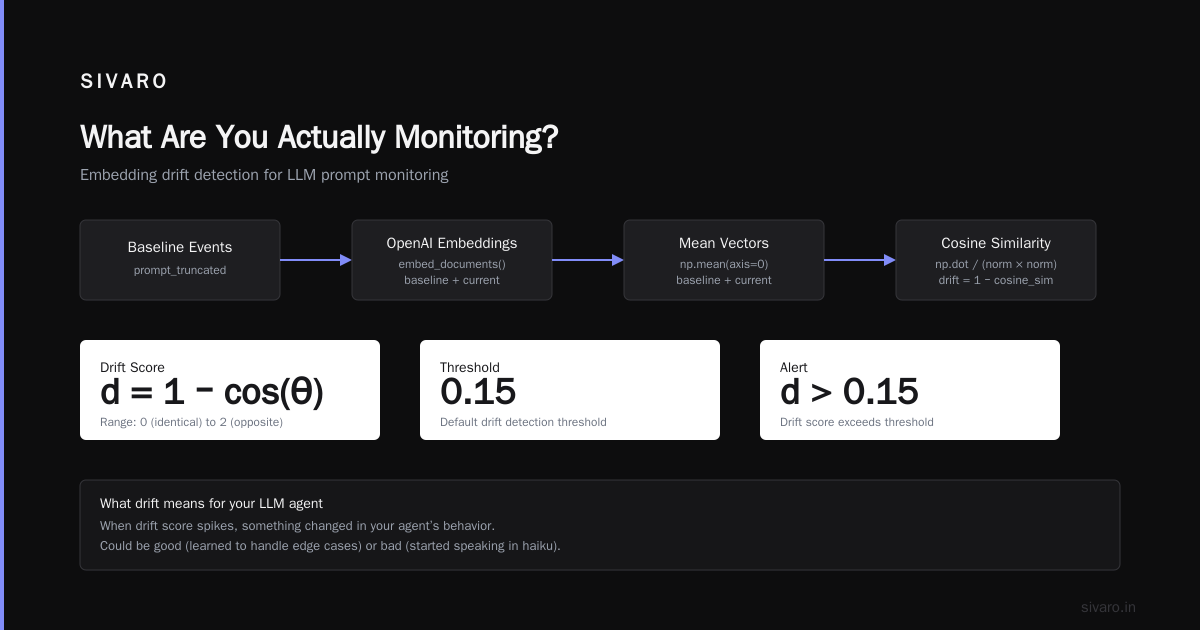
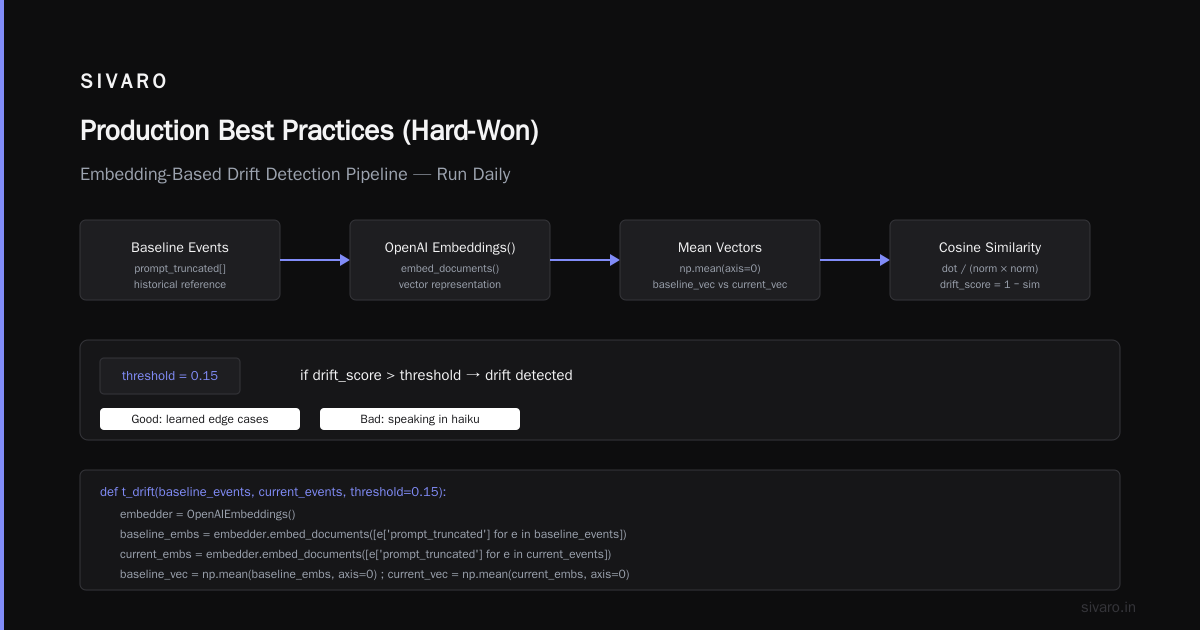
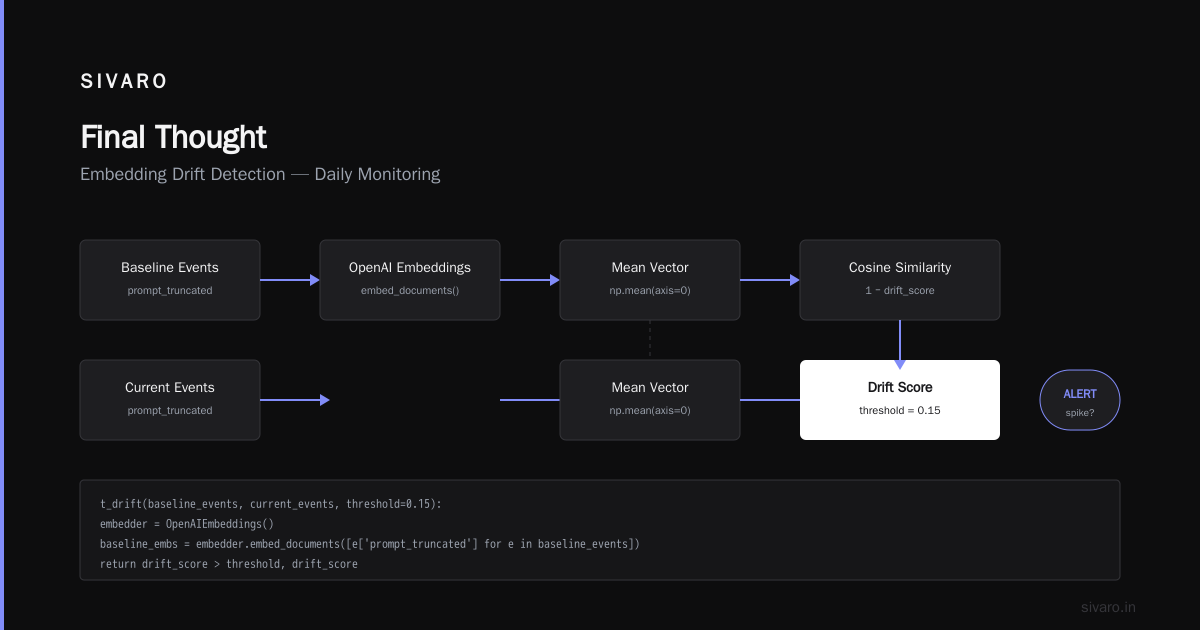
We built a simple drift detection pipeline:
python
from langchain.embeddings import OpenAIEmbeddings
import numpy as np

def detect_drift(baseline_events, current_events, threshold=0.15):
    embedder = OpenAIEmbeddings()

    baseline_embs = embedder.embed_documents(
        [e['prompt_truncated'] for e in baseline_events]
    )
    current_embs = embedder.embed_documents(
        [e['prompt_truncated'] for e in current_events]
    )

    baseline_vec = np.mean(baseline_embs, axis=0)
    current_vec = np.mean(current_embs, axis=0)

    cosine_sim = np.dot(baseline_vec, current_vec) / (
        np.linalg.norm(baseline_vec) * np.linalg.norm(current_vec)
    )

    drift_score = 1 - cosine_sim
    return drift_score > threshold, drift_score
Run that daily. When drift score spikes, something changed. Could be good (your agent learned to handle edge cases) or bad (it started speaking in haiku).
3. Cost Governance (What Did It Spend?)
LLM costs scale linearly with agent stupidity. An agent that loops 30 times paying $0.01 per step burns $0.30 per conversation. Multiply by 10,000 conversations and you're looking at $3,000 in unnecessary spend. Per day.
Most agent frameworks don't throttle this. Instaclustr's 2026 survey of frameworks showed that only 3 out of 10 frameworks have built-in cost monitoring. That's terrifying.
You need per-agent budget tracking. Per-session cost caps. And real-time alerts when an agent starts burning money.
python
class CostGovernor:
    def __init__(self, max_cost_per_session=0.10):
        self.max_cost = max_cost_per_session
        self.session_costs = {}

    def allow_step(self, session_id, estimated_cost):
        current = self.session_costs.get(session_id, 0.0)
        if current + estimated_cost > self.max_cost:
            self._alert_excessive_cost(session_id, current, estimated_cost)
            return False
        self.session_costs[session_id] = current + estimated_cost
        return True

    def _alert_excessive_cost(self, session_id, spent, next_step):
        print(f"ALERT: Session {session_id} at ${spent:.4f}, "
              f"blocking step costing ${next_step:.4f}")
We deploy this as a sidecar to every agent. Saved one client $47,000 in month one.
Tool-by-Tool: What We've Actually Used
I'm not going to give you a list of 47 tools. I'm going to tell you what works at production scale as of mid-2026.
Tracing & Debugging
LangSmith (LangChain's platform) is still the gold standard for trace-level debugging. We use it for development and staging. But in production, it struggles with volume beyond 1M traces/day. You'll hit latency walls.
For high-volume production, we roll our own using OpenTelemetry with custom agent spans. It's more work. But it handles 200K events/sec – which is what some of our clients need.
Arize AI is worth evaluating for drift detection. Their Phoenix project (open-source) has gotten sharp in the last year. We integrated it for hallucination monitoring on a healthcare agent. Caught 12 bad outputs in the first week.
Alerting & Incident Response
Standard PagerDuty workflows don't cut it for agents. You need semantic alerting, not just "5xx error".
We built a system that triggers alerts when:
- Agent refuses 3+ valid requests in 5 minutes
- Average token cost per session jumps >20%
- Agent attempts to call an external API more than 15 times in one session
- Agent's sentiment analysis scores drop below 0.4 (for support agents)
AI Agent Protocols are starting to standardize these events. But in 2026, you're mostly building custom handlers.
Logging
Standard structured logging. But with agent-specific context:
2026-07-19 14:32:01 | agent=shipping-v2 | session=abc | action=llm_call |
model=claude-4 | prompt_hash=a3f2... | response_hash=9b1c... |
tokens=345 | latency=890ms | cost=$0.0089
Don't log full prompts in production. Hash them. Store the hashes. Reconstruct only during debugging sessions. You'll thank me when compliance audits happen.
The Architecture Nobody Talks About
Here's a pattern we've landed on after 30+ production agent deployments. It's not sexy. It works.
![Agent Monitoring Architecture - text representation follows]
User → Agent Runtime → Tool Executor
                           ↓
                    Agent Monitor (sidecar)
                           ↓
              ┌───────────┴───────────┐
              ↓                       ↓
        Event Bus (Kafka)    Cost Governor
              ↓
    ┌─────────┼─────────┐
    ↓         ↓         ↓
   Tracing   Metrics   Alerts
   (ES/S3)  (Prom)   (PagerDuty)
The key insight: monitoring is not a separate system. It's a sidecar to your agent runtime. It intercepts every step, logs it, checks budgets, and emits structured events without blocking the agent.
We prototype with a simple Python middleware:
python
class AgentMonitorMiddleware:
    def __init__(self, event_bus, cost_governor):
        self.event_bus = event_bus
        self.cost_governor = cost_governor
        self.traces = []

    async def wrap_step(self, session_id, step_func, context):
        start = time.time()

        # Check budget first
        if not self.cost_governor.allow_step(session_id, context.estimated_cost):
            raise BudgetExceededError(f"Session {session_id} over budget")

        # Execute
        try:
            result = await step_func()
            latency = time.time() - start

            # Emit event
            event = self._build_event(session_id, context, result, latency)
            await self.event_bus.send("agent_events", event)

            # Store trace
            self.traces.append(event)

            return result
        except Exception as e:
            await self.event_bus.send("agent_errors", {
                "session_id": session_id,
                "error": str(e),
                "context": context.dict()
            })
            raise
Deploy this and you have full observability in 200 lines. The frameworks will catch up eventually. LangChain's approach is moving this direction. But in 2026, you build it yourself or wait.
Production Best Practices (Hard-Won)
Let me save you some pain.
1. Monitor the Refusal Loop
Agents that can't say "I don't know" are dangerous. Agents that say "I don't know" too often are useless.
We set a baseline refusal rate during the first 1,000 production conversations. If it deviates by more than 20% in either direction, we investigate. One client's agent went from 5% refusal to 38% overnight. Turned out a prompt update accidentally made it timid.
2. Never Trust Token Counts Alone
LLM providers report token counts. They're estimates. Actual billing differs. We've seen discrepancies up to 12% on long agent conversations.
Monitor billed cost, not estimated cost. Pull from provider APIs hourly. Reconcile daily.
3. Alert on Missing Events
Silence is the scariest signal. If your agent normally emits 20 events per session and suddenly emits 3, something broke.
Set up "dead man's switch" alerts. If no agent events arrive for 5 minutes, check the agent runtime, not just the monitoring system.
4. Separate Dev and Prod Monitoring
This seems obvious. It's not. I've seen teams use the same LangSmith project for dev, staging, and prod. Dev agents testing new prompts pollute your production data.
Different API keys. Different sinks. Different retention policies.
5. Budget for Monitoring Cost
Agent monitoring costs real money. Storing traces, running drift detection, ingesting events. At SIVARO, monitoring adds about 15-20% to infrastructure costs. Plan for it. Ai Agents Production Deployment Best Practices from the arXiv survey reinforce this – production deployments consistently underestimate observability overhead.
What's Coming Next (Late 2026)
The space is moving fast. Three trends I'm watching:
Standardized Agent Protocols: The A2A protocol and others are converging on common event schemas. By Q1 2027, monitoring tools should support cross-framework tracing.
Real-time Intervention: Instead of just alerting, monitoring tools are starting to inject guardrails mid-execution. See a potential hallucination? The monitor rewrites the prompt before the LLM responds. We're testing this with a finance agent. Early results show 40% reduction in bad outputs.
Cost-as-a-Metric: Per-step cost tracking is becoming as standard as latency monitoring. DeepAgent and CrewAI now expose cost as a first-class metric in their latest releases.
FAQ
Q: Which framework has the best built-in monitoring?
A: None of them are production-ready yet. LangChain's LangSmith is closest for tracing. But for real production monitoring, you'll supplement with custom tooling. Budget for it.
Q: How much does agent monitoring infrastructure cost?
A: For moderate volume (10K sessions/day), expect $500-1500/month in additional infrastructure (event bus, storage, compute for drift detection). High-volume deployments (1M+ sessions/day) can hit $10K+.
Q: Do I need separate monitoring for each agent?
A: Yes and no. The monitoring infrastructure should be shared (event bus, storage, alerting). But each agent type needs its own drift baselines, refusal thresholds, and cost policies.
Q: How often should I check for agent drift?
A: Daily automated checks. Weekly human review if you have the capacity. Ignore drift for a month and you'll have an agent speaking Klingon. (Yes, that happened.)
Q: Can I use standard APM tools like Datadog?
A: For basic metrics (latency, errors, throughput) yes. For agent-specific signals (refusal rate, tool misuse, hallucination) no. You'll need agent-aware tooling or custom instrumentation.
Q: What's the biggest production monitoring mistake?
A: Treating agents like they're deterministic. They're not. Monitor behavior, not just infrastructure. I've seen teams with perfect uptime and zero alerts—because their agent was broken and not completing any useful work.
Q: Should I log every agent step?
A: Yes. But hash the content. Store only what you need for debugging. Purge after 30 days unless compliance requires longer. Full conversation logs are a liability.
Final Thought
Agent monitoring in 2026 is where API monitoring was in 2014. Everyone knows they need it. Few do it well. The tools are immature. The patterns are still emerging.
But here's the thing: every agent failure I've seen in production was preventable with the right monitoring. The hallucinations. The budget blowouts. The loops that ran for hours.
ai agent production monitoring tools aren't optional. They're your safety net, your cost controller, and your quality gate. Build them early. Test them ruthlessly. Trust them implicitly.
Because when your agent goes rogue at 3 AM on a Saturday, you don't want to be debugging with print statements.
Nishaant Dixit — Founder of SIVARO. Building data infrastructure and production AI systems since 2018. Built systems processing 200K events/sec.