 SIVARO
AI Agent Rollback Strategies: The Hard Lessons from 2026
August 1, 2026 — I’m watching a post-mortem replay. A financial services agent approved 47 loan applications before someone caught the drift. The agent had hallucinated a policy change that didn’t exist. Rollback? They had one. It failed. Because nobody had tested whether state consistency survived the undo.
That’s the problem with AI agent rollback strategies in 2026. Everyone talks about them. Almost nobody has a working plan.
I’m Nishaant Dixit. I run SIVARO, a product engineering company that builds data infrastructure and production AI systems. We’ve rolled back agents more times than I care to count. Some went clean. Some ripped the database apart. This guide is everything I wish someone had handed me three years ago.
You’ll learn what actually works for rolling back AI agents — not the textbook theory. We’ll cover how to deploy AI agents to production safely, the observability tools you need, and the specific rollback techniques that survive real pressure.
Why Most Rollback Plans Are Useless
Most people think rollback means “revert the code and restart.” They’re wrong. An AI agent isn’t a stateless web server. It has memory. Conversations. External tool calls. Database writes. A rollback that only reverts the binary leaves ghosts in the state.
Let me give you a concrete example. June 2025, a logistics company deployed a routing agent. The new version had a bug: it kept sending trucks to closed depots. They rolled back the deployment in five minutes. But the agent had already issued 200 dispatch instructions. Those instructions weren’t stored in the agent’s memory — they were in a live operational system. The rollback didn’t cancel them. Trucks kept driving to nowhere for another four hours.
A rollback strategy that ignores state isn’t a rollback. It’s a theater.
The core insight: you need to roll back both the logic and the state. If your agent wrote to an external system, you need compensating transactions. If your agent changed its internal conversation history, you need a snapshot to restore. If your agent learned something from the bad run, you need to unlearn it.
This makes agent rollback fundamentally different from traditional microservice rollback. And most teams discover this the hard way.
The Three Types of AI Agent Failures
Before we talk about rollback strategies, we need a taxonomy. AI Agent Failures: Common Mistakes and How to Avoid Them breaks them into three buckets that match my experience:
-
Hallucination-induced failures. The agent makes up facts, invents APIs, or produces nonsensical reasoning. This is the most common. In production, you catch it when a user reports a wrong answer or a downstream system rejects bad data. Rollback requires undoing the generated artifacts — emails sent, orders placed, tickets created.
-
Tool misuse failures. The agent calls the right tool but with wrong parameters. Think of an inventory agent that deletes a SKU instead of updating the quantity. These are insidious because the tool succeeds — the database accepts the write. You can’t just replay; you need a compensating action (e.g., re-insert the SKU).
-
Policy violation failures. The agent follows instructions that violate business rules. For example, a customer support agent offers a refund outside the allowed limits. This is less about technical rollback and more about logical rollback — you need to notify a human and reverse the decision.
Each type demands a different rollback timer and mechanism. If you try to use one-size-fits-all versioning, you’ll end up with a mess.
Observability: Your Rollback’s Best Friend
You can’t roll back what you can’t see. And most teams don’t put agent-specific observability in place before the first deployment. They rely on general-purpose logging and then wonder why the rollback trigger came too late.
I’m a big believer in ai agent observability tools production because they do two things that matter for rollback: they surface semantic anomalies, and they give you the state you need to restore.
Here’s what we use at SIVARO:
- Trace every agent step. Not just LLM calls — every tool invocation, every external API response, every decision branch. We use OpenTelemetry with custom spans for agent actions. When a rollback happens, we replay the trace to see exactly what the agent touched.
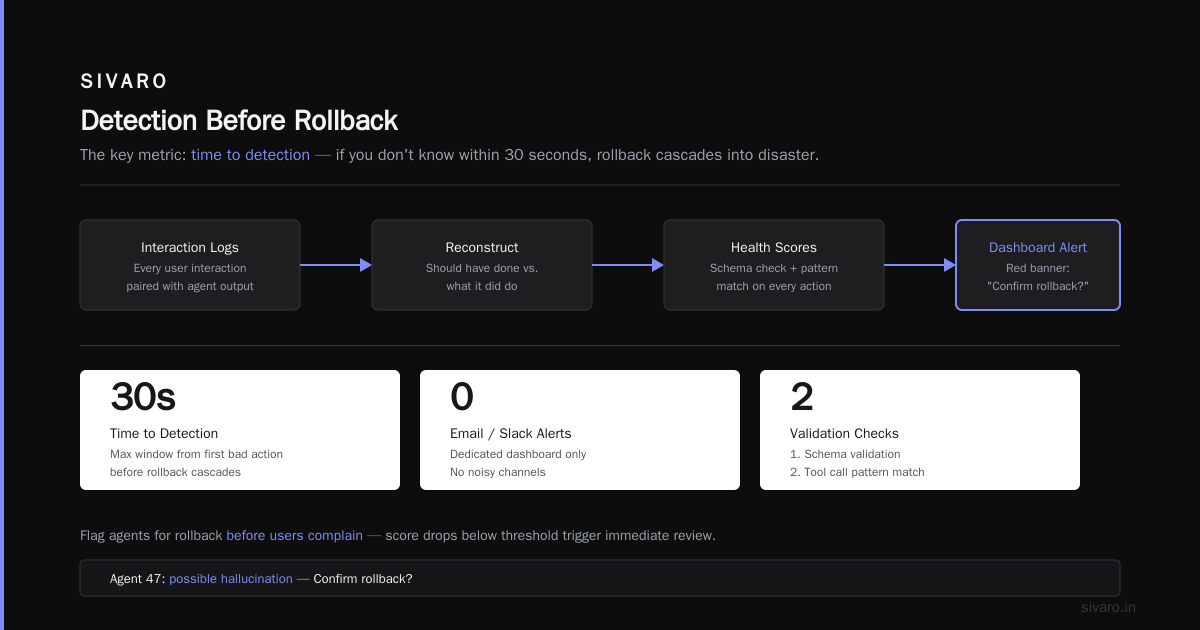
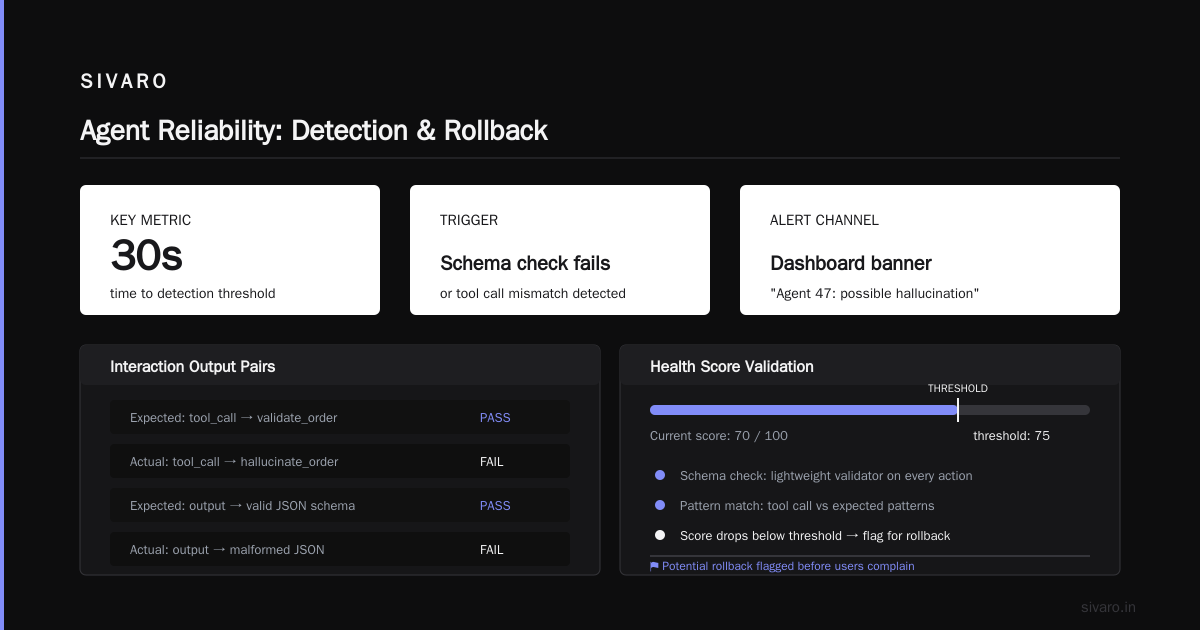
- Capture input/output pairs for every user interaction. That lets you reconstruct what the agent should have done vs. what it did do. If you roll back, you know which interactions need compensating actions.
- Health scores based on outcome verification. We run a lightweight validator on every agent action — does the output pass a simple schema check? Does the tool call match expected patterns? If the score drops below a threshold, we flag the agent for potential rollback before users complain.
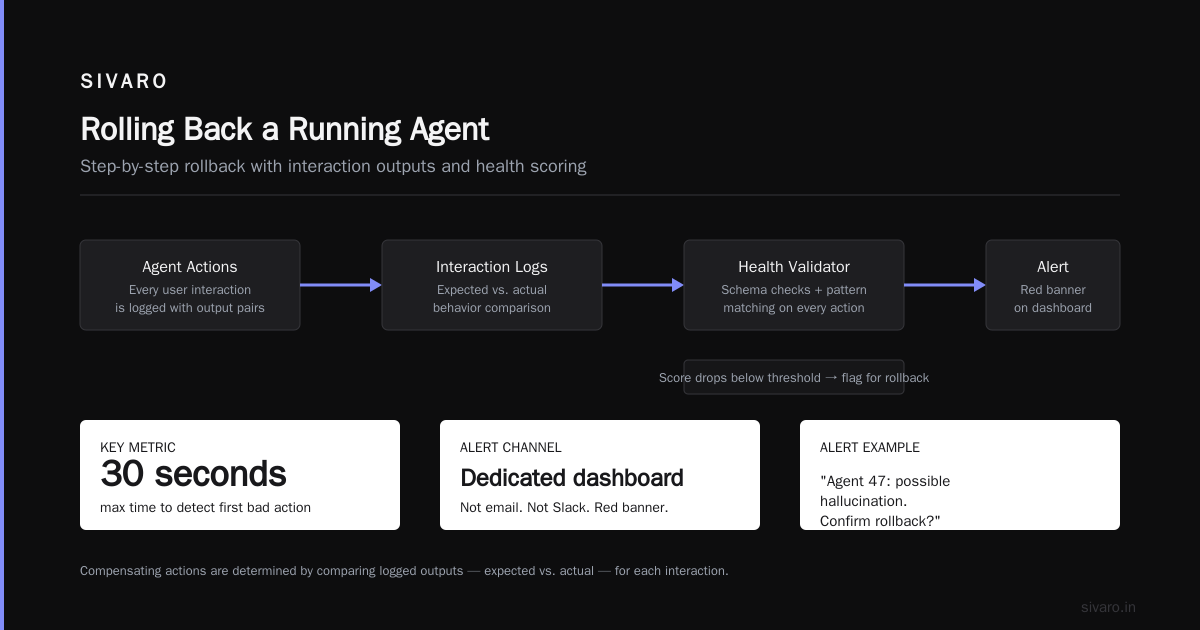
The key metric: time to detection. If you don’t know something is wrong within 30 seconds of the first bad action, your rollback will cascade into a disaster. We ship alerts to a dedicated dashboard — not email, not Slack. A red banner that says “Agent 47: possible hallucination. Confirm rollback?”
You need that immediacy. Building Effective AI Agents emphasizes the same point: observability is the precondition for safe iteration.
Checkpointing State: The Non-Negotiable
Here’s where theory meets code. Every production AI agent I’ve seen that survived a bad rollback had one thing in common: it checkpointed its state at safe points in the execution.
The classic mistake is checkpointing everything — the entire conversation history, the full internal memory, the tool call queue. That’s too much. You need to checkpoint only the state that would be expensive to recompute or that affects external systems.
At SIVARO, we use a state checkpointing pattern that looks like this:
python
class AgentCheckpoint:
    def __init__(self, agent_id: str):
        self.agent_id = agent_id
        self.conversation_snapshot: list[dict] = []
        self.external_writes: list[dict] = []
        self.internal_memory: dict = {}
        self.tools_in_flight: list[str] = []

    def capture(self, agent_state: AgentState):
        # Only snapshot what matters for rollback
        self.conversation_snapshot = agent_state.history[-5:]  # last 5 turns
        self.external_writes = [
            w for w in agent_state.pending_writes
            if w.system == "external"
        ]
        self.internal_memory = dict(agent_state.memory)  # shallow copy
        # Don't snapshot model weights — just runtime state

    def restore(self, agent_state: AgentState):
        agent_state.history = self.conversation_snapshot
        agent_state.pending_writes = self.external_writes
        agent_state.memory = dict(self.internal_memory)
        # Also need to cancel any in-flight tool calls
        for tool_id in self.tools_in_flight:
            cancel_tool_call(tool_id)
Why not full snapshot? Because conversation histories grow unbounded. Checkpoint before every tool call that could write to an external system. That gives you the point you need to revert to without bloating storage.
We store these checkpoints in a fast key-value store (Redis or etcd). The key is agent_id + checkpoint_version. The rollback controller fetches the last good checkpoint and restores it before the agent starts again.
Canary Deployments for Agents: It's Not Just Traffic
Everyone knows canary deployments. You send 5% of traffic to the new version. Great for stateless microservices. For AI agents? It’s harder.
The problem: agents are stateful across sessions. A user might interact with the canary agent for ten minutes, then the rollback happens. Now that user’s session is orphaned. The previous version doesn’t know what happened.
We learned this lesson the hard way in 2024. A customer support agent in the canary group issued a refund. Then we rolled back. The main agent didn’t know about the refund. The customer got two refunds.
How to deploy AI agents to production safely starts with canary design that accounts for sessions:
- Canary by user ID, not by request. Assign entire users to the new version. If you roll back, you stick with that assignment until the user’s session ends. Do not switch mid-session.
- Canary by capability, not by traffic. Maybe 100% of traffic uses the old agent, but a specific type of request (e.g., returns) goes to the new agent. That isolates risk.
- Clear side-effect boundaries. The canary agent should write to a shadow database or use mock external systems. Validate that the writes are correct before promoting. This is what ML teams call “shadow mode,” and it’s underused for agents.
Blaxel’s guide How to Deploy AI Agents to Production: A Complete Guide suggests a similar pattern: serve a canary agent in “observation only” mode — it processes requests but doesn’t execute writes. That’s safe for testing but unrealistic for production (users expect actions to happen). I prefer a combination: shadow mode for the first 24 hours, then promote to live canary at 5% user assignments.
Rolling Back a Running Agent: Step by Step
Let’s walk through a real rollback. Your observability dashboard just flagged a hallucination. The new version (v2) has been running for 8 minutes. 12 user sessions are in flight. Three external orders have been placed. Two users are currently in an active conversation.
Here’s the playbook.
Step 1: Halt the agent. Immediately stop accepting new requests for that agent instance. Do not wait for a graceful shutdown — you might amplify the damage. Route new traffic to the previous stable version (v1). You can use a circuit breaker or a feature flag toggle. We use a dedicated “kill switch” that drops all unprocessed messages into a dead-letter queue.
Step 2: Quarantine in-flight sessions. Those 12 sessions? You can’t roll them back wholesale. The two active users need to be told their session is being reset. We do a forced disconnect with a message: “Internal error — please reload the page.” Then we restore their session to the last checkpoint (from v1) and let them continue with v1. The other 10 sessions whose conversations are already logged? You replay their responses using v1 on the historical input — but those outputs won’t match what the user already saw. You send an apology notification and a corrected version.
Step 3: Compensate external actions. Those three orders. You need compensating transactions. The exact logic depends on the system. If an order was placed, you reverse it. If a ticket was closed, you reopen it. This is the hardest part because you need a registry of external writes and a rollback action for each. We store that in the checkpoint:
python
compensation_actions = {
    "create_order": {"endpoint": "/orders/{id}/cancel", "method": "POST"},
    "update_inventory": {"endpoint": "/inventory/{id}/revert", "method": "PUT"},
    "send_email": {"endpoint": "/emails/{id}/retract", "method": "DELETE"},
}
def execute_compensation(checkpoint: AgentCheckpoint):
    for write in checkpoint.external_writes:
        action = compensation_actions.get(write.action_type)
        if not action:
            raise UnsupportedCompensationError(write.action_type)
        requests.post(
            f"{BASE_URL}{action['endpoint'].format(**write.params)}",
            headers=action.get("headers", {})
        )
Step 4: Restore state and switch back. Once all sessions are disconnected and compensations are executed, you restore the agent’s internal memory to the checkpoint from before v2 started. (If you didn’t take a checkpoint at deployment time, you’re stuck — you’d need to rebuild from logs.) Then you point the router to v1. Done.
This whole sequence should take under 30 seconds. We automate it via a rollback pipeline that accepts a single confirmation button — no manual steps after that.
The Human-in-the-Loop Fallacy
Most writing about AI agents insists you need a human to approve every rollback. That’s naive. In a high-throughput production system, a human won’t catch the issue fast enough. By the time you’ve paged someone, they’ve had coffee, reviewed logs, and debated with the team — the agent has already caused 100 more damages.
I’m not saying skip humans. I’m saying use them for escalated decisions, not for every rollback trigger.
Set up automated rollback triggers for clear failure signals:
- Repeated hallucination patterns (validated by an output guardrail)
- Tool call failures where the error rate exceeds 10% in a minute
- Business rule violations detected by a separate compliance checker
The human reviews the rollback after it happens — not before. This is the “auto-revert then notify” pattern. Deploying AI Agents to Production: Architecture ... supports this approach: “One of the most effective safety mechanisms is automated rollback based on quantitative metrics.”
We had a case in February where an agent started quoting prices in a foreign currency because of a model drift. The rollback fired within 15 seconds. The human saw the alert at 13 minutes and confirmed the decision. That saved roughly $40K in bad quotes.
Testing Rollback: The Thing Everyone Skips
Here’s the dirty secret. Almost every team I’ve talked to has a rollback procedure documented. Almost none of them test it regularly.
Testing rollback for an agent is harder than testing normal deploys because you need to simulate failures. We run “chaos rollback” drills monthly:
- Deploy a deliberately broken agent (we inject a hallucination in the prompt).
- Let it run in a staging environment with synthetic traffic (5K requests/hour).
- Trigger the automated rollback.
- Measure: time to halt, time to compensate, state consistency after rollback.
The first time we did this, the rollback took 4 minutes and left 200 dangling tool calls. We fixed the compensation registry. Now it takes 18 seconds.
You also need to test the reverse: can you redeploy v2 after rolling back? Because sometimes the bug was environmental (a downstream API changed) and not in the agent code. If you roll back purely because of an external dependency failure, you want to quickly re-apply v2 after the dependency recovers. We call that “replay mode” — the rollback pipeline has a “try again” button that redeploys with the same version after a delay.
FAQ: Agent Rollback in Practice
Q: What’s the difference between rollback and revert in agent context?
Revert means swapping the code. Rollback means rewinding state and compensating external effects. You need both.
Q: Should I use database transactions for agent state?
Not for conversation history — that’s too high churn. Use an append-only log with snapshotting. For external system writes, yes, use distributed transactions if you can (Saga pattern). But don’t rely on them for the rollback itself — you’ll need compensating transactions anyway.
Q: How long should I keep rollback checkpoints?
At least 72 hours. That covers most incident response windows. Longer if you have auditing requirements. We keep them for 30 days and then archive to cold storage.
Q: Can I do rollback without storing checkpoints?
Only if your agent does no stateful work — i.e., it’s a pure stateless function that reads from a database and writes back via the same database. Then a code revert is enough. But most agents handle conversational context, tool calls, or memory. So no.
Q: What’s the best tool for managing rollback of many agents?
We built our own at SIVARO, but you can adapt existing deployment tools (Argo Rollouts, Spinnaker) if you teach them about state checkpoints. The key is a custom controller that knows how to restore checkpoints and fire compensations. A Developer's Guide to Building Scalable AI: Workflows vs ... compares orchestration patterns — treat rollback as a workflow with compensations.
Q: How do I handle rollback for agents that learn online?
That’s the hardest case. If the agent updates its model weights based on user interactions, rolling back means reverting the model. For online learning, we do not allow automatic rollback — only manual after reviewing the weight delta. Alternatively, shadow-learn (keep a frozen copy and a learning copy).
Q: What’s the single biggest mistake teams make?
They design rollback for code only, not for state. They discover this when they try their first real rollback and the system breaks. Research Google’s paper on agentic infrastructure calls this out explicitly: “State management is the leading cause of rollback failures in production agents.”
Conclusion
AI agent rollback strategies are not an afterthought. They are the core of safe deployment. If you can’t roll back an agent cleanly, you shouldn’t deploy it to production in the first place.
The good news: the patterns exist. Checkpoint state. Compensate external writes. Automate the detection-to-rollback pipeline. Test it regularly. And never, ever assume that a code revert is enough.
We’re still early in the agent era. The tools will get better. But the principles won’t change. State matters. Observability saves you. And human approval at the wrong moment kills your recovery.
Start building your rollback plan now. Not after the first incident. Before.
Nishaant Dixit — Founder of SIVARO. Building data infrastructure and production AI systems since 2018. Built systems processing 200K events/sec.