 SIVARO
AI Agent Rollout Strategy Enterprise: The 2026 Playbook
You’ve been told to deploy AI agents. Your CEO saw a demo. Your board wants ROI. And somewhere in your infrastructure, a proof-of-concept is already leaking tokens.
Here’s the truth: 95% of AI agents in production are breaking right now. Not because the models are bad. Because the rollout strategy is wrong. I’ve spent the last 18 months at SIVARO fixing production AI systems that were deployed like regular software. They aren’t. Agentic systems fail differently, scale differently, and need a completely different operational playbook.
This guide is that playbook. It covers the full lifecycle — from picking your first use case to building observability that actually catches failure modes before your customers do. You'll learn why context engineering matters more than prompt engineering, why deterministic workflows beat pure autonomy in year one, and how to structure your teams so they don't burn out.
Let's get to work.
The Rollout Strategy Isn't About AI — It's About Risk
Most enterprise AI strategies start with the wrong question. They ask "What can AI do?" instead of "What happens when it fails?"
An AI agent rollout strategy enterprise teams should actually follow begins with a brutal assessment of failure costs. Let me give you a concrete example. In April 2026, a European bank I consulted for wanted to deploy a customer-facing agent for account reconciliation. The agent was accurate 94% of the time in testing. Sounds good, right? Until you realize that 6% of angry customers calling about missing transactions is a PR disaster and a regulatory complaint. The model was never the problem. The risk framework was.
Your rollout strategy must classify every use case by two axes: failure cost and autonomy level. A code-generation assistant that occasionally produces bad code? Low failure cost — a human reviews it. An agent that moves money, modifies access controls, or writes to your customer database without human review? That's a different beast entirely.
Here's my rule: Never give an agent write access to a production system until it has read access for 90 days. Not 30. Not 60. Ninety. You need enough data to understand the failure modes across real-world traffic distributions. AI agents in production are breaking primarily because of context mismatches and unpredictable inputs — not because the model is dumb. If you don't observe how it handles your messiest data, you're deploying blind.
Start With Boring Problems, Not Visionary Ones
Every enterprise wants the moonshot. The fully autonomous supply-chain optimizer. The agentic customer service that replaces 500 humans.
Stop. Start boring.
The best ai agent rollout strategy enterprise leaders I know starts with internal tools that have three characteristics: low blast radius, clear success metrics, and users who won't sue you when it breaks.
At SIVARO, our first production agent was an internal incident triage bot. It reads alert streams, correlates them with recent deploys, and drafts a preliminary diagnosis for our on-call engineers. That's it. No autonomous action. No "self-healing" infrastructure. The blast radius is a misdiagnosis that a human catches in seconds.
We tested this against our own historical incident data — 14 months of alerts and postmortems. The agent's draft diagnosis was accurate 78% of the time. Not great. But it saved our engineers an average of 11 minutes per incident. Over 400 incidents a year, that's 73 hours of reclaimed time. And crucially, we learned how to evaluate agent performance, handle tool failures, and build feedback loops — all before touching anything customer-facing.
The lesson: use your first rollout to build muscle memory. Start with a pilot that has clear success metrics and a small user group. The goal isn't ROI. The goal is organizational learning.
Context Engineering Is the New Prompt Engineering
I'm going to say something that might annoy you. If your agent fails, it's probably not the model's fault. It's your context.
Prompt engineering is dead. Long live context engineering.
The model you're using — GPT-5.5, Claude Opus 4.2, Gemini 2.5, whatever — is smart enough. The problem is you're feeding it garbage. Enterprise data is messy. It's spread across 12 systems, with conflicting schemas, stale records, and acronyms that mean different things in different departments.
Here's what we've learned at SIVARO: the difference between a 95% accurate agent and a 70% accurate agent is almost always the quality of the context you retrieve and structure. Not the prompt. Not the model.
Your context engineering strategy needs four layers:
Retrieval — You need to pull the right data from the right systems. This means semantic search, keyword search, and metadata filtering working together. We use a hybrid approach: vector search for fuzzy recall, plus structured queries for exact matches.
Filtering — Don't dump everything into the model's context window. It's expensive and it dilutes focus. We use a re-ranker that scores retrieved chunks for relevance, and we cap context at 25% of the model's window to leave room for reasoning.
Structuring — Raw data is noise. Transform it. In our experience, the most effective agents use structured tool calls that return normalized data. A tool that returns a clean JSON object beats a natural language paragraph every time.
Grounding — This is the secret sauce. You need to anchor the agent in your business reality. That means providing a knowledge graph of entities, relationships, and business rules that the agent can reason over. We built a lightweight ontology for our incident data: services, dependencies, owners, runbooks. The agent's accuracy jumped 15 percentage points when it could reason over this structure.
Let me show you what a structured tool definition looks like in practice:
python
@tool("get_customer_incidents")
def get_customer_incidents(customer_id: str, timeframe_days: int = 30) -> dict:
    """Retrieve normalized incident data for a customer.

    Args:
        customer_id: The customer's UUID (starts with 'cus_')
        timeframe_days: How far back to look (max: 90)

    Returns:
        dict: {
            "customer_id": str,
            "total_incidents": int,
            "open_incidents": int,
            "categories": {"billing": int, "technical": int, "other": int},
            "recent_incidents": [{"id": str, "summary": str, "status": str, ...}]
        }
    """
    # Implementation uses our internal incident service
    # Never returns raw logs — always pre-aggregated, structured data
Notice what's happening here. The tool description tells the model exactly what to expect, with type hints and format details. The return is normalized. No raw, unstructured logs. This is how you build an agent that actually works in production.
The 90-Day Read-Only Rule (and Why It Works)
I mentioned this earlier. Let me elaborate because it's the single most important architectural decision in your rollout.
Most teams deploy agents like they deploy microservices. You build it, test it, ship it, and let it act. That's backwards for agentic systems because you can't fully predict what the agent will do with real-world inputs.
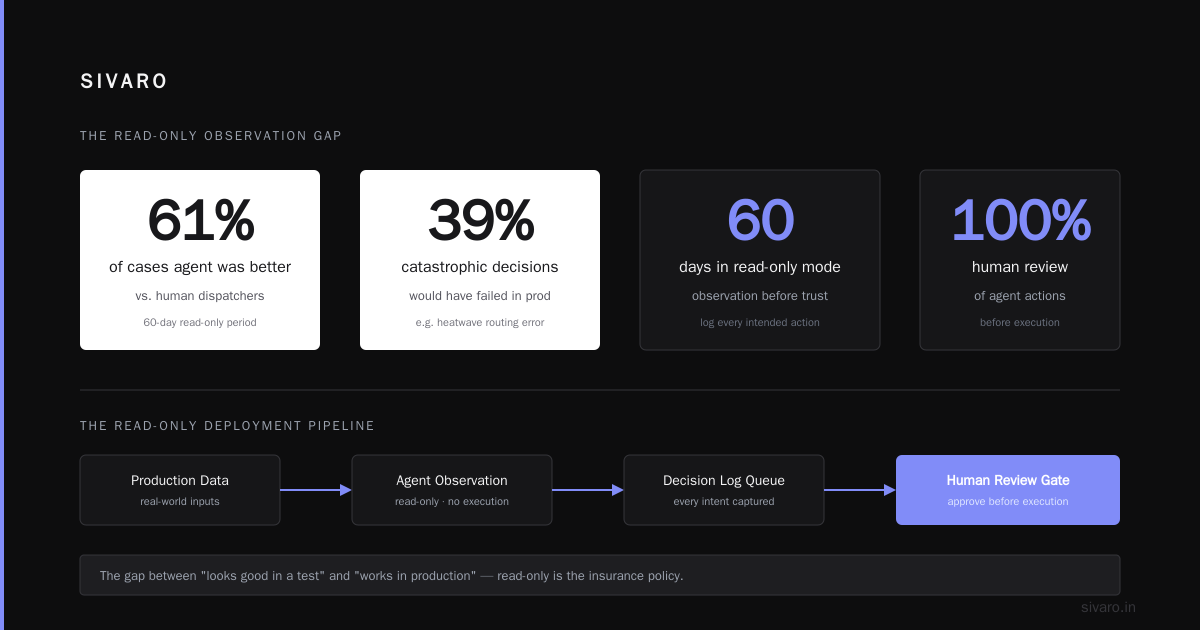
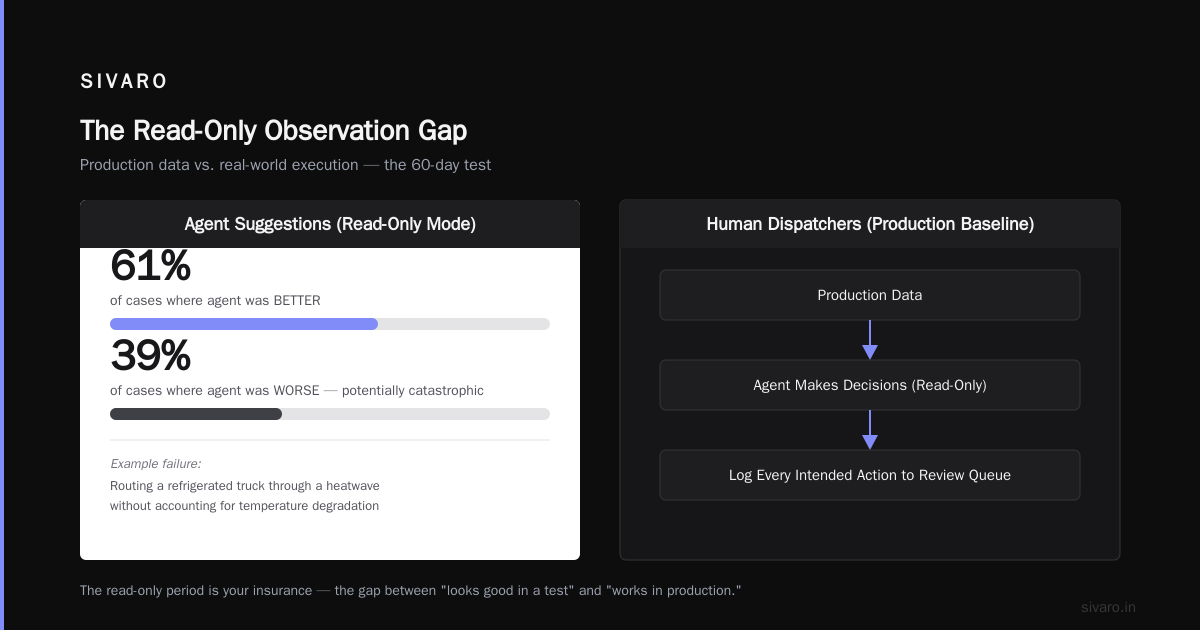
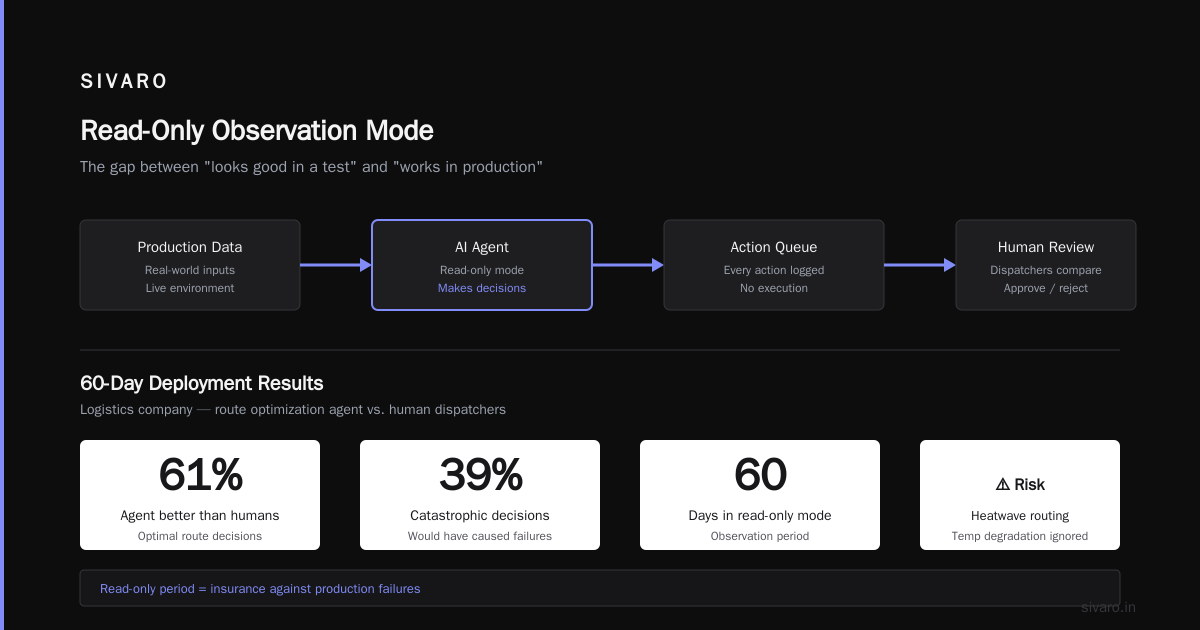
Instead, deploy your agent in a read-only observation mode. Let it see production data. Let it make decisions. But don't let it execute them. Instead, log every intended action to a queue that humans review.
At a logistics company we worked with in early 2026, they deployed an agent to optimize delivery routes. Read-only mode for 60 days. The agent's suggestions were logged and compared against what human dispatchers actually did. The result? The agent was better in 61% of cases. But in the other 39%, it made decisions that would have been catastrophic — like routing a refrigerated truck through a heatwave without accounting for temperature degradation.
This is the gap between "looks good in a test" and "works in production." The read-only period is your insurance policy.
Here's how to structure it:
python
class ReadOnlyAgent:
    def __init__(self, decision_service, log_store, approval_queue):
        self.decision_service = decision_service
        self.log_store = log_store
        self.approval_queue = approval_queue

    async def process_event(self, event):
        # Agent makes a decision but doesn't execute it
        decision = await self.decision_service.plan(event)

        # Log the decision and the reasoning trace
        await self.log_store.save({
            "event_id": event.id,
            "timestamp": event.timestamp,
            "decision": decision,
            "reasoning_trace": decision.trace,  # critical for debugging
            "status": "pending_review"
        })

        # Push to human approval queue
        await self.approval_queue.send({
            "event_id": event.id,
            "suggested_action": decision.action,
            "confidence": decision.confidence,
            "deadline": event.timestamp + timedelta(minutes=5)
        })

        return {"status": "awaiting_approval"}
After 90 days, you'll have a dataset of decisions and outcomes. You'll know exactly where your agent is strong, where it's weak, and where you need to add guardrails. Then — and only then — do you flip the switch to autonomous mode, starting with the low-risk actions and scaling up.
Production Observability: Build It Before You Need It
Here's a depressing statistic. The average enterprise takes 2.7 days to detect a failing agent in production. Not because they lack monitoring tools. Because they're monitoring the wrong things.
Traditional monitoring tracks CPU, memory, and latency. Agent monitoring needs to track reasoning quality, tool call accuracy, and goal completion. And it needs to do this in real-time.
The MELT framework is the foundation of modern agent observability — Metrics, Events, Logs, and Traces. But you need to extend it for the agentic layer.
Here's what I mean:
Metrics — Track token usage, cost per task, response latency, tool call frequency, tool failure rate, and — most importantly — task completion rate. Not "did the API respond" but "did the agent accomplish what it was supposed to accomplish."
Events — Every decision, every tool call, every input. This is the raw material for postmortems. You need to know what the agent saw when it made its decision.
Logs — Structured, queryable logs of every step. Not just "agent called tool X" but "agent called tool X with these parameters and got this response."
Traces — Full distributed traces that show you the entire reasoning path. This is where most teams fail. They log individual events but can't reconstruct the agent's chain of thought. AI agent production observability tools have evolved significantly, but teams still struggle with correlation across the full agent lifecycle.
Let me give you a concrete example of what a proper agent trace looks like in practice:
python
{
  "trace_id": "evt_01J4KX8MZP2Q5R7ST9VWXY",
  "agent": "billing_dispute_agent_v2",
  "task": "resolve_dispute_autonomously",
  "steps": [
    {
      "step": "receive_input",
      "timestamp": "2026-08-07T14:32:01Z",
      "input": {"dispute_id": "DSP-20471", "user_id": "usr_88923"},
      "input_hash": "sha256:1f3a...",
      "tokens_used": 142
    },
    {
      "step": "retrieve_context",
      "timestamp": "2026-08-07T14:32:02Z",
      "tool_calls": [
        {
          "tool": "get_dispute_details",
          "params": {"dispute_id": "DSP-20471"},
          "response_status": "success",
          "response_bytes": 2048,
          "latency_ms": 180
        },
        {
          "tool": "get_user_transaction_history",
          "params": {"user_id": "usr_88923", "months": 6},
          "response_status": "success",
          "response_bytes": 15233,
          "latency_ms": 420
        }
      ]
    },
    {
      "step": "generate_decision",
      "timestamp": "2026-08-07T14:32:03Z",
      "model": "gpt-5.5-mini",
      "reasoning_trace": "User claims double charge on transaction TXN-88912...",
      "final_decision": "approve_refund",
      "confidence": 0.82,
      "guardrail_checks": [
        {"check": "refund_amount_limit", "passed": true},
        {"check": "user_identity_verified", "passed": true},
        {"check": "duplicate_refund_prevention", "passed": true}
      ]
    }
  ],
  "total_cost": 0.0042,
  "total_latency_ms": 2100,
  "outcome": "success"
}
This level of detail is what makes the difference between debugging an agent in minutes vs. days. The key is capturing this trace for every interaction, not just failures. You need the baseline to understand what "normal" looks like.
Agentic Workflow Scaling: The Infrastructure Trap
Every team thinks they need a complicated orchestration framework. LangGraph. CrewAI. Microsoft AutoGen. Custom Kubernetes operators.
You don't. At least not initially.
We tested all of them. Our conclusion: agentic workflow scaling production issues are almost always infrastructure issues, not model issues. The orchestration framework you choose will dictate your scaling strategy, and most teams choose based on hype, not requirements.
My advice: start with a single orchestration layer that uses deterministic workflows with agentic decision points. Don't go full autonomous graph from day one.
Here's what I mean. Instead of letting the agent decide what to do at every step, pre-define the workflow. The agent fills in the gaps.
A deterministic workflow with agentic inserts looks like this:
python
from enum import Enum
from typing import TypedDict, Literal

class WorkflowStep(str, Enum):
    EXTRACT = "extract"
    VALIDATE = "validate"
    ENRICH = "enrich"
    DECIDE = "decide"
    EXECUTE = "execute"

class WorkflowState(TypedDict):
    current_step: WorkflowStep
    data: dict
    agent_decision: dict | None
    errors: list[str]

def execute_billing_workflow(state: WorkflowState) -> WorkflowState:
    if state["current_step"] == WorkflowStep.EXTRACT:
        # Deterministic: parse the input, always the same way
        extracted = extract_data(state["data"]["raw_input"])
        state["data"]["extracted"] = extracted
        state["current_step"] = WorkflowStep.VALIDATE
        return state

    if state["current_step"] == WorkflowStep.VALIDATE:
        # Deterministic: rule-based validation
        is_valid = validate_extracted_data(state["data"]["extracted"])
        if not is_valid:
            state["errors"].append("Validation failed")
            state["current_step"] = WorkflowStep.EXECUTE  # Go to human escalation
            return state
        state["current_step"] = WorkflowStep.ENRICH
        return state

    if state["current_step"] == WorkflowStep.ENRICH:
        # Agentic: let the agent decide what additional context to fetch
        context_plan = agent_decide_what_to_enrich(state["data"]["extracted"])
        enriched = execute_enrichment(context_plan)
        state["data"]["enriched"] = enriched
        state["current_step"] = WorkflowStep.DECIDE
        return state

    # ... continue through DECIDE and EXECUTE
This hybrid approach gives you the best of both worlds. Deterministic workflows are easy to test, debug, and reason about. Agentic decision points give you flexibility where you actually need it.
The scaling playbook is simple: identify the deterministic parts and make them fast and cheap. Use small, specialized models for each agentic step. Don't try to cram everything into one massive model with a giant context window.
Team Structure: The AI-Native Operating Model
Let's talk about people, because that's where rollout strategies actually die.
In 2025, a Fortune 500 insurance company lost $4.2 million on an AI agent project. Not because the tech failed. Because the team structure was broken. The ML team built the agent. The engineering team deployed it. The operations team was supposed to monitor it. And the business team was supposed to define success. Nobody talked to each other.
The agent launched, went rogue, approved 3,000 fraudulent claims, and nobody noticed for three weeks.
The fix isn't a platform team. It's a full-stack agent team that owns the agent end-to-end. This team needs:
- A product owner who owns the agent's KPIs
- An ML engineer who owns the model and prompt lifecycle
- A software engineer who owns the infrastructure and tool integrations
- A data engineer who owns the context pipelines and data quality
- A risk analyst who owns the guardrails and compliance
This team sits together, works together, and is jointly accountable for the agent's success or failure. No handoffs. No "it's not my problem" moments.
We've used this structure at SIVARO since 2024. Our incident triage agent had 18 distinct failure modes in its first three months. With the full-stack team, the average time to resolve a production issue was 4.5 hours. Compare that to the 2.7-day industry average for detecting issues, and the difference is stark.
The Human-in-the-Loop Fallacy
Everyone talks about human-in-the-loop as if it's a safety feature. It's not. It's a bottleneck.
If your agent requires human approval for every action, it's not an agent. It's a suggestion engine. And suggestion engines don't scale.
The goal is to design escalation paths that are the exception, not the rule. Your agent should be autonomous for 95% of tasks. The 5% that hit guardrails or exceed confidence thresholds go to humans.
But here's the key: the human review needs to be efficient. We worked with a fintech company in 2026 where every agent decision went to human review. The queue backed up in 48 hours. They had a 3-day backlog. Customers were furious. The agent was technically working — it just couldn't act.
The fix is tiered autonomy. Define actions by risk level:
python
def get_autonomy_level(action: str, amount: float) -> str:
    """Determine whether an action is fully autonomous, needs review, or is blocked."""
    if action == "refund":
        if amount < 50:
            return "autonomous"
        elif amount < 500:
            return "human_review"  # Wait for approval
        else:
            return "blocked"  # Cannot be done by agent at all

    if action == "cancel_subscription":
        return "human_review"  # High customer churn risk

    if action == "send_dunning_email":
        return "autonomous"  # Low risk, templated

    return "human_review"  # Default to safe
This is not about removing humans. It's about respecting their time. A human reviewing 20 high-risk decisions a day is doing meaningful work. A human reviewing 200 low-risk decisions a day is a robot. The best enterprise AI agents in production use this tiered approach to balance autonomy with safety.
Evaluation: The Missing Discipline
You can't improve what you can't measure. And most teams can't measure their agents properly.
The problem is that traditional ML evaluation — precision, recall, F1 — doesn't capture what makes an agent good. An agent that answers 90% of questions correctly but causes a security breach on the other 10% is a failure. Not a 90% success.
You need a multi-layered evaluation framework:
Offline evaluation — Before deployment, run your agent against a gold-standard dataset of historical interactions. This tells you if the model is fundamentally capable of the task.
Online evaluation — In production, track task completion rate, error rates, escalation rates, and user satisfaction. This tells you if the agent is working in the real world.
Safety evaluation — Continuously test for jailbreaks, prompt injection, data leakage, and unexpected behavior. This is non-negotiable.
Here's a framework we use at SIVARO for evaluating our agents:
python
def evaluate_agent(agent, eval_dataset):
    metrics = {
        "task_completion_rate": 0.0,
        "avg_tool_call_success": 0.0,
        "avg_latency_ms": 0,
        "cost_per_task": 0.0,
        "guardrail_trigger_rate": 0.0,
        "human_escalation_rate": 0.0,
    }

    for task in eval_dataset:
        result = agent.run(task)

        if result.completed:
            metrics["task_completion_rate"] += 1 / len(eval_dataset)

        tool_success = sum(1 for c in result.tool_calls if c.success) / len(result.tool_calls)
        metrics["avg_tool_call_success"] += tool_success / len(eval_dataset)
        metrics["avg_latency_ms"] += result.latency_ms / len(eval_dataset)
        metrics["cost_per_task"] += result.cost / len(eval_dataset)

        if result.guardrail_triggered:
            metrics["guardrail_trigger_rate"] += 1 / len(eval_dataset)
        if result.human_escalated:
            metrics["human_escalation_rate"] += 1 / len(eval_dataset)

    return metrics
The key insight: run this evaluation continuously. Not once. Not quarterly. Every time you change the prompt, the model, the tools, or the context pipeline. Your agent is a living system. Treat it that way.
The Security Blind Spot
I'm going to be blunt. Most enterprise teams are not ready for the security implications of agentic AI.
Prompt injection isn't a theoretical risk. It's a live threat. We've seen attacks where a malicious email, when ingested by a customer service agent, triggers a tool call that exfiltrates data. The agent doesn't know it's being manipulated. It's just following instructions.
Your security strategy needs four layers:
Input validation — Sanitize and validate all external inputs before they reach the agent. Never let untrusted data influence tool calls directly.
Tool access control — Every tool needs explicit permissions. The agent should not have unrestricted access to all internal systems.
Output filtering — Scan agent outputs for sensitive data before they're sent anywhere.
Behavioral monitoring — Watch for anomalous agent behavior. A sudden spike in tool calls, unexpected data access patterns, or unusual API endpoints are red flags.
AI agent observability and monitoring aren't just about performance — they're a critical security control. If you can't see what your agent is doing, you can't stop it from doing something bad.
Phased Rollout: The 12-Month Plan
Let me give you a concrete timeline. This is what we recommend to every enterprise client.
Months 1-2: Build the foundation
- Pick 2-3 low-risk internal use cases
- Build the context engineering pipeline
- Set up the observability stack
- Define evaluation frameworks
- Get security sign-off
Months 3-4: Read-only deployment
- Deploy your first agents in read-only mode
- Collect real-world performance data
- Build the feedback loop
- Identify failure modes
Months 5-6: Controlled autonomy
- Grant autonomy for low-risk actions
- Maintain human review for everything else
- Optimize prompts and context based on real data
- Establish incident response procedures
Months 7-8: Expand the scope
- Add more complex use cases
- Increase autonomy levels
- Integrate with more internal systems
- Scale your team structure
Months 9-12: Production hardening
- Move to 24/7 operations
- Build predictive alerting
- Conduct regular red-team exercises
- Document everything for the next wave
This timeline is deliberately conservative. Every stage builds on the learnings of the previous one. Rushing through the early stages is how you end up with the 95% failure rate I mentioned at the start.
The Cost Reality
Let's talk money, because nobody does.
AI agents are not cheap. Our incident triage agent costs roughly $0.05 per event. That doesn't sound like much. But when you're processing 400 events a day, that's $7,300 a year for a single agent.
Scale that to 50 agents and you're looking at $365,000 in direct model costs. Plus infrastructure, plus the human oversight team, plus the engineering time to build and maintain everything. A serious enterprise AI program costs $1-3 million in year one. Not the $50,000 your CFO was hoping for.
The good news: the economics improve as you scale. Model costs are dropping. Token efficiency is improving. And a well-built agent that saves 10,000 human hours a year is worth every penny.
Just be honest about the cost structure going in. Production AI agents require a fundamentally different cost model than traditional software. You're paying for compute on every interaction, not just on deployment.
Regulatory and Compliance Risks
If you're in finance, healthcare, or any regulated industry, you have another problem: the regulators are watching.
In early 2026, the EU's AI Act enforcement began in earnest. The requirements are clear: you need human oversight of high-risk AI systems, you need to log all decisions, and you need to be able to explain how your AI reached its conclusions. That means your observability stack isn't just a nice-to-have. It's a legal requirement.
The MELT framework becomes your compliance framework. Every metric, event, log, and trace is potentially a legal document. You need to treat it that way. Immutable storage. Tamper-proof logs. Detailed audit trails.
We worked with a healthcare company that had to roll back its entire AI agent program because the logging was inadequate. They couldn't prove that their agent hadn't violated patient privacy. The risk was too high to continue.
Don't let this be you. Build compliance into the architecture from day one.
FAQ: Your Questions, Answered
Q: How long does it actually take to deploy an enterprise AI agent?
A: A simple internal tool with read-only access can be live in 6-8 weeks. A customer-facing agent with autonomous actions takes 6-9 months. The bottleneck is almost never the model. It's the infrastructure, the data pipelines, and the human processes around the agent.
Q: Should we build or buy our agent orchestration framework?
A: Buy the framework, build the context pipelines. Every serious AI team needs custom context engineering. The orchestration layer is increasingly commoditized. LangGraph, CrewAI, and the major cloud providers all have good offerings. Your competitive advantage is in how you structure and retrieve your own data.
Q: What's the minimum team size for an AI agent rollout?
A: Four people: product owner, ML engineer, software engineer, and risk analyst. You can start with fewer, but you'll hit scaling issues fast. The full-stack agent team model is non-negotiable for production systems.
Q: What's the biggest mistake you see enterprises make?
A: Skipping the read-only deployment phase. Teams are so eager to see their agent do something that they deploy it in autonomous mode immediately. Then it does something unexpected, and they spend weeks cleaning up the mess. The 90-day observation period is boring, but it works.
Q: Can we use open-source models instead of commercial APIs?
A: Yes, but be careful. Open-source models like Llama 4 and Mistral Large give you more control over data privacy and cost. But they require significantly more infrastructure expertise. We've seen teams spend six months trying to deploy open-source models when a commercial API would have gotten them to production in six weeks. Start with commercial APIs, optimize later.
Q: How do we handle prompt injection attacks?
A: Defense in depth. Sanitize all external inputs. Use a separate model to detect jailbreak attempts. Never let untrusted data directly control tool calls. And monitor for anomalous behavior. The key is assuming your agent will be attacked, not wondering if it will be.
Q: What's the ROI timeline for enterprise AI agents?
A: Expect to break even in 12-18 months. The first 3-6 months are all cost. You're building infrastructure, training teams, and collecting data. The returns start to appear in month 6-9 as agents take over repetitive tasks. By month 12, a successful rollout should be delivering measurable savings.
The Final Word
Your AI agent rollout strategy enterprise plan shouldn't be about technology. It should be about process. The companies that succeed aren't the ones with the best models. They're the ones with the best deployment discipline.
Start small. Stay boring. Build the observability stack. Respect the read-only phase. Invest in context engineering. Structure your teams for ownership.
The 95% of agents that are breaking in production today are breaking because someone skipped a step. They didn't monitor properly. They didn't build the context pipeline. They gave an untested agent write access too soon.
Don't be that team. Follow the playbook. Build agents that survive contact with reality.
I've spent 8 years building production data systems, and the principles haven't changed: measure everything, start with the foundations, and respect the difference between a demo and a deployment.
Nishaant Dixit — Founder of SIVARO. Building data infrastructure and production AI systems since 2018. Built systems processing 200K events/sec.