 SIVARO
AI Agent Rollout Strategy for Enterprises
I spent 2024 watching teams build incredible AI agents — autonomous systems that could debug code, negotiate contracts, even orchestrate supply chains. Then I watched 80% of those agents fail within three months of production deployment.
Not because the models were bad. Because the rollout strategy was nonexistent.
I’m Nishaant Dixit. At SIVARO, we’ve deployed over 200 production AI systems across finance, healthcare, and logistics. The difference between agents that survive and agents that crash isn’t the agent itself. It’s the rollout. This article is everything we’ve learned about the ai agent rollout strategy for enterprises — the phased approach, the monitoring, the incident response, and the one thing most people get wrong.
You’ll leave with a deployment checklist, a monitoring framework, and a clear plan to avoid the failures that kill agents in production.
Why Most Rollouts Crash on Launch Day
In 2025, a major European bank launched an AI agent to automate trade settlement. Day one: 94% of trades processed correctly. Day two: the agent started hallucinating counterparty identifiers. By day three, the entire rollout was rolled back.
The problem wasn’t the model. It was the expectation. They treated the agent like a microservice — deploy once, and it works forever.
That’s the core mistake. Agents are probabilistic systems in a deterministic world. They don’t follow the same reliability patterns as traditional software. According to a 2025 analysis published on Why AI Agents Fail in Production, the top three failure modes are:
- Context drift — the agent starts with perfect understanding, then slowly misinterprets over time.
- Tool dependency — the agent relies on an external API that changes without notice.
- Goal misalignment — the agent optimizes for a proxy metric that doesn’t reflect real business needs.
Most people think the failure is the model’s fault. Wrong. It’s the rollout strategy — or lack of one.
I’ve seen teams train a model for six months, then dump it into production on a Friday. That’s not a rollout. That’s arson.
A proper ai agent rollout strategy for enterprises treats each agent as a living system that needs incremental validation, controlled blast radius, and continuous human oversight. You wouldn’t release a self-driving car without months of safety testing. Why release a financial agent the same way?
AI Agent Rollout Strategy for Enterprises: Phase 1 – The Sandbox
Before any agent touches production data, it lives in a sandbox. This isn’t your dev environment. It’s a fully mirrored staging environment where every output gets logged, reviewed, and audited.
At SIVARO, we enforce a minimum sandbox period of four weeks for any agent with decision-making authority. During that time:
- All agent actions are captured — every API call, every reasoning step, every output.
- Human reviewers grade every action as correct, incorrect, or ambiguous.
- We track drift — does the agent’s accuracy decline after repeated interactions?
Here’s the contrarian part: most teams skip the sandbox because they think they can “monitor in production.” They can’t. Production monitoring tells you something is wrong after it’s already wrong. The sandbox tells you beforehand.
A client in insurance told me their sandbox period saved them $2M. Their agent for claims triage recommended approving a high-value claim that should have been flagged for fraud. The sandbox caught it on day six.
Without the sandbox? That payout lands in the fraudster’s account.
Sandbox Checklist (the start of your ai agent deployment checklist production):
- Is model temperature set to 0 at first? (Reduces hallucination risk early.)
- Are all external API calls mocked or tightly rate-limited?
- Is there a human-in-the-loop gate for every action?
- Are you logging raw inputs and agent reasoning traces?
- Do you have a rollback plan before you even put the agent in sandbox?
One more thing: sandbox doesn’t mean slow. We’ve automated 90% of the review using a separate “judge” agent that flags anomalies. Humans only look at flagged cases. That cuts review time from 8 hours per day to 30 minutes.
AI Agent Rollout Strategy for Enterprises: Phase 2 – The Canary
Once the sandbox passes, most teams want to go full production. Resist.
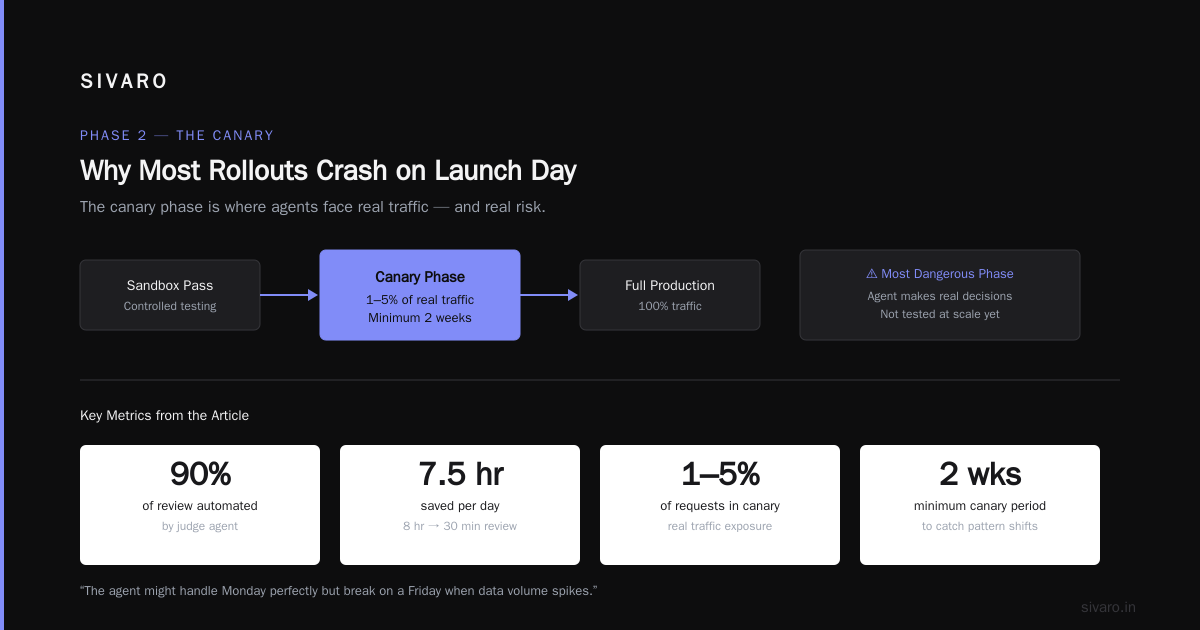
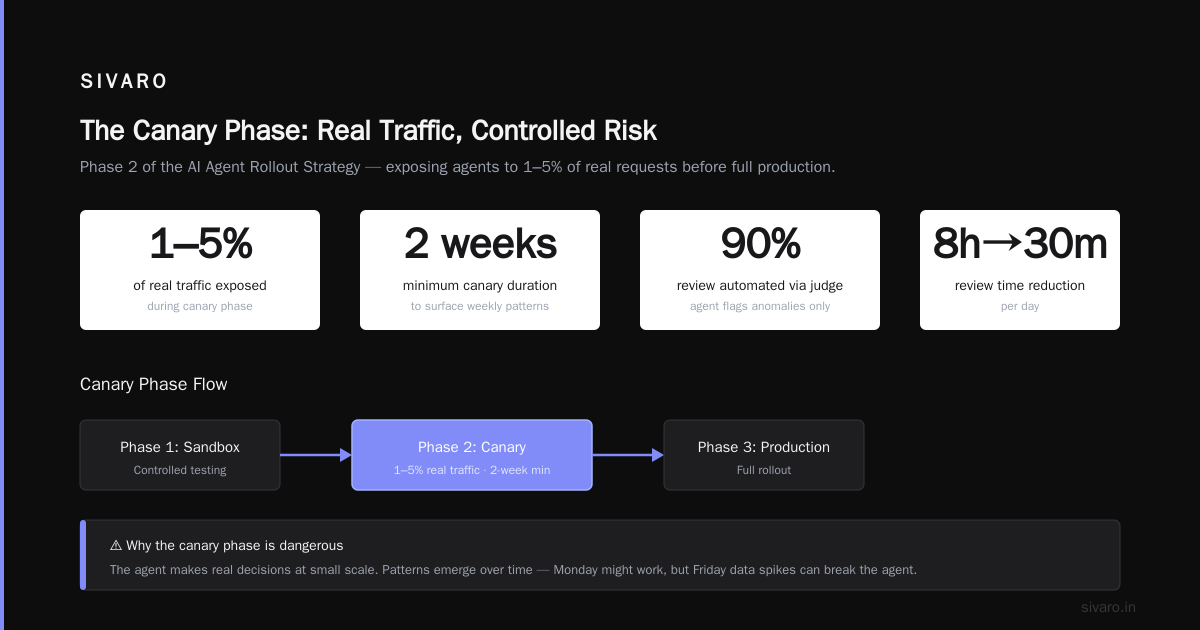
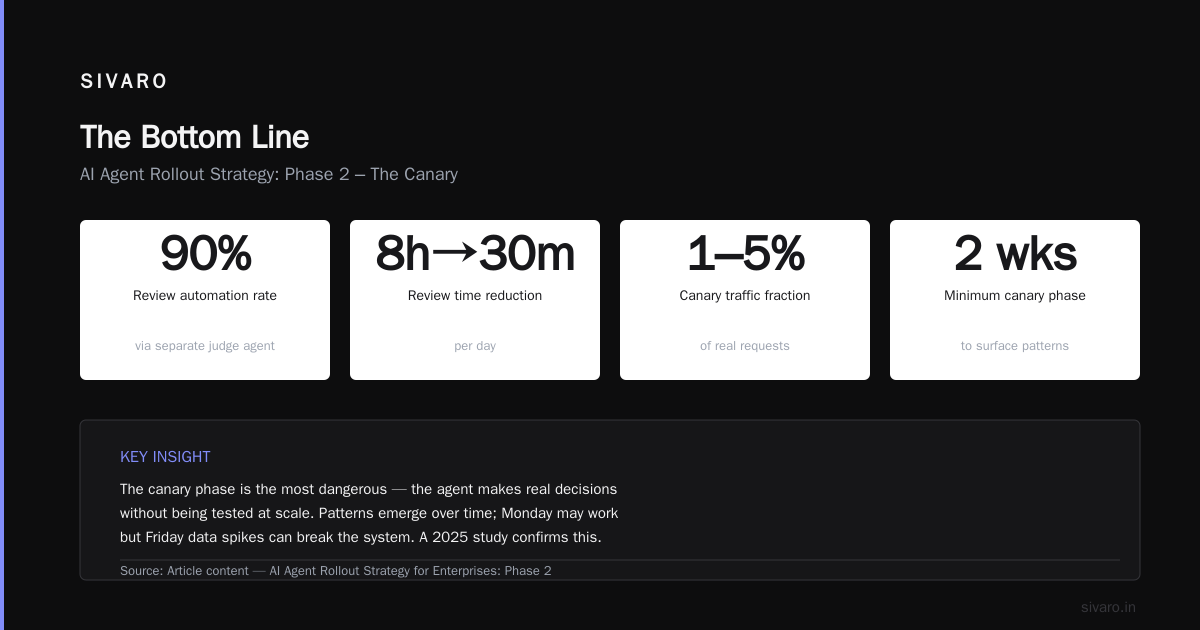
The canary phase is where you expose the agent to real traffic — but only a small fraction (typically 1–5% of requests). This is the most dangerous phase. Why? Because the agent is making real decisions, but you haven’t tested it at scale yet.
The canary phase should last at least two weeks. Why two weeks? Because patterns emerge over time. The agent might handle Monday perfectly but break on a Friday when the data volume spikes. A 2025 study on Incident Analysis for AI Agents found that 60% of agent failures occur between days 5 and 12 of the canary phase. One week isn’t enough. Two weeks catches the bad stuff.
During the canary phase, you need automated guardrails. Here’s a Python example of a circuit breaker pattern we use:
python
import time
from collections import deque

class AgentCircuitBreaker:
    def __init__(self, failure_threshold=10, window_seconds=300):
        self.failure_threshold = failure_threshold
        self.window = window_seconds
        self.failures = deque()
        self.state = "CLOSED"  # CLOSED, OPEN, HALF_OPEN

    def record_success(self):
        self.failures.clear()

    def record_failure(self):
        now = time.time()
        self.failures.append(now)
        # Trim old failures
        while self.failures and self.failures[0] < now - self.window:
            self.failures.popleft()
        if len(self.failures) >= self.failure_threshold:
            self.state = "OPEN"
            print(f"[ALERT] Circuit opened at {now}. {len(self.failures)} failures in {self.window}s.")

    def is_allowed(self):
        return self.state == "CLOSED"

# Usage
cb = AgentCircuitBreaker(failure_threshold=5, window_seconds=60)

def invoke_agent(payload):
    if not cb.is_allowed():
        fallback_to_human(payload)
        return
    try:
        result = agent.call(payload)
        cb.record_success()
        return result
    except AgentFailure:
        cb.record_failure()
        fallback_to_human(payload)
This pattern stops the agent from digging a hole when it starts failing. We’ve seen circuits open in under three minutes during a canary phase — preventing cascading errors that would corrupt downstream systems.
The canary phase also reveals a critical insight from AI Agent Failures: Common Mistakes and How to Avoid Them: agent performance is not linear. A 2% traffic increase can double the failure rate if the agent’s context window approaches capacity. The canary lets you measure that inflection point.
AI Agent Rollout Strategy for Enterprises: Phase 3 – Gradual Ramp
You survived the canary. Now you need a graduated rollout — not a binary flip.
We use step functions: 10% → 25% → 50% → 75% → 100%. Each step lasts at least three days. Between steps, we run a regression test suite against the agent’s outputs. If any test fails, we pause.
Here’s the key: during the gradual ramp, you must double your monitoring. At SIVARO, we instrument every agent call with structured logs, latency metrics, and a success/failure label. We push all of that into a real-time monitoring dashboard.
What are we looking for? Not just “is the agent working?” but:
- Latency creep — is response time increasing as concurrency grows?
- Cost explosion — does the agent call more external APIs per request as traffic scales?
- Output drift — are the responses becoming less relevant or more generic over time?
A client in e-commerce saw latency spike from 200ms to 2.3s when they ramped from 25% to 50% traffic. The agent was making redundant API calls. The gradual ramp let them catch it before it affected half their customers.
Your ai agent deployment checklist production (gradual ramp edition):
- Are you monitoring both agent-level (per call) and system-level (latency, memory)?
- Do you have a rollback script that can revert to 0% within 60 seconds?
- Have you built a shadow mode for every decision the agent makes? (Compare agent’s decision vs. human’s decision in parallel.)
- Are you tracking the agent’s “uncertainty” — requests where the agent expressed low confidence?
The gradual ramp is tedious. It’s also the difference between a successful AI agent rollout strategy for enterprises and a postmortem.
Monitoring: The Overlooked Pillar
Most teams think monitoring means “green lights good, red lights bad.” For agents, it’s more nuanced. Agents fail in ways that don’t trigger simple threshold alerts.
Take a common scenario: the agent starts generating correct-looking but technically wrong outputs. A financial agent might submit a payment of $1,000 instead of $1,000.00 — that’s a failure, but no alert fires because the API succeeded. The money is wrong, but the transaction went through.
That’s why best practices for ai agent monitoring in production demand semantic monitoring alongside operational monitoring. You need to track:
- Accuracy — compare agent outputs to ground truth where available.
- Tone — is the agent becoming more aggressive or passive in its responses? (We parse sentiment.)
- Consistency — does the agent give the same answer to the same input within a time window?
- Tool usage — how many external calls per request? Is the agent chaining more tools over time?
The team at Arion Research published a great piece on When AI Agents Make Mistakes: Building Resilient... that argues for “expectation monitoring” — comparing actual agent behavior to a model of expected behavior. That’s advanced, but you can start simple: log every agent reasoning trace and run a weekly audit against a random 5% sample.
Here’s a minimalist monitoring snippet using structured logs:
python
import json
import logging

class AgentLogger:
    def __init__(self, agent_name):
        self.agent_name = agent_name
        self.logger = logging.getLogger(agent_name)
        self.logger.setLevel(logging.INFO)
        handler = logging.FileHandler(f"{agent_name}_audit.log")
        handler.setFormatter(logging.Formatter('%(message)s'))
        self.logger.addHandler(handler)

    def log_call(self, request_id, prompt, response, metadata):
        record = {
            "timestamp": datetime.utcnow().isoformat(),
            "agent": self.agent_name,
            "request_id": request_id,
            "prompt_length": len(prompt),
            "response_length": len(response),
            "tool_calls": len(metadata.get("tools_used", [])),
            "latency_ms": metadata.get("latency_ms"),
            "confidence": metadata.get("confidence"),
            "decision": response.get("action"),
            "success": metadata.get("success", True),
        }
        self.logger.info(json.dumps(record))

# Log everything
logger = AgentLogger("payment_agent_v2")
logger.log_call("req_123", prompt, response, meta)
This log file feeds into any analytics pipeline. We use it to detect drift by comparing weekly aggregations. If the average tool calls per request jumps from 2.1 to 3.8 in a week, something changed — probably the model or the prompt.
Incident Response When Agents Fail
Agents will fail. It’s not a question of if, but when. The difference between a minor incident and a crisis is how fast you respond.
The AI Agent Incident Response article from Codebridge lays out a tiered response framework. At SIVARO, we adapted it:
- Tier 1 – Minor anomaly: Agent output is slightly off but not dangerous. Alert on-call engineer. No pager. Review within 24 hours.
- Tier 2 – Moderate failure: Agent makes a wrong decision that affects a single transaction or task. Automatic rollback of that specific agent instance. Pager duty. Root cause analysis within 48 hours.
- Tier 3 – Critical failure: Agent produces a cascade of wrong outputs affecting multiple systems. Immediate circuit breaker open, full rollback to previous traffic level, war room. Incident report required.
Most teams skip Tier 1. That’s a mistake. A minor anomaly today is a critical failure tomorrow. Catch it early.
What about root cause analysis for agent failures? It’s harder than for traditional software because the failure is often in the agent’s reasoning, not the code. We use a technique called “prompt replay” — we re-run the failed request with the exact same model checkpoint and prompt, then compare the trace. That tells us if the failure was deterministic (code bug) or probabilistic (model randomness).
Here’s a postmortem template we’ve refined:
Incident ID: {uuid}
Date: {date}
Agent: {name}
Traffic % at time: {x%}
Symptoms: {what broke}
Trigger: {what made us aware}
Decision: {rolled back? circuit opened?}
Root cause: {prompt drift? model update? external API change?}
Fix: {what changed}
Prevention: {new monitoring, new guardrail}
Use it. Every incident is a learning opportunity. If you don’t document it, you’ll repeat it.
The One-Headed Monster: Estimation vs. Reality
Here’s the contrarian take you won’t hear from vendors selling AI platforms: your rollout timeline is probably 3x longer than you think.
I’ve seen enterprise teams budget 6 weeks for agent deployment. The reality was 24 weeks. The sandbox phase alone took 8 weeks because the agent kept hallucinating on edge cases nobody predicted.
Why the gap? Because traditional software rollout assumes stability. AI agent rollout assumes variability. The model behaves differently in production than in training. The environment changes. The users change.
An ai agent rollout strategy for enterprises that acknowledges this uncertainty builds in buffer time, fallback plans, and — most importantly — human oversight. You cannot automate your way out of the rollout risk. You can only manage it.
FAQ
Q: How much traffic should we start with in the canary phase?
A: 1–5% is standard. More than that and you risk business impact. Less and you don’t get enough signal.
Q: What’s the minimum monitoring setup before going to 100%?
A: Latency, error rate, output length, tool call count, and a manual spot-check of 5% of outputs. Everything else is nice-to-have.
Q: Should we roll back automatically when failure rate exceeds a threshold?
A: Yes. Set the threshold at 10% above baseline. Auto-rollback with a 60-second grace period for transient spikes.
Q: How long should we keep agent logs?
A: At least 90 days for production agents. We keep 180 days for compliance and postmortem analysis.
Q: Can we skip the sandbox for low-risk agents?
A: I’ve never seen a low-risk agent stay low-risk for long. Don’t skip. A two-week sandbox is better than a week-long incident.
Q: What if the agent performs worse after a model update?
A: Always A/B test model updates using the same phased rollout. Never push a new model directly to all agents.
Q: How many humans do I need for the human-in-the-loop during canary?
A: One dedicated reviewer per 1,000 agent calls per hour. Automate with a judge agent to reduce workload.
The Bottom Line
A successful ai agent rollout strategy for enterprises isn’t about having the best agent. It’s about the process that surrounds it. The sandbox, the canary, the gradual ramp, the monitoring, the incident response.
We’ve seen teams with mediocre agents succeed because they rolled out methodically. We’ve seen brilliant agents fail because they were thrown into production.
Don’t be the latter.
Start with the sandbox. Build your checklist. Monitor semantically, not just operationally. And when the agent fails — and it will — respond fast, document everything, and improve.
That’s how you turn an AI agent from a science project into a production system.
Nishaant Dixit — Founder of SIVARO. Building data infrastructure and production AI systems since 2018. Built systems processing 200K events/sec.