 SIVARO
AI Agent Scaling: Horizontal vs Vertical
Two weeks ago, a client's customer-support agent hit a wall. Traffic doubled overnight, and their system fell over. They assumed they needed more instances. We added 20 replicas. It got worse.
That failure taught me something about AI agent scaling horizontal vs vertical that I wish I'd known earlier. You can't treat an agent like a stateless web service. Scaling isn't about throwing more containers at a problem—it's about understanding where the bottleneck actually lives.
In this article, I'll break down ai agent scaling horizontal vs vertical, give you a decision framework I've used at SIVARO, and share the mistakes I've seen (and made) along the way. You'll learn when to add instances, when to make each agent smarter, and how to build a hybrid that actually survives production.
Why Agent Scaling Is Different from Scaling Web Services
Every scaling pattern assumes you can duplicate work cleanly. Web services can—each request is independent, stateless, and you can spin up 100 pods without a second thought. Agents break that assumption.
An agent is a stateful system. It carries context, maintains a conversation, decides which tools to call, and remembers previous steps. Anthropic's engineering team makes this clear: agents aren't just function calls—they're a loop of reasoning, acting, and observing. That loop creates dependencies. If you replicate an agent without careful state management, you get two instances fighting over the same memory.
I saw this firsthand with the client. Their agent used a shared session store in Redis. When we scaled horizontally, every new replica pulled the same session, each made independent tool calls, and the user saw contradictory responses. The system didn't crash—it just hallucinated chaos.
So you can't naively scale agents like you'd scale a REST API. You have to decide: do you need more agents handling separate tasks, or do you need a single agent that can handle more complex tasks? That's the horizontal vs vertical axis.
Horizontal Scaling: Add More Instances
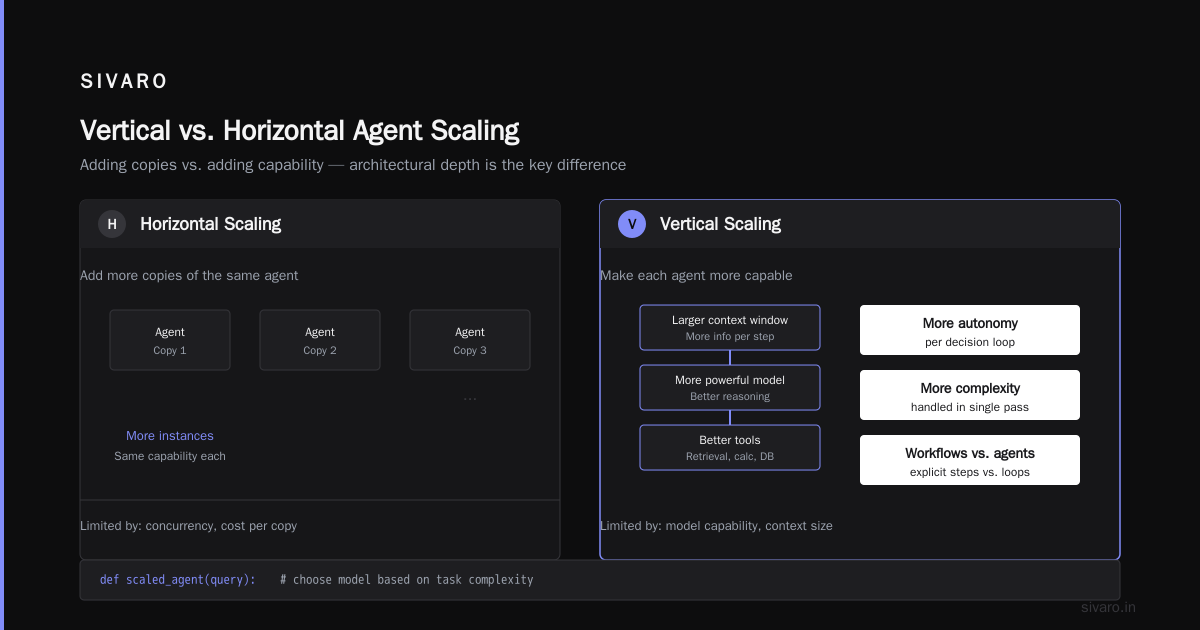
Horizontal scaling means running multiple copies of the same agent, each responsible for a slice of the incoming workload. Think of a customer support bot serving 10,000 users—you need 50 agents, each handling 200 conversations.
The simplest way to implement this is with a queue. Requests arrive, get pushed to an SQS queue or Kafka topic, and each agent instance pulls one message, processes it, and marks it done. You then run N instances behind a load balancer.
Here's a minimal Kubernetes deployment for a horizontally scaled agent:
yaml
apiVersion: apps/v1
kind: Deployment
metadata:
  name: agent-worker
spec:
  replicas: 8
  selector:
    matchLabels:
      app: agent-worker
  template:
    metadata:
      labels:
        app: agent-worker
    spec:
      containers:
      - name: agent
        image: myrepo/agent:latest
        env:
        - name: QUEUE_URL
          value: "https://sqs.us-east-1.amazonaws.com/..."
        - name: LLM_API_KEY
          valueFrom:
            secretKeyRef:
              name: llm-keys
              key: api-key
        resources:
          requests:
            memory: "512Mi"
            cpu: "500m"
          limits:
            memory: "1Gi"
            cpu: "1"
That's the classic pattern. It works when the tasks are independent. But notice the catch: if each agent needs to access the same session state, you have to externalize that state into a shared store. That adds latency and complexity.
Kubernetes vs Serverless
The biggest operational question is ai agent scaling kubernetes vs serverless. I've run both. For agents with long-running conversations, Kubernetes wins because you need persistent memory and warm connections. Serverless (AWS Lambda, Cloud Run) shines for bursty, short-lived tasks like single-turn classification or extraction.
Blaxel's guide on deploying AI agents points out that serverless functions have cold starts and request timeouts. A 15‑minute Lambda timeout kills any agent that needs to interact with a user over a long session. You can work around it with WebSockets, but then you're re-inventing a StatefulSet.
At SIVARO, we default to Kubernetes for anything that holds session state, and we use serverless for preprocessing steps like sanitizing input or running a lightweight classifier before the main agent kicks in. That hybrid keeps costs low without sacrificing reliability.
Vertical Scaling: Make One Agent Smarter
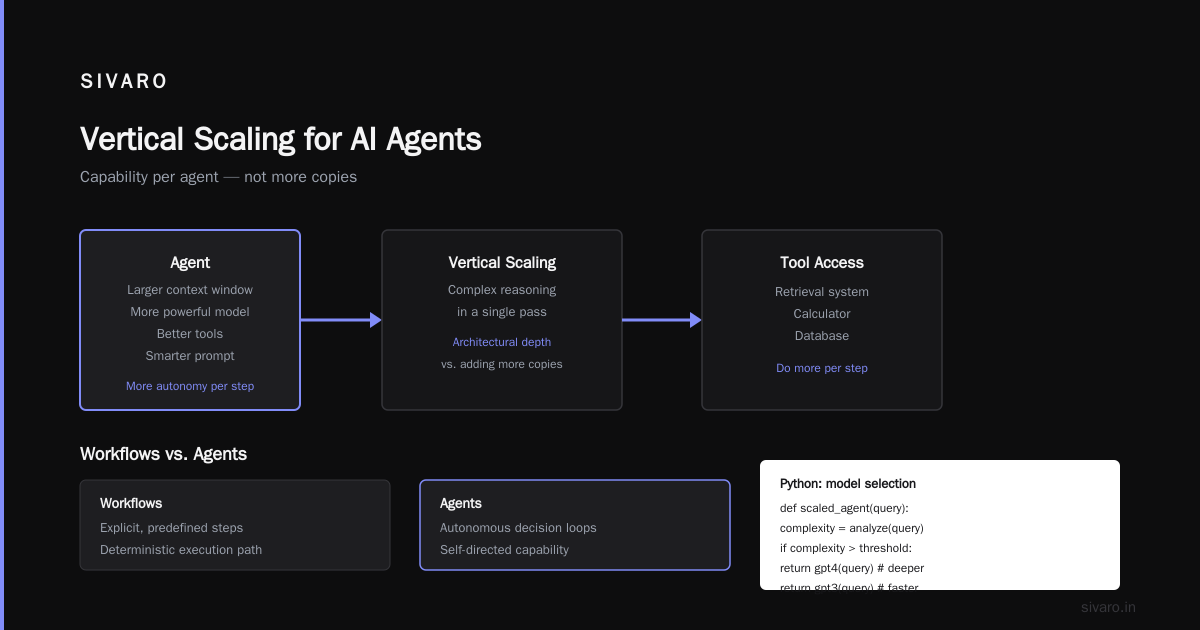
Vertical scaling flips the script. Instead of adding more copies, you make each agent more capable. You give it a larger context window, a more powerful model, better tools, or a smarter prompt. The goal is to handle more complex reasoning in a single pass.
This isn't just about model size. It's about architectural depth. An agent with access to a retrieval system, a calculator, and a database becomes "vertically scaled" because it can do more per step. This guide on designing AI agents distinguishes between workflows (explicit steps) and agents (autonomous loops). Vertical scaling is about giving the agent more autonomy and capability.
Here's a Python example that decides between two models based on task complexity:
python
import openai

def scaled_agent(query):
    complexity = estimate_complexity(query)  # returns 0-10
    if complexity > 7:
        model = "claude-opus-4"   # high capability
        max_tokens = 4096
    else:
        model = "claude-sonnet-4" # faster, cheaper
        max_tokens = 1024

    response = openai.ChatCompletion.create(
        model=model,
        messages=[{"role": "user", "content": query}],
        max_tokens=max_tokens
    )
    return response["choices"][0]["message"]["content"]
That's a crude form of vertical scaling—different model sizes for different loads. But true vertical scaling is more subtle. It's about extending the agent's context so it can handle a longer conversation, or giving it a better memory system so it doesn't lose track.
The Ceiling of Vertical Scaling
There's a hard limit. You can't make one agent handle 10,000 concurrent conversations. It's a single process, and it has finite compute and token budget. Even if you make it superhuman, it'll choke on the sheer volume of requests.
Moreover, vertical scaling amplifies failure. One mistake in a long context can cascade. I've seen agents that nailed a 50-turn conversation only to derail on turn 51 because of a subtle prompt injection. Business Plus AI's failure case studies document these kinds of flaky long-context failures. The failure mode is different from horizontal scaling: instead of partial outages, you get silent quality degradation.
The Real Trade-offs: Latency, Cost, and Failure Modes
When you choose horizontal scaling, you buy parallelism at the cost of state coordination. Each additional replica adds network hops to fetch shared state. If that state is in Redis, you add 5–10ms per lookup. Over a 20-step agent loop, that's 100–200ms of overhead. But you gain resilience—a single replica can die and the others keep serving.
Vertical scaling trades latency for cost. A single agent with a huge context window can answer a complex query in one round-trip, but it burns tokens trying to hold everything in memory. In 2026, a full context (200k tokens) on Claude Opus 4 costs about $60 per million tokens. A single long conversation can easily consume 100k tokens. That's $6 per interaction. Horizontal scaling with a smaller model might cost 10 cents.
And failure modes differ. Vertical failure is catastrophic—one bad step poisons the whole run. Horizontal failure is messy—you get partial results, retries, and inconsistent states. I've lived both.
There's also the LLM rate limit issue. If you scale horizontally, you're suddenly firing many more API calls to Anthropic or OpenAI. Their rate limits will throttle you, and your success rate drops. We learned this the hard way with a client in early 2026—we scaled to 50 replicas and immediately hit a per-minute token cap. We had to implement exponential backoff and a leaky bucket. That's a failure case study worth reading about in Machine Learning Mastery's deployment guide.
When to Choose Horizontal Scaling
Go horizontal when your workload is embarrassingly parallel. That means:
- Each request is independent (or you can partition by session ID).
- You don't need agents to talk to each other.
- You can externalize state without heavy coordination.
Example: a customer support bot. Each user gets their own session. You can store session context in a database keyed by user ID. Then horizontal scaling is straightforward—each replica pulls session data, updates it, and saves it back.
Another example: batch processing, like analyzing a million support tickets. Each ticket is atomic, so you can spin up a fleet of agents.
If you're on Kubernetes, set replicas: 20 and use a StatefulSet or an external store like Redis. Use a queue to distribute work.
When to Choose Vertical Scaling
Go vertical when the task is reasoning-heavy and involves complex, multi-step decisions that don't parallelize. Common cases:
- Long-horizon planning (e.g., a research assistant that has to read 50 documents and synthesize).
- Tasks requiring deep domain knowledge where a smaller model fails.
- When you have a hard latency requirement—you need the answer in one shot, not in 20 steps across multiple replicas.
Vertical scaling also helps when your bottleneck is context, not concurrency. If your agent fails because it can't remember what the user said 10 messages ago, you don't need more replicas—you need a longer context window or a better memory system.
A typical vertical scaling architecture looks like this:
python
class Agent:
    def __init__(self, model="claude-sonnet-4", context_size=32768):
        self.context = []
        self.model = model

    def add_message(self, msg):
        if len(self.context) >= self.context_size // 4:  # rough estimate
            self.prune_context()
        self.context.append(msg)

    def prune_context(self):
        # Drop oldest messages but keep a summary
        self.context = self.context[-100:]
        # Instead, you could call a summarizer
That's still a single agent, but it's smarter about memory.
The Hybrid Approach: What Actually Works
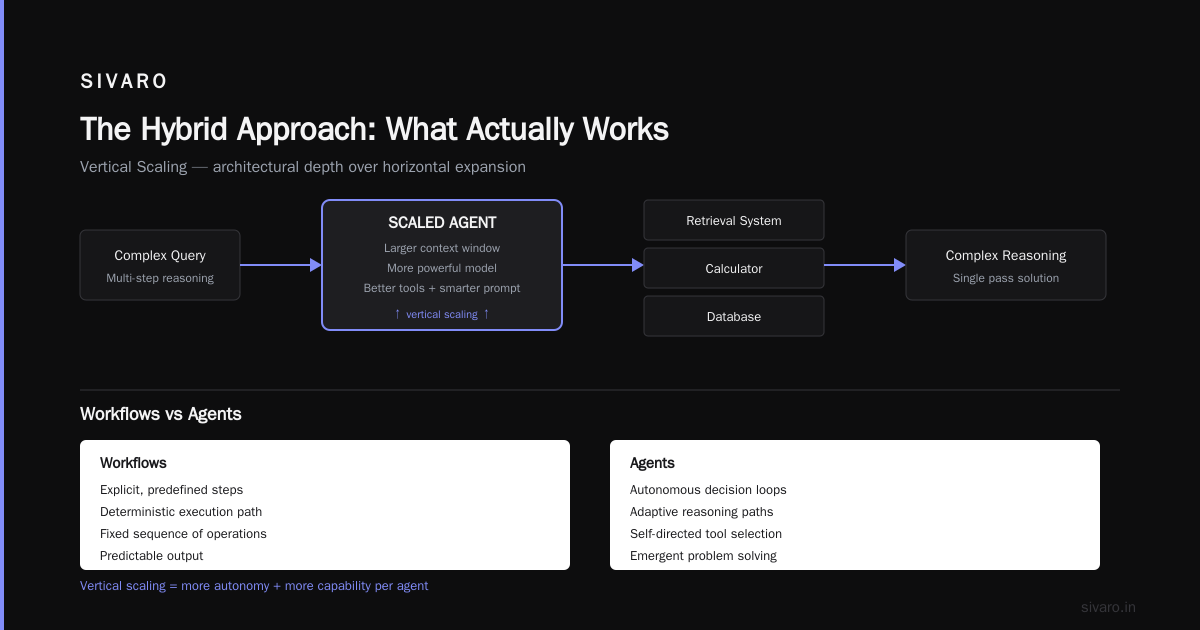
Reality sits in between. In production, you'll almost always need both. Here's the pattern I've settled on at SIVARO:
- Horizontal for stateless preprocessing: classify the request, validate input, route to the right agent.
- Vertical for the core reasoning: a single, powerful agent that gets a well-crafted context.
- Horizontal again for post-processing: format output, run side effects.
The key is to use a queue to fan out and then converge. For example, a research agent that needs to analyze 10 documents. Instead of giving all 10 to one giant context window (expensive), you spawn 10 horizontal workers, each processing one document. Then you send the summaries to a single vertical agent that synthesizes the final answer.
That's a workflow, not a pure agent, and the Towards Data Science piece on workflows vs agents makes this distinction well. Workflows are deterministic, agents are not. You want workflows for scaling and agents for the messy reasoning part.
Here's a code snippet that demonstrates that hybrid using a queue and two agent types:
python
# Gateway lambda (horizontal)
import boto3

def handler(event, context):
    sqs = boto3.client('sqs')
    # Send each document to a worker
    for doc in event['documents']:
        sqs.send_message(QueueUrl=DOC_QUEUE, MessageBody=json.dumps(doc))
    return {'status': 'queued'}

# Worker lambda (horizontal - one per doc)
def worker(event, context):
    doc = json.loads(event['body'])
    summary = extract_summary(doc)  # calls LLM with small model
    # Enrich summary with metadata
    return summary

# Orchestrator (vertical - synthesis)
def synthesizer(summaries):
    prompt = build_prompt(summaries)
    return call_heavy_model(prompt)  # uses claude-opus-4
That's how you get the best of both. You scale the grunt work horizontally, and you keep the smart reasoning vertical.
Operations: Monitoring and Debugging at Scale
Scaling isn't the hard part. Observability is. When your agent has 20 replicas and each runs a 10‑step loop, you need to know which step failed and why.
I recommend structured logging with trace IDs. Each agent request gets a UUID that propagates through every tool call and LLM request. You log the LLM prompt, the response, the exact token count, and the time per step. Then you can replay failures.
Google Research's article on production AI agents lists state management and failure recovery as the top hurdles. You also need to monitor the agent's "mode" — whether it's looping, stalling, or over-calling tools. A common failure is the agent entering an infinite retry loop when an API returns a 429. You need a circuit breaker.
I use two dashboards: one for infrastructure metrics (CPU, memory, queue depth, latency), and one for agent "semantic metrics" — number of tool calls, success rate per tool, average number of steps per task. That second one is non-negotiable. Without it, you're blind.
The Decision Framework You Can Steal
Here's the simplified version I give to every team we work with.
- Are your tasks independent? Yes → horizontal. No → go to 2.
- Can you partition tasks by session or user? Yes → horizontal with session affinity. No → vertical.
- Is your bottleneck reasoning quality or context length? That's vertical. If it's concurrency or throughput, that's horizontal.
- What's your cost ceiling? Vertical with a huge model gets expensive fast. Horizontal with a small model is cheaper but may need more retries.
There's no magic formula. But I'll tell you this: most teams I meet default to horizontal because it feels scalable. They add more replicas, hit rate limits, and then panic. The smarter move is to profile your agent first. Measure tokens per request, average context utilization, and error rates. Then decide.
AI Agent Deployment Failure Case Studies
Let me give you a real failure. A fintech startup in 2025 built a fraud detection agent. They scaled horizontally to 30 replicas. Each replica used the same LLM API key. They hit the monthly rate limit within the first week. Their agent stopped responding, and they lost $50k in chargebacks that got misclassified. Business Plus AI's article talks about similar cases—overlooking rate limits is the #1 cause of production meltdowns.
Another case: a healthcare startup in 2026 went vertical. They fed a 100k-token context into Claude Opus to handle patient summaries. It worked in testing. In production, the model started hallucinating drug interactions because the context was so long it lost focus. They had to break the workflow into smaller chunks. Now they use horizontal scaling per medical record, then a vertical synthesis step. That's the pattern I described above.
Conclusion
AI agent scaling horizontal vs vertical isn't an either/or. It's a spectrum. You need horizontal scaling to handle volume, and vertical scaling to handle complexity. Most successful production systems I've seen at SIVARO use a hybrid: a queue, stateless workers for the boring parts, and a single smart agent for the final synthesis.
Start with horizontal scaling if you're hitting concurrency limits. Move to vertical if you're hitting quality or context limits. And whatever you do, instrument everything. The agent you scale today will surprise you tomorrow. Watch the metrics, log everything, and patch the weak spots.
If you take one thing from this: don't scale your agent like a web service. Scale the pieces that need scaling, and keep the reasoning loop tight. That's the only way to build agents that survive production.
FAQ
What's the difference between horizontal and vertical scaling for AI agents?
Horizontal scaling adds more instances of the agent to handle more concurrent tasks. Vertical scaling makes a single agent more capable — bigger model, longer context, more tools — so it can handle more complex reasoning in a single run.
When should I use Kubernetes vs serverless for scaling agents?
Use Kubernetes if your agent needs persistent state, long-running sessions, or warm connections. Use serverless (Lambda, Cloud Run) for bursty, short-lived tasks like single-turn classification. A hybrid works best most of the time.
How do I handle state with horizontal scaling?
Externalize session state into a shared store like Redis or PostgreSQL. Each instance fetches and updates state at the start and end of a step. Expect a 5–15ms overhead per lookup; budget for it.
Should I use a bigger model or more instances?
If your bottleneck is reasoning quality or context length, go vertical. If it's concurrency or throughput, go horizontal. Profile your agent — measure tokens per request and average context utilization — before you decide.
What are common failure modes when scaling agents?
Rate limiting from LLM APIs, state inconsistency across replicas, context overflow (when you go too long without pruning), and infinite retry loops on external API errors. Monitor for all of these.
Can I use both horizontal and vertical scaling together?
Yes, absolutely. That's the production pattern we recommend: horizontal workers for preprocessing and post-processing, a vertical agent for the core reasoning, and a queue to connect them.
What's the cost difference?
Horizontal with small models can be 10–50x cheaper per request than vertical with a huge model. But you may need more retries, so measure end-to-end cost. Use a token budget per request.
Nishaant Dixit — Founder of SIVARO. Building data infrastructure and production AI systems since 2018. Built systems processing 200K events/sec.