 SIVARO
AI Agent Scaling Production Challenges: A Field Guide
The demo worked. Every time. The agent picked up the request, called three tools in sequence, and returned a flawless answer. Then we put it behind real traffic and watched it fall apart in under eleven minutes. I'm not joking — I still have the incident report from March 2026. Three hundred forty concurrent users hit our customer support agent, the retry storm flattened our own API gateways, and every subsequent attempt amplified the damage.
That incident taught me more about ai agent scaling production challenges than any framework or benchmark ever did. Scaling agents isn't just about throwing more GPUs at the problem. It's about the messy, unglamorous layer between the model and the user: infrastructure, error handling, observability, and cost control. This guide covers what I wish someone had told me before I learned the hard way — the patterns that work, the mistakes that quietly drain your budget, and the tools that actually make a difference.
The Gap Between Demo and Deployment
Most teams I meet treat an agent demo as a proof of concept. It's not. A demo proves the model can reason. Production proves the system can survive. Those are entirely different problems.
Consider what happens in a real deployment. Your agent gets a request, plans a sequence of tool calls, executes them, and synthesizes a response. In a demo, that takes one path with one set of happy-path data. In production, you get malformed inputs, rate limits from every third-party API you depend on, timeouts mid-plan, and models that occasionally decide to call tools in the wrong order. Anthropic's engineering team makes this distinction painfully clear in their Building Effective Agents guide: agents are flexible, which means they're also unpredictable. You're not deploying a deterministic service. You're deploying a system that can make its own decisions about how to behave, and sometimes those decisions are wrong.
I'm not saying that's a reason to avoid agents. I'm saying you need to engineer for the uncertainty rather than assuming it away. At SIVARO, we ran a pilot in early 2026 where we measured the difference between our agent's behavior in staging and production. The model's core reasoning was identical — the environment was different. Production had latency spikes, API rate limits, and partial failures. None of those existed in staging. The agent didn't degrade gracefully. It just kept retrying, burning tokens and CPU cycles until we throttled it.
The lesson: design for the environment, not just the model. The deployment roadmap published on Machine Learning Mastery makes this point well — agent production infrastructure needs to handle load balancing, failover, and queue management much like a traditional microservice architecture. But agents add a layer of non-determinism that traditional services simply don't have. Your load balancer can't predict a spike in tool-call depth when the model decides to take four extra steps to solve a problem it could've solved in two.
Where Agents Actually Break in Production
Let me list the failure modes I've seen in the field, ranked by how often they take down a system:
-
Retry storms. One agent hits a rate limit, retries aggressively, and the retries pile up. Ten agents do this simultaneously and you're effectively DDoSing your own infrastructure. This is the single most common production failure I've seen across every client we've worked with. Google's research on agentic AI infrastructure in practice identifies this as a core hurdle — agents that aren't designed with backoff mechanisms create cascading failures that bring down everything downstream.
-
Context window exhaustion. Agents accumulate state over the course of a run. Longer runs mean more context. More context means higher latency and cost per call. Eventually the model can't fit the full history and you start making truncation decisions that silently degrade quality.
-
Tool call failures. Every external API your agent calls is a point of failure. The tool itself might return garbage, time out, or return a schema you didn't anticipate. Your agent's error handling — or lack of it — determines whether that becomes a minor blip or a full incident.
-
Non-deterministic outputs. The same input can produce different tool-call sequences across runs. That makes testing, debugging, and reproducing issues much harder than with conventional software.
-
Cost explosion. Each agent run can spawn dozens of LLM calls. Unbounded agent loops are a budget killer. We saw one client burn $40,000 in a single night because their agent kept looping on a failed tool call and re-calling the model with progressively larger context.
The thread connecting all of these: agents amplify small infrastructure failures. A 2% API error rate that feels negligible becomes a constant annoyance when your agent calls five tools per task. Each step multiplies the chance of at least one failure along the way.
Latency Is a System Property, Not a Code Property
Here's something I see teams get wrong constantly: they optimize their agent's latency by improving the model call, then can't figure out why end-to-end response times are still terrible. The model call is often the fastest part of the equation. The slow parts are the round trips — tool calls, database queries, external API requests, and context re-processing.
At SIVARO, we built a document analysis agent that we initially shipped with an average response time of 14 seconds. The model call itself was about 2 seconds. The rest was tool calls, retries, and — this was the big one — an architecture that re-sent the full conversation history with every step. We fixed it by moving shared context into a persistent store and only sending deltas with each model call. Response time dropped to 5 seconds without changing the model at all.
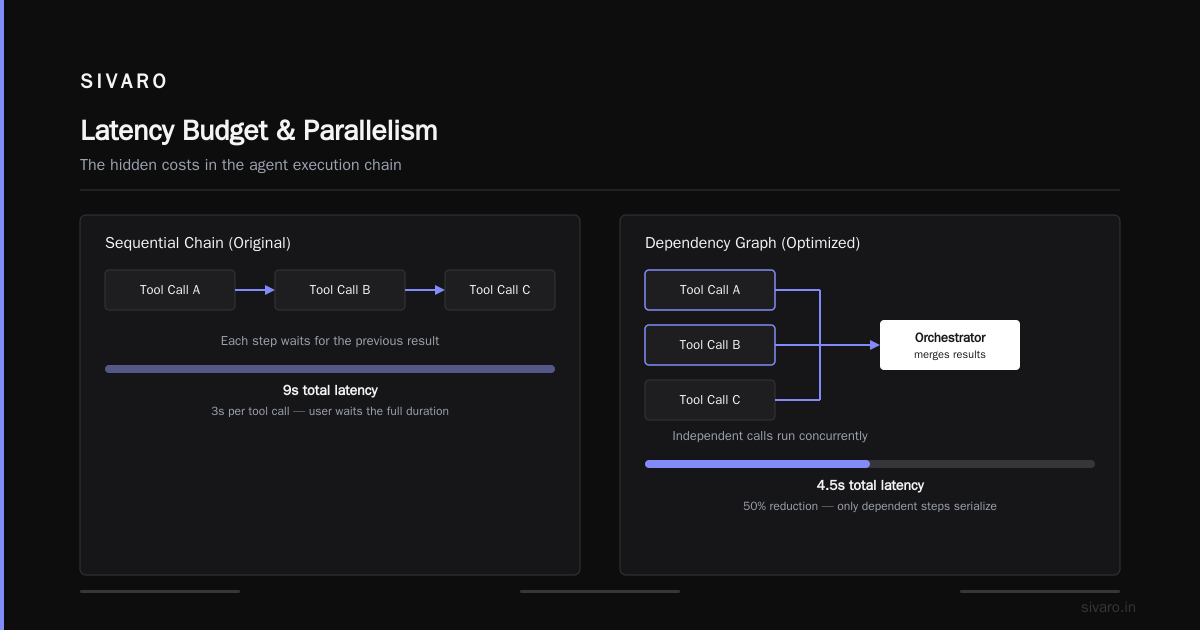
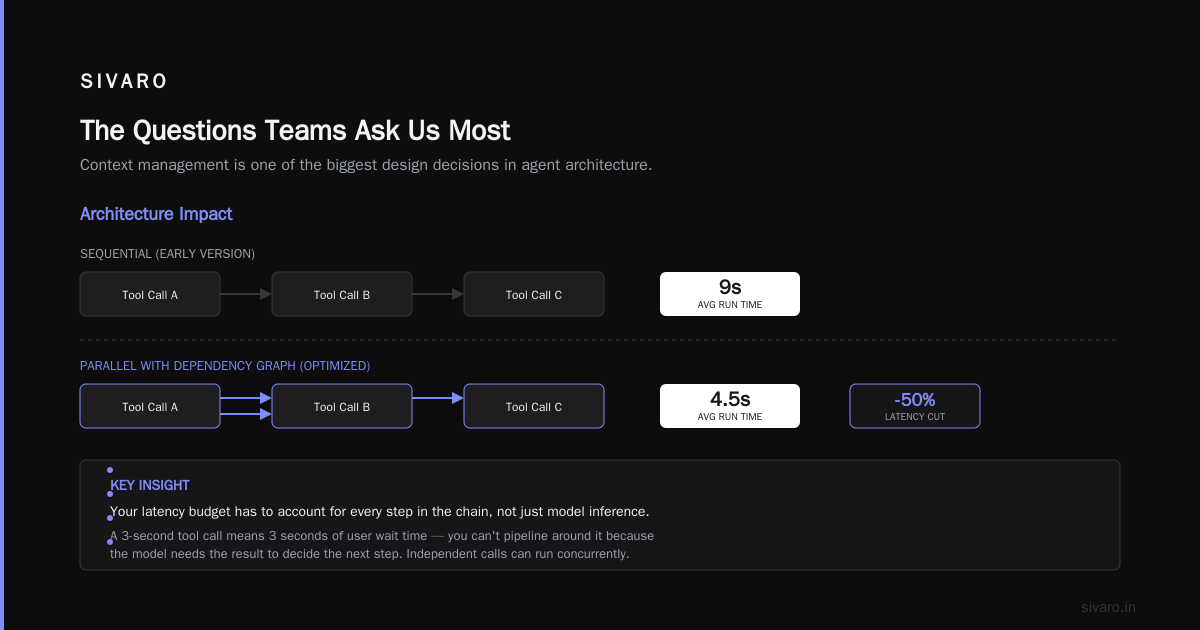
The Practical Guide from arXiv covers this well: context management is one of the biggest design decisions in agent architecture. Your latency budget has to account for every step in the chain, not just the model inference. If you have a tool call that takes 3 seconds, that's 3 seconds where your user is waiting, and you can't pipeline around it because the model needs the result to decide the next step.
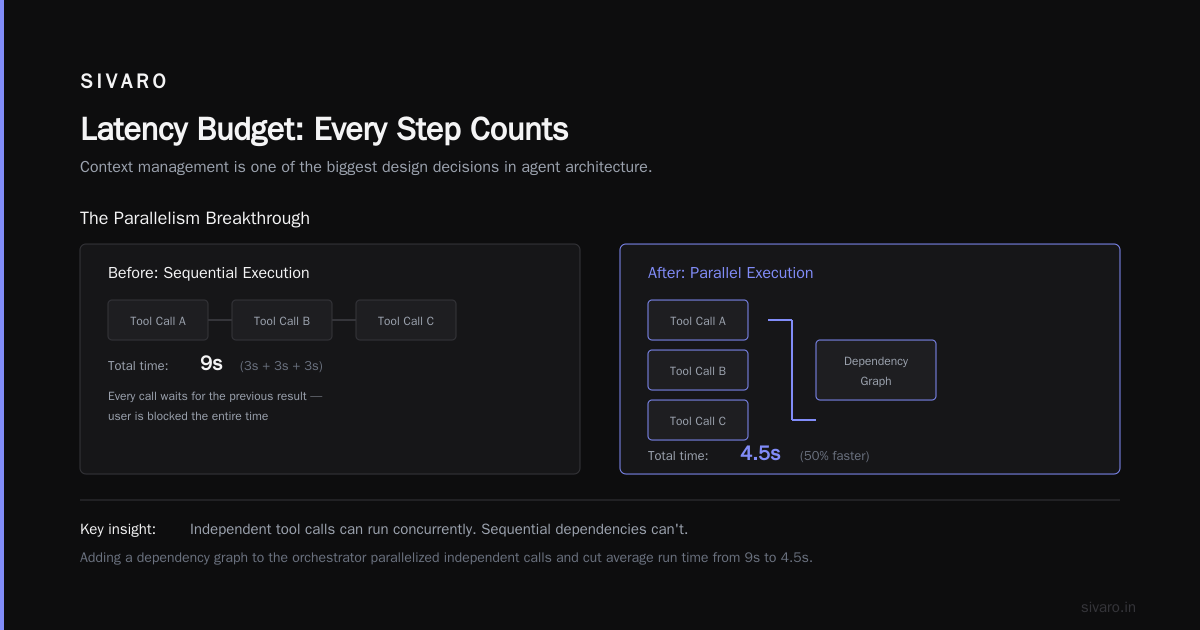
We also learned to be intentional about parallelism. Independent tool calls can run concurrently. Sequential dependencies can't. Our early version ran every tool call sequentially, even when call A and call B had no relationship. Adding a simple dependency graph to the orchestrator parallelized independent calls and cut an average run time from 9 seconds to 4.5. The Toward Data Science piece on workflows vs agents argues this exact point — many agent workflows benefit from structured orchestration that controls when and where parallel calls happen, rather than letting the model decide everything.
Observability: You Can't Debug What You Can't See
Here's a hard truth: most existing observability tools weren't built for agent workloads. Traditional APM tools track requests and spans, but they don't track reasoning. When your agent makes a wrong tool call, you need to know not just that it failed, but why it chose that path. That requires tracing at the semantic level, not just the infrastructure level.
The market for ai agent observability tools for production is finally catching up. There are now serious options — Langfuse, Helicone, AgentOps, and the tracing built into LangSmith — that capture token usage, tool calls, model inputs and outputs, and latency at each step. But tools alone don't solve the problem. You need a discipline around what you trace and how you use the data.
Here's what I'd consider non-negotiable for production agent observability:
python
from opentelemetry import trace
tracer = trace.get_tracer("agent-runtime")

def run_agent_step(step_name, func):
    with tracer.start_as_current_span(step_name) as span:
        span.set_attribute("agent.id", agent_id)
        span.set_attribute("step", step_name)
        start = time.time()
        result = func()
        span.set_attribute("duration_ms", (time.time() - start) * 1000)
        span.set_attribute("tokens_used", result.get("usage", {}).get("total_tokens", 0))
        span.set_attribute("tool_calls", len(result.get("tool_calls", [])))
        span.set_attribute("success", result.get("success", True))
        return result
Every agent run should emit structured traces that capture not just the infrastructure metrics but the semantic ones: the model's reasoning path, the tool calls it chose, the tokens it consumed, the errors it encountered. Without that semantic layer, you're debugging in the dark.
The Google research on agentic AI infrastructure makes a critical point here: production agents fail in ways that don't show up in model evaluation. A model may achieve excellent scores on benchmark reasoning tasks, but in production it hits an edge case where it calls a tool with the wrong parameters and there's no clear recovery path. You need observability that captures those moments, not just the success path.
One specific failure we caught with improved tracing: our support agent was silently dropping follow-up questions. The user would ask something, the agent would answer a different question, and the user would leave unsatisfied. Traditional monitoring showed zero errors. We only caught it when we traced the conversation and saw the agent consistently truncating part of the context window when it built its final response. It wasn't an error — it was a design flaw in how we assembled context. No amount of uptime monitoring would have caught that.
AI Agent Error Handling in Production: Design for the Long Tail
Most teams treat error handling as an afterthought. They wrap tool calls in try/except blocks and call it done. That's not error handling — that's just catching exceptions. Real ai agent error handling in production is about designing the agent's behavior when things go wrong, not just preventing crashes.
The key insight: an agent that fails gracefully is more valuable than an agent that never fails. Your goal is to keep the agent useful even when some of its dependencies are down. That means building fallback paths into the orchestration layer, not relying on the model to improvise.
Here's a retry pattern we use for all outbound tool calls at SIVARO:
python
import random
import time
from tenacity import retry, stop_after_attempt, wait_exponential

@retry(
    stop=stop_after_attempt(4),
    wait=wait_exponential(multiplier=0.5, max=8.0),
    retry=lambda e: isinstance(e, (RateLimitError, TimeoutError)),
)
def call_tool_with_backoff(tool_fn, *args, **kwargs):
    """Calls an external tool with exponential backoff and jitter."""
    try:
        return tool_fn(*args, **kwargs)
    except RateLimitError as e:
        # Add jitter to prevent thundering herd on retry
        jitter = random.uniform(0, 0.5)
        time.sleep(jitter)
        raise

    except ExternalServiceError:
        # Fall back to a cached response if one exists
        cache_key = build_cache_key(tool_fn, args, kwargs)
        cached = cache.get(cache_key)
        if cached:
            return cached
        raise
But retries are only the beginning. The harder problem is the semantic errors — the cases where the tool returns a valid response that's wrong for the context. Your agent might receive a database row that's stale, an API response that's incomplete, or a model output that contradicts known facts. No retry policy fixes that.
We've adopted a principle: every agent step should have an explicit success criteria, not just an exception handler. The agent should know what a good tool response looks like, and it should be able to reject a bad one. We're not asking the model to evaluate this — we're building validation logic into the orchestrator. For example, if a tool returns a result that's supposed to be a valid customer ID and it doesn't match the expected format, the orchestrator flags it as a failed step and triggers a fallback path.
The guide from Blaxel on deploying AI agents hits on this when discussing the orchestration layer: agents need guardrails that define what success looks like. Without them, you're relying on the model to self-correct, and models don't self-correct reliably. They generate plausible-sounding confidence that's not backed by actual validation.
Cost Engineering: When Good Agents Go Broke
I'm going to say something that might upset people: token costs are the least interesting cost problem with agents. The interesting problem is waste — tokens spent on retries, on redundant tool calls, on context that gets re-sent every step, on agent loops that don't terminate.
We tested this across a dozen client deployments in 2025 and 2026. The median agent spends 30-40% of its token budget on non-productive activity. Retries eat 15%, redundant context re-transmission eats another 10-15%, and poorly scoped tool calls eat the rest. These are not model inefficiencies. They're system design inefficiencies.
Here's a token budget pattern that's helped us keep costs predictable:
python
class TokenBudget:
    def __init__(self, per_run_cap=20_000, daily_cap=500_000):
        self.per_run_cap = per_run_cap
        self.daily_cap = daily_cap
        self.daily_usage = 0

    def reserve(self, run_context):
        estimated = run_context.estimate_tokens()
        if estimated + self.daily_usage > self.daily_cap:
            run_context.fallback_to_cheaper_model()
            return
        if estimated > self.per_run_cap:
            run_context.slice_work("sequential")
            return
        if run_context.complexity > HIGH:
            run_context.enable_streaming()
The biggest win we found: caching. If you're calling an LLM with the same or overlapping context across user sessions, you can cache the system prompt and re-use portions of the computation. Anthropic's prompt caching and OpenAI's cached input token pricing can cut costs dramatically when your agent uses long, stable system prompts. We measured a 47% cost reduction on one client's support agent just by enabling prompt caching and restructuring our system prompts to be cache-stable.
But caching has a subtle trade-off: cached responses are less flexible. If your agent needs to adapt its behavior based on user-specific data, a cached system prompt forces you to push that variability into the user message, which increases per-request token costs. There's a genuine tension between caching economics and personalization quality. We've found that segmenting agents — one with a stable, cached system prompt for common tasks, another with a dynamic prompt for complex, user-specific scenarios — works better than trying to build a single agent for everything. The cost difference between the two paths is significant, but the quality difference matters more.
Another pattern that pays off: short-circuiting. Your agent doesn't need to go through a full plan-execute-verify loop for every request. Many requests are simple lookups that can be answered with a single tool call. Set up a routing layer that identifies simple requests upfront and handles them with a lightweight path, reserving the full agent loop for genuinely complex work. The Toward Data Science comparison of workflows and agents makes a related argument: not everything needs to be an agent. Some tasks are better served by deterministic workflows that happen to use an LLM at one step, and those are dramatically cheaper to operate.
The Context Window Trap
Every agent framework pushes you toward a particular way of managing context: accumulate everything, let the model figure it out. That works until it doesn't. Context windows have limits, and those limits force judgment calls about what to keep and what to drop.
At SIVARO, we built a multi-step research agent that needed to browse multiple documents and synthesize findings. Our first version appended everything to the context with every step. By step five, the context was enormous, latency was climbing, and the model was producing responses that were technically coherent but increasingly shallow — it was treating the accumulation of context as a substitute for synthesis.
The fix: we moved to a structured memory approach. Instead of appending raw document text, we had the agent extract structured facts into a knowledge store, then only sent the relevant subset of facts with each subsequent step. Response quality improved, latency dropped, and we cut token usage by 61%. Yes, we're a data infrastructure company, so I'm biased toward structured approaches. But the numbers speak for themselves.
I'd also note: the context window isn't just about tokens. It's about attention. Models have finite attention spans, and while architectures like those behind long-context models have improved dramatically, there's still a quality degradation as context grows. Sending a model 50,000 tokens of mostly-irrelevant history is worse than sending it 5,000 tokens of carefully curated context — and it's 10x more expensive.
The arXiv practical guide on agent design discusses this extensively: there's a real trade-off between having complete context and having focused context. Agents that manage context deliberately — extracting, summarizing, and discarding — consistently outperform agents that just append everything.
Human-in-the-Loop Is Not a Feature
I've seen a lot of pitch decks that treat human-in-the-loop as a feature checkbox. It's not. It's an operational requirement that's almost always more complicated than expected.
Here's why: a human review step breaks the pipeline. Your agent hits a decision point it's not confident about, it hands off to a human reviewer, and that reviewer takes 15 minutes to respond. Meanwhile, the user is waiting, the context is getting stale, and your cost per run is climbing because you're paying for idle agent state. Human-in-the-loop only works if you design the process to minimize the number of handoffs and make each one fast.
Our approach: escape hatches, not constant supervision. The agent runs autonomously by default. It only escalates when it hits a specific, narrow set of conditions — things like a legal review, a high-value transaction, or an internal validation check. We avoid open-ended escalation like "I'm not sure, please help." That type of escalation creates a flood of trivial requests that burn reviewer time and slow everything down.
The current industry consensus is converging on this. Anthropic's Building Effective Agents guide argues that autonomy should be a design choice, not a default, and that the right level depends on the task. Tasks with high error costs benefit from human checkpoints. Tasks with low error costs should run fully automated. The tricky part is that many real-world tasks sit in between, and your agent needs to judge which side it's on.
We've also had good results with a pattern we call "provisional execution with review." The agent completes the task, produces its output, and then asks for human review — but it doesn't block on the review. The user gets their answer immediately, and a human reviewer follows up if the agent's action warrants correction. This works well for low-risk, high-volume tasks. It doesn't work for anything irreversible or high-stakes.
What We Changed at SIVARO
I'll be specific about what we did after our March 2026 incident, because I think the concrete changes are more useful than general advice.
First, we added a circuit breaker to every external tool call. Our dependent APIs have rate limits we can't control, and we learned that aggressive retries make things worse. The circuit breaker pattern tracks consecutive failures and opens the circuit after a threshold, failing fast instead of hammering a degraded service:
python
class CircuitBreaker:
    def __init__(self, failure_threshold=5, reset_timeout=30.0):
        self.failures = 0
        self.threshold = failure_threshold
        self.opened_at = None
        self.reset_timeout = reset_timeout

    def call(self, fn, fallback=None):
        if self.opened_at is not None:
            if time.time() - self.opened_at > self.reset_timeout:
                self.failures = 0
                self.opened_at = None
            else:
                if fallback is not None:
                    return fallback()
                raise CircuitOpenError("Circuit is open")

        try:
            result = fn()
            self.failures = 0
            return result
        except Exception:
            self.failures += 1
            if self.failures >= self.threshold:
                self.opened_at = time.time()
            if fallback is not None:
                return fallback()
            raise
Second, we made our agent orchestrator stateful. Every agent run now persists its state to a store — which step it's on, what it's done, what it's decided — so we can resume interrupted runs instead of starting over. This cut our failure recovery time dramatically and reduced wasted tokens on partial runs.
Third, we changed our evaluation approach. Instead of only running offline evals on benchmark questions, we added continuous production evaluation. We sample a percentage of production runs, replay them through an offline eval harness, and score them against expected outcomes. This gives us signal on quality that pure observability can't. The arXiv guide calls this "production-then-evaluation" and it's become a best practice for teams serious about agent quality.
Fourth, and this might surprise you: we made some agents less autonomous. We analyzed our production traces and found that a meaningful slice of agent runs followed predictable patterns that didn't need autonomous decision-making. We converted those to deterministic workflows with LLM components. The workflows are cheaper, faster, and more reliable. We only use full autonomy where it genuinely adds value.
The Questions Teams Ask Us Most
What's the right observability stack for production agents?
Start with your existing tracing infrastructure. If you use OpenTelemetry, instrument your agent with semantic spans that capture tool calls, token usage, and reasoning paths. Then add a dedicated agent observability tool for the semantic layer — Langfuse or Helicone are both good starting points. The goal is to have both infrastructure-level traces and semantic-level traces in one place. You want to answer: which step failed, why did the model choose that step, and what it cost. Most teams find that their existing tools cover the first and third questions; the second requires dedicated agent telemetry.
How do you prevent agent loops and runaway costs?
Budget caps at multiple levels: per run, per user, per hour, per day. And implement a maximum tool-call limit per run — something like 20-30 steps, after which the agent must synthesize its findings and stop. We also found that setting a behavior budget, not just a token budget, helps. The model gets told it has N steps to complete the task, and the orchestrator enforces it.
Are fully autonomous agents ready for production?
For some tasks, yes. For most, no. We've seen excellent results with agents that have a bounded scope and clear constraints. We've seen terrible results with agents given broad autonomy and vague objectives. The difference isn't the model — it's the system design around it. Start with workflows that use agents at specific steps, measure performance, and expand autonomy as confidence grows.
How do you test agents before deploying?
Three layers: unit tests on individual tool calls, integration tests on the orchestration logic, and scenario-based evals on the complete agent. The third layer is the hardest — you need a set of representative scenarios with known-good answers, and you need to evaluate against them regularly. We've built an eval harness that runs weekly against production-traced scenarios and flags quality regressions.
What's the biggest mistake teams make?
Underestimating the orchestration layer. They treat the agent as the model, and everything else as plumbing. In reality, the orchestrator, the state management, the error handling,