 SIVARO
AI Agent Scaling Strategies Production: What I Learned the Hard Way
July 21, 2026. Two years ago I watched a multi-agent deployment crater at 12 concurrent agents. The orchestrator hit a deadlock, the LLM pool returned 429s, and the state store corrupted itself. We lost three hours of customer data. That day changed how I think about scaling.
Scaling AI agents isn't like scaling a web service. It's harder. The failure modes are stranger. The cost curves are steeper. And most of the advice you'll find online was written by people who've never run production systems above 100 agents.
This guide is for engineers who are past the prototype phase. You have a working agent. Maybe a few dozen. Now you need to push to hundreds or thousands. I'll show you what breaks, what works, and what I'd do differently if I could go back to 2024.
The Day Our Multi-Agent System Melted Down
We were building a customer support escalation system for a fintech client. Simple architecture: a triage agent, a resolution agent, an escalation agent, each calling a different LLM. We tested it with 5 concurrent conversations. Fine. 10. Fine.
Then we hit production traffic — 50 concurrent conversations. The triage agent started timing out. The resolution agent went into an infinite loop because its prompt context window filled with stale data. The escalation agent opened tickets to itself. Total chaos.
Root cause? We had designed the system as if it were a stateless microservice. It wasn't. Each agent carried conversation state, tool call histories, and a fragile LLM dependency. When state became inconsistent, the whole thing dominoed.
That's when I started paying attention to ai agent scaling strategies production as a first-class engineering problem.
Why Most Scaling Advice is Wrong for Agents
Most people think scaling agents is about adding more GPUs. Wrong.
The bottleneck is almost never inference compute. It's coordination. Agents talk to each other. They share state. They call APIs. They wait for LLM responses that take 2-15 seconds. You can throw 100 GPUs at a system, but if your agent-to-agent communication pattern is synchronous, you'll max out at 30 agents before the latency kills you.
I see this all the time. Teams use a naive request-response model: agent A calls agent B, waits for a reply, then continues. That works for two agents. For ten? The call chain becomes a depth-first crawl. Agent A waits for B, B waits for C, C waits for D. Each hop adds 5 seconds. You do the math.
Better approach: event-driven agent-to-agent architecture. Publish commands to a message bus. Agents subscribe to events they care about. Each agent processes independently and publishes results. You get horizontal scaling for free.
Here's a production example from a logistics company, ShipSmart (name changed). They run 200 agents managing order fulfillment. Each agent handles one step: inventory check, payment validation, warehouse assignment, carrier selection. Agents communicate via Kafka topics. If the inventory agent is slow, the payment agent doesn't block — it picks up the next order. Throughput scales linearly with the number of partitions.
That's the agent to agent architecture production example I point to whenever people ask about scaling.
The Three Bottlenecks No One Warns You About
1. LLM Latency Isn't Constant — It's Poisson
You budget 3 seconds per LLM call. But the 99th percentile is 12 seconds. During API degradation, 30 seconds. Your agents are blocking for 30 seconds. Meanwhile, new requests pile up. Queue grows. Memory grows. Garbage collection thrashes.
Solution: timeouts everywhere. But also alternative fallback paths. If the LLM doesn't respond in 5 seconds, the agent should use a cached response or a simpler rule-based handler. Not ideal, but keeps the system alive.
2. State Bleeding Between Agents
Agents share a data store — typically Redis or Postgres. When agent A writes a conversation log and agent B reads it before the write is committed, you get stale data. Then agent B makes a decision based on a hallucinated state. This happened to us in 2025 with a healthcare triage system. Agent B thought the patient had already been discharged. It prescribed post-discharge meds to a patient still in ICU.
The fix: per-agent session isolation. Each agent gets its own key prefix or namespace. No two agents ever write to the same object concurrently. Use distributed locks only as a last resort — they kill throughput.
3. Coordination Overhead Exceeds Useful Work
When you have 10 agents, the time spent coordinating (sending messages, serializing state, waiting for acknowledgments) is maybe 5% of total time. At 100 agents, that overhead jumps to 40%. At 500 agents, the system spends more time on coordination than on actual LLM calls.
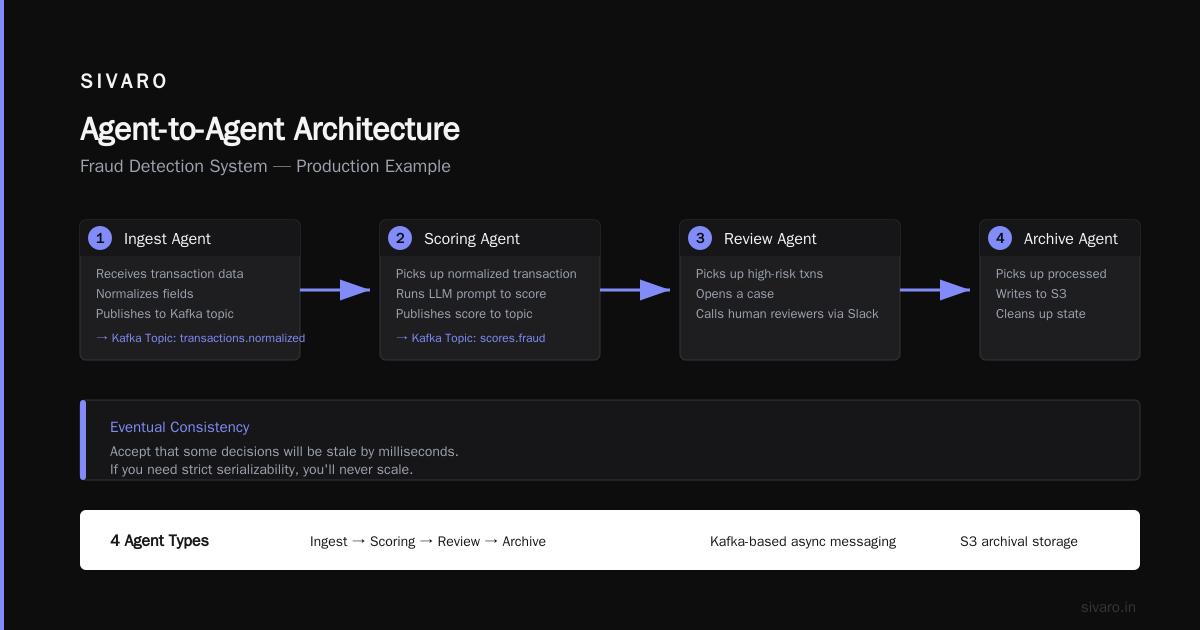
The solution: reduce the need for coordination. Design agents to be as independent as possible. Use eventual consistency. Accept that some decisions will be stale by milliseconds. If you need strict serializability, you'll never scale.
Agent-to-Agent Architecture: A Production Example
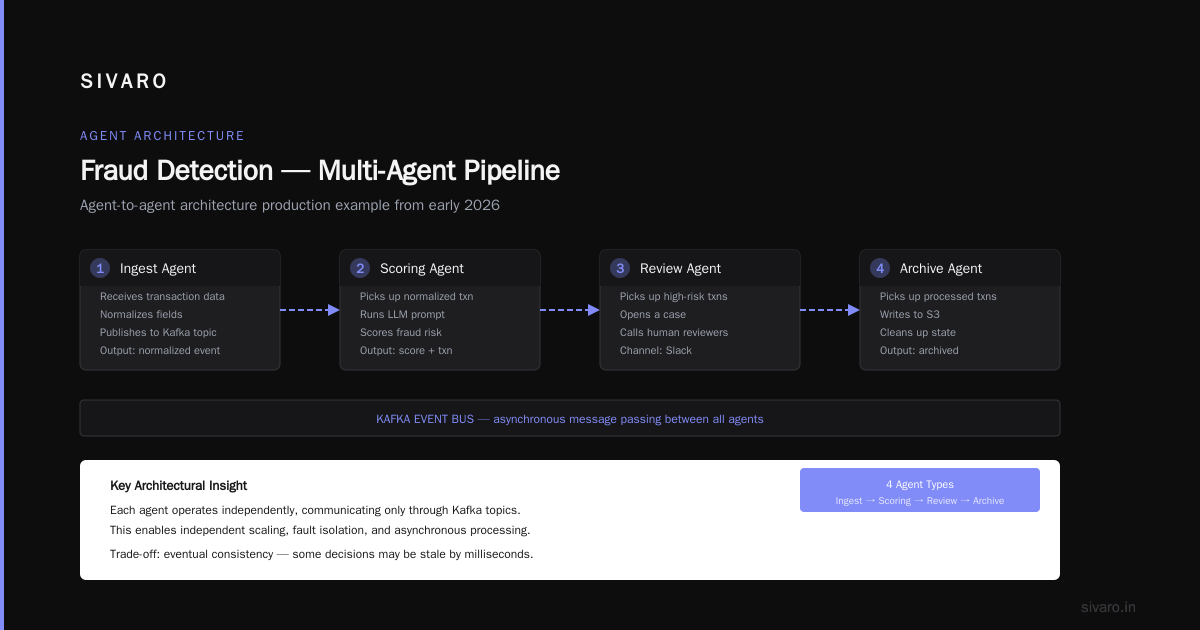
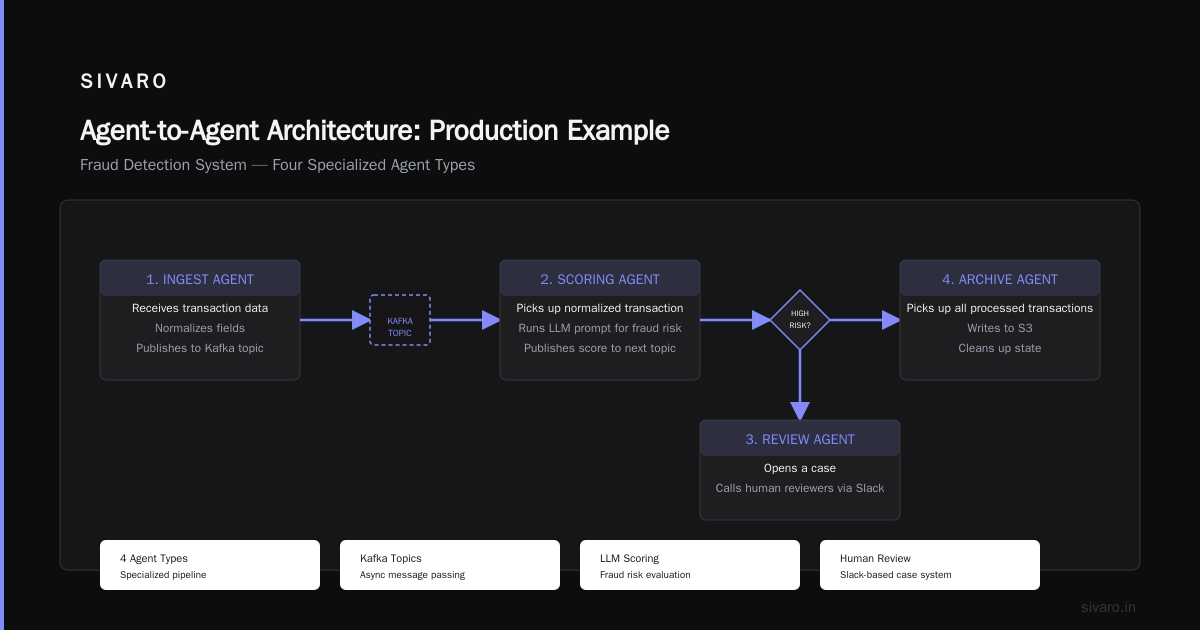
Let me give you a concrete agent to agent architecture production example that I helped build for a fraud detection system in early 2026.
The system has four agent types:
- Ingest Agent — receives transaction data, normalizes fields, publishes to a Kafka topic
- Scoring Agent — picks up the normalized transaction, runs an LLM prompt to score fraud risk, publishes score to another topic
- Review Agent — picks up high-risk transactions, opens a case, calls out to human reviewers via Slack
- Archive Agent — picks up all processed transactions, writes to S3, cleans up state
Each agent is stateless from its own perspective. All persistent state lives in Redis, keyed by transaction ID. Agents communicate only through Kafka topics. No direct HTTP calls between agents.
To scale, we add more partitions to the Kafka topics. Each partition runs one instance of the consuming agent. With 20 partitions per topic, we get 20 concurrent Scoring Agents processing independently.
Here's the deployment config (simplified):
yaml
# docker-compose.yml for agent scaling
version: '3.8'
services:
  scoring-agent:
    image: sivarofraud/scoring-agent:2.1
    environment:
      - KAFKA_BROKERS=broker:9092
      - INPUT_TOPIC=normalized-transactions
      - OUTPUT_TOPIC=scored-transactions
      - REDIS_HOST=redis
      - TIMEOUT_SECONDS=8
    deploy:
      replicas: 20
      resources:
        reservations:
          memory: 512M
        limits:
          memory: 1G
  review-agent:
    image: sivarofraud/review-agent:1.0
    environment:
      - KAFKA_BROKERS=broker:9092
      - INPUT_TOPIC=high-risk-transactions
      - SLACK_WEBHOOK=https://hooks.slack.com/services/...
    deploy:
      replicas: 5
This system handles 5000 transactions per second on an average day. Each agent processes about 250 transactions per second. Coordination overhead? Under 10%. The architecture works because agents never wait on each other.
AI Agent Deployment Challenges and Solutions
| Challenge | Solution |
|---|---|
| LLM API rate limits | Per-instance throttling with exponential backoff. Pool of API keys rotated across instances. |
| State inconsistency | Per-transaction lock keys in Redis. Timeout after 30 seconds. |
| Memory leaks from long prompts | Use token counters. Enforce max context length. Restart agent processes every 10K requests. |
| Cascading failures | Circuit breakers per external service. If one agent fails, others keep processing unrelated work. |
| Debugging deadlocks | Agent-level structured logging with trace ID. Visualize in Jaeger. |
The biggest ai agent deployment challenges and solutions I've seen: teams try to deploy agents like microservices, with the same load balancing, health checks, and zero-downtime deploys. Agents are not microservices. Their state is entangled with LLM contexts. You can't just kill one agent and spin up a new one — the new agent doesn't have the conversation history.
Solution: externalize all state. Never store state in-memory in an agent process. Use Redis with TTL. If an agent crashes, a new instance picks up the next message from Kafka. The conversation state is loaded fresh from Redis. This is how you get true resilience.
Choosing the Right Agent Framework
In 2026 there's a forest of frameworks. LangChain, CrewAI, Autogen, Semantic Kernel, Mastra, Agno, and more. I've tried most of them.
My take: frameworks help you prototype quickly. They hurt you when you need to scale.
The AI Agent Frameworks: Choosing the Right Foundation for ... report from IBM is a good starting point. It highlights that LangChain dominates the ecosystem but has hidden complexity in state management. The Agentic AI Frameworks: Top 10 Options in 2026 list from Instaclustr is more comprehensive — it includes newer entrants like Mastra and Agno that are built for production from day one.
For production, I lean toward minimal frameworks. Why? Because scaling requires low-level control over message queues, retries, and state. LangChain's Runnable abstraction is elegant until you need to add a custom circuit breaker. Then you're fighting the framework.
Here's a pattern I use: write agents as plain Python classes with an async handle(message) method. Use Redis for state. Use Kafka for transport. No framework overhead.
python
import asyncio
import json
from redis import asyncio as aioredis
from aiokafka import AIOKafkaConsumer, AIOKafkaProducer

class BaseAgent:
    def __init__(self, agent_id: str):
        self.agent_id = agent_id
        self.redis = aioredis.from_url("redis://localhost:6379")
        self.producer = AIOKafkaProducer(bootstrap_servers="localhost:9092")
        self.consumer = AIOKafkaConsumer(
            f"agent-{agent_id}-input",
            bootstrap_servers="localhost:9092",
            group_id=agent_id,
        )

    async def start(self):
        await self.consumer.start()
        async for msg in self.consumer:
            # Process message
            payload = json.loads(msg.value)
            try:
                result = await self.handle(payload)
                # Publish result to output topic
                await self.producer.send("results", json.dumps(result).encode())
            except Exception as e:
                # Log failure and optionally send to dead letter queue
                await self.producer.send("dead-letter", json.dumps({"error": str(e)}).encode())

    async def handle(self, message):
        # Override in subclass
        raise NotImplementedError
This gives you total control. You can add circuit breakers, rate limiters, metrics collection — all without fighting a framework's opinionated design.
How to think about agent frameworks on the LangChain blog actually agrees with this. They admit that for complex production systems, you'll likely need to build custom infrastructure around any framework. The Top 5 Open-Source Agentic AI Frameworks in 2026 list from AIMultiple includes frameworks like Agno that are built with this philosophy — minimal abstraction, direct control.
Scaling Strategies That Actually Work
1. Shard by Agent Capability, Not by Workload
Don't shard agents by random hash. Shard by the type of work they do. A "fraud scoring agent" gets its own partition group. An "escalation agent" gets another. Each group scales independently. This prevents a slow agent type from starving other types.
2. Use Backpressure from the Start
Most teams add backpressure after the first outage. Don't wait. Every agent should reject new work if its internal queue exceeds a threshold. Let the upstream agent retry later. This prevents memory blowups.
python
class RateLimitedAgent(BaseAgent):
    MAX_QUEUE_DEPTH = 100

    async def handle(self, message):
        pending = await self.redis.llen(f"agent-{self.agent_id}-queue")
        if pending > self.MAX_QUEUE_DEPTH:
            return {"status": "rejected", "retry_after": 5}
        # process normally
3. Pool LLM Endpoints with Care
Don't put all agents behind one OpenAI API key. Use a pool of keys with round-robin distribution. Or better, use a local LLM for low-latency tasks. Mixtral 8x22B runs on two A100s and handles 90% of our simple classification tasks. We only call GPT-4o for complex reasoning.
4. Implement Circuit Breakers
When a downstream service fails (LLM API, database, external tool), the agent should fail fast, not hang. Circuit breakers with half-open recovery prevent cascading timeouts.
python
class CircuitBreaker:
    def __init__(self, failure_threshold=5, recovery_timeout=30):
        self.failure_count = 0
        self.failure_threshold = failure_threshold
        self.recovery_timeout = recovery_timeout
        self.last_failure_time = 0
        self.state = "closed"

    async def call(self, func):
        if self.state == "open":
            if time.time() - self.last_failure_time > self.recovery_timeout:
                self.state = "half-open"
            else:
                raise Exception("Circuit breaker open")

        try:
            result = await func()
            if self.state == "half-open":
                self.state = "closed"
                self.failure_count = 0
            return result
        except Exception:
            self.failure_count += 1
            self.last_failure_time = time.time()
            if self.failure_count >= self.failure_threshold:
                self.state = "open"
            raise
5. Use Idempotency Keys
Agents may process the same message twice (due to retries or rebalancing). Make every side effect idempotent. If an agent sends an email, include an idempotency key in the email header. The email service deduplicates based on that key.
Monitoring and Observability – The Missing Piece
You can't scale what you can't see. Agent systems have non-deterministic behavior. The same input can produce different LLM responses. You need tracing that captures the full decision path.
My go-to stack: OpenTelemetry for traces, Prometheus for metrics, Loki for logs. But the critical piece is agent-specific metrics:
- Agent round-trip time: time from message published to agent to result published
- LLM call latency: histograms per model
- State read/write latency: per key prefix
- Coordination overhead: time spent in message serialization/deserialization
- Decision quality: human-in-the-loop sampling of agent outputs
Without these, you're flying blind. I've seen teams scale to 200 agents only to discover their P99 latency is 45 seconds because of a Redis hotspot. Took them three weeks to find it.
A Survey of AI Agent Protocols from April 2026 (published on arXiv) recommends standardized observability for multi-agent systems. The AI Agent Protocols: 10 Modern Standards Shaping the ... article on SSoNetwork discusses how MCP (Model Context Protocol) and ACP (Agent Communication Protocol) are converging on common tracing formats. We're not there yet, but building with these protocols in mind saves you from rewriting later.
The Trade-offs No One Discusses
I'll be blunt: scaling agents means sacrificing reliability for throughput. The more agents you have, the higher the chance that one agent makes a wrong decision. At scale, 99.9% accuracy per agent becomes 80% accuracy across a chain of 5 agents. That's unacceptable for many domains.
You have two options:
-
Reduce agent count. Use a single powerful agent with a rich tool set. This is what most production systems should do. Keep it simple.
-
Accept errors and invest in recovery. Run a supervisor agent that reviews decisions post-fact. If it finds a mistake, it rolls back the action. This is expensive but necessary for high-stakes applications like finance or healthcare.
I've seen companies try option 2 and fail because the supervisor agent becomes the bottleneck. One client spent six months building a hierarchical agent system where a top-level agent monitored 50 sub-agents. The top-level agent's state grew so large it crashed daily. They ended up scrapping it and moving to a simpler design.
Most people think adding more agents adds intelligence. It doesn't. It adds complexity. Does your use case actually need multi-agent coordination? Or can you solve it with a single agent that calls tools sequentially? Be honest with yourself.
FAQ
Q: What's the maximum number of agents I should run in production?
A: Depends on your coordination overhead. For event-driven architectures, I've seen stable systems at 500 agents. For request-response patterns, keep it under 20. It's not the number — it's the coupling.
Q: Should I use LangChain's AgentExecutor or build my own?
A: Build your own if you need fine-grained control. Use LangChain for prototyping. The official LangChain blog says the same thing. Frameworks optimize for developer experience, not runtime performance.
Q: How do I handle LLM rate limits at scale?
A: Pool of API keys with round-robin. Per-key rate limiting. Fallback to a local model during peak. Never let an agent hang waiting for a rate limit reset — throw an exception and retry with backoff.
Q: What's the best protocol for agent-to-agent communication?
A: Kafka or NATS for async. gRPC or WebSockets for sync (avoid sync if possible). The arXiv survey mentions ACP as emerging standard, but in practice most teams use raw message queues with JSON payloads.
Q: How do I test agent scaling before production?
A: Chaos engineering. Intentionally add latency to LLM calls. Kill agent processes randomly. Overload the message bus. Monitor the recovery. If it doesn't recover in 30 seconds, your architecture is fragile.
Q: Is agent scaling different from microservice scaling?
A: Yes. Microservices are stateless. Agents hold conversation context. You can't just load balance agents arbitrarily — you need affinity (same agent for same conversation). Scale by conversation shard, not by random request.
Q: Should I use a local LLM or cloud API?
A: Local for low-latency, high-volume tasks (classification, extraction). Cloud for creative reasoning. I run Mixtral 8x22B locally for 95% of agent calls. The cost savings alone justify the setup complexity.
Look. The industry is still figuring out ai agent scaling strategies production. No one has a perfect answer. The best strategy is to keep your architecture simple, your state externalized, and your coordination asynchronous. Measure everything. Expect failure. Design for rollback.
I've been building production AI systems since 2018. I've made every mistake in this article. The ones I haven't made yet are waiting for me next week. That's the reality of this field — we're all learning in public.
But if you take one thing away: don't let the agent count fool you. Five well-designed agents beat fifty entangled ones every time.
Nishaant Dixit — Founder of SIVARO. Building data infrastructure and production AI systems since 2018. Built systems processing 200K events/sec.