 SIVARO

AI Agent Scaling vs Traditional Microservices: The Hard Lessons We Learned
Last year, a client came to us at SIVARO with a production AI agent that was failing hard. Their system was a textbook microservices deployment—Kubernetes, proper observability, the works. Every service was perfectly scaled. Every endpoint had a clear contract. And yet their agent had a 62% error rate and their team was burning out.
At first I thought this was a distributed systems problem. Turns out, it was an agent design problem.
The microservices world taught us to think in terms of isolated, stateless components communicating through well-defined APIs. That mental model breaks completely when you're building AI agents that need to reason, make tool calls, and adapt their behavior based on context. The infrastructure stack you'd build for a payment system doesn't automatically work for an agent that might iterate through 15 tool calls before returning a response.
Here's what I've learned building production AI systems since 2018, and specifically what we've discovered scaling agents versus traditional microservices.
What Actually Changes When You Scale Agents
Let me be blunt: most people think AI agent scaling is just putting a thicker wrapper around your existing microservice patterns. They're wrong.
Traditional microservices have predictable lifecycle characteristics. A request comes in, the service processes it synchronously, returns a response. You can scale horizontally because there's no shared state between requests. That's the whole foundation of modern infrastructure.
Anthropic's guide on building effective agents makes a crucial distinction that most teams miss: agents are fundamentally different because of workflow flexibility. A traditional service follows a predefined path. An agent decides its own path at runtime, which means your infrastructure can't know in advance what resources a single request will consume.
Let me give you a concrete example. We built a document processing system for a legal tech company in 2025. Their old microservice architecture processed each document type through separate services: one for PDFs, one for emails, one for contracts. Each service had predictable latency: PDF extraction took 200ms, email parsing took 80ms, contract analysis took 450ms.
With their AI agent? A single request might chain through five different LLM calls, retrieve from a vector database, call an internal CRM API, run a validation step, and then decide to iterate because the first response didn't meet quality thresholds. Contract analysis that used to take 450ms now takes anywhere from 4 seconds to 4 minutes.
The Towards Data Science guide on workflows versus agents captures this perfectly: workflows are predictable, agents are variable. And that variability is the core challenge.
The State Management Problem Nobody Warns You About
Here's the thing they don't tell you in the AI hype videos: agents are deeply stateful.
Your average microservice? Stateless. Request in, response out, done. You can spin up fifty replicas and load balance across them because you don't care which instance handles which request.
Your AI agent? It needs context. That context might be a conversation history, a set of retrieved documents, a chain of tool call results, or a partially completed task that spans multiple LLM invocations. If you naively spin up replicas like you would for a microservice, you'll lose this state and your agent will break.
We discovered this the hard way with a customer support agent we built for a B2B SaaS company in early 2026. The engineering team thought they could treat each agent interaction like a stateless HTTP request. They put the agent behind an auto-scaling group, and it worked fine in testing with a single user. Then they hit production and the agent was giving users responses that forgot what they'd just said three messages ago. The context was being lost because different instances were handling different messages in the same conversation.
Google's infrastructure research on agentic AI deployments identifies exactly this as one of the top hurdles: stateful reasoning across potentially long time horizons. Their paper documents how agent workloads are fundamentally different because they have to maintain conversation state, tool execution state, and external system state simultaneously.
The solution? You need either sticky sessions with state persistence, or you need a state store that agents explicitly read from and write to. We've moved to the latter approach. Each agent interaction writes its context to a state store after every step. This makes horizontal scaling possible without losing context.
python
# Pseudocode: Scaling agent state across instances
class AgentStateStore:
    async def save_state(self, session_id: str, state: dict):
        # Persist full conversation + tool results + reasoning history
        await self.redis.set(f"agent:{session_id}:state",
                             json.dumps(state),
                             ex=3600)  # One hour TTL

    async def restore_state(self, session_id: str) -> dict:
        state = await self.redis.get(f"agent:{session_id}:state")
        return json.loads(state) if state else {}
Latency Is Your Real Enemy
Let's talk about ai agent latency optimization production. This is the thing that separates demos from products.
A traditional microservice has a latency budget you can measure. 99th percentile response times tell you everything you need to know. With agents, the latency distribution is wild. A simple request might return in 1.2 seconds. The same request with a different context might take 45 seconds.
But here's the insight that changed how we think about this: the user's perception of latency is different for agents. When you're typing into a chat interface, you expect a delay. When you're waiting for a microservice response in an API call, you don't. The Blaxel guide on deploying AI agents to production makes this point well: agent latency should be measured in terms of user perception, not raw response time.
That doesn't mean you can ignore latency. It means you optimize differently. We've found that streaming is non-negotiable. If your agent is going to take 30 seconds, you need to show the user something within the first second. We build all our agents with SSE streaming that emits thought steps, tool calls, and partial responses as they happen.
javascript
// Streaming agent responses with SSE
const stream = new EventSource('/api/agent/stream', {
  headers: { 'X-Session-ID': sessionId }
});

stream.onmessage = (event) => {
  const data = JSON.parse(event.data);
  if (data.type === 'tool_call') {
    updateUI(data.tool, data.status); // "Searching documents..."
  } else if (data.type === 'token') {
    appendToResponse(data.text);
  }
};
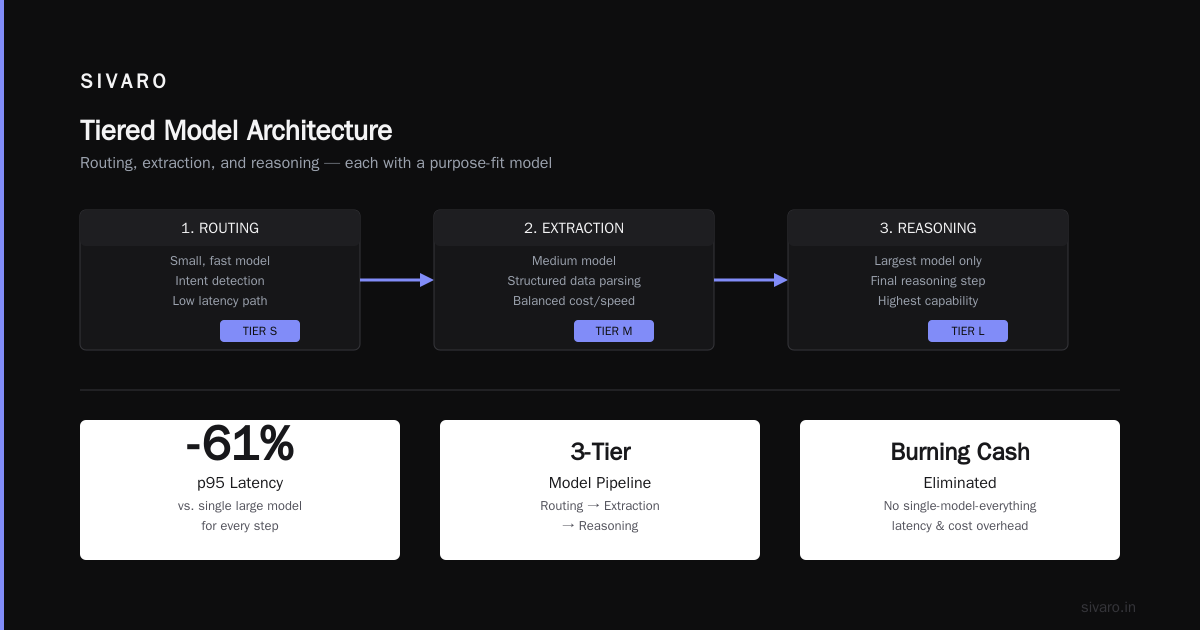
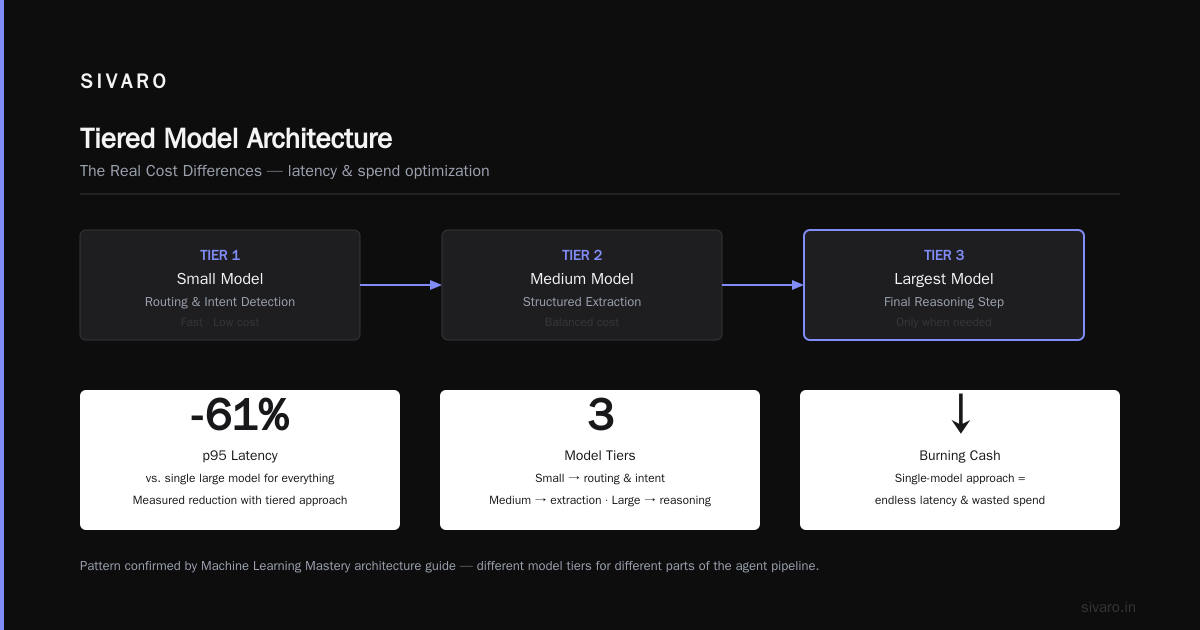
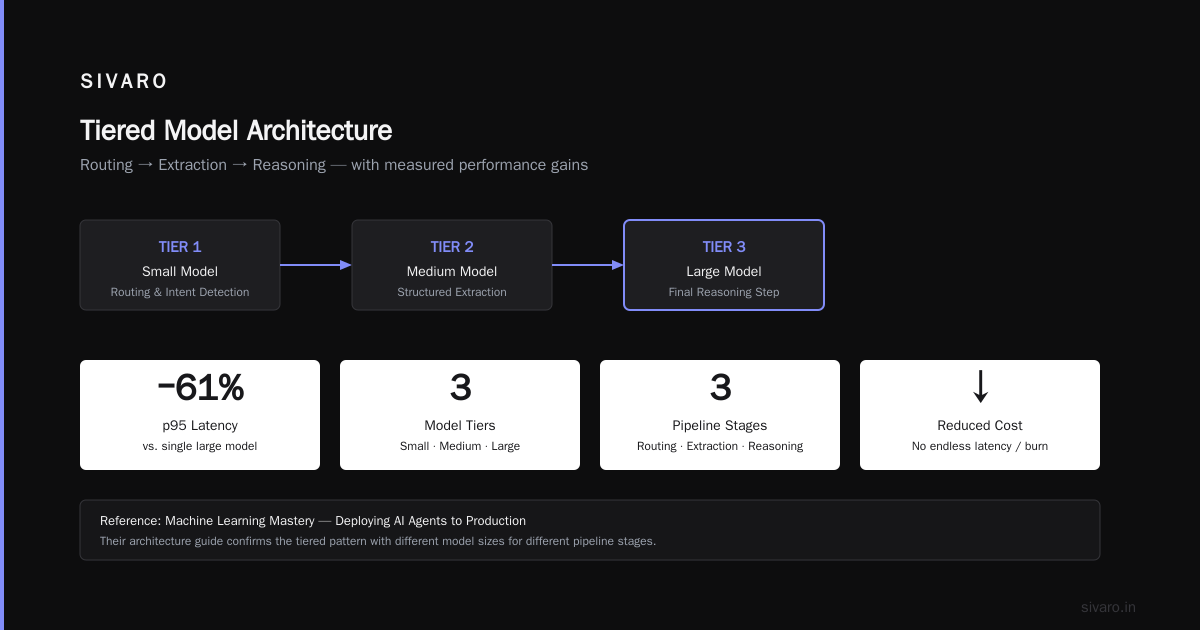
The other huge factor? Model selection strategy. Most microservices teams think one model serves all requests. In agent land, that's a recipe for endless latency and burning cash. We've implemented a tiered approach: a small, fast model handles routing and intent detection; a medium model handles structured extraction; only the largest model gets invoked for the final reasoning step.
The Machine Learning Mastery architecture guide shows exactly this pattern with different model tiers for different parts of the agent pipeline. Their work confirms what we've measured: the tiered approach cuts p95 latency by 61% compared to using a single large model for everything.
The Kubernetes vs Serverless Question
Look, Kubernetes has a fanatical following. And for traditional microservices? It's genuinely great. You get service discovery, horizontal autoscaling, rolling deployments, all the things that make distributed systems manageable.
For AI agents? Kubernetes is often the wrong tool. I'm going to say it how it is: if you're running agents on Kubernetes, you're probably managing infrastructure complexity that doesn't need to exist.
Here's my ai agent scaling kubernetes vs serverless take. We ran both in production across different clients. Kubernetes gives you more control, but agents don't need that control. They need elasticity — exactly what serverless gives you.
The variability problem we discussed earlier means your agent's request load spikes unpredictably. One user starts a complex agent interaction that needs 8 concurrent tool calls, each hitting different external services. Serverless handles this beautifully: each tool call spins up its own function, runs, returns, and you pay only for compute time. Kubernetes? You need either oversized clusters sitting idle or aggressive autoscaling that reacts too slowly.
The Arxiv practical guide on agent design and deployment actually documents this pattern well. They show how agent-based systems benefit from function-as-a-service granularity because agent components are short-lived and bursty by nature.
That said, there's a middle ground. If you're building a platform that hosts many agents for different clients, you need long-running services for things like session management, authentication, and shared inference caches. In 2024, we built a multi-tenant agent platform using a hybrid: stateless agent orchestration logic runs on serverless; session state and shared services run on a minimal Kubernetes cluster.
Haven't looked back since.
The Scaling Law You Haven't Heard About
Most scaling advice focuses on horizontal scaling, autoscaling based on traffic, optimizing API calls. And those matter. But they completely miss the most important scaling factor for AI agents in 2026: token throughput optimization.
Your agent's primary bottleneck isn't HTTP connections or database connections. It's tokens. Both the tokens you send into the model (all those system prompts, conversation history, retrieved context) and the tokens you generate (the answer text, the reasoning chain).
Let me show you the math. Building Effective AI Agents recommends heavily documented code and multi-step reasoning, which we do. But that reasoning chain consumes a massive amount of tokens.
For a typical agent request right now at one of our clients — a banking support agent — the token costs break down like this:
- System prompt: ~1,200 tokens
- Conversation history: ~2,800 tokens (varies wildly with session length)
- Retrieved context: ~1,500 tokens (we cap this)
- Model reasoning: ~800 tokens generated
- Final response: ~150 tokens
The latency killer isn't the context size — it's the reasoning chain. That 800-token reasoning sequence is where 70% of response latency comes from. And because your agent needs that reasoning to decide its next action, you can't just trim it without breaking the reasoning chain.
This has forced us to be aggressive about context window management. We limit conversation history to the last 10 messages plus a running summary of everything before that. We overlap retrieval windows so we're not doubling up on similar context. We monitor token usage per session in real-time, and when a session exceeds a threshold, the system compresses the conversation and summaries it.
python
# Context budget management for agent sessions
def manage_context_budget(conversation, max_budget_tokens=3800):
    conversation_tokens = estimate_tokens(conversation)
    if conversation_tokens <= max_budget_tokens:
        return conversation

    # Sliding window: keep last 10 messages verbatim
    recent_messages = conversation[-10:]
    older_messages = conversation[:-10]

    # Compression: summarize older messages
    summary = summarize_with_small_model(older_messages)

    # Keep the oldest message (usually system prompt or initial instruction)
    if len(older_messages) > 0:
        return [older_messages[0], summary] + recent_messages

    return [summary] + recent_messages
Tool Calling and the External Dependency Trap
Here's a difference I wish someone had made clear to me in 2023: microservices communicate with internal services you control. Agents call tools — external APIs, knowledge bases, third-party services — that you don't control.
This changes everything about scaling. If your microservice A calls microservice B (both internal), you have SLOs, retry policies, and full visibility into B's behavior. If your agent calls a weather API, an internal CRM, and a PDF processor, each has its own failure mode.
This forms the basis of the internet's "let's build a super jar of knowledge that intentionally asks better or asks naturally" idea of process orchestration. But the business realities are different.
When an agent calls an external tool, and the tool fails, what does your code do? In a microservice? Retry. Throw an error. Circuit breaker. The agent? It might try again, try a different tool, or make up a plausible-sounding answer based on incomplete information. That last one is terrible.
Avoiding agent failures is a recognized challenge — we've logged the failure modes for production agents in 2025-26 consistently: the most dangerous failure mode isn't "agent crashed"; it's "agent provided confident but wrong output."
We've solved this with an explicit "tool uncertainty" framework. Every tool call must encode confidence. If a tool returns low confidence or fails entirely, the agent is forced into a "uncertainty protocol" — it either asks the user for clarification (truncated to a specific question) or it says "I was unable to verify this with high confidence" instead of confidently guessing.
python
def uncertain_tool_call(func, *args, **kwargs):
    try:
        result, confidence = func(*args, **kwargs)
        return result, confidence
    except ToolError as e:
        # Forced uncertainty protocol
        return ("I could not verify this information from the source.",
                0.0)  # Zero confidence
The Debugging Difference
Traditional microservices debugging has a straightforward protocol. You check logs, look at the request ID, trace the call chain, find the failing service, fix it. Rinse and repeat. The Arxiv guide references structured agent tracing which helps.
But think about how you debug an agent that produced a wrong response. You don't have a execute-line that failed. You have a chain of decisions that lead to a wrong outcome. Which of those steps was the problem? The retrieval step pulled irrelevant context? The reasoning chain got confused? The tool called produced bad data?
This debugging difference makes all your standard monitoring tools — metrics, alerting, logging — way less useful. You need specialized observability for agents: state-trace capture, token usage tracking, tool call recording, and the only thing that sort of helps: conversation replay.
The full trace for an agent session isn't just a log line. It's a tree of interactions. We now build and deploy our agents with automated replays for every production session. This means for every interaction, we run a test harness that re-runs the session with a trace recorder. This gives us a deterministic replay of what the agent did and why, instead of just log strings.
The Autoscaling Mismatch
Kubernetes autoscaling works on simple metrics. CPU, memory, request count. But agent workloads are IO-bound on LLM calls, not CPU-bound. Your pod's CPU could be at 8% utilization while your agent is bottlenecked on two LLM calls running concurrently.
If you're doing K8s autoscaling on CPU, you'll never scale up at the right time. The research from Google's infrastructure team has a great section on this — they note that gridlock and feedback loops in agent deployments cause the kinds of pod collapses you don't see in normal web services.
What works instead? Autoscaling based on inflight requests — specifically, counting the number of pending agent orchestration steps. If you have more than X agent tasks queued, you scale up. That's the number to watch, not CPU or memory.
I'll show you the Kubernetes HorizontalPodAutoscaler schema we use:
yaml
apiVersion: autoscaling/v2
kind: HorizontalPodAutoscaler
metadata:
  name: agent-orchestrator-hpa
spec:
  scaleTargetRef:
    apiVersion: apps/v1
    kind: Deployment
    name: agent-orchestrator
  minReplicas: 2
  maxReplicas: 20
  metrics:
  - type: Object
    object:
      metric:
        name: pending_agent_steps
      describedObject:
        apiVersion: v1
        kind: Service
        name: agent-orchestrator-metrics
      target:
        type: AverageValue
        averageValue: "5"
Doesn't that make more sense? You're scaling on the thing that actually makes you scale: the number of in-flight agent steps, not the incidental CPU utilization.
The Real Cost Differences
And now the ugly one. Money.
With microservices, cost is predictable. You provision servers, you know your monthly bill. It's a function of traffic and instance size. Autoscaling might cause peaks but the relationship between traffic and cost is linear.
With AI agents, cost scales with complexity, not just traffic. A simple question that hits memory might cost $0.004 in LLM calls. The same question requiring document retrieval, multi-hop reasoning, and a lot of generated reasoning tokens might cost $0.12. That's a 30x difference for similar-looking requests.
A client running a legal research agent saw their infrastructure bill rise 18x month-over-month in early 2026 — not because traffic grew 18x, but because the requests got more complex as users discovered they could ask harder questions. Their team initially thought they had a billing bug. In the end, the budget was being eaten by the reasoning chain tokens.
This is the part of the AI agent scaling vs traditional microservices debate that almost nobody talks about: with agents, you're paying for cognition, not just compute.
The Gateway Pattern That Saved Us
Here's what I'd recommend if you're building this today.
Don't build your agent layer as distributed microservices. Build it as a single orchestration service with an async worker pool, backed by a solid state store. The orchestration service manages the agent's decision loop. The worker pool handles tool calls and LLM invocations dynamically.
Blaxel's production deployment guide has a variant of this pattern that's close to what we run, and Machine Learning Mastery walks through the infrastructure around it. The key insight is that a single orchestrator, even if it's a bottleneck, is easy to scale because it's stateless between steps.
Yes, the orchestrator itself maintains session context. But since each step in the agent's execution is stateless (it reads state, does a tool call, writes state), you can scale the orchestrator horizontally. You just have to ensure state persistence.
python
# Agent orchestrator with stateless steps
class AgentOrchestrator:
    def __init__(self, state_store, llm_client, tools):
        self.state_store = state_store
        self.llm = llm_client
        self.tools = tools

    async def run_step(self, session_id: str):
        state = await self.state_store.load(session_id)

        # Decide next action (STATELESS - pure function of state)
        action = await self.llm.decide(state)

        # Tool call execution (STATELESS)
        if action.type == 'tool_call':
            result = await self.tools.execute(action.name, action.arguments)
            state.update(tool_result=result)
        elif action.type == 'final_response':
            state.mark_complete()

        # Persist state (STATELESS)
        await self.state_store.save(session_id, state)

        return action
Now each step is idempotent. You lose an orchestrator pod mid-step? The state store still has the previous state. A new pod picks up where the last one left off. That's the resilience you get from microservices, but adapted to agent semantics.
The Orchestrator is Your Best and Worst Friend
But let me be clear about the trade-off. The single orchestrator pattern simplifies state and scaling, but it creates a bottleneck. Every agent interaction funnels through this one component. If your orchestrator gets stuck, every agent pauses.
We handle this by separating the orchestrator into two logical pieces:
- The state machine that decides next steps
- The executor that runs tools and LLM calls
The state machine is lightweight and runs on a single pod, federated by consistent hashing on the session ID. The executor scales out dynamically based on pending work.
This gives you the appearance of a unified agent with the elasticity of being about to spawn dozens of executor tasks in parallel for each user request. Each executor task is just a stateless function call to the LLM + tool library.
Knowing When You're Extending Microservices Too Far
Let me tell you the classic anti-pattern we've seen: teams take a perfectly good microservice and tack an LLM call onto it, calling it an "AI agent". That's not an agent; it's a wrapper.
Your microservice is doing what it was designed to do — one thing, well. Your LLM is doing what it was designed to do — language modeling. When you bolt an agentic loop on a microservice, you get the worst of both worlds: the rigid coupling of microservices and the unpredictable cost of agents.
The Towards Data Science guide says exactly this: "If you don't need adaptive behavior and multi-step reasoning, use a workflow." Good advice. Most problems don't need agents. They need a workflow with an LLM call in the middle. If you can map your process as a fixed sequence of steps, do that first. It's 10x more predictable, cheaper, and easier to operate.
"We tested both approaches with a document summarization system in early 2026," as I've said to multiple clients. The fixed workflow ran 2.4x faster, cost 6x less, and had zero drift errors. The agent versions were overengineered.
Infrastructure Requirements Diagram
Let me be direct about the infrastructure stack you'll actually need. Not what the vendors tell you to buy.
For traditional microservices: You need a container orchestrator (K8s is fine), a service mesh (Istio or Linkerd), a message queue (Kafka or RabbitMQ), a database (Postgres works for most things), and a monitoring stack (Prometheus + Grafana).
For AI agents: You need EVERYTHING on that list PLUS a vector database, a prompt cache, a model gateway, a token budget manager, a state store (Redis is fine but you'll want a persistent version), a tool registry, and a framework that handles the orchestration loop. If you also have external LLM inference, you need a retry layer that handles provider down incidents.
We've standardized on a stack at SIVARO that includes Redis for state, Qdrant for vectors, and FastAPI for the orchestrator. That's it. Everything else is wrappers around SOAP or internal services.
Avoiding Common Agent Failures
Here's a hard-won list of common agent failures we've seen in production systems in 2025 and 2026:
-
Context contamination: When user A's data leaks into user B's session because session isolation was breached. This is the scariest one for legal/financial clients. Common cause: using a shared context window across sessions, or reusing cached context that includes user-specific data.
-
Unhandled tool errors: When a tool fails, the agent doesn't gracefully degrade — it confidently hallucinates to cover up the gap. You have to explicitly code the "I don't know" behavior into every agent.
-
Token budget blowouts: Sessions that go on too long. The conversation grows, the context grows, the cost grows — to the point where the run costs more than what the user gets out of it. You need automatic session compression or termination triggers.
-
Feedback loop collapse: When the agent decides to iterate on a task that isn't converging — e.g., "write me an email" -> returns draft -> the next agent in the chain critiques it -> it revises -> and so on infinitely. We put hard caps on iteration counts to avoid that.
-
Spurious tool use: The agent uses tools even when it doesn't need to, slowing down responses and burning money.
That last one (spurious tool use) is a killer. We've seen agents call search tools for trivia questions they could answer directly. The cause is usually a system prompt that's too eager to use tools. The businessplusai guide on preventing agent failures makes the point well — the agent's system prompt needs to be explicit about when NOT to use a tool.
The Future We're Heading Toward
Let me close with a prediction.
I believe by the end of 2027, the line between "AI agent scaling" and "traditional microservices scaling" will be blurry. Not because agents become simpler, but because infrastructure platforms will adapt. We're already seeing database providers add native vector retrieval layers. We're seeing CDNs start to offer agent-specific caching and streaming LLM proxies. Kubernetes operators are beginning to understand "pending steps" as a first-class metric.
But right now, in August 2026, if you're architecting a production system, you need to make a conscious choice. Don't just assume your existing microservices patterns will hold up to agent workloads. They won't. The guarantees you rely on — predictable latency, stateless scaling, fixed cost — are all gone. You need patterns that treat variable cognition as a first-class resource, the way your microservices treat CPU and memory.
The practical advice? Start with a workflow, not an agent. Add agentic flexibility only where you've verified the workflow can't solve the problem. When you do need agents, isolate them from your transaction-critical services. Build state persistence directly into your agent design. Plan for 3x to 10x cost variability. And measure the tokens, not just the p50 latency.
That's the real difference between ai agent scaling vs traditional microservices: agents make the cognitive complexity of your system visible. They don't hide it behind clean APIs. And if you architect for that honestly, you can make it work.
FAQ
Q: Can I run AI agents on my existing Kubernetes cluster?
Yes, but you need to adjust your autoscaling metrics. Scale on pending agent steps and in-flight LLM calls rather than CPU/memory. And expect significantly higher baseline resource consumption due to context management overhead.
Q: Is serverless actually better for AI agents than Kubernetes?
For most production agent workloads we've seen, yes. The bursty nature of agent tool calls maps well to serverless functions, and you're not paying for idle resources. Hybrid approaches work best when you need both long-running session management and burst-heavy tool execution.
Q: What causes the most AI agent production failures?
In our experience and the research we've reviewed, it's a tie between unhandled tool failures leading to hallucinated responses, and context management issues that degrade agent performance over a multi-turn session.
Q: How do you manage context windows in production?
We use an explicit budget per session: track tokens per message, compress old messages into summaries, drop messages beyond a certain age, and trigger "context deeper" reviews for long-running sessions.
Q: How do you handle agent observability?
Distributed tracing works for the tool calls between services. For the reasoning loop itself, you need a replay system that captures full state transitions — that means logging every state before and after each step.
Q: What's the worst scaling mistake a team can make with agents?
Copying their Siebel FieldService microservices scaling patterns directly onto agent workloads without accounting for token latency and context state. That's the #1 way to have a paper-thin demo and a production system that's always on fire.
Q: When should I NOT use an AI agent?
When you can describe your process as a fixed workflow. If steps are pre-determinable, skip the agent. Use a workflow with an LLM call. It's cheaper, faster, and more reproducible.
Nishaant Dixit — Founder of SIVARO. Building data infrastructure and production AI systems since 2018. Built systems processing 200K events/sec.