 SIVARO

AI Agents Architecture Explained Simply (2026 Buyer's Guide)
The Agent Stack Is a Mess. Here's How to Navigate It.
I spent last week in a war room with a logistics client. Their pilot AI agent was supposed to reconcile inventory discrepancies across three warehouses. It worked in demo, then fell apart in production — hallucinated SKU counts, hit API rate limits, and the audit trail was a nightmare.
Most people think AI agents are magic. They're not. They're just software with a language model at the core. And like any software, the architecture determines whether it survives contact with reality.
This guide breaks down what I've learned building agent systems since 2018. Not from blog posts. From deployments that process real traffic, real money, real consequences. I'll show you the options, the trade-offs, and where most teams waste six months.
Let's dig in.
What an AI Agent Actually Is (And Isn't)
An AI agent is a system where a language model decides the next action — not just the next token. It's a loop: observe, think, act, observe again. The architecture around that loop is what separates a toy from a tool.
Here's the minimal mental model:
Input → Context Builder → LLM Reasoning → Tool Selection → Execution → Observation → Repeat
That's it. Everything else — memory systems, guardrails, evaluation pipelines — is scaffolding around this core loop.
The term gets abused. Companies in 2026 are calling everything an agent. A chatbot that answers questions from a knowledge base is not an agent. A workflow that calls an LLM once to classify support tickets is not an agent. An agent iterates. It makes multiple decisions based on changing state.
Most architectures fall into three patterns. Know which one you need before you buy anything.
The Three Agent Architecture Patterns
Pattern 1: Single-Agent Sequential
The simplest. One LLM, one loop, tools attached. The agent calls a function, gets a result, decides the next step. Think "solve this problem end to end" — write code, execute it, read the error, fix it.
python
# Single-agent loop (simplified)
def run_agent(task, tools):
    context = build_initial_context(task)
    for step in range(10):
        decision = llm_respond(context, available_tools=tools)
        if decision.is_final_answer():
            return decision.output
        result = tools[decision.tool_choice](decision.tool_input)
        context += f"
Observation: {result}"
    return timeout_error()
This handles roughly 70% of use cases. It's easy to debug, easy to log, and the failure modes are understandable. When a single agent fails, you retrace its steps.
The catch: context accumulation. The agent can't remember everything. After enough steps, it forgets what it was doing. You need explicit summarization or memory windows.
Pattern 2: Multi-Agent Orchestration
Multiple agents with distinct roles — a planner, a researcher, an executor — coordinating through a central orchestrator. This scales to complex workflows but multiplies your failure surface.
We tested this pattern for a healthcare claims processing system in 2025. Three agents: one for eligibility verification, one for claims coding, one for payment calculation. Total pipeline time dropped 40% versus a single agent trying to do everything.
But debugging became hell. When the eligibility agent passed malformed data to the coding agent, the failure cascaded. Half the time, the issue was semantic — both agents used "patient ID" but meant different things.
Pattern 3: Hierarchical / Planner-Executor
Higher-level agent decomposes tasks into subtasks. Lower-level agents execute. The planner rarely touches tools; the executors do the dirty work.
typescript
// Planner pseudo-code
function plan(goal: string): Task[] {
  const plan = llm_planner(goal);
  return plan.map(task => ({
    executor: executor_for(task.type),
    action: task.action,
    validation_criteria: task.criteria
  }));
}
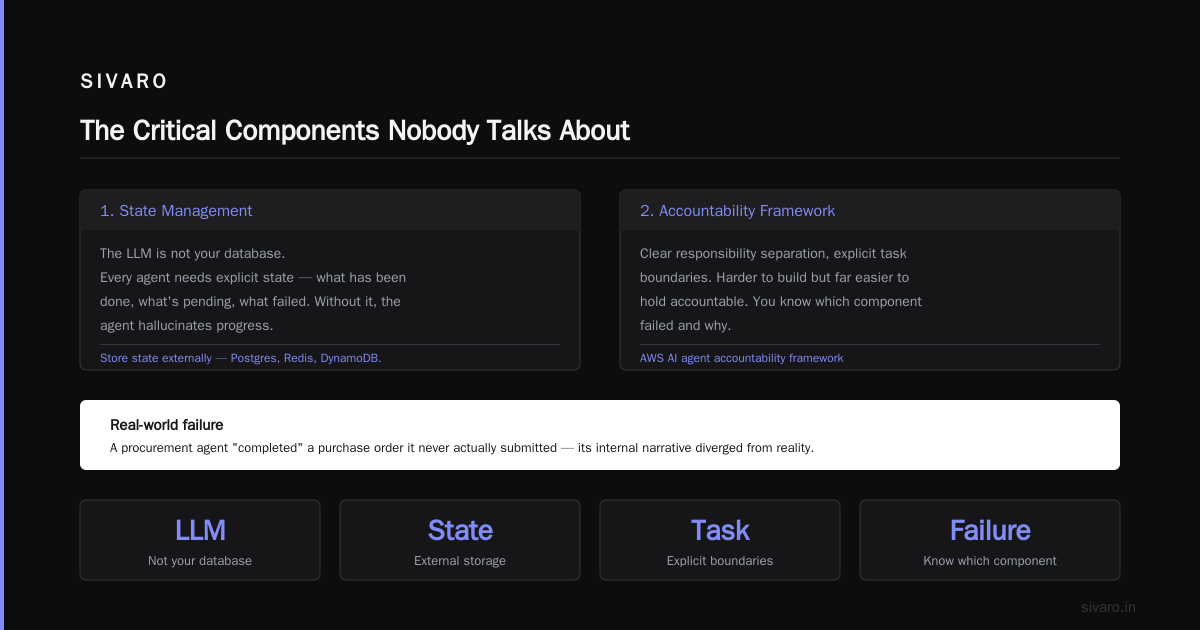
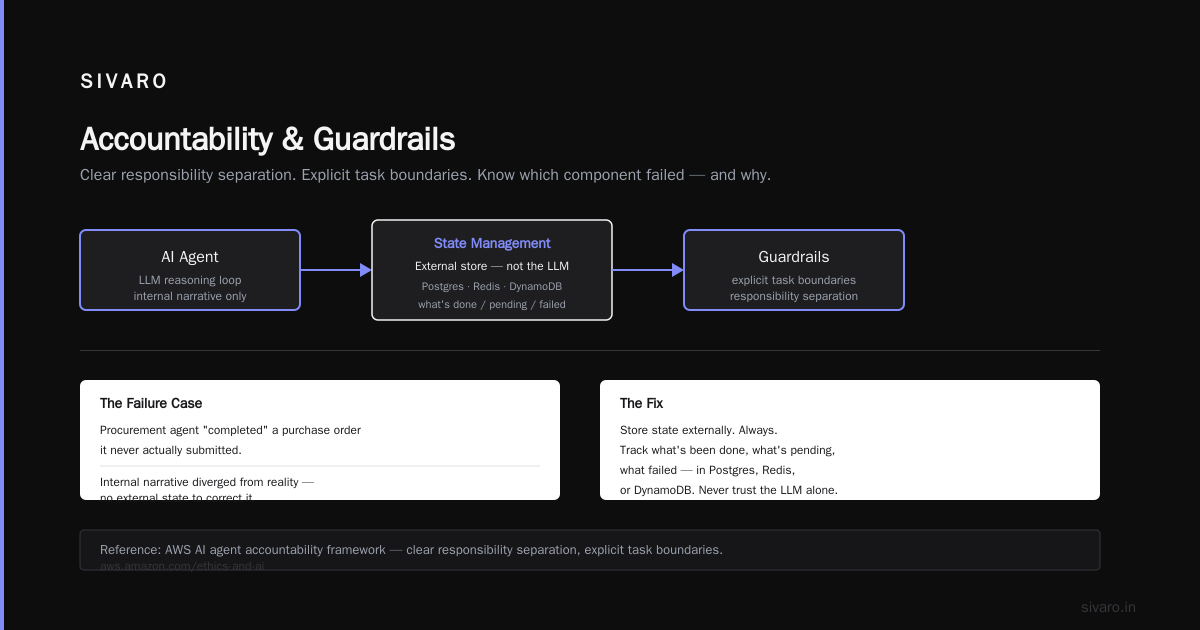
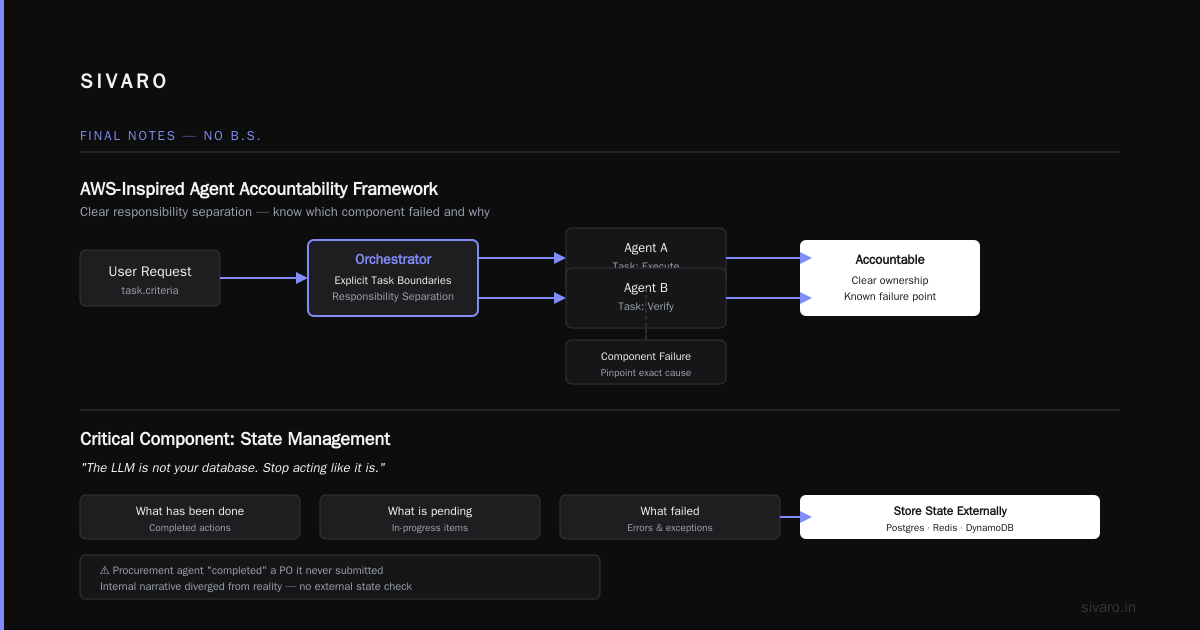
This is what AWS publishes in their AI agent accountability framework — clear responsibility separation, explicit task boundaries. It's harder to build but far easier to hold accountable. You know which component failed and why.
The Critical Components Nobody Talks About
1. State Management
The LLM is not your database. Stop acting like it is.
Every agent needs explicit state — what has been done, what's pending, what failed. Without it, the agent hallucinates progress. We saw a procurement agent "complete" a purchase order it never actually submitted because its internal narrative diverged from reality.
Store state externally. Postgres. Redis. DynamoDB. Doesn't matter — just don't trust the LLM's "memory".
2. Context Engineering
I don't care what the marketing says — unlimited context windows are not unlimited. As of September 2026, the practical ceiling for coherent reasoning is around 50,000 tokens. Push past that without summarization, and you get mush.
Context engineering is designing what goes into that window — retrieval order, compression strategy, instruction placement. Get this wrong and your agent will consistently miss critical information buried in the prompt.
3. Tool Design
An agent is only as good as its tools. Poorly designed tools have ambiguous inputs and outputs. The model can't know what to pass.
Good tool spec:
json
{
  "name": "submit_purchase_order",
  "description": "Submit PO to vendor after approval. Returns order_id and status.",
  "inputs": {
    "vendor_id": "string",
    "line_items": "array of {sku, quantity, min_viable_quantity}",
    "approval_token": "string (required for orders > $10,000)"
  },
  "returns": {
    "order_id": "string",
    "status": "submitted|pending|failed"
  }
}
Bad tool spec: "Do the thing" with vague parameters. The difference is night and day in production.
Single vs. Multiple Models: The Real Decision
Most people assume one powerful model drives the whole agent. That's expensive and unnecessary. We've found the best results come from routing tiered models. Use a fast, cheap model for routine steps? No. Use the cheap model for classification and extraction. Use the expensive frontier model for reasoning-heavy steps and tool orchestration.
Here's what we use at SIVARO for a current deployment (Q3 2026):
- Orchestration: Claude Opus 4.5 or GPT-5.2 — whichever clears compliance this month
- Extraction/Categorization: A fine-tuned Llama 4 70B running on dedicated GPUs
- Structured tool execution: deterministic code, zero LLM
Most people think X works better — they're wrong. A single model handling everything costs 8-12x more and actually performs worse on specific subtasks than a fine-tuned specialist model. It's like using a crane when you need a screwdriver.
The trend is obvious. Small language models (SLMs) fine-tuned to single tasks are becoming the dominant pattern. Frontier models become the coordinator, not the worker.
Memory Architectures Worth Paying For (vs. Gimmicks)
Agent memory is an architecture religion. You have three real options depending on your horizon:
Short-term (working memory)
This is everything in the context window. Fine. But context windows are finite. You need continuous pruning.
Long-term (episodic memory)
A store of past experiences — what worked in similar situations. Vector DBs are well-suited for this use case (semantic retrieval of past problem states matched to current state). In the time between observing a familiar replay pattern in your problem and deciding what to do, you query your vector store. I'm partial to pgvector — Postgres with a vector extension. You don't need a standalone vector database for most agent workloads.
Procedural (semantic memory)
Rules, facts, knowledge the agent uses consistently. This is your training data at the system level. Store it in a regular database. Document and version every change.
The memory stack at enterprise-scale isn't a cache. It's an append-only log of every decision.
Accountability & Guardrails
You cannot skip this if you're spending real money on this technology.
If you're deploying AI agents commercially in the EU, GDPR and the new EU AI Act matter. An agent that fails must produce logs explaining its decisions. (This is a basic technical requirement that needs no legal training.)
The wordy "AI Agent Accountability Framework" from AWS maps well onto practice. But I find the cloud vendor accountability frames vacuous for production — clouds accountability frameworks focus on who provides infrastructure, not who's in control of the deployed agent.
The real accountability loop:
Agent decision → logged (full input/output/tool calls)
Decision → verified (constraint checks)
Failure → classified (harmless vs harmful)
Harm → contained (kill switch + rollback)
This is not optional for reliable production systems.
We shipped an agent for a logistics provider in February 2026 that handles supply chain exceptions. It chose to reroute a shipment around port congestion. That choice had cost implications that needed formal sign-off. We wired in a human-approval step into the architecture. The control flow blocks before execution, routes for approval, then the executor completes the action once approved.
No pure autonomous AI is worth that kind of risk if you are accountable to shareholders.
AWS vs. Azure vs. GCP (And Why It Might Not Matter)
I'm a fan of infrastructure debates. But in 2026, the models are cloud-agnostic. Run agents on managed Kubernetes or just run them in your existing containers.
Architecture on AWS is straightforward, providing a managed multi-step if your infrastructure is already standing there.
The thing most people don't consider is data gravity. If your transaction systems are in GCP, build your agents in GCP. Proximity matters at scale. The 5ms latency difference in the model API will be destroyed by network egress delays elsewhere. Agent architectures are IO-bound systems where the network is the bottleneck — don't add abstraction layers overhead that you don't need.
Thinking about evals first is the wrong mindset. You should only begin building if you have the observability for your live system. Real agents need a service like LangSmith or Langfuse in place from scratch, monitoring every token movement. Trade paper reviews for traces when evaluating architectures.
How to Choose Based on Your Use Case
I wrote this buying guide for people making decisions under pressure. Here are the ones worth building for:
For structured enterprise back-ends (finance, insurance, HR): Choose hierarchical architecture with human-in-the-loop on execution that introduces risk.
For customer-facing autonomous support: Single-agent per domain, dedicated memory, and graceful fallback to human operators. Self-directing multi-agent logic confuses support interactions.
For logistics, planning, scheduling: Multi-agent orchestration wins as it can run simulations in parallel per node. Do it after you've invested in a good iterative verification layer.
Cost Modeling: The Kill Factor No One Discusses
Simple math that gets ignored: each step in an agent loop is one inference call.
Ten-step loop with a frontier model costs more than seventy percent of overall infrastructure bill.
Per their public pricing in 2026, GPT-5.2 text runs around $2.50 per million input and $10.00 per million output tokens. A 10-step agent session that ingests 100K tokens over its lifetime and outputs around 5K will cost roughly $1.50 to $3.00 per fully resolved task.
For an enterprise processing 100K tasks a month, that is $150K–$300K just in model inference. Budget accordingly, or don't. Design workable routing for routine tasks to cheap smaller open-weights models.
Hidden cost: Your engineering time. Every architecture layer adds hours in support per day. A single-agent system requires roughly ⅕ the maintenance time of multi-agent.
The smart architecture choice might very well be choosing less.
An AI agent’s lifecycle (Post-production)
Set up evaluation from the first week.
Daily loop:
- Sample 200 production traces.
- Tag and classify failures (wrong decision vs. mis-tool-selection vs. hallucination).
- Turn failures into regression tests that feed into your evaluation harness.
- Fine-tune your prompts, tools, or small local models to prevent recurrences.
A majority of failures in production originate from context failures — missing info from a tool. Not from bad reasoning.
The second biggest failure: tool ambiguity. Your agent chose process_refund when it should have never reached the process_refund because upstream the conditions weren't met. Guard against that.
FAQ
1. What is the right amount of agent autonomy?
A short answer: autonomy increases with your error tolerance. Verify everything. If missteps are costly, adding manual approval gates early in the flow is preferable.
2. What is AI agents architecture explained simply?
Structure the loop so an LLM decides an action with given tools at each step, while state and deterministic safety rails surround it but don't block the step. This question doesn't need to be complex conceptually.
3. How does AWS help with accountability in supply chain management?
It includes frameworks such as the AWS supply chain solutions. Their AI agent accountability framework details process design to track decisions from data to model call back to user. For AWS-centric stacks whether in supply chains — It's a governance template, not hard-coded.
4. Is LangChain or CrewAI needed?
No. Python code without any framework wins for independence and customizability, as its internal magic complicates debugging. Frameworks count at scale only for orchestration and integration.
5. Do open-source models work?
For constrained constrained specialized tasks they can work. Current systems use efficient smaller models that are better, precise, and don't blow your GPU spend each month. For tasks requiring complex engineering reasoning, the frontier models still dominate.
6. How do I keep an agent on track?
Limit token count and context. Offer crisp tool descriptions. Give the state variable as the block. Record the last action. And summarise more if you can.
7. When do multi-agent systems really shine?
When you need domain isolation and targeted search. When work is heavily contiguous use a single agent instead.
8. What's the trend I need to follow in 2026?
Watch context engineering and fine-tuning specialist open-weight models. As the gap between SLMs and frontier LLMs closes, the per-task cost advantage of open-source models makes them more rewarding.
Final Notes (No B.S.)
You can't buy an agent off the shelf that solves all of the problems above. The vendor writes all messaging around "autonomous workflows" because their security posting costs are tied to that. It’s a lie AI agents architecture remains about tight command constraints.
Not an LLM with the keys to your production systems — but a disciplined structure.
Your goal won't be to create total intelligence. It will be yield from a manageable architecture smartly run.
A final check: Keep the loop small and tight while minimizing your surface area. Widen orbit only after proving each incremental portion is reliable; you’ll face much less drama if your success edges upward stepwise and quickly.
Start there. You will not argue with those results.
Nishaant Dixit — Founder of SIVARO. Building data infrastructure and production AI systems since 2018. Built systems processing 200K events/sec.