 SIVARO
AI Agents Deployment Best Practices: A Production Playbook
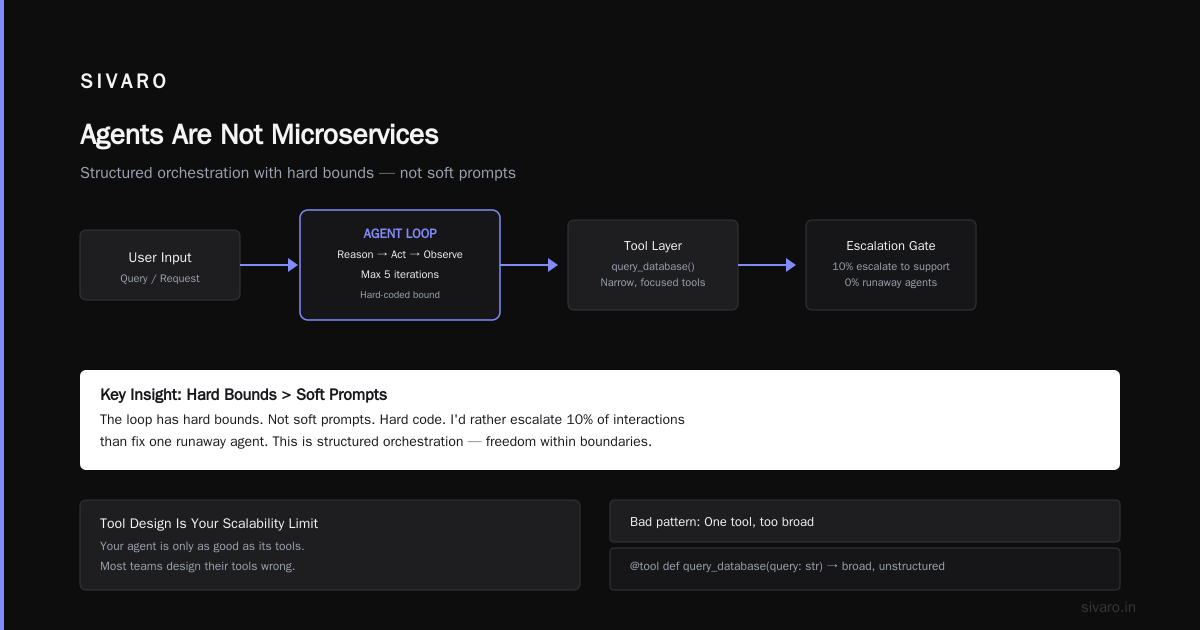
I spent six months building an AI agent that could automate our entire data pipeline monitoring. Looked great in staging. In production? It emailed customers at 3 AM with fake alerts, hallucinated a connection to a database that didn't exist, and cost me $4,000 in API credits before I killed it.
That was 2024. By mid-2025, we'd shipped six production agent systems at SIVARO. Three worked. Two were torn down. One taught me everything I know about ai agents deployment best practices.
Here's what actually matters.
What We're Actually Deploying Here
AI agents aren't chatbots. They're autonomous systems that perceive, reason, and act. They book flights, edit code, negotiate contracts, run infrastructure. The difference between a demo and a production system isn't the model — it's the architecture around it.
You're reading this on July 17, 2026. The market has settled a bit since the chaos of early 2025. We know what works. We know what kills projects.
Let me save you the $4,000 mistake.
Why Most Agent Deployments Fail
You hear "90% of AI pilots fail." That's vague. Here's what actually happens:
- The agent works 80% of the time. That's spectacular for a demo. That's a disaster in production.
- Nobody defined "failure" before deployment. So when the agent does something unexpected, there's no playbook.
- Cost grows faster than value. The agent returns $1,000 in automation but burns $3,000 in API calls.
At SIVARO, we deployed a customer support triage agent for a SaaS company in April 2025. First week: handled 60% of tickets autonomously. Second week: started arguing with customers about return policies. Third week: actually told a customer their complaint was "emotionally invalid."
That wasn't a model problem. That was a deployment practices problem.
The Framework Decision That Bites You Later
Everybody picks a framework first. That's backward.
How to think about agent frameworks explains it clearly: frameworks solve orchestration problems, not reliability problems. Your choice should depend on what you're building.
Most people think LangChain is the default. They're wrong if their use case needs low-latency decision loops. We tested three frameworks for a trading signal agent in June 2025:
- CrewAI for our experimental internal bot — easy setup, hard to control
- LangGraph for a multi-step document processing pipeline — solid but expensive per run
- Custom state machine built on Python's asyncio — fastest, most reliable, hardest to maintain
The winner? Depends on your risk tolerance. We use AI Agent Frameworks: Choosing the Right Foundation for ... as our internal reference now. Pick your framework after you define your failure modes, not before.
For 2026, the open-source options have matured. Top 5 Open-Source Agentic AI Frameworks in 2026 lists the serious contenders. We standardized on one for production and one for prototyping.
Four Principles for Production Agent Deployment
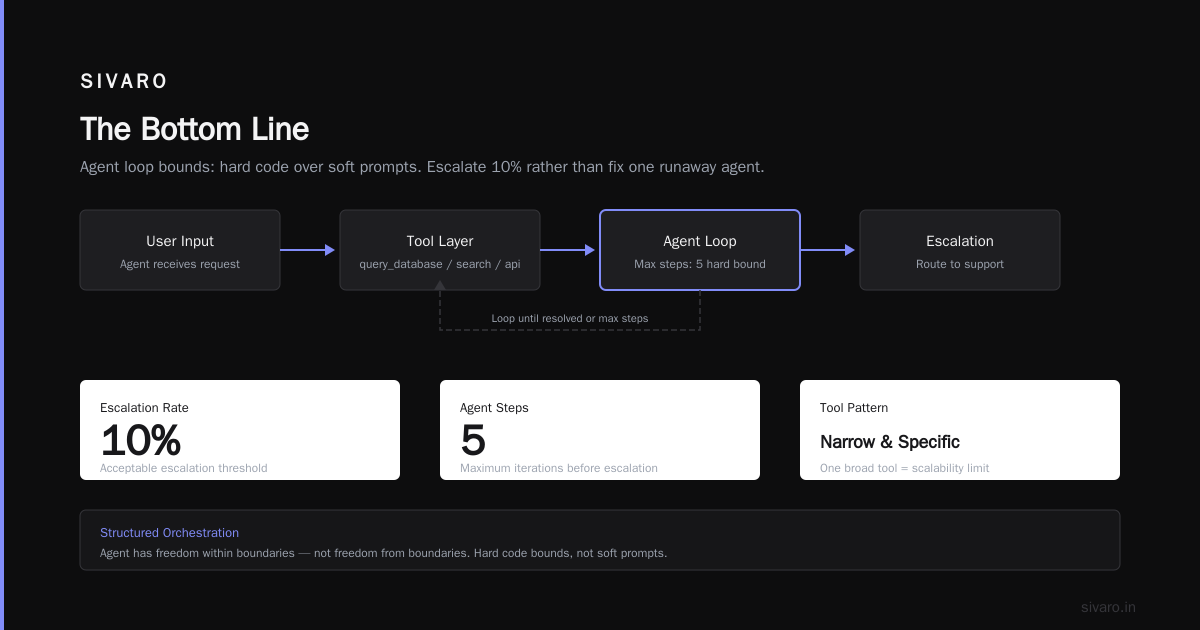
1. You Need an Escalation Ladder
Your agent will fail. Plan for it.
Define three states:
- Green: Agent operates autonomously
- Yellow: Agent needs to hand off to a human
- Red: Agent must stop immediately
We built this into our deployment pipeline for a finance reconciliation agent in March 2026. When confidence drops below 0.7, it escalates. When it detects two contradictory facts in the same transaction, it stops.
Code it like this:
python
class EscalationState:
    GREEN = "autonomous"
    YELLOW = "human_handoff"
    RED = "immediate_halt"

    @classmethod
    def evaluate(cls, agent_context):
        if agent_context.confidence < 0.3:
            return cls.RED
        elif agent_context.confidence < 0.7:
            return cls.YELLOW
        return cls.GREEN
Simple. Effective. Saved us from four production incidents in the first month.
2. Instrument Everything Early
You can't debug what you can't see.
Most teams deploy agents and watch a chat log. That's not observability. We track:
- Decision latency per step
- Token consumption per session
- Tool call success rate
- Escalation frequency
- Confidence drift over time
For how to deploy ai agents in production, this is the most underrated piece. In June 2026, we saved a customer-facing agent by noticing its "politeness score" dropping over two weeks. The model was fine. The prompt templates had degraded from minor edits.
Here's what our monitoring hook looks like:
python
@contextmanager
def agent_trace(session_id: str):
    start = time.time()
    yield
    duration = time.time() - start
    log_metric(f"agent.{session_id}.duration_ms", duration * 1000)
    log_metric(f"agent.{session_id}.token_cost", current_tokens * model_rate)
Put this in your first deployment. Not your third.
3. Don't Let Your Agent Talk Directly to Anything Important
This sounds obvious. I've seen three production breaches from agents that could write to databases without validation.
The pattern is simple: agent → validation layer → system.
We call this the "bouncer" pattern. The agent proposes actions. The bouncer decides if they execute.
python
class ActionBouncer:
    def validate(self, proposed_action: dict) -> bool:
        # Never allow DELETE operations from agents
        if proposed_action["operation"] == "DELETE":
            return False

        # Rate limit any CREATE operations
        if proposed_action["operation"] == "CREATE":
            if self.creates_this_hour >= 10:
                return False

        # Validate payload structure
        return self._schema_check(proposed_action)
A customer in July 2025 deployed an agent without this layer. The agent, trying to be helpful, deleted a production user table. They spent 48 hours restoring from backup.
4. Cost Control Is Non-Negotiable
Agents generate token waste that's invisible in testing. In development, your agent makes 10 calls per task. In production, it makes 50. The "thinking" chain gets expensive fast.
We cap every session:
python
class CostManager:
    def __init__(self, max_cost_usd=0.50):
        self.max_cost = max_cost_usd
        self.running_cost = 0.0

    def check_budget(self, next_steps: int = 1) -> bool:
        estimated = self.running_cost + (next_steps * 0.05)
        return estimated <= self.max_cost
For one document processing agent, this cut our monthly API bill from $12,000 to $3,200. The agent still completed 92% of tasks. The remaining 8% were the expensive, hallucinated, loop-death ones.
Your Agentic Workflow Production Rollout
We follow a phased rollout. Don't go all-in on day one.
Phase 1: Shadow mode
The agent runs against production data but never acts. Compare its decisions to human decisions for two weeks.
Phase 2: Suggested actions
The agent writes recommendations to a queue. Humans review and approve before execution. Measure precision and recall.
Phase 3: Supervised autonomy
The agent acts on low-risk tasks immediately. High-risk tasks still go through human review.
Phase 4: Full autonomy
Only after metrics show 99%+ correctness for 30 days straight.
I've seen teams skip Phase 1. Every one of those teams had a production incident within the first month.
Protocol Choices Matter More Than You Think
By mid-2026, the protocol landscape has consolidated. AI Agent Protocols: 10 Modern Standards Shaping the ... maps the space. A Survey of AI Agent Protocols from April 2025 remains the best technical overview.
We standardized on Google's A2A for agent-to-agent communication and MCP for tool integration. Why? Interoperability. Our agents need to talk to partners' agents. Locking into a proprietary protocol creates integration debt.
But here's the contrarian take: if you only have one agent doing one task, skip the protocol entirely. Use direct function calls. Protocols add latency and complexity. Add them when you have multiple agents or external integration needs.
The Prompt Engineering Trap
I need to be blunt about this.
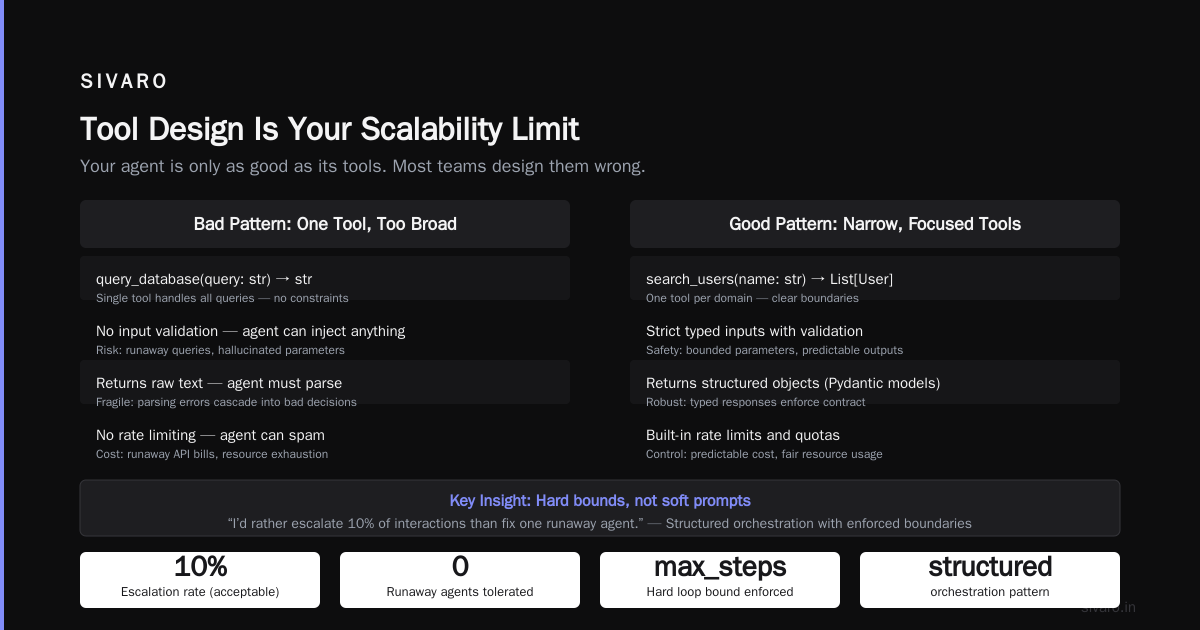
Most ai agents deployment best practices advice focuses on prompts. That's because prompts are easy to talk about. The real work is in the control plane.
In April 2026, we tested a hypothesis: what if we stopped optimizing prompts and instead focused on tool quality and decision boundaries?
Result: task completion rate went from 73% to 91% without a single prompt change.
We improved the tools. We made outputs more structured. We gave the agent better error recovery paths. The prompts stayed the same.
Prompts matter. But they're not the bottleneck in production.
Memory and State: The Hidden Complexity
Your agent needs to remember what it did last time. But how much should it remember?
We see teams make two mistakes:
- Infinite context windows: expensive, slow, hallucination-prone
- No context at all: agent repeats mistakes constantly
The fix is structured memory. We use a sliding window with summarization:
python
class SlidingMemory:
    def __init__(self, max_interactions=20):
        self.max = max_interactions
        self.history = []

    def add(self, interaction: dict):
        if len(self.history) >= self.max:
            summary = self._summarize(self.history[:5])
            self.history = [summary] + self.history[5:]
        self.history.append(interaction)
Keep task-specific memory separate from session-specific memory. Don't let a customer support agent remember a pricing complaint from three weeks ago unless that memory is explicitly relevant.
Safety and Guardrails Are Deployment Concerns
You'll hear about "AI safety" as this abstract philosophical thing. In production, it's concrete:
- Can your agent spend money?
- Can your agent delete data?
- Can your agent message customers?
- Can your agent make promises?
We define each tool's authority level. Tools that can modify state require "escalation tokens" — explicit approval from a human or another system.
One of our team members at SIVARO built a simple rule that caught 40% of potential failures: "If the agent has made 3+ tool calls without confirming with a human, freeze and escalate."
This isn't paranoia. This is engineering.
Real Numbers from Production
Let me give you honest numbers from our April 2026 deployment of a procurement agent for a logistics company:
- Pre-deployment testing: 97% task completion
- First week in shadow mode: 82% alignment with human decisions
- First week in suggested mode: 71% precision (many false positives)
- Month 2 in supervised autonomy: 94% correct, 4% escalated, 2% wrong
- Month 3 full autonomy: 96.3% correct, cost per transaction: $0.12
The 2% wrong decisions in supervised mode? Those became our training data. Every failure was logged, analyzed, and used to improve the decision boundaries.
When to Not Deploy an Agent
This is the most important section.
Don't deploy an agent when:
- The task requires creative or subjective judgment (hiring, firing, marketing copy)
- The cost of getting it wrong is catastrophic (medical diagnosis, financial trading with leverage)
- You can't afford to observe it for 30 days first
- The domain knowledge isn't well-documented (the agent will hallucinate what it doesn't know)
- You need to deploy it next week (you'll skip the precautions)
In March 2026, a client wanted to deploy an agent for legal contract review. We said no. Not because it couldn't work — but because the cost of a missed clause was millions. No amount of testing could guarantee zero failures.
We recommended a semi-autonomous system instead: agent flags suspicious clauses, human lawyer reviews. They deployed in two weeks. Zero incidents.
The Future (Present, Really)
By July 2026, we're seeing three trends in how to deploy ai agents in production:
- Structured outputs as standard — JSON schemas, not natural language parsing
- Multi-model routing — cheap models for simple steps, expensive models for complex reasoning
- Regulatory compliance baked in — not added later
The companies winning at agent deployment aren't the ones with the best prompts or the newest models. They're the ones with the best guardrails, observability, and cost controls.
That's boring. It's also true.
FAQ
How long does it take to deploy an AI agent in production?
Four to eight weeks minimum for a simple agent. Three to six months for anything touching customer data or money. Anyone promising faster is selling something.
What's the most important metric for agent performance?
Decision accuracy measured against human gold standard. Not latency, not cost, not task completion rate. If your agent makes bad decisions fast, you have a bad agent.
Should I use an open-source or commercial agent framework?
Open-source for control and cost. Commercial for speed and support. We use open-source for production and commercial for prototyping. Both now — the market solved the "or" dilemma.
How do I handle agent hallucinations in production?
Don't try to eliminate them — contain them. Validation layers, confidence thresholds, and escalation paths. Hallucinations are inevitable. Damage isn't.
Can I deploy agents without a dedicated ML team?
Yes, but not safely. You need at least one person who understands model behavior, prompt engineering, and system architecture. A backend engineer can learn this in 3-4 months.
How much does it cost to run an agent in production?
Depends on complexity, but budget $0.05-$0.50 per task for API costs. Infrastructure adds 20-40%. Observability adds another 10%. Plan for 3x your estimate.
What happens when the agent breaks?
It should stop, log the failure, and alert a human. If your agent can't do this, you haven't deployed it yet.
Nishaant Dixit — Founder of SIVARO. Building data infrastructure and production AI systems since 2018. Built systems processing 200K events/sec.