 SIVARO
AI Agents Distributed Systems Architecture Best Practices
You're building an AI agent. You think you're building intelligence. You're actually building a distributed system, and it will fail like one.
I learned this the hard way. In March 2025, SIVARO ran a multi-agent procurement system for a retail client. The system had a "smart" orchestrator agent delegating to specialist sub-agents. In demo, it was magic. In production, it was a disaster. Agents hung waiting on responses that never arrived. The orchestrator duplicated tasks across sub-agents. Two sub-agents wrote conflicting updates to the same database. Costs spiraled because the orchestrator kept retrying failed calls with no backoff.
The problem wasn't intelligence. It was coordination. Agentic systems are distributed systems, and the best practices that keep microservices alive apply directly to agent swarms. AI agents distributed systems architecture best practices aren't optional anymore — they're the difference between a demo that dazzles and a system that survives.
Here's what I've learned running agentic systems in production, in this article.
The Hard Truth: Agents Are Just Distributed Systems With a Different Brain
Most people think the hard part is the model. They're wrong. The hard part is everything around the model.
An agent is a process that calls an LLM, interprets the result, and takes an action. When you have one agent, that's a single service. When you have multiple agents collaborating — each with their own state, making decisions, and communicating over a network — you've built a distributed system. AI agents are just distributed systems (with a different brain). The brain is non-deterministic, but the infrastructure underneath needs to be deterministic enough to handle failures.
I've seen teams burn months building elaborate agent workflows only to discover that their entire architecture collapses when a sub-agent times out. The fix isn't a better prompt. It's a better protocol.
Why Your Agent Swarm Will Fail (And It's Not the Model)
Here are the failure modes I've actually witnessed in production:
The Hang. Agent A calls Agent B. Agent B's LLM call takes 90 seconds. Agent A's timeout is 30 seconds. Agent A retries. Now Agent B has two identical tasks. Both write results. You have a conflict.
The Update War. Two agents hold the same context object. Agent 1 updates the customer's shipping address. Agent 2, working from a stale snapshot, updates the same field with old data. Last write wins. The customer's package goes to the wrong city. I watched this happen at a logistics company in August 2025.
The Spiral. A supervisor agent notices a sub-agent failed. It instructs the sub-agent to retry. The sub-agent fails again. The supervisor retries with a more desperate prompt. Repeat 20 times. You've just spent $40 on API calls for a task that should have failed fast.
The Hallucinated Handshake. Agent A thinks it's sending JSON. Agent B thinks it's receiving XML. Both are technically "communicating." Nothing works.
Sound familiar? These are classic distributed systems problems: partial failure, race conditions, message format mismatch, and retry storms. The Azure Architecture Center's guidance on AI agent design patterns covers several orchestration approaches, but the fundamental lesson is that your agent architecture is a distributed systems architecture first, an AI system second.
Message Passing: The Foundation You Can't Skip
At SIVARO, we learned to treat agent-to-agent communication like a pub/sub system, not like function calls. In 2024, we tried direct HTTP calls between agents. Every integration point became a debugging nightmare. We switched to an event-driven model, and our failure rate dropped by an order of magnitude.
Four design patterns for event-driven, multi-agent systems makes the case clearly: agents should communicate through a shared message bus, not point-to-point. This gives you:
- Decoupling. Agents don't need to know each other's addresses. They publish events. They subscribe to events.
- Replayability. If an agent crashes, you can replay the message stream. Try that with a synchronous HTTP call.
- Auditability. Every message is logged. You can trace exactly why an agent made a decision.
Here's the schema we use for inter-agent messages. This is boring, and that's the point. Boring wins.
python
{
  "message_id": "uuid-v4",
  "event_type": "task.completed",
  "source_agent": "inventory-checker",
  "target_agent": "order-manager",
  "correlation_id": "order-87321",
  "timestamp": "2026-08-13T10:30:00Z",
  "payload": {
    "inventory_status": "in_stock",
    "quantity": 12,
    "warehouse_id": "wh-01"
  },
  "schema_version": "1.2"
}
Notice the schema_version field. We learned that one the hard way when we pushed a new payload format and Agent B — still running old code — silently ignored the new field. No error. Just wrong behavior. Version your messages. Your future self will thank you.
The Proof of Continuity Problem
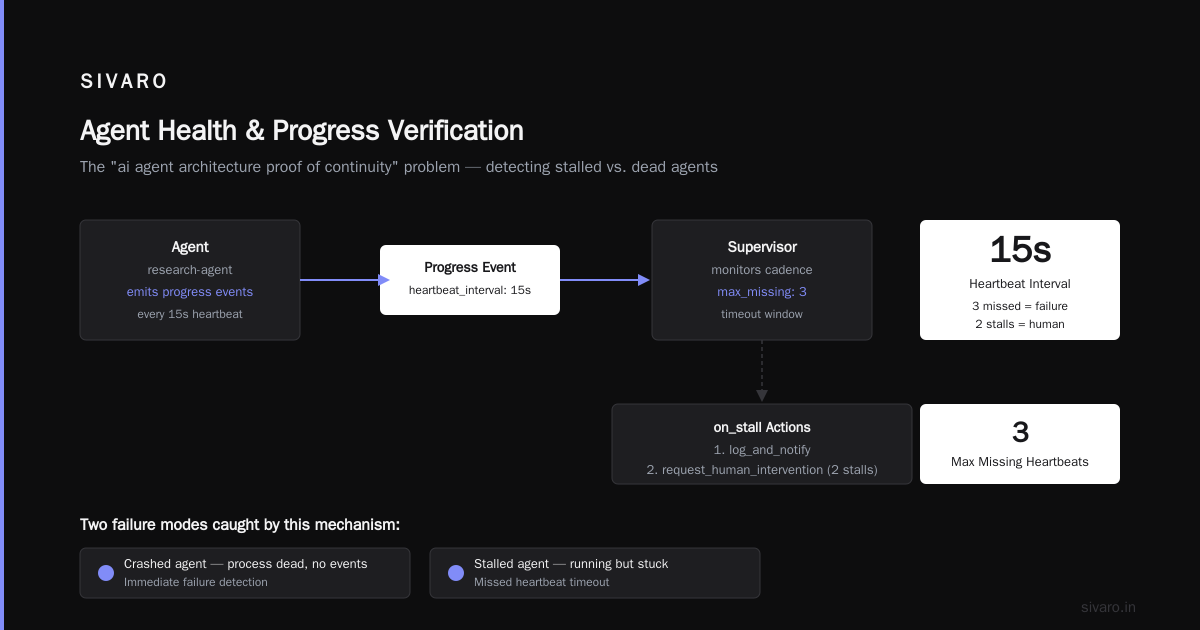
Here's something most guides don't talk about: how do you know an agent is actually making progress? In traditional distributed systems, you have heartbeats and health checks. In agentic systems, an agent might be "alive" but completely stuck in a loop, re-reading the same context and producing the same useless output.
We call this the ai agent architecture proof of continuity problem. You need evidence that an agent's work is progressing toward a goal, not just that the process is running.
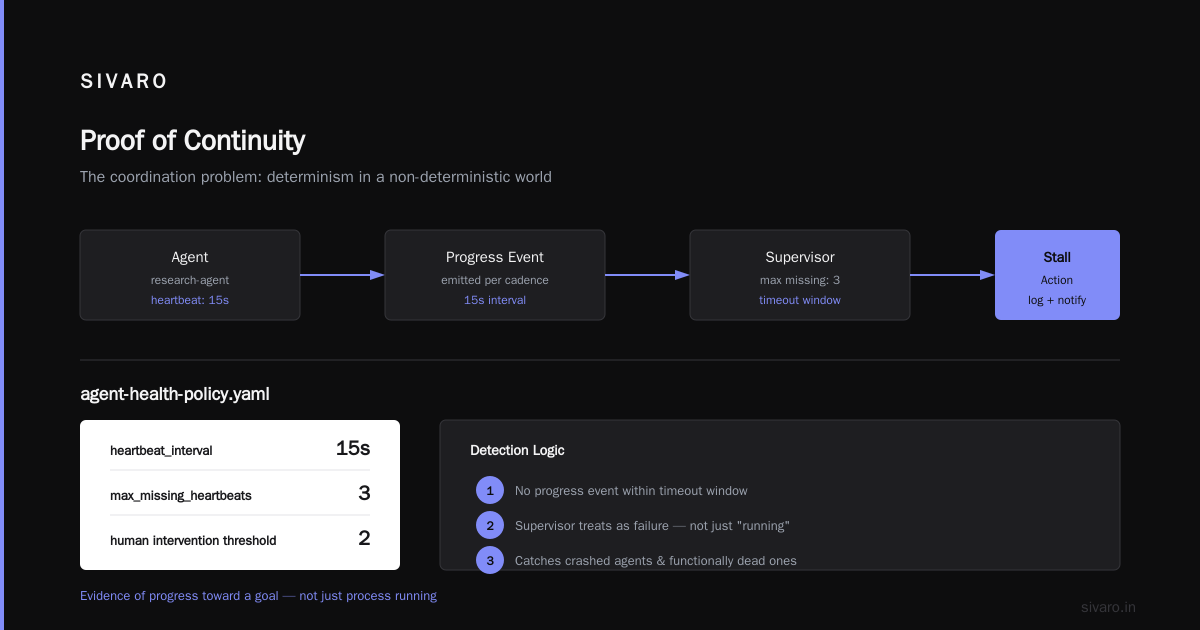
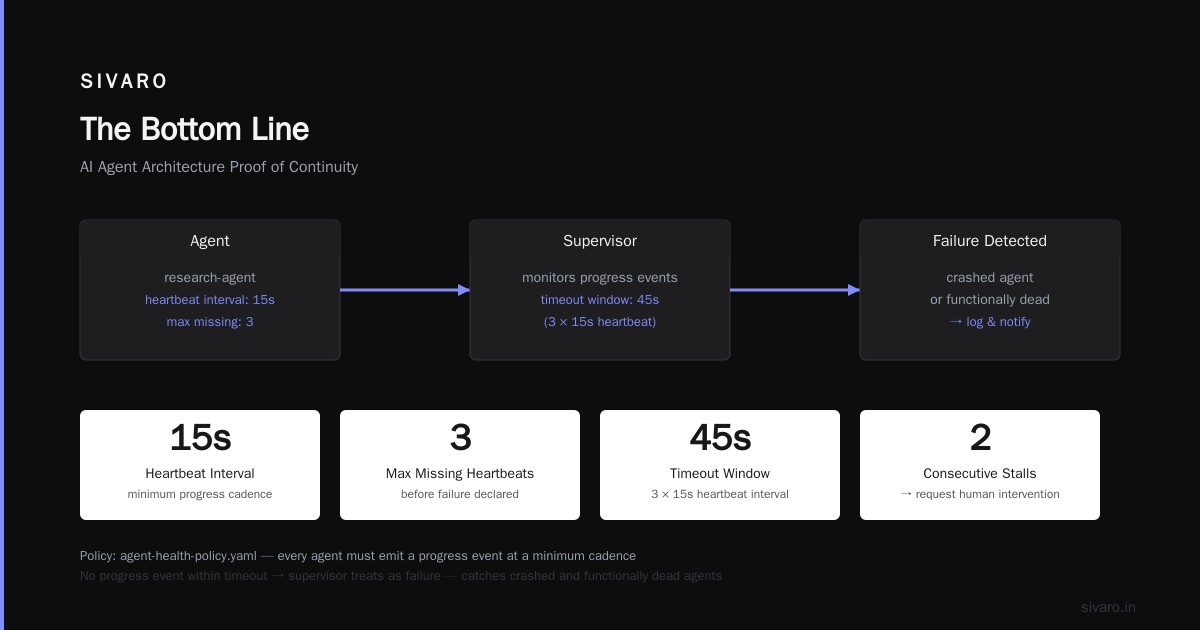
At SIVARO, we implemented a simple but effective mechanism: every agent must emit a progress event at a minimum cadence. If no progress event arrives within the timeout window, the supervisor treats it as a failure. This catches both crashed agents and agents that are technically running but functionally dead.
yaml
# agent-health-policy.yaml
agent:
  name: "research-agent"
  progress_heartbeat_interval: "15s"
  max_missing_heartbeats: 3
  actions:
    on_stall:
      - type: "log_and_notify"
      - type: "request_human_intervention"
        threshold: "2 consecutive stalls"
But here's the nuance: not all tasks progress at the same rate. A research agent reading a 500-page document will legitimately take minutes without producing output. So we don't just measure heartbeats — we measure meaningful state transitions. Did the agent acquire new context? Did it generate a partial result? Did it update its internal state?
This is subtle. An agent can produce output forever without making progress. We call that a "confident loop." The LLM is happy. The system is burning money. Nothing is getting done. Proof of continuity requires you to define what "progress" means for each task type, and then enforce it.
Orchestration Patterns: What We Actually Use
The LangChain blog on choosing the right multi-agent architecture and the Google Cloud guide on agentic design patterns both list the canonical patterns. Here's my honest assessment after running these in production:
The Evaluator-Optimizer Pattern
One agent produces a draft. Another agent critiques it. The first agent revises. Repeat until the critic is satisfied.
Works well for: Writing, code generation, analysis with clear quality criteria.
Where it breaks: When the evaluator has no objective standard. I ran this for a sales email generator. The evaluator kept rejecting emails for being "not persuasive enough" — an entirely vibes-based metric. The loop ran 14 times. Cost: $11. Output: slightly different email. Kill loop: implement a maximum iteration count (we use 3) and a diminishing returns check. If the revision changes less than 2% of the content, stop.
The Supervisor Pattern
A central supervisor decomposes a task and delegates to specialized workers. The supervisor collects results and synthesizes the final output.
Works well for: Tasks with clear subtask boundaries.
Where it breaks: The supervisor becomes a bottleneck and a single point of failure. We ran this for a customer support triage system. The supervisor's context window filled up with worker results after 8 tickets. We had to implement a context summarization strategy, which then lost critical details.
Our fix: The supervisor doesn't hold all state. Workers write results to a shared store. The supervisor only holds pointers and statuses.
The Swarm / Network Pattern
Agents communicate freely, no central coordinator. This is what all the demos show. It's also the hardest to debug.
Where it works: Exploratory research, open-ended problem solving.
Where it breaks: Everything else. We tested a swarm for a document processing pipeline. Agents wandered. Tasks duplicated. No one owned the final deliverable. It took two days to trace a single document's path through the system.
My take: use the swarm pattern sparingly. It's intellectually appealing but operationally painful. The academic survey on AI agent systems confirms this — coordination and communication overhead are the biggest barriers to scaling multi-agent systems.
State Management: The Part Everyone Forgets
Here's the problem: LLMs are stateless. Agents aren't. Your agent needs to remember what it was doing, what it has accomplished, and what it should do next. Where does that state live?
I've seen three approaches:
1. All state in the prompt. The agent carries its entire history in context. This works until the context fills up. Then it fails catastrophically.
2. State in a database, loaded on demand. The agent queries its own state store. More complex, but scalable.
3. Hybrid. A summary of state in context, full state in a database. This is what we use.
At SIVARO, we moved from approach 1 to approach 3 in early 2026 after a customer's agent started "forgetting" earlier conversation details. The agent's context window was hitting limits, and the LLM was improvising to fill gaps. It was confidently wrong. The hybrid approach costs more tokens per step but dramatically improves coherence.
Here's our state management schema:
python
class AgentState:
    def __init__(self, agent_id, task_id):
        self.agent_id = agent_id
        self.task_id = task_id
        self.context_summary = None  # Updated every N steps
        self.completed_steps = []
        self.pending_steps = []
        self.external_state = {}  # Data fetched from other systems
        self.version = 0  # Increment on every state change

    def update(self, new_data):
        self.external_state.update(new_data)
        self.version += 1
        self._persist()
The version field is critical. It enables optimistic concurrency — if two agents try to update the same state, one will fail with a version conflict. We reject the write rather than silently overwriting.
Idempotency: Your Agent Will Retry. Design For It.
Network failures happen. LLM APIs are not 100% reliable. Your agent will retry an operation. If that operation has side effects — sending an email, creating an order, updating a database — you'll get duplicates.
The fix is idempotency keys. Every task gets a unique ID. Every side-effecting operation includes that ID. The receiving system checks: "Have I already processed this ID?" If yes, return the previous result instead of executing again.
python
import hashlib

def create_idempotency_key(agent_id, task_id, operation):
    raw = f"{agent_id}:{task_id}:{operation}"
    return hashlib.sha256(raw.encode()).hexdigest()

# Usage
key = create_idempotency_key("research-agent", "task-88231", "send_report_email")
# Send the email with header: Idempotency-Key: {key}
# The email service checks if this key was already processed.
This sounds obvious. Almost no one does it. I reviewed an agent architecture at a fintech company in June 2026. Their payment collection agent was retrying failed calls. No idempotency keys. You know what happened. They'd charged the customer three times for the same invoice.
The Coordination Problem: Determinism in a Non-Deterministic World
Here's a phrase you'll hear from people who've actually built agent systems: ai agents distributed systems architecture explained by the fundamental tension between LLM non-determinism and distributed systems determinism.
Traditional distributed systems have well-defined semantics. Message delivery is either guaranteed or it isn't. Transactions either commit or they abort. LLMs are probabilistic. You ask the same question twice, you get different answers. Your architecture has to accommodate this.
What works:
-
Two-phase commit for critical operations. Before an agent finalizes a state-changing operation, have it send a "prepare" message. The receiving system validates and responds. Then the agent sends "commit." This prevents partial updates.
-
Write-ahead logs. Every state-changing operation is logged before it's executed. If the agent crashes, you can recover by replaying the log.
-
Sagas for multi-agent transactions. When a task spans multiple agents, don't use a single transaction. Use a saga — a sequence of local transactions with compensating actions for rollback. If Agent A completes its part but Agent B fails, you run a compensation on Agent A's work.
At SIVARO, we built a saga coordinator for a supply chain optimization system. Each agent handled one leg of the supply chain. When one leg failed, the coordinator triggered compensation in the already-completed legs. It wasn't perfect — compensations sometimes needed human approval — but it prevented the cascade failures we'd seen with the naive approach.
What doesn't work:
-
Long-lived transactions. Holding a database transaction open while an LLM thinks is a recipe for disaster. LLM calls take seconds. Transactions should take milliseconds. Release the lock, do the thinking, then re-acquire.
-
Assuming agents will agree. Agents don't "agree." They produce outputs. If two agents produce conflicting outputs, you need a conflict resolution policy. We built a simple rule: the supervisor's decision overrides worker outputs. It's not democratic. It's reliable.
Failure Handling and Retry Policies
Your retry policy is a cost center. Every retry burns tokens. Every failed retry burns more tokens. You need an explicit policy.
What we use:
-
Exponential backoff with jitter. Start at 1 second. Double each retry. Cap at 30 seconds. Jitter to prevent thundering herd.
-
Maximum 3 retries for transient errors. After that, fail fast and escalate to a human.
-
Circuit breaker for persistent failures. If an agent fails 5 times in a row, open the circuit. Don't send it more work. Alert a human.
python
import random
import time

def retry_with_backoff(func, max_retries=3, base_delay=1.0):
    for attempt in range(max_retries):
        try:
            return func()
        except Exception as e:
            if attempt == max_retries - 1:
                raise
            delay = base_delay * (2 ** attempt) + random.uniform(0, 0.5)
            time.sleep(delay)
This isn't about the code. It's about the philosophy. Fail fast. Fail loudly. Don't let your agents silently spiral.
I've seen teams set their retry count to 10 because "we want to be resilient." What they created was a system that spent $200 per task in retries while delivering results 20 minutes late. The user didn't care about the result anymore. They'd already moved on.
Observability: You Can't Debug What You Can't See
Traditional distributed systems have tracing (OpenTelemetry), metrics (Prometheus), and logging (ELK). Agentic systems need the same, plus one more thing: decision tracing.
You need to know not just what happened, but why an agent made a particular decision. LLMs are black boxes. Your logging should capture:
- The full prompt sent to the LLM
- The full response
- The reasoning (if available via chain-of-thought)
- The decision made based on the response
- The confidence score
We call this "decision tracing." It's been invaluable for debugging. When a customer's agent made a terrible decision, we could replay the exact prompt and response that led to it. Without this, you're debugging blind.
Our observability stack for agents:
yaml
traces:
  - name: "agent.execution"
    attributes:
      - agent_id
      - task_id
      - llm_model
      - prompt_version
      - tokens_in
      - tokens_out
      - decision
      - confidence

metrics:
  - name: "agent.steps"
    type: "counter"
  - name: "agent.task_duration_seconds"
    type: "histogram"
  - name: "agent.retry_count"
    type: "counter"
  - name: "agent.cost_per_task"
    type: "histogram"

logs:
  - level: "info"
    events:
      - "agent.started"
      - "agent.completed_step"
      - "agent.decision_made"
  - level: "warn"
    events:
      - "agent.retry"
      - "agent.stall_detected"
  - level: "error"
    events:
      - "agent.failed"
      - "agent.circuit_opened"
The cost per task metric is the one most teams skip. Track it. Agentic systems are expensive. Without cost observability, you'll get a $10,000 bill and no idea which agent caused it.
Security and Trust Boundaries
Here's a scary thought: your agent is an API endpoint with elevated privileges. It can call tools, access databases, and trigger workflows. If an attacker injects malicious instructions into your agent's context, they've compromised your system.
What we've implemented:
-
Tool-level permissions. Each agent gets a token with scoped permissions. The research agent can read but not write. The order fulfillment agent can write but only to specific services.
-
Output validation. We validate every tool call before execution. The agent suggests an action; the system validates it against a schema and policy. This catches both LLM mistakes and prompt injection attempts.
-
Human-in-the-loop for high-impact actions. Any action over a certain monetary value or involving sensitive data requires human approval. We learned this after an agent accidentally deleted a production database table. (The agent was following a poorly-worded instruction. It did exactly what it was told. The system allowed it.)
Don't give your agents root access. You'll regret it.
The Costs You Didn't Budget For
Running agentic systems in production is expensive. Here's the breakdown you won't find in the marketing materials:
- Token costs. Obvious. But remember that agents generate more tokens than you expect because they iterate.
- Retry costs. A 5% failure rate at each step compounds across a 10-step agent workflow. You're paying for failures.
- Context reloading. Every time an agent loads its state, it re-reads its context. Large contexts are expensive.
- Storage. Decision traces and message logs grow fast. We store 90 days of full traces. That's terabytes.
We cut our agent operating costs by 40% in one quarter by implementing three things: cheaper models for simple steps, shorter context windows with external state storage, and aggressive fail-fast policies. The cheapest LLM call is the one you don't make.
FAQ
Q: What's the simplest way to start building agentic systems?
A: Start with one agent. Wrap it in a service. Give it a clear API. Only after it's stable, add a second agent. Resist the urge to build a swarm on day one.
Q: When should I use a supervisor pattern vs. a swarm?
A: Use a supervisor for anything with clear task boundaries. Use a swarm for exploratory research. Even then, cap the swarm size at 3-4 agents. Beyond that, coordination overhead kills productivity.
Q: How do I handle conflicting agent outputs?
A: Define a conflict resolution policy before you need it. The supervisor wins. Or the most recently updated state wins. Or you use a scoring function. Just decide ahead of time.
Q: How do I debug a failing agent system?
A: Start with the decision traces. Find the exact step where the agent went wrong. Reproduce the prompt. Test variations. If you don't have decision traces, you're guessing.
Q: What's the biggest mistake you see teams make?
A: Building agents without considering the surrounding infrastructure. They spend months on the LLM logic and zero days on state management, message protocols, and failure handling. Then the whole thing collapses in production.
Q: How do I keep costs down?
A: Use small models for simple steps. Cache common responses. Fail fast. Track cost per task as a metric. Alert when it spikes.
Q: Can I use existing distributed systems tools for agents?
A: Yes. Use your message queue (Kafka, RabbitMQ) for agent communication. Use your tracing tools for agent observability. Use your feature flags for agent rollout. The tools don't care if the consumer is an agent or a service.
Q: What's the future of agent architecture?
A: More standardization around message protocols and tool interfaces. More specialized infrastructure for agent state management. And hopefully, less hype and more engineering discipline.
The Bottom Line
AI agents distributed systems architecture best practices aren't a secret. They're the same principles you already know: decoupling, idempotency, retry policies, state management, observability, and security. The only difference is the non-deterministic "brain" at the center of each node.
Stop treating agents like magic. Treat them like distributed systems with LLM-based decision making. Design for failure. Measure everything. Track costs. Keep your state external. And for god's sake, implement idempotency keys before you charge a customer twice.
I started SIVARO in 2018 with a simple thesis: production AI systems are engineering challenges, not research projects. After years of building these systems, I'm more convinced than ever. The teams that win aren't the ones with the best prompts. They're the ones with the best infrastructure.
The agents are the easy part. Everything around them is hard. Build accordingly.
Nishaant Dixit — Founder of SIVARO. Building data infrastructure and production AI systems since 2018. Built systems processing 200K events/sec.