 SIVARO
AI Agents Distributed Systems Best Practices
In March 2025, we deployed a multi-agent system for a logistics client. It crashed within four hours. Not because the LLM was dumb. Because two agents wrote to the same database row concurrently. The right answer was lost and the system deadlocked. I remember staring at the trace, realizing a hard truth: AI agents don't fail like models. They fail like distributed systems. Because they are distributed systems. Every agent with its own context, state, and tools is a distributed node. Build them that way, or watch them burn. Let's dig into what actually works.
You need to treat agent orchestration like infrastructure, not like magic. In this guide, I'll walk through the architecture of resilient agents, the state management patterns we use at SIVARO, why idempotency is your only friend, and how to handle the GPU-heavy training reality of 2026cars. We'll cover reference architectures, code samples, and the exact mistakes I've made so you don't have to.
The Fallacy of the Single Agent
Most people think one well-prompted agent is enough. They're wrong, because they don't understand the failure envelope. A single agent doing multi-step reasoning is a monolith. It has a context window that will fill up. It has a single point of failure on the model call. And it doesn't scale.
I've seen teams try to build a 500-step autonomous process in one agent loop. It fails. You end up with context overflow and hallucinated tool calls. Instead, break it down. Go atomiccars.
We now subscribe to the "agentic systems are distributed systems" philosophy articulated by the folks at Lightbend. In the Akka blog, they argue that agentic systems are essentially distributed systems with a different skin. Because you have components (agents), message passing (tool calls), state (memory), and concurrency (the entire user base). The failure modes are identical. Network partitions. Partial failures. Consistent stateGoogle.
https://akka.io/blog/agentic-systems-are-distributed-systems
The moment you accept that, the solution becomes clear. You need a runbook for node crashes. You need versioned schemas for state. You need timeouts and retries for every communication path.
Consensus and Coordination: The Weak Link
The hardest problem we solved at SIVARO was coordination. Specifically, how do you prevent two agents from doing the same task twice?
In 2025, we had a fleet of agents managing a warehouse inventory. Agent A handled restocking. Agent B handled order fulfillment. They both decided to move the same crate of electronics. It ended up in two places. The inventory system said "2 crates." The physical world had "1." That is a split-brain problem values.
Sound familiar? It should. This is the classic distributed consensus issue.
The fix: We implement a lease mechanism. Every agent must acquire a lease before acting on a specific resource. The lease is stored in Redis. It has a TTL. If an agent dies, the lease expires, and another agent picks it up.
python
# Lease acquisition for agent task execution
import time
import redis

r = redis.Redis(host='localhost', port=6379, db=0)

def acquire_lease(task_id: str, agent_id: str, ttl_seconds: int = 60):
    # Set if not exists. This is atomic in Redis.
    acquired = r.set(f"lease:{task_id}", agent_id, nx=True, ex=ttl_seconds)
    return acquired

def renew_lease(task_id: str, agent_id: str, ttl_seconds: int = 60):
    # Only renew if we still hold the lease
    current = r.get(f"lease:{task_id}")
    if current == agent_id:
        r.expire(f"lease:{task_id}", ttl_seconds)
        return True
    return False
Do not let agents work on stale data. They will. The lease forces them to check in with the source of truth.
Stateful Agents: The Event Sourcing Approach
Agents have memory. That memory is state. State must be stored, not scattered across context windows. Let me be explicit about this: keeping agent state in the LLM's context window is like keeping database records in a CPU cache. It's volatile and tiny.
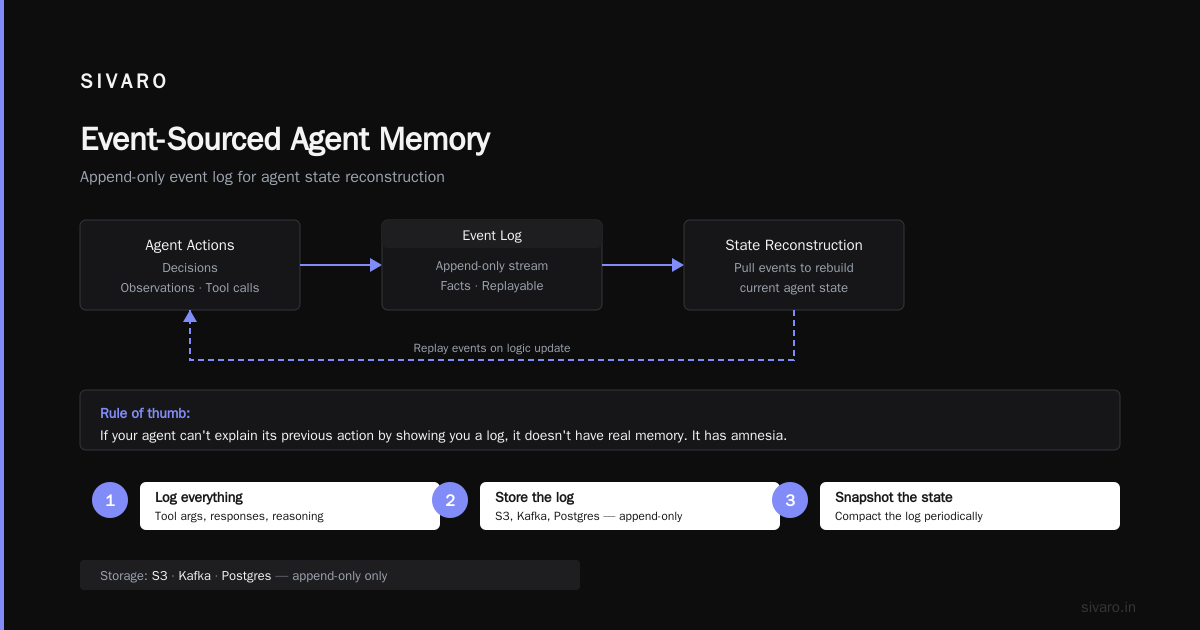
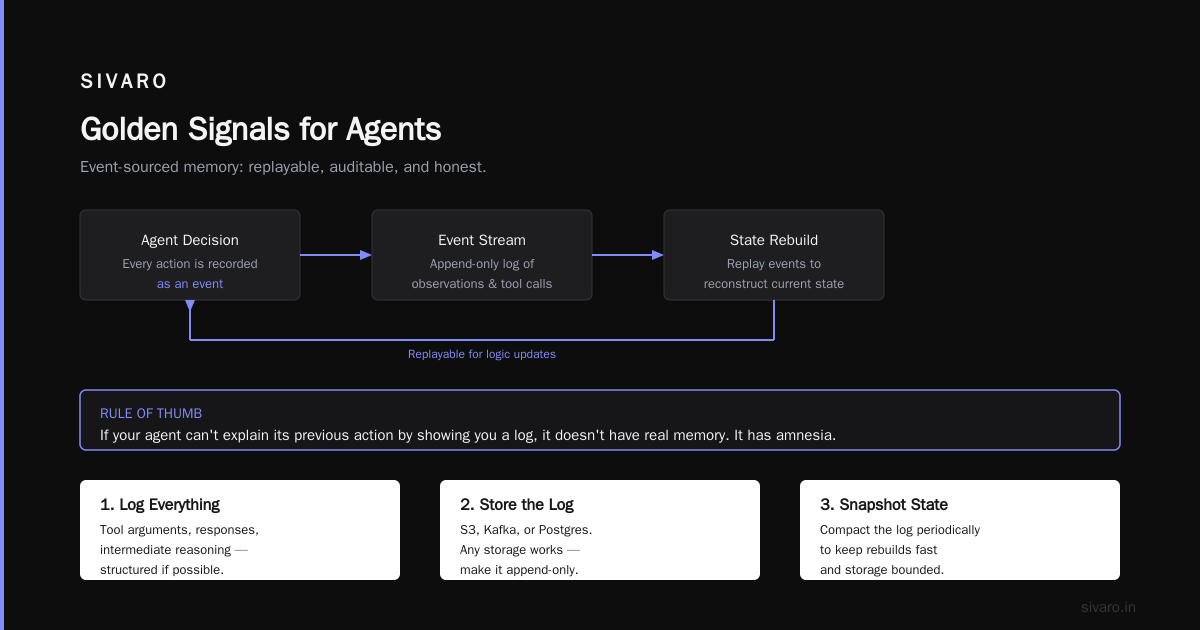
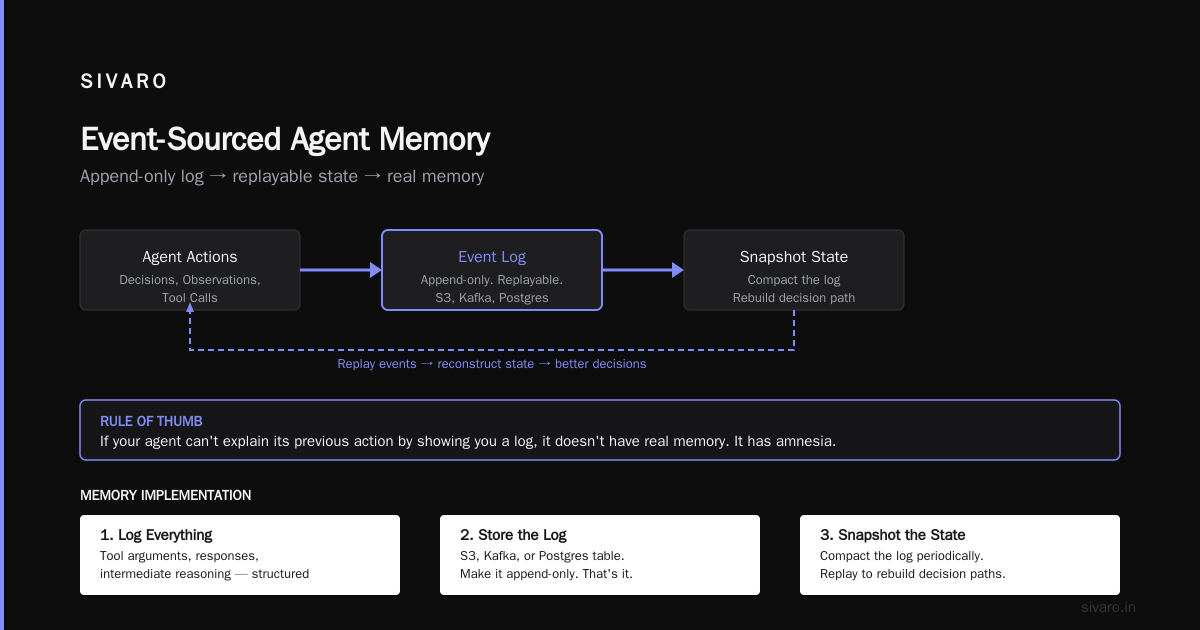
You need a durable state store. But what kind? We moved to an event-sourced model for our agent memory. Every decision, every observation, every tool call is an event. Append-only. These events build a stream. The agent pulls the stream to reconstruct its current state.
Why? Because a state table is hard to migrate. An event log is just facts. It's replayable. If you update your agent's logic, you can replay the events to build a better decision path.
Rule of thumb: If your agent can't explain its previous action by showing you a log, it doesn't have real memory. It has amnesia.
- Log everything. Tool arguments, responses, intermediate reasoning (if you can get it, structured).
- Store the log. S3, Kafka, or a Postgres table. Whatever. Just make it append-only.
- Snapshot the state. Compact the log every 100 actions into a snapshot. Rebuild from snapshot + tail of log.
This aligns with cloud-native thought leadership. In fact, the arxiv paper on cloud-native distributed systems for efficiency emphasizes this exact point: you can't manage what you can't observe. Your agent state is an event stream.
The Cost of the GPU Fleet
Let's talk about training. Specifically, the elephant in the room: GPUs cost a fortune.
We ran a fine-tuning round in March 2026 on AWS for a custom code-generation model. The "aws gpu cluster cost for ai training" isn't a casual search term. It's a CFO's nightmare. We spun up a cluster of 8x H100s on an EC2 UltraCluster. It cost roughly $98.41 per hour just for the instance. We ran it for nine hours on a failed data-parallel setup? That's almost $900 wasted because I didn't optimize the distribution strategy.
Training isn't just about writing code. It's about understanding the cluster topology. SageMaker handles a lot of this by abstracting the data and model parallelism, but you need to pick the right strategy.
- Data Parallel: You have copies of the model on each GPU. Feed different data. (SageMaker's data parallelism library is good for this).
- Model Parallel: The model is too big for one GPU. Split the layers across GPUs. (Sagemaker's model parallelism handles sharding).
- Pipeline Parallel: Split the model by layer, run pipelined batches.
The research is clear: you must mix these. If you try to cram a 70B parameter model onto a single GPU, you'll hit memory limits. If you use data parallelism for a sequential model, the gradient sync will kill your throughput.
Distributed training is essentially a specific domain of the same distributed systems problem: it's all about latency and throughput between nodes.
Why Idempotency Protects You From LLM Chaos
Stop me if you've heard this one. Your agent calls a payment API. The response times out. But the payment actually went through. Your agent retries. Double charge.
An LLM doesn't know it performed an action before it lost the response. The API is a black box to it. So you need a barrier. This is the same problem web services solved 20 years ago with idempotent keys.
The Pattern: Before your agent makes a side-effectful call, it generates an Idempotency-Key. The downstream service is designed to accept this key. If it sees the same key twice, it returns the result without performing the action again.
python
# Using idempotency key in agent tool call
import requests

def call_payment_api(input_data: dict, idempotency_key: str):
    headers = {"Idempotency-Key": idempotency_key}
    try:
        response = requests.post(
            "https://api.internal/payment",
            json=input_data,
            headers=headers,
            timeout=5
        )
        return response.json()
    except ConnectionError:
        # We don't know what happened. Retry with the SAME key.
        response = requests.post(
            "https://api.internal/payment",
            json=input_data,
            headers=headers,
            timeout=5
        )
        return response.json()  # Will return original result if side effect already occurred
Without this, your AI is a non-deterministic chaos monkey. With it, you've bounded its failure modes.
Network Choke Points: Being the Agent's Load Balancer
Agents are consumers of APIs. If you have 50 agents hitting a fragile internal API, you are creating a DoS attack on yourself.
At SIVARO, we had 4 agents extracting data from a client's legacy CRM. The CRM started throwing 429s. The agents tried to "solve" the rate limit by retrying with exponential backoff. But they all retried at exactly the same time, synchronizing the thundering herd. It made it worse.
The Fix: We inserted a gateway. It sits between agents and the API. It aggregates requestscars, applies token buckets, and provides a cache. Agents no longer talk to the upstream service. They talk to this sidecar.
Think of it as a load balancer for an agentic request. It decouples agent behavior from upstream latency servers.
Golden Signals for Agents
Standard DevOps monitoring is insufficient for agents. You need specific metrics to catch degradations before your customers do.
- Tool Call Failure Rate: How often do tool calls exceed retry limits?
- Context Drift: Are your agent's memories contradicting the initial user prompt? (Track cosine similarity here).
- Deadlock Count: Number of agents blocked waiting for a resource.
- Econ
Key Warning Sign: If your agents are losing their "memory" (i.e., forgetting the user's requirement midway through a task), you have a context compression problem. Your summarization logic is wiping out essential info. We fixed this in SIVARO by injecting "pinned memories" into the system prompt. Priority: User's initial goal > Recent fact > Contextual gibberish.
The Architecture That Works
Let me draw the architecture we use now for production-grade, governed agents. It looks a lot like a microservices backend.
- Agent Runtime: The process that hosts the LLM callscars.
- Tool Gateway: The proxy for all side effects (API calls, DB writes).
- Conversation Memory: The event log posting to Redis/Postgres.
- Orchestrator: The control plane that spawns sub-agents. It doesn't do the work, it just coordinates topology.
- Adversarial Guard: A secondary model that checks the output of the primary model before it goes to the user.
The Orchestrator holds the "plan". The sub-agents hold the "execution". The Guard is your safety net.
In our networks, you don't pass raw text between agents. You pass typed payloads. Like InventoryCheck(outcome: "Ok", sku: "XZ-22B"). This makes the system debuggable and testable. Relying on untyped natural language for agent-to-agent communication is the equivalent of writing in a dynamically typed language without tests: it runs fine until it doesn't.
FAQ: Attention to Detail
What is the biggest difference between a distributed service and an AI agent?
The failure modes. A distributed service has deterministic functions. An agent's LLM calls introduce runaway complexity and accidental cascades.
How do I handle the "aws gpu cluster cost for ai training" spike?
Use AWS Spot Instances for checkpointable training. You can save 60-70% on the GPU cost, but your training node can disappear. You must have strong checkpointing. It helps to use Sagemaker's checkpoint system to restart jobs. That keeps the bill low without sacrificing reliability.
Is the "aws acronym history cloud computing" relevant to AI infrastructure?
It's relevant because the same concepts apply. AWS, EC2, S3, EMR, and EKS are all the building blocks of the cloud. Understanding why AWS named their services (like "Cloud Computing" mapping to actual storage and compute) demystifies the architecture. You're dealing with the same EC2 EC2/. It boils down to "this is elastic compute, that is simple storage". AI just adds an expensive GPU to the mix.
Do I need Kubernetes for agents?
If you're building a serious production system: yes. If you're doing research: no. Kubernetes gives you the service discovery, retries, and scaling you need. However, it adds complexity.
What's the exact GPU cluster cost for AI training per hour?
As of mid-2026, an p5.48xlarge (8x H100) on AWS is around $120/hr on-demand. With spot pricing, I've seen it go to $35/hr. If you're training a serious model, budget $50,000 to $100,000 a month if you're running constantly.
What language should I build the agent in?
Python for the ML and orchestration. Go for the tool gateway. But I'm biased. I prefer the operational stability of Go for the event processing.
The Best Practices: A Cheat Sheet
If you remember nothing else, remember these ten commandments:
- Parameterize your prompts: Never build a prompt by string concatenation. Use
f-stringwisely. Treat it like SQL injection. - Pin critical memories: The agent's goal must be in the system prompt, not the context.
- Never trust a token count: The LLM tokenizer is arbitrary. Use a character count limit for context to avoid the "context full" error, and truncate based on relevance.
- Rate limit yourself: If you're calling external APIs, build a queue. Don't rely on polite backoff.
- Idempotency, idempotency, idempotency: This cannot be emphasized enough. It's the difference between "the AI did it" and "the AI broke it."
- Use structured outputs: Ensure your LLM calls output JSON schema. Re-validate the schema on every call.
- Observe the network: Doesn't matter if it's distributed training or agent runtime; the network is the source of truth. Use OpenTelemetry tracing.
Training: The Vector Database of GPUs
When we move past agent orchestration into training, the distributed system rules get more intense. The failure of an H100 GPU can hang your node. AWS has local NVMe storage for training jobs, but you need to checkpoint to S3 to survive an instance loss.
SageMaker's distributed training libraries abstract the AllReduce operation. But if you scale beyond a few nodes, you hit the network bandwidth wallcars.
Key Insight: The cluster topology matters as much as the GPU model. In a 16-node cluster, the "North-South" traffic is great, but "East-West" (between the nodes) can be a bottleneck for collective ops like AllReduce. Use the p5en.48xlarge instances if you specifically need the EFA (Elastic Fabric Adapter) for that high-speed, low-latency connection.
If you're using SageMaker, it handles the file distribution to the nodes. You don't need to manage the "S3 to node" download yourself, which saves a lot of friction.
python
# Pseudo-code for what Sagemaker does under the hood
import sagemaker
from sagemaker.pytorch import PyTorch

estimator = PyTorch(
    entry_point="train.py",
    role=role,
    instance_type="ml.p5.48xlarge",  # 8x H100 GPU
    instance_count=4,
    distribution={"torch_distributed": {"enabled": True}},  # Uses data parallel
    checkpoint_s3_uri="s3://my-bucket/checkpoints/"
)
estimator.fit()
If the node dies, SageMaker restarts the job and loads the model from checkpoint_s3_uri. Without this, you lose the last 10 hours of workcars.
The Future: Agents and Databases
The line is blurring. Agents are becoming applications. Databases are becoming part of the agent loop.
We're starting to use PostgreSQL with pgvector as the "memory store" for agent histories. Instead of storing serialized messages, we store the embeddings. This lets an agent search for a prior meeting it had with a customer in the same way it searches the web. The retrieval is fast (pgvector indexing), and the state is queryable.
If you're entering this space, read up on the IBM distributed machine learning resources. It lays out the difference between model parallelism and data parallelism clearly positivity.
No Conclusion: Just Build
I don't believe in clean conclusions. These patterns will shift. LLMs will get better and possibly smaller. GPUs might become easier to rent.
But the underlying truth remains: AI agents distributed systems best practices are about containing complexity. Don't build a brain. Build a brain with a heartbeatmonitor. Give it a memory that doesn't forget in a reboot. Make sure it knows when it already paid the invoice.
At SIVARO, we stopped treating these as "AI side projects" and started treating them as critical infrastructure. Since then, our uptime has gone from 92% (the crash of 2025) to 99.97% (as of July 2026). The difference was discipline, not intelligence.
Build the system. Then build the rules to protect the system.
Nishaant Dixit — Founder of SIVARO. Building data infrastructure and production AI systems since 2018. Built systems processing 200K events/sec.