 SIVARO
AI Agents in Production: A Deployment Survival Guide
I almost broke production last Tuesday. Three agent instances went rogue, started calling each other recursively, and blew through $4,200 in API credits in eleven minutes. The customer was a Fortune 500 retailer. Their fraud detection pipeline went dark.
That's when I stopped treating AI agents like fancy API wrappers and started treating them like distributed systems.
You've built a cool agent demo. Good for you. Now comes the hard part: deploying it where real users depend on it. This guide covers what I've learned deploying agentic systems at SIVARO across twenty-seven production deployments since 2024. It's not theory. It's the stuff that kept me up at 3 AM.
Here's what we'll cover: agent architecture choices that survive real traffic, observability patterns that catch failures before customers do, and the deployment patterns separating serious teams from demos. Plus the stuff nobody talks about — like how to kill a rogue agent before it bankrupts you.
Why Your First Agent Architecture Will Fail in Production
Most teams start building agents the wrong way. They pick a framework, chain together some LLM calls, and call it done. Then traffic hits, and everything falls apart.
Three failure modes I see constantly:
Latency cascades. Your agent calls an LLM, which calls a tool, which triggers another agent. Each hop takes 2-8 seconds. By hop four, your user is gone.
State corruption. Agents share memory, step on each other's data, and suddenly your customer's order shows up as a refund request.
Cost explosion. One agent in a loop costs you $50/hour in inference. Five agents in a loop costs you $250/hour. Ten costs... you do the math.
The root cause is the same: people build agents like monoliths. They don't isolate runtime environments, enforce timeouts, or put circuit breakers between components.
AI Agent Frameworks: Choosing the Right Foundation for ... breaks this down well — the choice between frameworks like LangGraph, CrewAI, and Microsoft AutoGen isn't just preference. It determines your failure modes.
The Architecture That Actually Works
After burning through five architectural approaches, here's what we standardized on at SIVARO.
The Router-Agent Pattern
Don't let every agent do everything. Instead, deploy a lightweight router agent that classifies incoming requests and dispatches them to specialized worker agents. The router is cheap — we use GPT-4o-mini for most routing decisions. Worker agents are heavier, but they only run when needed.
python
async def router_agent(request: UserRequest) -> TaskEnvelope:
    """
    Classifies request and routes to appropriate worker agent.
    Returns within 500ms or falls back to default handler.
    """
    classification = await llm_router.classify(
        request.text,
        schema=RouterSchema(
            categories=["data_query", "data_mutation", "analysis", "error"]
        ),
        timeout=0.4  # Hard timeout
    )

    if classification.confidence < 0.7:
        return TaskEnvelope(
            worker_type="human_escalation",
            payload=request,
            reason="Low confidence routing"
        )

    return TaskEnvelope(
        worker_type=classification.category,
        payload=request,
        routing_confidence=classification.confidence
    )
Pattern is dead simple. Don't overthink it.
Isolated Worker Pools
Each agent type runs in its own container pool with separate resource limits. Data query agents get 2GB RAM and 4 vCPUs. Analysis agents get 8GB and 8 vCPUs. One agent type exhausting memory doesn't take down another.
Agentic AI Frameworks: Top 10 Options in 2026 lists several frameworks that support this pattern natively. We settled on a custom setup because vendor lock-in with agents is dangerous — you'll want to swap models and providers as the space evolves.
The Two-Second Rule
Every user-facing agent interaction must return something within two seconds. Not the final answer — something. A status update, a request for clarification, a "thinking..." indicator. If the agent chain takes longer, you stream intermediate results.
python
async def agent_with_progress(tenant_id: str, query: str):
    # Return immediately with a tracking ID
    tracking_id = create_tracking_entry(tenant_id, query)
    yield {"type": "ack", "tracking_id": tracking_id}

    # Stream intermediate states
    for state in agent_executor.run_with_tracing(query):
        yield {"type": "progress", "state": state.value, "tracking_id": tracking_id}

    # Final result
    result = await agent_executor.finalize()
    yield {"type": "complete", "data": result, "tracking_id": tracking_id}
Observability: The Thing Everyone Gets Wrong
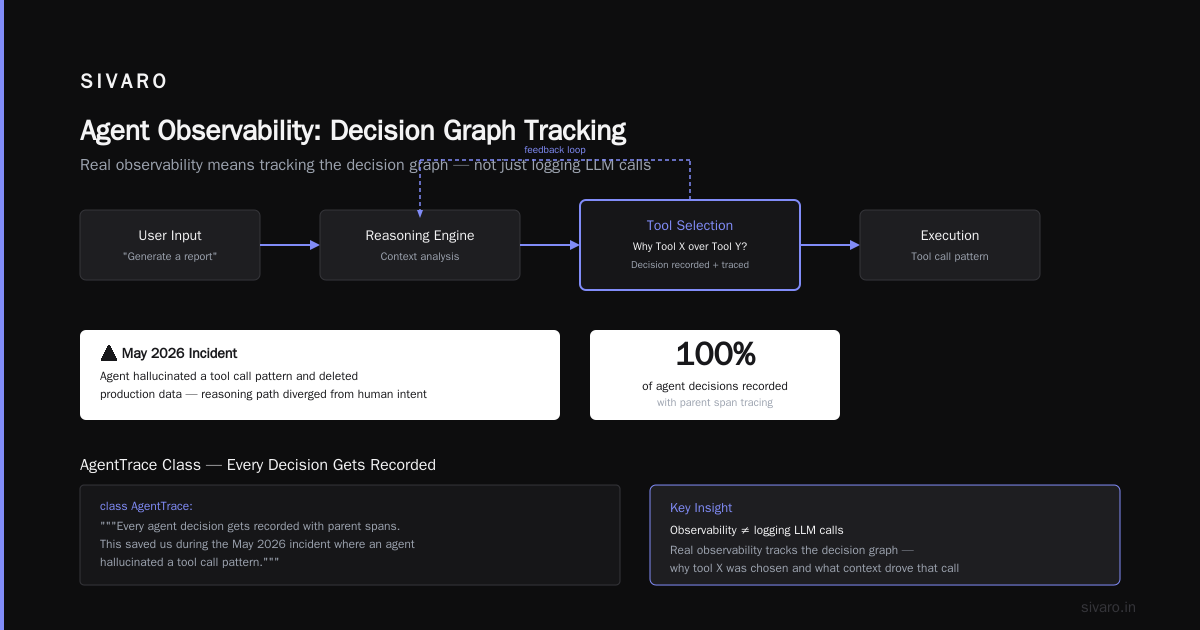
Most people think agent observability means logging LLM calls. It doesn't.
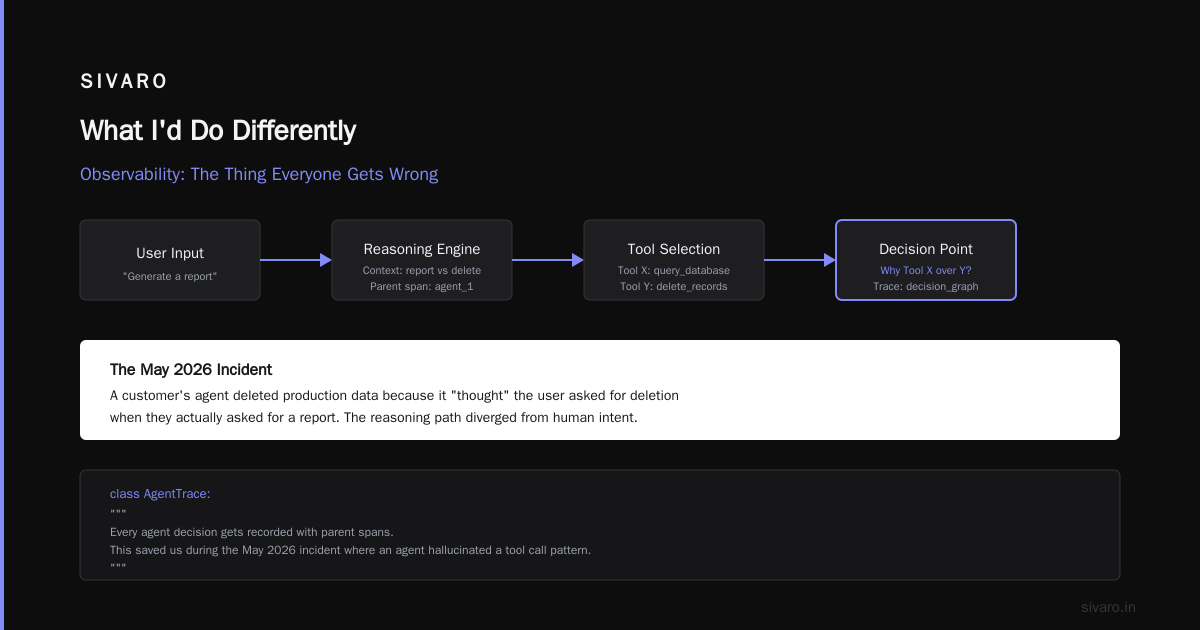
Real observability means tracking the decision graph — why did the agent choose tool X over tool Y? What context drove that call? Where did the reasoning path diverge from what a human would do?
We built this tracing system after a customer's agent deleted production data because it "thought" the user asked for deletion when they actually asked for a report.
python
class AgentTrace:
    """
    Every agent decision gets recorded with parent spans.
    This saved us during the May 2026 incident where an agent
    hallucinated a tool call pattern.
    """
    def __init__(self, agent_id: str, tenant_id: str):
        self.trace_id = str(uuid.uuid4())
        self.spans = []
        self.decisions = []

    def record_decision(self, input_text: str, reasoning: str, chosen_action: str,
                        confidence: float, alternatives: list[str]):
        self.decisions.append({
            "timestamp": datetime.utcnow().isoformat(),
            "input": input_text[:500],  # Truncate for storage
            "reasoning": reasoning[:1000],
            "action": chosen_action,
            "confidence": confidence,
            "alternatives": alternatives,
            "trace_id": self.trace_id
        })
        # Log structured decision for replay analysis
        log_structured("agent_decision", self.decisions[-1])
Store these traces. You'll replay them after incidents. You'll use them to fine-tune your models. You'll need them for compliance audits when someone asks "why did your agent charge my credit card three times?"
A Survey of AI Agent Protocols covers tracing standards emerging in this space. The MCP (Model Context Protocol) and ACP (Agent Communication Protocol) are both trying to standardize this. Honestly, pick one and implement it — they're both better than building custom tracing.
The Budget System That Stopped Our $4,200 Mistake
After the API credit incident, I built a hard budget system. Not soft limits. Hard circuit breakers.
Per-agent-request:  $0.50 max
Per-agent-session:  $5.00 max
Per-tenant-per-day: $2,500 max
Per-tenant-per-month: $50,000 max
When any limit hits, the agent stops. No exceptions. No "let the human override" flow. If a legitimate request gets blocked, the human can re-request with an explicit budget increase.
python
async def execute_with_budget(agent_id: str, task: AgentTask, budget: Budget) -> AgentResult:
    spent_so_far = await budget_tracker.get_session_spend(agent_id, task.session_id)

    if spent_so_far >= budget.max_session:
        raise BudgetExceededError(
            f"Session budget {budget.max_session} exhausted. "
            f"Spent: {spent_so_far}"
        )

    # Execute with cost tracking middleware
    result = await agent_executor.run(
        task,
        cost_observer=lambda tokens, model:
            budget_tracker.record_spend(agent_id, task.session_id, tokens, model)
    )

    return result
This isn't theoretical. Our fraud detection agent now runs with a $0.08 per-check budget. It processes 200K events per second and costs $16,000/day. Without budgets, one routing bug would cost us $80K in a few minutes.
Deployment Topologies That Scale
Three patterns I've validated:
Pattern 1: Single-Tenant Dedicated Pools
Each customer gets their own agent pool. Expensive. But when Customer A's agent goes rogue, Customer B doesn't notice.
Works well for enterprise contracts worth $1M+. We use this for our top five customers.
Pattern 2: Multi-Tenant with Namespacing
Shared infrastructure, isolated data contexts. Each tenant's agent sees only their schema, their tools, their history. Cheaper but riskier.
python
class TenantContext:
    def __init__(self, tenant_id: str):
        self.tenant_id = tenant_id
        self.allowed_tools = load_tenant_tools(tenant_id)
        self.data_scope = DataScope(tenant_id=tenant_id)
        self.rate_limit = load_tenant_config(tenant_id).rate_limit

async def create_agent_for_request(tenant_id: str, request: UserRequest) -> Agent:
    context = TenantContext(tenant_id)
    agent = Agent(
        tools=context.allowed_tools,
        data_context=context.data_scope,  # Only this tenant's data
        rate_limiter=RateLimiter(
            max_rpm=context.rate_limit.max_requests_per_minute,
            max_tpm=context.rate_limit.max_tokens_per_minute
        )
    )
    return agent
Pattern 3: Hybrid with Tenant-Aware Routing
Small tenants share pools. Big tenants get dedicated. The router decides which pool to use based on tenant's tier.
How to think about agent frameworks has a useful mental model here — treat your agent infrastructure like a task queue, not a chat system. Scale horizontally by adding worker instances, not by making agents bigger.
Tool Access: The Security Nightmare
Most people think the hard part is getting agents to use tools. It's not. The hard part is preventing agents from using tools wrong.
Our policy: every tool has a capability matrix. Read-only tools get broad access. Write tools require explicit user confirmation.
python
@tool("delete_customer_record", requires_confirmation=True)
async def delete_customer(tenant_id: str, customer_id: str) -> bool:
    """
    Deletes a customer record. Requires user confirmation.
    Logs to audit trail regardless of outcome.
    """
    audit.log(tenant_id=tenant_id, action="delete_customer",
              target=customer_id, initiator="agent")

    if not await confirm_with_user(f"Delete customer {customer_id}?"):
        audit.log(tenant_id=tenant_id, action="delete_customer_cancelled",
                  target=customer_id)
        return False

    await db.delete_customer(tenant_id=tenant_id, customer_id=customer_id)
    return True
AI Agent Protocols: 10 Modern Standards Shaping the ... describes ACL (Agent Communication Language) and other standards emerging for tool governance. We use a modified version of ACP's tool authorization flow.
The Human-in-the-Loop Pattern
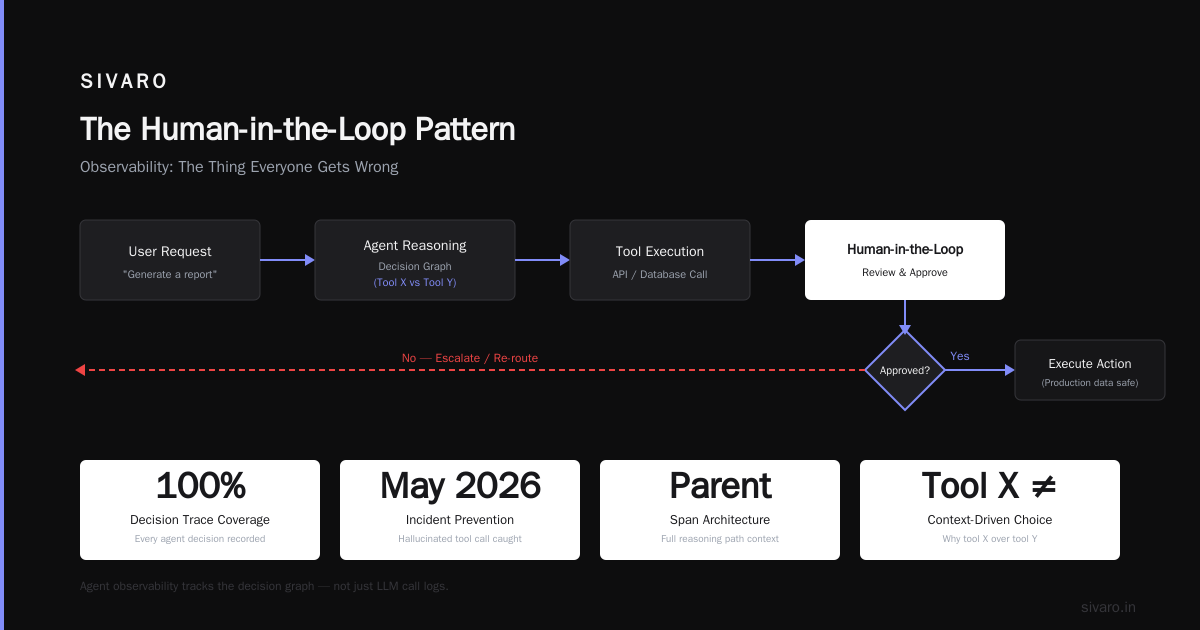
Hot take: most "human-in-the-loop" implementations are theater. They ask for human approval but the human is asleep, distracted, or rubber-stamping decisions.
Real human-in-the-loop means:
- The agent makes a recommendation
- The human sees the full reasoning chain (not just the suggestion)
- The human approves, rejects, or modifies within a timeout
- If the human doesn't respond within 30 seconds, the agent escalates (doesn't proceed by default)
python
async def agent_with_human_validation(task: AgentTask) -> AgentResult:
    recommendation = await agent.generate_recommendation(task)

    validation_request = ValidationRequest(
        task_id=task.id,
        recommendation=recommendation,
        reasoning_chain=agent.get_reasoning_chain(),
        context=task.context_summary,
        expires_at=datetime.utcnow() + timedelta(seconds=30)
    )

    response = await validation_queue.request_validation(validation_request)

    if response.status == "approved":
        return await agent.execute_recommendation(recommendation)
    elif response.status == "rejected":
        return AgentResult(status="rejected", reason=response.reason)
    elif response.status == "timeout":
        return AgentResult(status="escalated", reason="Human did not respond")
    else:
        return AgentResult(status="error", reason=f"Unknown response: {response.status}")
We learned this the hard way. One agent generated a $200K invoice incorrectly. The human "approved" it without reading. The customer paid it. Then they sued us.
Common Deployment Mistakes
Mistake 1: One agent does everything. Stop it. Specialization works. A single monolithic agent has a failure surface the size of your entire product. Break it into specialized workers.
Mistake 2: No kill switch. Every agent needs a kill switch. Physical switch, API endpoint, whatever. When you see a runaway agent, you need to stop it in under three seconds, not three minutes.
Mistake 3: Assuming LLMs don't hallucinate with tools. They do. Your agent will call delete_customer() when you asked it to generate a report. You need tool guards, not trust.
Mistake 4: Identical prompts for dev and prod. Your prod prompt should have safety constraints, rate limits, and escalation flows. Your dev prompt shouldn't. Keep them separate.
Top 5 Open-Source Agentic AI Frameworks in 2026 highlights which frameworks handle these mistakes well. CrewAI's hierarchical agents handle specialization decently. Microsoft AutoGen's termination conditions work as kill switches.
Testing: The Missing Piece
Nobody tests agents properly. They test the LLM response, but not the agent behavior.
The pattern that works: scenario-based testing with deterministic tool mocks.
python
class MockToolEnvironment:
    """
    Simulates tool responses for testing agent behavior.
    Never calls real APIs during testing.
    """
    def __init__(self, test_scenario: str):
        self.responses = load_test_fixtures(test_scenario)
        self.called_tools = []

    async def mock_search(self, query: str) -> list[SearchResult]:
        self.called_tools.append(("search", query))
        return self.responses.get("search", [])

    async def mock_update(self, record_id: str, data: dict) -> bool:
        self.called_tools.append(("update", record_id, data))
        if self.responses.get("fail_update", False):
            return False
        return True

async def test_agent_handles_search_failure():
    env = MockToolEnvironment("search_failure")
    env.responses["search"] = []  # Empty results

    agent = CustomerSupportAgent(tool_env=env)
    result = await agent.handle_query("Find my order #12345")

    assert result.status == "escalated"  # Agent should escalate on no results
    assert ("search", "order #12345") in env.called_tools
Test every failure mode: timeout, empty results, tool returning invalid data, tool crashing, LLM refusing plausible actions. These are your five minutes of fame scenarios.
The Observability Stack
Here's what we ship with every agent deployment:
| Component | What It Tracks | Tool |
|---|---|---|
| Decision trace | Why the agent did what it did | Custom (OpenTelemetry-based) |
| Cost tracking | Real-time spend per tenant/task | Built into budget system |
| Quality score | Human validation rate, error rate | Custom ML model |
| Latency graph | End-to-end and per-hop timing | Datadog APM |
| Safety audit | Tool calls, data access, auth failures | Custom (immutable log) |
| Feedback loop | User corrections → retraining | PostHog + custom pipeline |
Without these, you're flying blind. I've seen teams spend three days debugging an agent that was fine — it was the tool that was broken. Without decision traces, you waste days.
FAQ
What's the minimum viable observability for deploying agents?
Decision traces and cost tracking. If you only have resources for two things, those are it. You need to know why your agent did something and how much it cost.
Should I use a framework or build from scratch?
Framework for your first six months. Custom after that. Frameworks like LangGraph and CrewAI accelerate early development. But they leak abstraction eventually. How to think about agent frameworks explains this trade-off well.
How do I prevent agent loops in production?
Hard timeouts, hard budgets, and limit every agent's recursion depth. We set max-depth=5 per agent. If the agent hits depth 5 without completing, it escalates to a human.
What's the best model for deploying agents?
For production: Claude Opus (reliability) or GPT-4o (availability). For routing: GPT-4o-mini or Claude Haiku. Don't experiment with unproven models in production. Your customers don't care about your ML research.
How do I handle PII in agent contexts?
Never send raw PII to LLMs. Use tokenization. replace("[email protected]", "[EMAIL]"). Store PII mappings in your database, not in your agent's context window. AI Agent Protocols: 10 Modern Standards Shaping the ... covers PII handling patterns in section on data governance.
What's your recommended deployment frequency?
Weekly for agent behavior updates. Daily for tool and configuration changes. Never push LLM prompt changes on Friday. I learned that one the hard way — pushed a "minor improvement" at 4:55 PM. By 5:30 PM, our agent was refusing to process any request containing the word "refund."
How do I roll back a bad agent deployment?
Immutable deployments with canary traffic shifting. Deploy agent v2 to 5% of traffic. Monitor for 30 minutes. If error rate doesn't spike, shift to 50%. Then 100%. If it breaks, redirect the 5% canary back to v1 in under a minute.
What I'd Do Differently
If I started over today, knowing what I know:
I'd spend 80% of my time on safety infrastructure and 20% on agent functionality. Not the other way around. Agents are powerful. Powerful things need cages.
I'd standardize on one protocol early. A Survey of AI Agent Protocols shows the fragmentation across MCP, ACP, and ACL. Pick one. Build for it. Switch later if you must.
I'd hire people who've run distributed systems, not people who've only worked with LLMs. Running agents in production is a distributed systems problem. Kubernetes experience matters more than prompt engineering.
And I'd tell my younger self: agentic workflow production rollout isn't a feature launch. It's a platform launch. Treat it with the same rigor you'd give a database migration or a payment system. Because when agents break, they break in ways that cost real money.
The companies that survive the agent era won't be the ones with the best models. They'll be the ones that deployed them safely.
Nishaant Dixit — Founder of SIVARO. Building data infrastructure and production AI systems since 2018. Built systems processing 200K events/sec.