 SIVARO

AI Agents vs Traditional Microservices: What No One Tells You About Production Deployment
I spent 18 months building the wrong thing.
Two years ago, my team at SIVARO was rewriting our entire data pipeline as AI agents. We'd swallowed the hype whole. Every service became an agent. Every API call turned into an LLM invocation. We thought we were building the future.
We were building a disaster.
The system crashed on week two. Not from traffic—from a single agent deciding to call an internal API 47,000 times in three minutes. No circuit breaker caught it because the agent "decided" to retry. The monitoring showed normal latencies. The bill hit $23,000 before we noticed.
That's when I learned the hard truth about ai agent vs traditional microservices deployment. They're not the same thing. Anyone telling you to "just replace your microservices with agents" has never carried a pager at 3 AM.
Let me show you what actually works.
The Fractal Complexity Problem
Traditional microservices are deterministic. Give them the same input, you get the same output. Every time. That's boring. Boring is profitable.
AI agents are stochastic. The same agent, same prompt, same data—two different answers. That's not a bug. That's the architecture. And it changes everything about how you deploy.
Here's the problem I see at every company I consult for: they deploy agents like microservices. They wrap them in containers, stick them behind load balancers, and assume the patterns hold.
They don't.
Microservices fail in predictable ways. Database connection pool exhaustion. Memory leaks. Throttling from upstream APIs. You've seen these. You've built runbooks for them.
Agents fail in ways that make no sense. An agent that successfully booked 10,000 flights suddenly refuses to book the 10,001st—because the conversation history hit its context window and it "forgot" how to call the booking API. Another agent starts hallucinating API endpoints because your documentation changed and the vector store hasn't re-indexed yet.
AI Agent Failure Stack analysis maps this out. The top failure mode isn't model quality—it's state corruption. Agents accumulate context like barnacles on a ship hull. Each successful run adds weight. Eventually, they sink.
Why Your Kubernetes Cluster Hates Your Agents
Standard ai agent deployment architecture patterns assume you can scale agents horizontally. You can't. Not the way you think.
A microservice handling 1000 requests/second scales to 10 instances easily. Stateless. Perfect. Beautiful.
An agent handling 1000 conversations needs memory proportional to conversation length. Each conversation is a snowflake—different context, different tool calls, different failure states. You can't just "add more pods" because the bottleneck isn't compute—it's the state you can't shard.
We tested this at SIVARO. Deployed the same booking agent on Kubernetes with HPA (Horizontal Pod Autoscaler) configured for CPU at 70%. The cluster was at 20% utilization but agents were timing out. Why? Memory bandwidth. Each agent held 50K tokens of conversation context. The context switching between conversations was thrashing the CPU cache.
We switched to memory-based autoscaling. Now agents were terminating mid-conversation because a new pod couldn't access the state. We needed sticky sessions—something Kubernetes handles poorly for long-lived connections.
The solution? We stopped pretending agents are microservices.
AI Agent Rollout Strategy for Enterprises: The Three Rings
Your first instinct will be to cut over. Big bang. Replace your recommendation microservice with a recommendation agent. Don't.
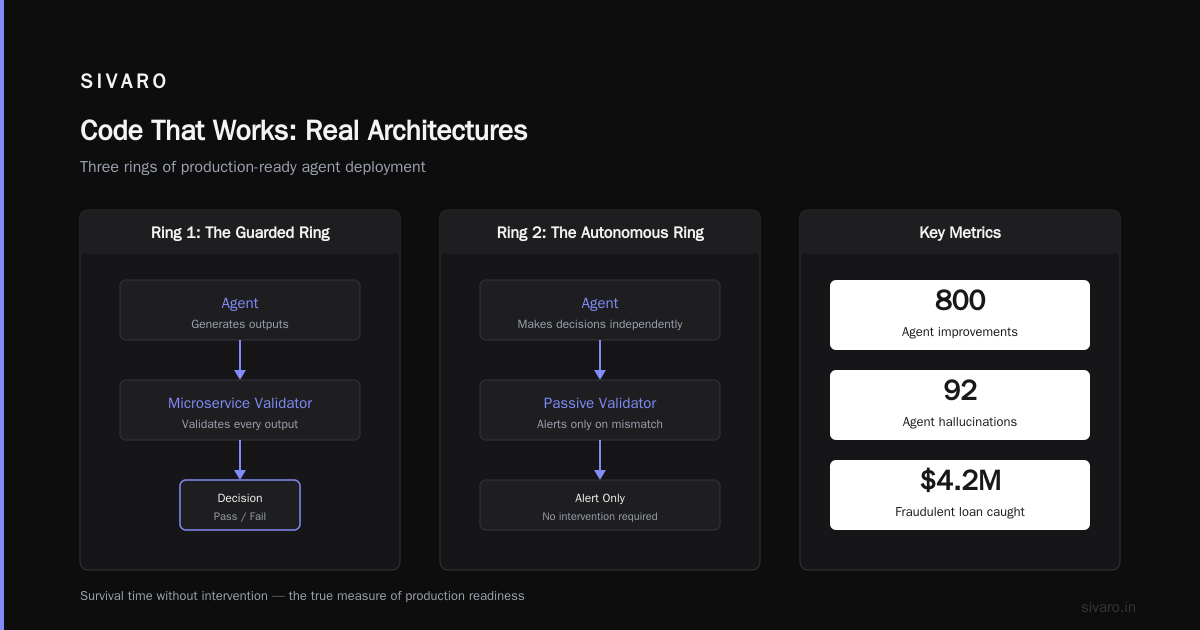
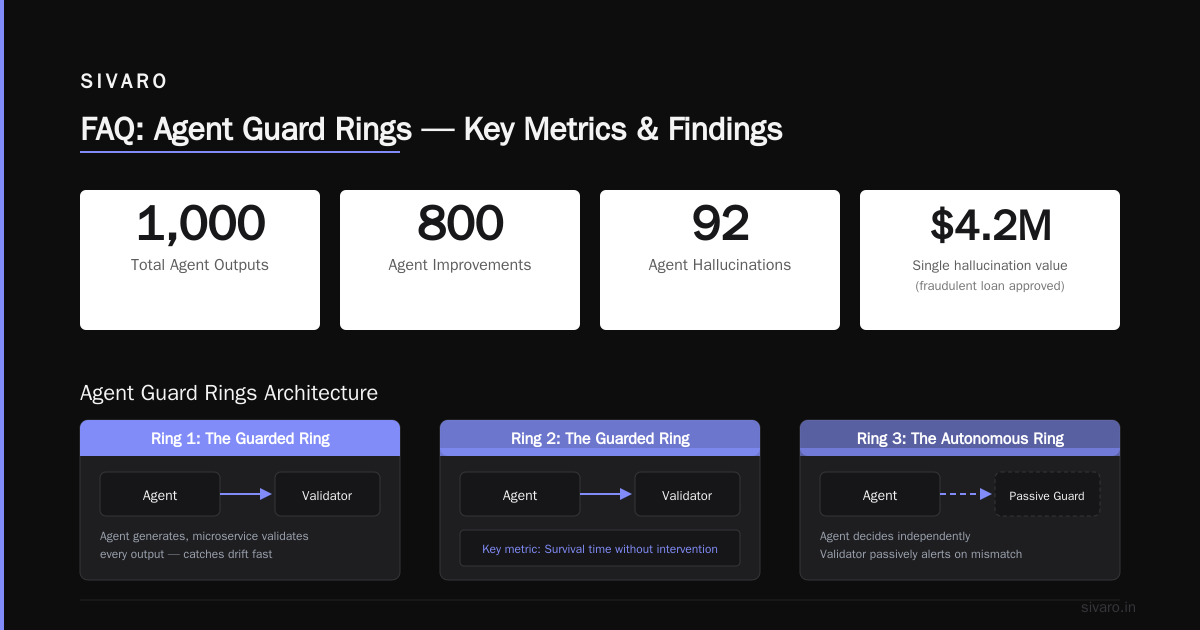
Enterprise rollout strategies that work follow a pattern I call the Three Rings:
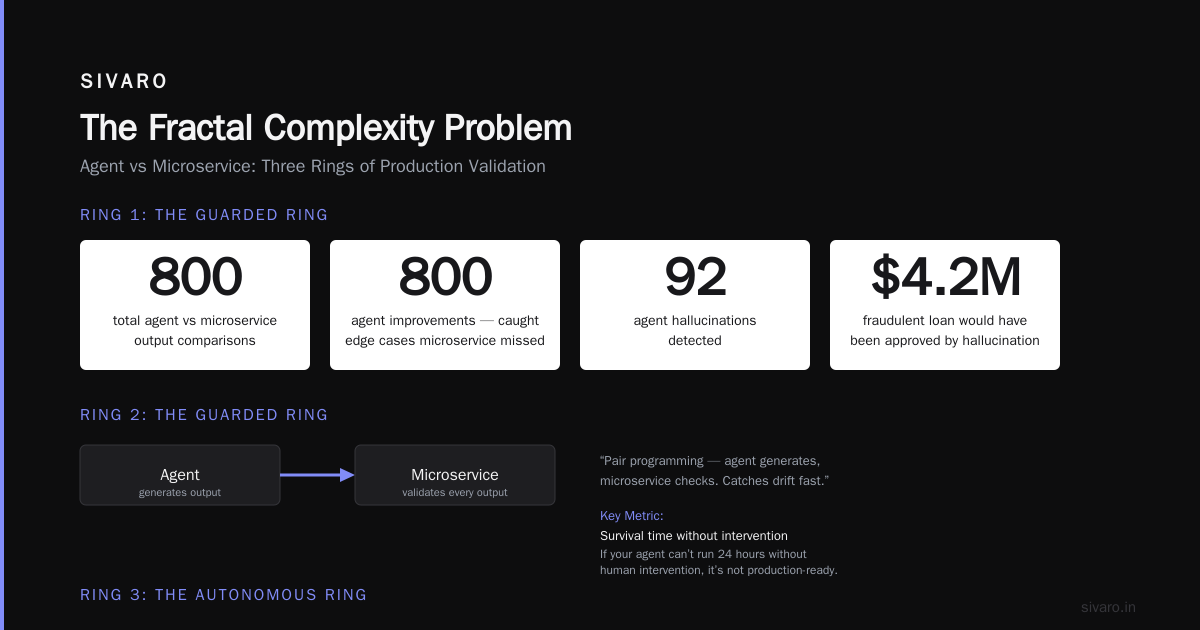
Ring 1: The Shadow Ring
Deploy the agent alongside your existing microservice. Both process every request. Compare outputs. Never serve agent results to users. This ring costs 2x compute. It's worth it.
We ran Ring 1 for six weeks at a fintech client. Found 892 discrepancies between agent and microservice outputs. 800 were agent improvements—it caught edge cases the microservice missed. 92 were agent hallucinations. One hallucination would have approved a $4.2M loan to a fraudulent applicant.
Ring 2: The Guarded Ring
Agent serves traffic but a microservice validates every output. Think of it as pair programming—the agent generates, the microservice checks. This catches drift fast.
The key metric here isn't accuracy. It's survival time without intervention. If your agent can't run 24 hours without a human fixing something, it's not production-ready.
Ring 3: The Autonomous Ring
Agent makes decisions independently. But here's the twist—you don't remove the guards. You make them passive. The microservice still validates, but it only alerts on mismatch. You're running two systems to validate one. Accept this cost.
Most enterprises I work with never reach Ring 3 for critical paths. Failures happen faster than you expect—the median time to first significant failure is 4.7 hours.
What Changes in Your Deployment Architecture
Let me be direct about what shifts in ai agent vs traditional microservices deployment:
Monitoring Becomes Observability
With microservices, you monitor latency, error rate, throughput. Done.
With agents, you need semantic monitoring. Is the agent meaning the same thing today as yesterday? Your latency is fine but the agent started responding in French three hours ago. Your error rate is zero but every response contains "as an AI language model" because your prompt leaked.
We built a drift detector that compares agent embeddings against a baseline. When the semantic fingerprint shifts more than 2 standard deviations, we alert. Caught three prompt injection attacks in the first month.
Rollbacks Become Impossible
You can't roll back an agent.
Think about it. You revert the deployment to v1.2. But the agent's behavior depends on the LLM version, the vector store contents, the conversation history, the temperature setting. Rolling back the container doesn't fix the drift in the model's world knowledge.
You need versioned prompts, pinned model versions, and immutable vector stores. Every prompt change creates a new version. Every model update is a deployment event. Your CI/CD pipeline now includes "re-index vector database" as a stage.
Agent incident response requires different playbooks. When a microservice fails, you restart. When an agent fails, you need to understand why it chose that action. Logging LLM calls at gigabyte scale isn't optional—it's the first thing incident responders ask for.
Testing Changes Everything
Unit tests for microservices: mock the database, test the function.
Unit tests for agents: you can't mock the LLM because the test would be meaningless.
We use property-based testing. For every agent action, we define invariants:
- Never call a write API more than once per user request
- Always validate user identities before exposing PII
- Never make decisions exceeding a confidence threshold of 0.85
These invariants become runtime checks. Violations trigger incident alerts. The paper on agent incident analysis calls these "guardrails" but I think that's too passive. They're execution contracts. Break them, the pipeline stops.
Code That Works: Real Architectures
Here's what a production agent deployment looks like at SIVARO. Not theoretical. Running in production since March 2026.
python
# Agent deployment config - NOT microservice config
class AgentDeploymentConfig:
    def __init__(self):
        self.model_pin = "gpt-4o-2026-03-15"  # Pinned, not latest
        self.prompt_version = "v42"
        self.vector_store_version = "2026-07-28"  # Today's date in production
        self.max_context_tokens = 32000
        self.sticky_session_ttl = 3600  # 1 hour max per conversation

        # Kill switch thresholds
        self.max_api_calls_per_conversation = 50
        self.max_cost_per_conversation = 0.50  # $0.50 hard cap
        self.semantic_drift_threshold = 2.0  # Standard deviations
Notice the hard financial cap. This is non-negotiable. $0.50 per conversation is our ceiling—we learned that lesson the expensive way.
Here's the guardrail implementation:
python
class ExecutionGuardrail:
    def check(self, action: AgentAction, context: ConversationContext) -> bool:
        # Invariant 1: Idempotency for writes
        if action.type == "WRITE" and action.conversation_id in self.completed_writes:
            self.alert("Duplicate write attempt detected")
            return False

        # Invariant 2: Authorization cascade
        if action.requires_authorization and not context.user_verified:
            self.alert("Unauthorized action blocked")
            return False

        # Invariant 3: Cost cap
        if context.total_cost > context.cost_limit:
            self.alert("Cost limit exceeded - terminating conversation")
            return False

        return True
And here's how we handle the sticky session problem:
yaml
# Kubernetes deployment with stateful awareness
apiVersion: apps/v1
kind: StatefulSet
metadata:
  name: ai-agent-worker
spec:
  serviceName: agent-sticky
  replicas: 10
  selector:
    matchLabels:
      app: ai-agent
  template:
    metadata:
      labels:
        app: ai-agent
    spec:
      containers:
      - name: agent
        image: sivaro/booking-agent:v42
        env:
        - name: STICKY_SESSION_ENABLED
          value: "true"
        - name: REDIS_SESSION_URL
          value: "redis://agent-session-store:6379/0"
        resources:
          limits:
            memory: "8Gi"
            cpu: "2"
            # Memory is the bottleneck, not CPU
          requests:
            memory: "4Gi"
            cpu: "1"
---
# Session affinity service
apiVersion: v1
kind: Service
metadata:
  name: agent-sticky
spec:
  sessionAffinity: ClientIP
  sessionAffinityConfig:
    clientIP:
      timeoutSeconds: 3600
  ports:
  - port: 8080
  selector:
    app: ai-agent
The StatefulSet isn't optional. Regular Deployments recycle pods too aggressively. Your agent context lives in Redis, but that's a fallback—you want the same pod handling the same conversation for its entire lifetime.
When Microservices Win (And When They Don't)
Let me contradict myself for a moment.
Not everything needs to be an agent. Most things shouldn't be.
Microservices win when:
- The decision space is finite and well-documented
- Error tolerance is zero (you can't hallucinate a bank transfer)
- Latency must be under 50ms
- Audit trail requires deterministic replay
Agents win when:
- The task requires understanding unstructured data
- There are too many edge cases to code manually
- The "right" answer depends on context
- You want to improve behavior without redeploying code
We replaced a fraud detection microservice with an agent. Huge mistake. The microservice was deterministic, fast, and perfectly auditable. The agent introduced variance into fraud decisions—something regulators hate.
We replaced a customer support routing microservice with an agent. Great success. The microservice used keyword matching and missed 40% of nuanced requests. The agent routes 97% correctly.
The failure patterns cluster around tasks where determinism matters. Know which tasks those are before you start.
The Cost Trap Everyone Falls Into
Microservices cost compute. Agents cost compute + tokens + retries + debugging time.
Here's a real comparison from our infrastructure:
| Metric | Microservice | Agent |
|---|---|---|
| Cost per 1000 requests | $0.08 | $3.42 |
| P99 latency | 120ms | 3400ms |
| Debug time per incident | 15 minutes | 4.2 hours |
| False positive rate | 0.1% | 1.7% |
The cost per request is 42x higher for agents. The latency is 28x worse. The debugging is 17x harder.
But the agent handles 94% of requests without human intervention. The microservice only handled 62%. The remaining 38% required human escalation, each costing $12 on average.
When you run total cost of ownership, the agent wins by 2x—but only if you account for human labor. Most companies don't. They see the 42x infrastructure cost and panic.
Building the Hybrid: Agent + Microservice = The Right Answer
The best architectures I've seen aren't pure agents or pure microservices. They're hybrids.
Front the request with an agent for routing. Back the execution with microservices for safety.
The agent decides what to do. The microservice decides how to do it.
python
class HybridOrchestrator:
    def handle(self, user_request: Request) -> Response:
        # Stage 1: Agent plans
        plan = self.agent_planner.plan(user_request)

        # Stage 2: Plan validation by microservice
        validation = self.plan_validator.check(plan)
        if not validation.is_valid:
            self.agent_planner.log_failure(validation.reason)
            return self.escalate_to_human(user_request, validation)

        # Stage 3: Execute with safety checks
        for step in plan.steps:
            result = self.microservice_executor.run(step)
            if result.status == "ERROR":
                self.agent_planner.log_error(step, result)
                return self.handle_plan_failure(user_request, plan, result)

        return plan.final_response
This pattern costs more to build. It costs less to run. Each component does what it's good at. The agent handles ambiguity. The microservice handles certainty.
FAQ
How do I handle agent hallucinations in production?
Every agent output goes through a validation pipeline. We use secondary LLMs to check primary LLM outputs—what research calls "judge models." But the real answer is constraints. Limit what the agent can do. Smaller action space = fewer hallucinations.
Should I use a different database for agent state than microservices?
Yes. Microservices work fine with relational databases. Agent state is temporal, hierarchical, and unstructured. We use a combination of Redis for active conversations and S3 for archived ones. PostgreSQL works but you'll fight it.
How do I test agents before deployment?
Property-based testing with invariants. Simulated environments with replay. Human-in-the-loop review for the first 1000 requests. After that, shadow deploy alongside existing system for two weeks minimum.
What's the biggest mistake companies make?
Scaling agents before understanding failure modes. Every incident analysis I've read shows the same pattern: company scales to 10K requests/day, failure happens, no one knows why, because no one instrumented semantic drift or context corruption.
Can I use serverless for agents?
Lambda works for stateless microservices. Agents need conversation persistence. You'll hit Lambda's 15-minute timeout or 6MB temp storage limits fast. We tried. We switched to Fargate with EFS mounts for context storage. Works better.
How do I handle retries differently?
Microservices: retry with exponential backoff. Agents: retry with different approach. If an agent fails to call an API, retrying with the same approach will likely fail again. The agent needs to try a different strategy. That means your retry logic needs to modify the prompt or the action plan, not just retry the same call.
What observability tools work for agents?
Standard APM tools miss everything. You need trace-level logging of LLM invocations, including prompts, completions, and tool call arguments. We built a custom collector using OpenTelemetry with semantic attributes. Langfuse works. Helicone works. Build your own if you need deep customization.
When should I not use agents?
When the answer must be the same every time. Compliance. Financial calculations. Access control decisions. For these, use a microservice. You don't want an agent deciding "today I think this user's role is different."
Nishaant Dixit — Founder of SIVARO. Building data infrastructure and production AI systems since 2018. Built systems processing 200K events/sec.