 SIVARO
AI Agents vs Traditional Software Deployment: The Hard Truth Nobody Tells You
I spent 2018 to 2022 building deterministic systems. APIs that always returned the same output for the same input. Databases with ACID guarantees. CI/CD pipelines where a green build meant the same thing every time.
Then I started deploying AI agents.
And everything broke.
Not the agents themselves — they worked fine in notebooks. But the deployment? A nightmare. The cost structure flipped. The failure modes changed. The monitoring tools we relied on for a decade became useless.
This isn't a "both have merits" piece. Traditional deployment and AI agent deployment are fundamentally different animals. If you treat an agent like a microservice, you'll lose your shirt. If you treat a microservice like an agent, you'll miss every deadline.
Here's what I learned the hard way — building SIVARO's production AI systems since 2018, processing over 200K events per second, and deploying agents that actually make money.
Why Traditional Deployment Feels Like a Warm Blanket
Traditional software is deterministic. You write code, you run it, the output is predictable. The cost per transaction is fixed — spin up a server, process a request, return a response. You can estimate infrastructure costs from a spreadsheet.
Google's research on agentic AI infrastructure makes this brutal point: deterministic services have bounded latency and bounded cost. An API call costs you the compute time plus network overhead. You know, within 5%, what your AWS bill will be next month.
Agents laugh at spreadsheets.
The Fundamental Difference: Probability vs Determinism
An AI agent isn't a function. It's a chain of LLM calls, tool selections, and internal state, each with non-deterministic outcomes. The same input can produce different execution paths — and different costs.
Here's a concrete example from a customer we onboarded at SIVARO in early 2025. They had a customer support agent: traditional rule-based routing (a decision tree) cost them $0.004 per interaction. The AI agent version (same task, but using an LLM to route and draft responses) cost $0.12 on average — but the tail was $1.80 for complex tickets.
That 45x variance in cost? You can't plan for that with static capacity.
Blaxel's deployment guide calls this out: "AI agent production deployment cost is not a single number — it's a distribution." Most teams I talk to are still using average cost per token to estimate budgets. Big mistake. The tail cost will eat your margins.
What Actually Changes When You Deploy Agents
1. Observability Moves From Metrics to Traces
Traditional monitoring: CPU, memory, request latency, error rate. If p99 latency spikes, you know where to look.
Agent monitoring: step-level traces, LLM call latency, tool invocation success, hallucination rate, cost per step, context window utilization.
We switched from Datadog to a custom tracing system at SIVARO because agents generate graphs of execution, not request-response pairs. Anthropic's engineering guide nails it: "Agent observability requires instrumenting the loop itself, not just the endpoints."
// Traditional API monitoring (trivial)
app.get('/api/v1/order', handler);
// You monitor: method, path, status, duration

// Agent loop monitoring (complex)
while (agent.alive) {
  const action = await agent.think(state);
  const result = await agent.execute(action);
  // You need to monitor: action type, confidence score,
  // context window usage, token cost, tool response time
  state = agent.update(state, result);
}
Most teams miss this. They deploy agents with standard APM tools and wonder why they can't debug a "looping agent" that calls the same tool 50 times. You need step-level traces with parent-child relationships.
2. Testing Goes From Unit Tests to Behavioral Validation
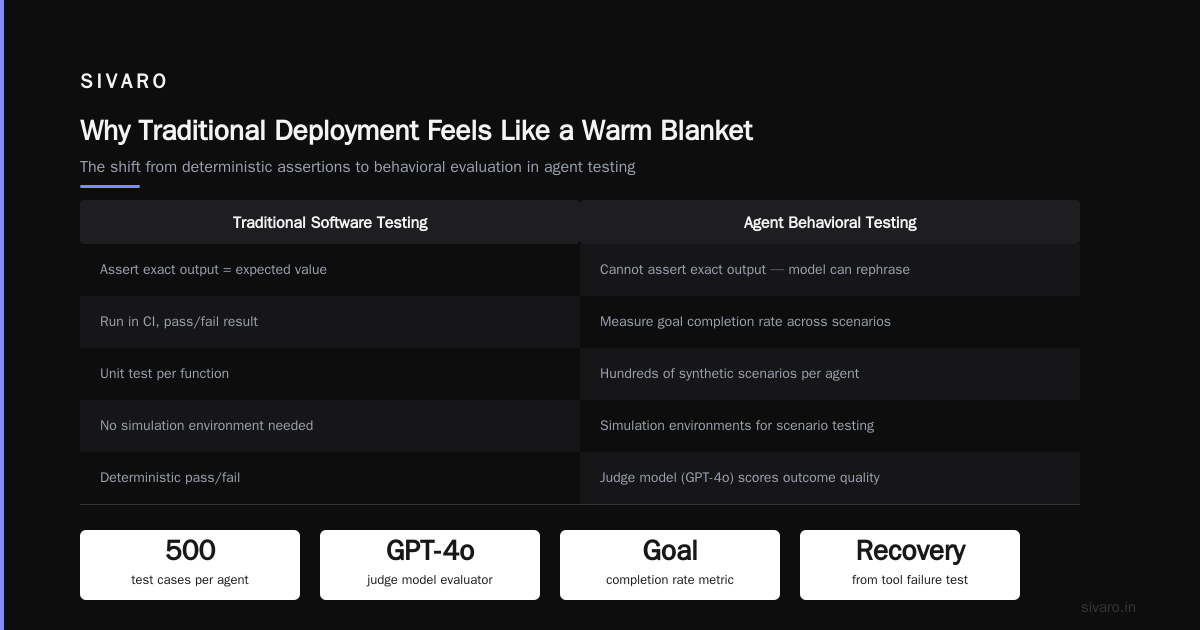
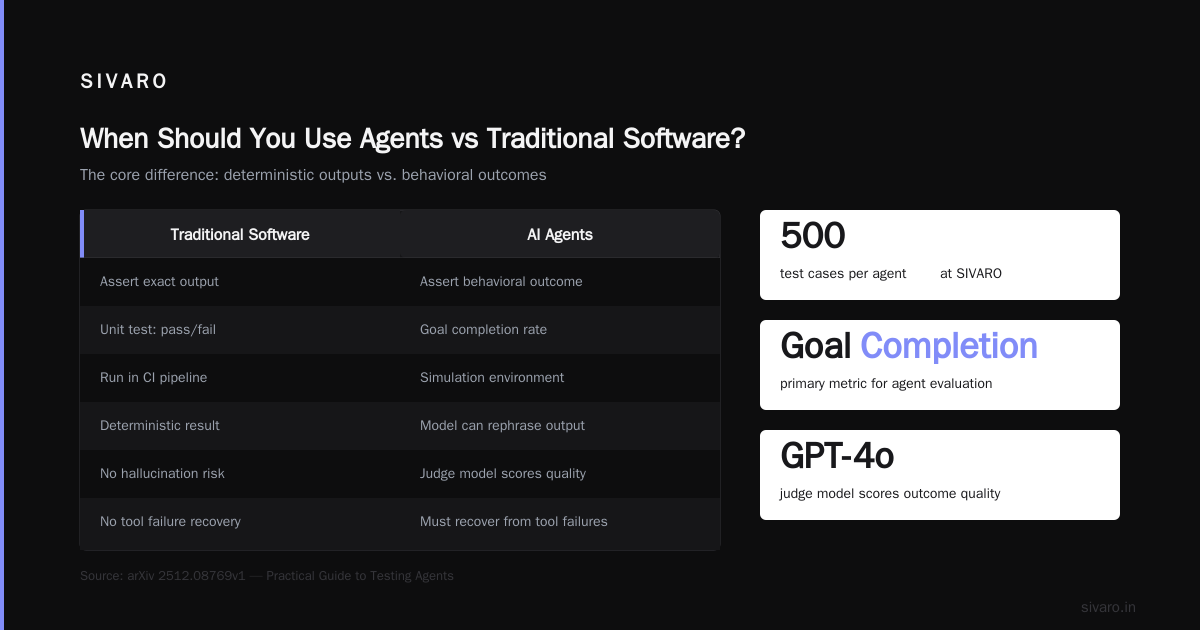
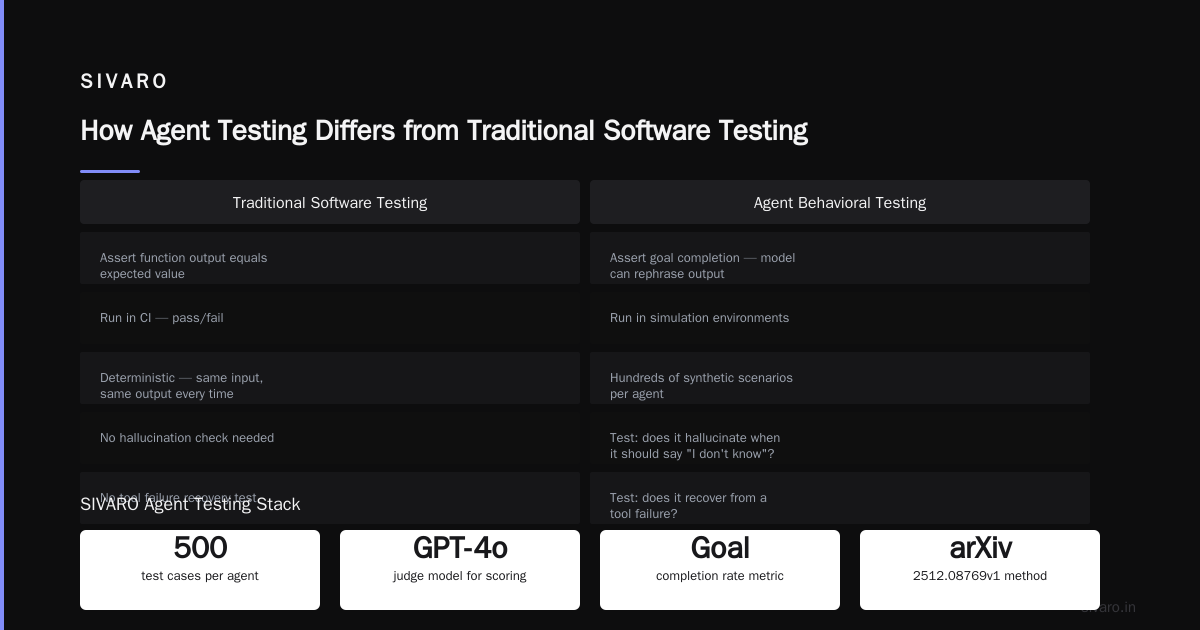
Traditional software: write a unit test, assert function output equals expected value. Run in CI, pass/fail.
Agents: you can't assert exact output because the model can rephrase. You need behavioral tests — does the agent accomplish the goal given a scenario? Does it hallucinate when it should say "I don't know"? Does it recover from a tool failure?
The arXiv practical guide proposes testing agents with "simulation environments" — run hundreds of synthetic scenarios and measure goal completion rate, not exact output. We do this at SIVARO: 500 test cases per agent, each evaluated by a judge model (GPT-4o in our stack) that scores outcome quality.
Example test case for a customer support agent:

Scenario: User asks for a refund for an order placed 45 days ago (policy: 30-day refund window)

Expected agent behavior:
1. Empathize with the customer
2. Explain the 30-day policy
3. Offer alternative resolution (store credit, exchange, or escalation)
4. Do NOT refund against policy

Judge model checks: Did agent avoid the refund action? Did it offer alternatives?
Traditional pytest won't cut it. You need an evaluation pipeline that feeds judge models.
3. Cost Management Becomes a First-Class Concern
In traditional deployment, cost is proportional to load. More users → more servers → more cost. Linear.
In agentic systems, cost depends on task complexity. A simple request might take 3 LLM calls (1000 tokens total). A complex request could take 20 LLM calls, 4 tool invocations, and context window refreshes — 15,000 tokens.
The Machine Learning Mastery deployment architecture guide emphasizes: "AI agents production deployment cost optimization requires caching of LLM responses for deterministic components, batching of independent actions, and limiting retry loops."
We implemented a cost cap per agent session at SIVARO: if an agent spends more than $0.50 on a single conversation, it escalates to a human. Saved us 30% on our monthly LLM bill in Q1 2026.
// Cost capping implementation (pseudocode)
class CostCappedAgent {
  constructor(maxCost = 0.50) {
    this.spent = 0;
    this.maxCost = maxCost;
  }

  async think(context) {
    if (this.spent >= this.maxCost) {
      return new EscalationAction("Cost limit exceeded");
    }
    const cost = estimateTokens(context) * PRICE_PER_TOKEN;
    this.spent += cost;
    return await this.model.think(context);
  }
}
4. Deployment Strategy Shifts From Push to Guarded Rollout
Traditional: blue-green deployment, canary release, test a percentage of traffic.
Agents: you can't "canary release" an agent the same way because the same input can have different behavior from different model versions. Towards Data Science's guide describes "agent shadowing" — run the new agent in parallel with the old one, compare outcomes, but don't serve from the new one until you've validated hundreds of completions.
We do something similar: deploy to 1% of users, but we run offline evaluation on the agent's decisions for the remaining 99%. If the offline evaluation shows a hallucination rate above 2%, we hold the release.
The Failure Modes You Don't See Until You've Deployed
Most people think agent failures are about the model being wrong. They're not.
The Tool Call Loop
An agent decides to call a search tool. The tool returns empty results. The agent retries with a different query. Empty again. Retry. Empty. Retry. 50 times.
This happened to us in March 2025 on a customer-facing agent. The agent burned $12 in LLM calls in 30 seconds before the timeout killed it. Our traditional monitoring showed "200 OK" responses and latency within bounds — because the agent did respond. It just responded with garbage and cost us a month's cloud bill.
Fix: implement a tool call counter. After 3 failures, make the agent explicitly state "I cannot find this information" and return a fallback.
The Context Window Bloat
Agents that maintain conversation history will grow context windows indefinitely. Each token costs money. We saw an agent that had been running for 20 minutes with a 128K token context window. Cost per step: approximately $0.08. After 1,000 steps, that's $80 for one conversation.
Business Plus AI's failure analysis is brutal: "Agents without context window budgeting will bankrupt you." They're right. We now hard-limit context to 32K tokens and summarize older history.
Agent memory management:
- Keep last 10 turns of raw conversation (~4K tokens)
- Summarize older turns into a single paragraph (saves 80% tokens)
- Drop tool call outputs after they're incorporated into state
- Never include raw JSON tool responses in context — extract only the relevant fields
The Non-Deterministic Approval
Your agent calls a third-party API. That API is down. The agent, instead of failing gracefully, generates a hallucinated response: "Your order has been refunded" — when it actually wasn't.
We caught this only because we introduced action verification — every destructive action a agent takes (refunds, deletions, account changes) must be validated by a downstream system before being committed.
When Should You Use Agents vs Traditional Software?
I get this question every week. Here's my framework:
Use traditional software when:
- The task is deterministic (e.g., data validation, CRUD, business logic with clear rules)
- The cost per action must be predictable within 10%
- You cannot tolerate variability in output (e.g., financial calculations, legal compliance)
- You already have a working non-AI solution that meets requirements
Use agents when:
- The task requires reasoning over unstructured data (e.g., customer emails, legal documents)
- The task has multiple valid solution paths that depend on context
- You need natural language interaction
- The cost of a mistaken decision is low enough that you can afford exploration
The builders guide from Towards Data Science puts it well: "If you can write a decision tree, don't use an agent. If you can't, an agent might work but you need guardrails."
That last part is crucial: agents add capability but also add risk. Every agent deployment should have a "kill switch" — when uncertainty exceeds a threshold, hand off to a human.
The Deployment Checklist That Actually Works
After six agent deployments (three successful, three that cost us time and money), here's the agentic workflow deployment checklist I share with every team:
- Cost budget per session — set a hard cap in dollars
- Token budget per step — limit context window to avoid bloat
- Tool call limit per session — max 5 retries per tool
- Fallback actions — what happens when the agent fails gracefully
- Tracing for every step — LLM call, tool invocation, state update, cost per step
- Offline evaluation pipeline — run synthetic test scenarios before exposing to real users
- Shadow mode — run new agent versions alongside old, compare outcomes
- Human-in-the-loop for destructive actions — require approval for refunds, deletions, etc.
- Monitoring dashboard — tokens used, session cost, goal completion rate, hallucination rate
- Escalation path — when agent confidence is low, hand off to human support
The Cost Reality No One Talks About
Let's be specific about ai agents production deployment cost.
A typical customer support agent (serving 10,000 conversations per month):
- LLM inference (GPT-4o): ~$0.15 per conversation (average 8 steps, 4K tokens) = $1,500/month
- Vector search (Pinecone or similar): ~$200/month for indexing
- Tool execution (API calls, database reads): ~$100/month
- Monitoring and tracing infrastructure: ~$300/month
- Model fine-tuning and eval pipeline: ~$1,000/month (amortized)
- Total: ~$3,100/month
Compare to a traditional rule-based system: $200/month for servers and logic.
Is the agent 15x better? In many cases, yes — it handles edge cases the rules miss, provides natural language, and scales without rewriting code. But if your use case doesn't need that additional capability, you're burning money.
Blaxel's deployment guide reports that teams typically underestimate agent costs by 3-5x in the first month. Under-promise on costs to your stakeholders.
The Future: Agents as First-Class Systems
By mid-2026, the industry is converging on a pattern: agents are not just "LLM wrappers." They are stateful processes with their own infrastructure — runtime, evaluation, monitoring, and cost management. The gap between ai agents vs traditional software deployment is closing as tooling matures, but the fundamental differences remain: agents are probabilistic, stateful, and cost-variable.
At SIVARO, we're building infrastructure that treats agents as long-running processes with resource governance — CPU, memory, token budget, tool access. Traditional deployment tools (Kubernetes, CI/CD) still apply, but you need an agent runtime layer on top.
The teams that succeed are the ones who abandon the "it's just another microservice" mindset. They treat agents as a new category of software — with new failures, new costs, and new opportunities.
Frequently Asked Questions
Q: Can I use Kubernetes to deploy AI agents?
Yes, but you need an orchestration layer that manages agent state, tool connections, and LLM clients. Kubernetes handles scaling the containers; you need additional tooling for agent lifecycle management. Machine Learning Mastery has a good architecture pattern for this.
Q: How do I estimate the cost of an agent before building it?
Run a prototype on 100 real conversations, measure tokens per step and steps per conversation. Multiply by your LLM pricing. Then multiply by 2x for the tail. Then add 30% for monitoring and tool execution. That's your floor.
Q: What's the biggest mistake teams make when deploying agents?
Not implementing a cost cap. I see teams go from prototype to production without any spend guardrails. Within a week, they have a $5,000 surprise bill from an agent that got stuck in a loop. Business Plus AI lists this as mistake #1.
Q: Should I use a workflow engine (e.g., LangGraph, CrewAI) or build from scratch?
Use a framework for the agent loop (workflow orchestration), but build your own evaluation and monitoring. The frameworks abstract the "how" of agent execution; they don't help with "is this agent working?".
Q: How do I handle multiple agents coordinating?
That's the hardest part. We use a supervisor agent that routes tasks to specialist agents. Each specialist has its own context window and tool set. The supervisor manages the orchestration and cost budgets across agents.
Q: What's the most important metric for agent performance?
Goal completion rate, not response quality. If the agent accomplishes the user's goal (e.g., refund processed, answer given), it's working. We measure this via explicit user feedback and judge model evaluations.
Q: Can agents replace traditional software entirely?
No. Agents are complementary. You still need deterministic systems for when you need exact answers (account balances, legal compliance, inventory counts). Agents handle the fuzzy parts around those systems — natural language input, reasoning over ambiguous data, adapting to new scenarios.
Q: How do I know when an agent is "production-ready"?
When you have passed the checklist above and have run at least 1,000 real conversations in shadow mode with a goal completion rate above 80% and a hallucination rate below 2%. That's our SIVARO bar.
Nishaant Dixit — Founder of SIVARO. Building data infrastructure and production AI systems since 2018. Built systems processing 200K events/sec.